

BLEAK + BRUTE
A
Study in Curated Calm
A collection defined by Conscious Reduction and the poetic beauty of the void. This is our interpretation of Curated Calm—a space where the noise of the modern world is stripped away to reveal the soul of the object.
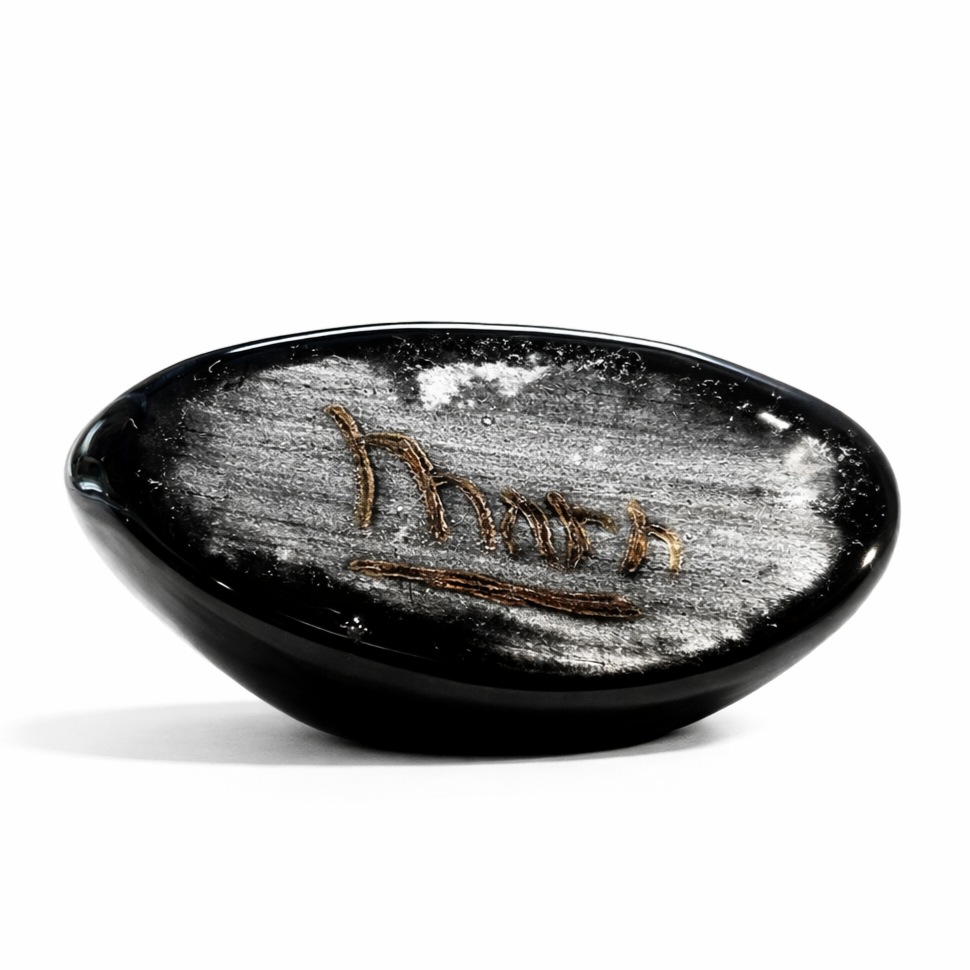
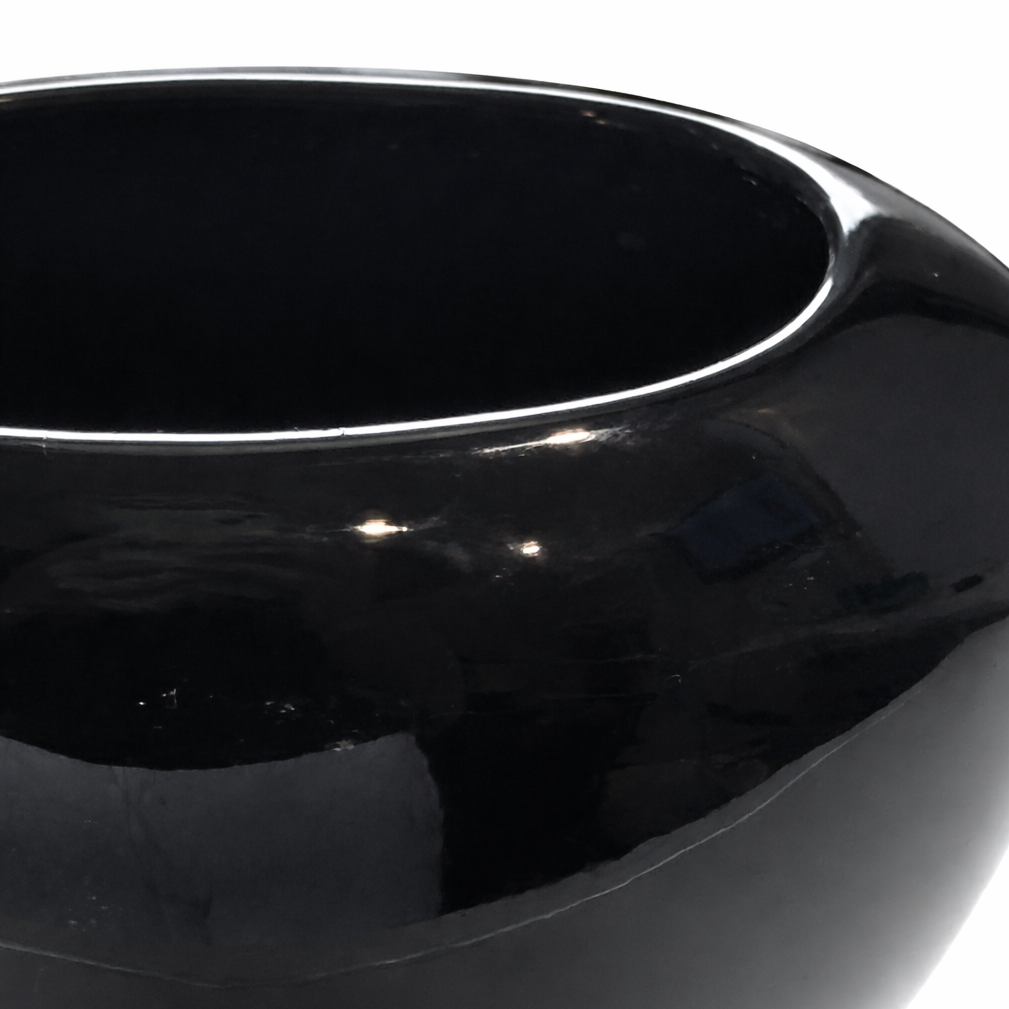
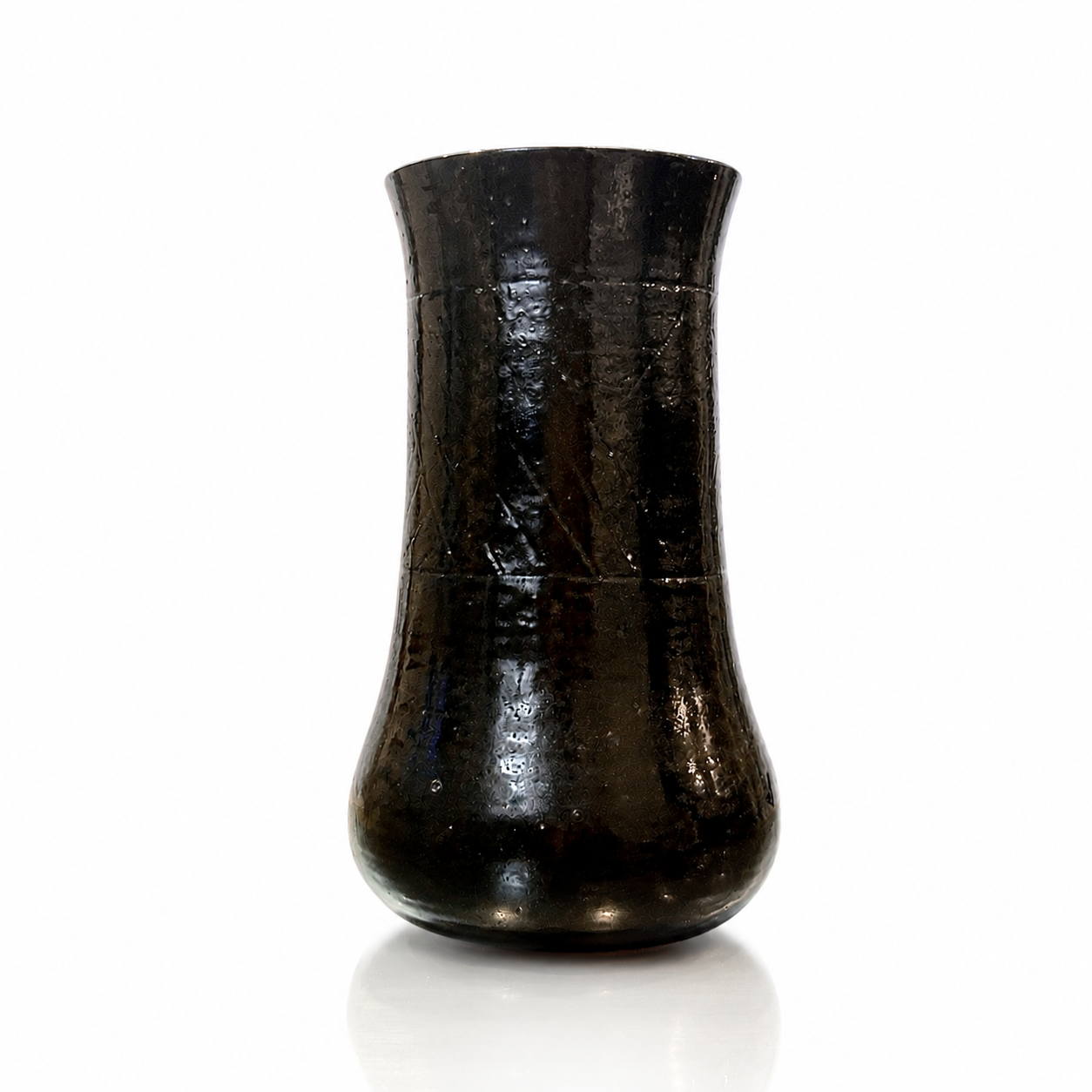
This powerful studio ceramic vase makes an assertive design statement with its dense, architectural silhouette and highly reflective metallic black glaze. Synthesizing the raw, expressive energy of late-century Brutalism with the polished sophistication of the 1980s, the gently flaring baluster body features deeply hand-carved geometric bands and sharp diagonal slashes. The exterior’s high-gloss finish plays dynamically against the matte, recessed channels of the incisions, transforming the vessel into a fascinating study of shadow and reflected light. Substantial in weight and presence, this sculptural object brings a compelling tactile grounding to avant-garde or minimalist spaces.
Attribution & Period
Stylistically aligned with the American and European Postmodern Brutalist movement of the 1980s. The unglazed underside bears two distinct, enigmatic markings: a sharp, hand-incised geometric monogram resembling a stylized "CZ" or interlocking chevrons, and a secondary, faint circular studio stamp near the outer edge as shown in image_17.png and image_19.png. This specific pairing of aggressive, "primitive" surface carving with a slick, dark glaze aligns perfectly with independent studio pottery from the mid-to-late 1980s, an era when artisans actively merged 1970s architectural texture with the high-contrast, graphic trends of the Art Deco revival.
Dimensions & Weight
Height: 8 1/2 inches
Width / Diameter: 3 3/4 inches (mouth diameter)
Depth / Base Diameter: 3 7/16 inches
Weight: 2.218 pounds
Condition
In excellent condition. Clinical inspection reveals a beautifully preserved exterior free of structural chips, cracks, or repairs, keeping the sharp contrast of the incised lines intact. The interior features natural mineral deposits and a beautifully weathered, water-worn patina resulting from historical utilitarian use, which lends an authentic, time-hewn character to the piece as documented in image_16.png. The unglazed base rim shows light, authentic shelf wear consistent with age.
Authenticity & Construction
This heavy vessel is a masterfully hand-thrown stoneware piece constructed with thick walls and an organic, weighted base designed to anchor its form. Prior to firing, the artist deeply gouged the damp clay body to create recessed geometric motifs, ensuring the cuts retained sharp, dramatic edges. A rich, iron- or manganese-dominant glaze was then applied to the exterior and fired to a high gloss; this allowed the metallic slip to pool naturally within the hand-carved channels, exaggerating the depth of the pattern and celebrating its artisanal origins.
Placement
With its brooding, monochromatic presence and striking geometric lines, this vase is exceptionally interior-designer friendly, bridging the gap between historical texture and modern luxury. It serves as an ideal sculptural accent on a raw concrete or white oak mantel, styled alongside post-modern art volumes on a minimalist shelf, or centered on a travertine console table where its dark, glossy finish can sharply contrast against light stone textures.
STANDARD ATTRIBUTION & VALUE DISCLOSURE; This piece is described to the best of current scholarly and market knowledge. Any maker or regional attribution is based on visual analysis, materials, construction techniques, and documented stylistic comparisons. As with many MCM and antique design objects, definitive attribution may not be possible without original labels or factory records. Pricing reflects condition, quality, decorative appeal, and current collector demand rather than guaranteed maker identification.
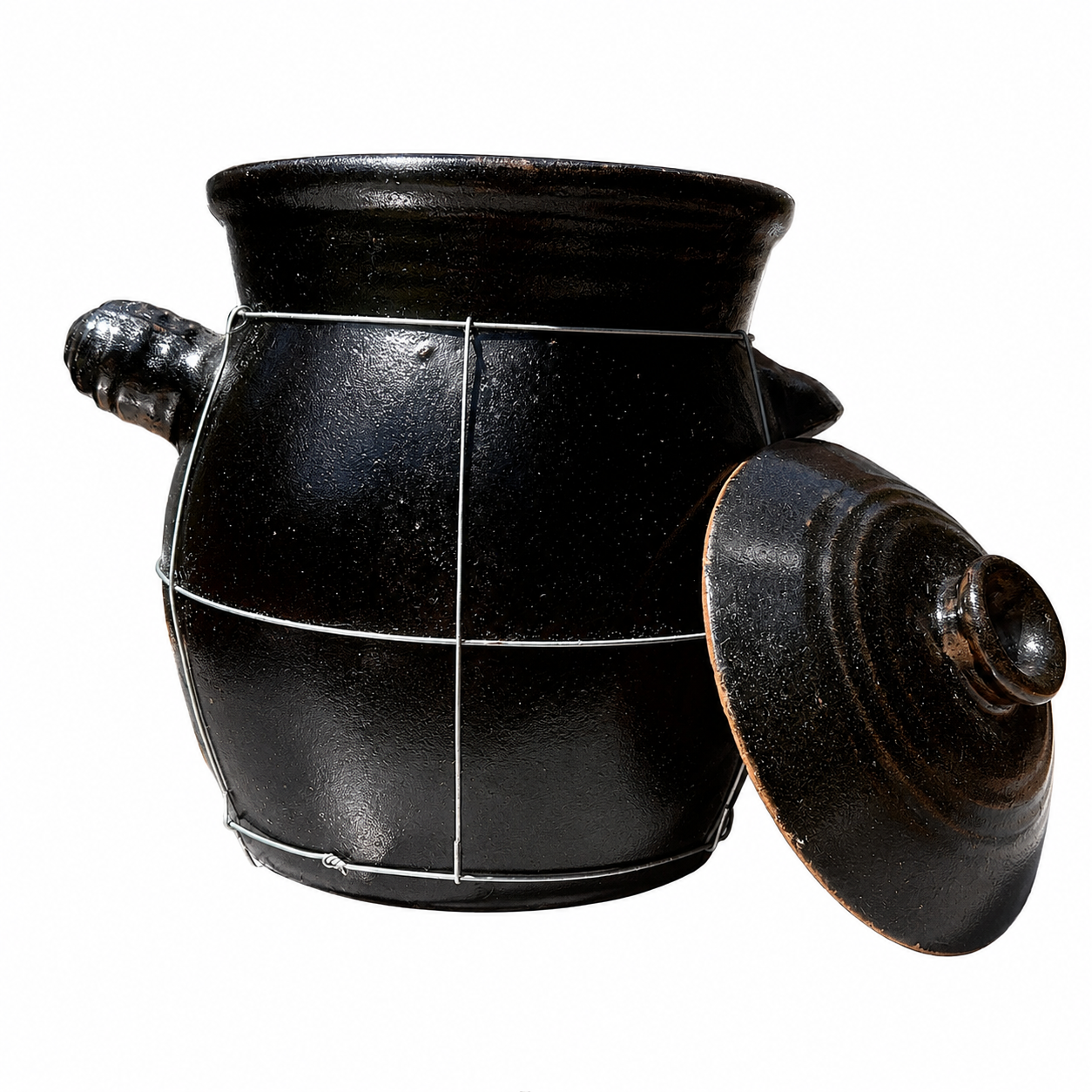
An exceptional specimen of rustic culinary history, this antique glazed earthenware cooker balances robust utility with a compelling, time-hewn aesthetic. Designed for slow-simmering and hearth cooking, the vessel features a deep, high-shouldered profile with an integrated lip to cradle its matching, recessed lid. Its most striking feature is a traditional, hand-knotted external wire cage that wraps securely around the body—a historic reinforcement technique implemented to prevent heat expansion from fracturing the clay over an open flame. Coated in a dark, organic brown-black glaze that subtly shifts under the light, this pot possesses a commanding tactile presence that makes it an extraordinary sculptural artifact.
Attribution & Period
Stylistically and structurally characteristic of late 19th to early 20th-century Asian utilitarian folk pottery (circa 1880–1920), likely of Chinese or Japanese origin (Donabe / Kamado tradition). Lacking formal factory stamps or signatures, its provenance is preserved entirely through its traditional construction: the hand-thrown stoneware body, the specific formulation of the iron-rich local slip glaze, and the specialized wire-bracing system are all indicators of historic, pre-industrial kitchenalia. This pot is a magnificent representative for the "Earth and stone" collection on Maison de Valier, celebrating the raw beauty of natural clay used across generations.
Dimensions & Weight
Height: 10 1/2 inches (including lid knob)
Width / Max Diameter: 14 inches
Mouth Diameter: 9 1/2 inches
Weight: 8.718 pounds
Condition
In honest, beautifully preserved antique condition. The exterior glaze retains an impressive lustrous sheen with minor, authentic surface variations and firing pitting typical of historic kiln environments as seen in image_21.png and image_24.png. The unglazed bottom is heavily weathered, showing extensive, authentic wear, soot patina, and mineral coloration from historic hearth use, providing unmistakable evidence of its significant age as documented in image_25.png. The wire cage is intact, structurally sound, and weathered with a beautiful, authentic patina as shown in image_30.png.
Authenticity & Construction
This heavy-walled cooker is masterfully hand-thrown from coarse, thermal-shock-resistant earthenware clay capable of withstand direct heat. The pot features an asymmetric pair of handles—one classic loop handle and one prolonged, hollow bulbous handle designed to allow a wooden tool to be inserted for safe moving over a fire, close-ups of which are detailed in image_23.png, image_26.png, and image_28.png. The top-down view in image_29.png reveals a deep interior ledge and a hollow-knobbed lid engineered to vent steam. The protective iron wire web surrounding the belly is entirely hand-twisted, custom-fitted to the individual proportions of this specific vessel.
Placement
An absolute treasure for an interior designer, this cooker brings grounding soulfulness to high-end kitchens and rustic dining areas alike. It serves as an imposing focal point placed on an open shelf alongside contemporary ceramics, settled on a rough-sawn oak island, or displayed prominently inside a stone alcove. Its dark, rich tones and iron framework provide a magnificent textural contrast when styled within bright, modern minimalist or Mediterranean-inspired spaces.
STANDARD ATTRIBUTION & VALUE DISCLOSURE: This piece is described to the best of current scholarly and market knowledge. Any maker or regional attribution is based on visual analysis, materials, construction techniques, and documented stylistic comparisons. As with many MCM and antique design objects, definitive attribution may not be possible without original labels or factory records. Pricing reflects condition, quality, decorative appeal, and current collector demand rather than guaranteed maker identification.
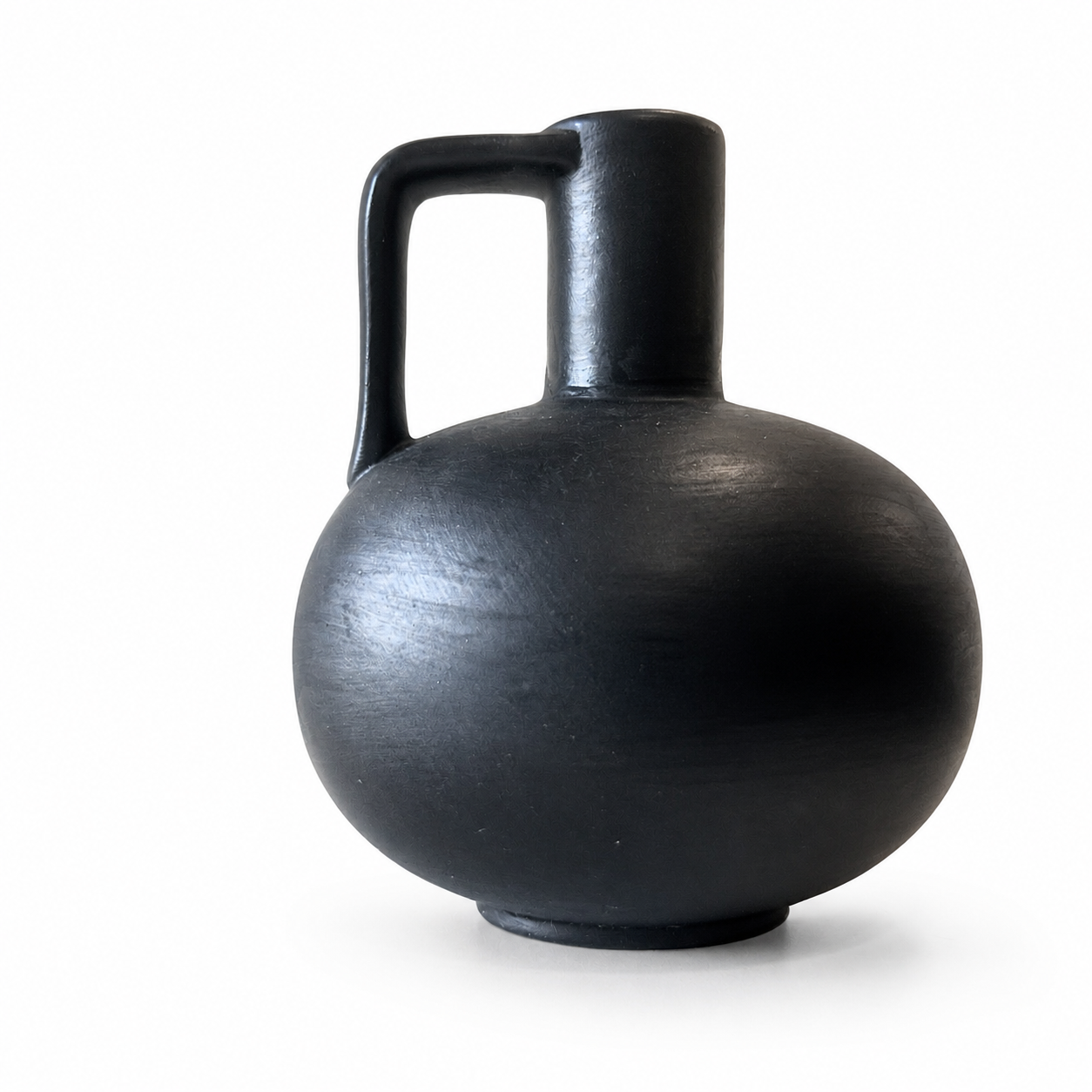
This substantial Austrian terracotta vase commands a powerful sculptural presence, defined by its bold silhouette and deep matte black finish. The vessel features integrated, stylistically simplified handles that emerge seamlessly from the shoulder, creating a rhythmic, geometric profile. Its light-absorbing surface and significant material weight make it a compelling focal point, offering a moody, architectural impact that anchors any high-end collection of European ceramics.
Attribution & Period; Consistent with Keramos (Wiener Kunst-Keramik), 1930s
The construction and aesthetic are strongly aligned with the interwar period of Austrian decorative arts, specifically the Art Deco movement. The underside bears an incised model number "2653" and a clear "Made in Austria" mark, which is typographically consistent with production from the Keramos workshops or contemporaneous Viennese manufactories such as Goldscheider. The use of a red terracotta body beneath a localized black slip—revealed at the mouth and high-relief edges—is a hallmark of 1930s Austrian studio pottery.
Dimensions & Weight
Height: 5 1/8”
Width / Diameter: 6 “
Depth / Base Diameter: 2”
Mouth Diameter: 1 ¼ “
Weight: 1.392 lbs. Substantially heavy for the size; (indicative of thick-walled terracotta construction)
Condition
The vase is in good condition, possessing a weathered patina that enhances its "found object" aesthetic. Clinical observation reveals honest wear to the matte black finish throughout, particularly on high-relief edges where the red terracotta substrate is exposed. The base shows characteristic shelf wear and some historical mineral deposits. No structural cracks or major repairs are observed, though the surface exhibits the charming irregularities of a hand-finished ceramic.
Authenticity & Construction
This piece is expertly slip-cast or hand-turned from red terracotta, a traditional Austrian clay known for its durability and rich color. The exterior was finished with a matte black glaze or cold-paint technique—a popular choice during the Secessionist and Deco eras to emphasize form over ornament. The incised "2653" and "Made in Austria" stamps provide definitive evidence of its industrial-artisan origin in the renowned ceramic centers of Vienna or Gmunden.
Placement
With its brutalist-adjacent aesthetic and matte texture, this vase is ideal for an interior featuring raw wood, concrete, or polished stone. It serves as a sophisticated sculptural anchor on a minimalist mantelpiece or as a centerpiece in a moody, executive library.
STANDARD ATTRIBUTION & VALUE DISCLOSURE; This piece is described to the best of current scholarly and market knowledge. Any maker or regional attribution is based on visual analysis, materials, construction techniques, and documented stylistic comparisons. As with many MCM and antique design objects, definitive attribution may not be possible without original labels or factory records. Pricing reflects condition, quality, decorative appeal, and current collector demand rather than guaranteed maker identification.
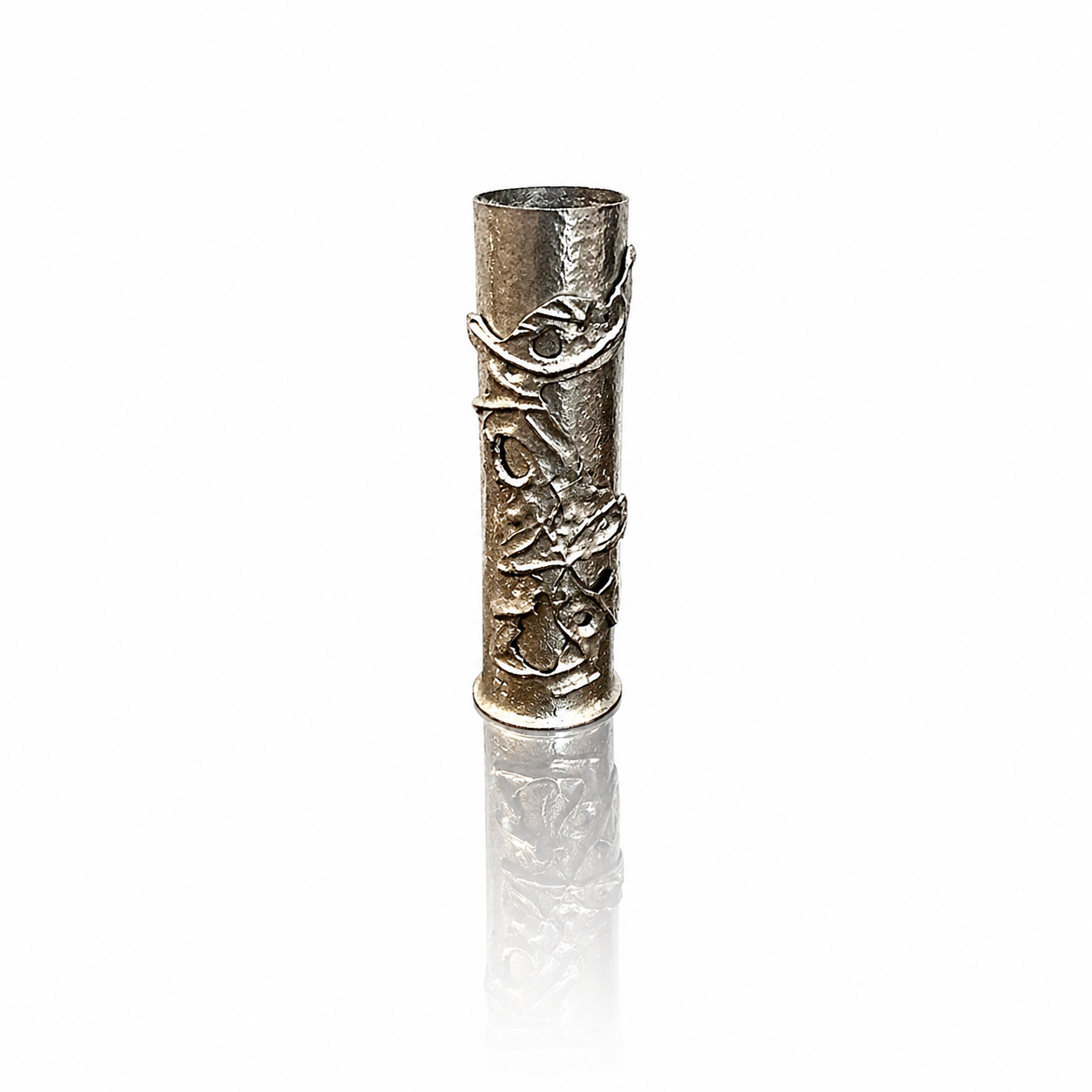
This striking vessel presents a sophisticated interplay of textures, combining a tactile, hand-hammered cylindrical body with bold, organic relief ornamentation. The abstract, flowing motif offers a stark, sculptural contrast to the industrial rigidity of the form, creating a piece that functions as both a decorative object and an architectural accent. Its substantial weight and aged, patinated finish impart a sense of provenance and artistic intent, making it a compelling addition to a curated interior.
Attribution & Period
Stylistically aligned with 1970s European Brutalist metalwork. The construction exhibits characteristics typical of mid-century artisan studios, specifically the integration of cast relief elements onto a manually hammered metal substrate. The aesthetic reflects the era's focus on material honesty, textural complexity, and the elevation of artisanal metalcraft into the realm of fine art.
Dimensions & Weight
Height: 8.5 inches
Width / Diameter: 2 1/4 inches
Depth / Base Diameter: 2 1/2 inches
Weight: 1.31 lbs
Condition
Excellent structural condition. The surface displays a rich, intentional patina consistent with the material and era. Variations in the texture and surface tone are inherent to the hand-hammered manufacturing process. No significant dents, structural compromises, or repairs observed.
Authenticity & Construction
This piece demonstrates high-level manual metal-working techniques. The body is formed from a substantial metal substrate with a consistent, rhythmic hammer-struck texture, onto which the sculptural organic relief element has been securely bonded. The weight and quality of the construction indicate a focused, artisan-made production rather than mass-market manufacture.
Placement
An ideal candidate for a minimalist console, a brutalist-inspired bookshelf, or as a standalone focal point atop a stone coffee table. It pairs exceptionally well with other modernist metal accessories or as a textural counterpoint to smooth, monochromatic ceramics.
STANDARD ATTRIBUTION & VALUE DISCLOSURE
This piece is described to the best of current scholarly and market knowledge. Any maker or regional attribution is based on visual analysis, materials, construction techniques, and documented stylistic comparisons. As with many MCM and antique design objects, definitive attribution may not be possible without original labels or factory records. Pricing reflects condition, quality, decorative appeal, and current collector demand rather than guaranteed maker identification.
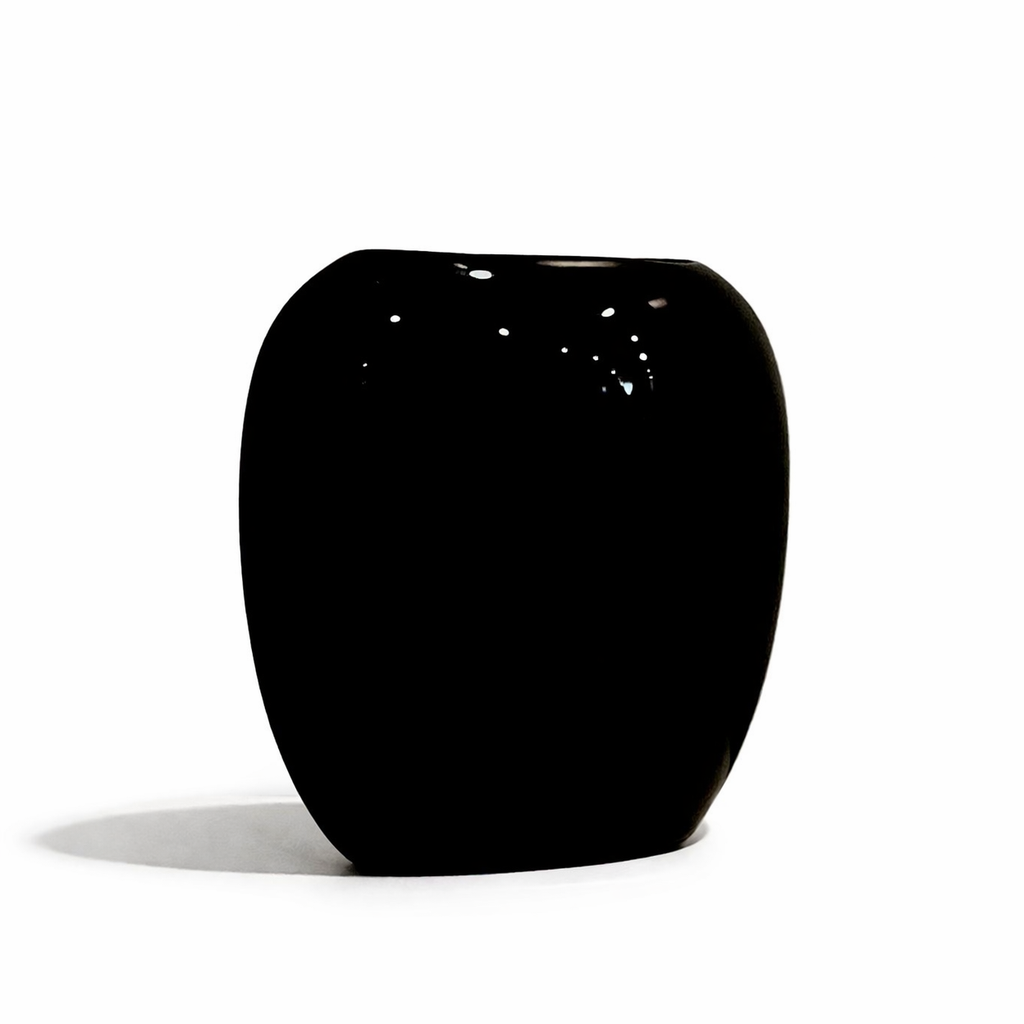
This monolithic vessel exerts a powerful sculptural presence through its compressed, ovoid geometry and "mirror-black" glaze. The form is a masterclass in mid-century minimalism, utilizing a low center of gravity and a precise, elongated aperture designed specifically for the structural requirements of architectural floral arrangement. Its surface depth and high-reflectivity finish create a sophisticated interplay of shadow and light, making it a definitive statement piece for a curated interior.
Attribution & Period
Mid-Century Modern (1960s)
This vessel is a definitive example of Japanese studio pottery, attributed to the Mashiko tradition. The hand-incised signature on the base is consistent with the stylized, western-facing marks used by Mashiko-based artists during the 1960s international design boom. The characteristic "pin-hole" bubbling in the glaze and the iron-rich clay body are direct signatures of the high-temperature reduction firing processes unique to the Tochigi Prefecture. This piece represents the critical era where traditional Japanese folk-craft (Mingei) transitioned into high-modernist sculptural art.
Dimensions & Weight
Height: 5.75 in
Width / Diameter: 6 in (widest area)
Depth / Base Diameter: 3.375 in x 1.625 in (base)
Weight: 0.224 lbs
Condition
The vessel is in immaculate, museum-grade condition. The high-gloss midnight glaze remains vibrant and deep with no chips, cracks, or restorations. Clinical examination reveals minor "glaze pops" or pin-hole bubbles near the shoulder, which are an authentic, sought-after result of the artisan kiln firing process. Light, appropriate shelf wear is present on the unglazed foot, confirming its vintage origin and careful residential history.
Authenticity & Construction
Hand-thrown and expertly altered, the vessel exhibits a seamless transition from its stable base to the elegantly tapered rim. The midnight glaze is applied with exceptional thickness, achieving a liquid-like depth that is a hallmark of Mashiko studio work. The hand-incised signature is deeply integrated into the clay body, providing a permanent and verifiable mark of provenance.
Placement
The dramatic silhouette and noir finish demand a prominent placement. It is exceptionally well-suited for a brutalist sideboard, a minimalist stone mantel, or a glass-top executive desk. It functions with equal strength as a standalone sculptural object or as a vessel for a singular, architectural branch to highlight its Ikebana heritage.
STANDARD ATTRIBUTION & VALUE DISCLOSURE; This piece is described to the best of current scholarly and market knowledge. Any maker or regional attribution is based on visual analysis, materials, construction techniques, and documented stylistic comparisons. As with many MCM and antique design objects, definitive attribution may not be possible without original labels or factory records. Pricing reflects condition, quality, decorative appeal, and current collector demand rather than guaranteed maker identification.
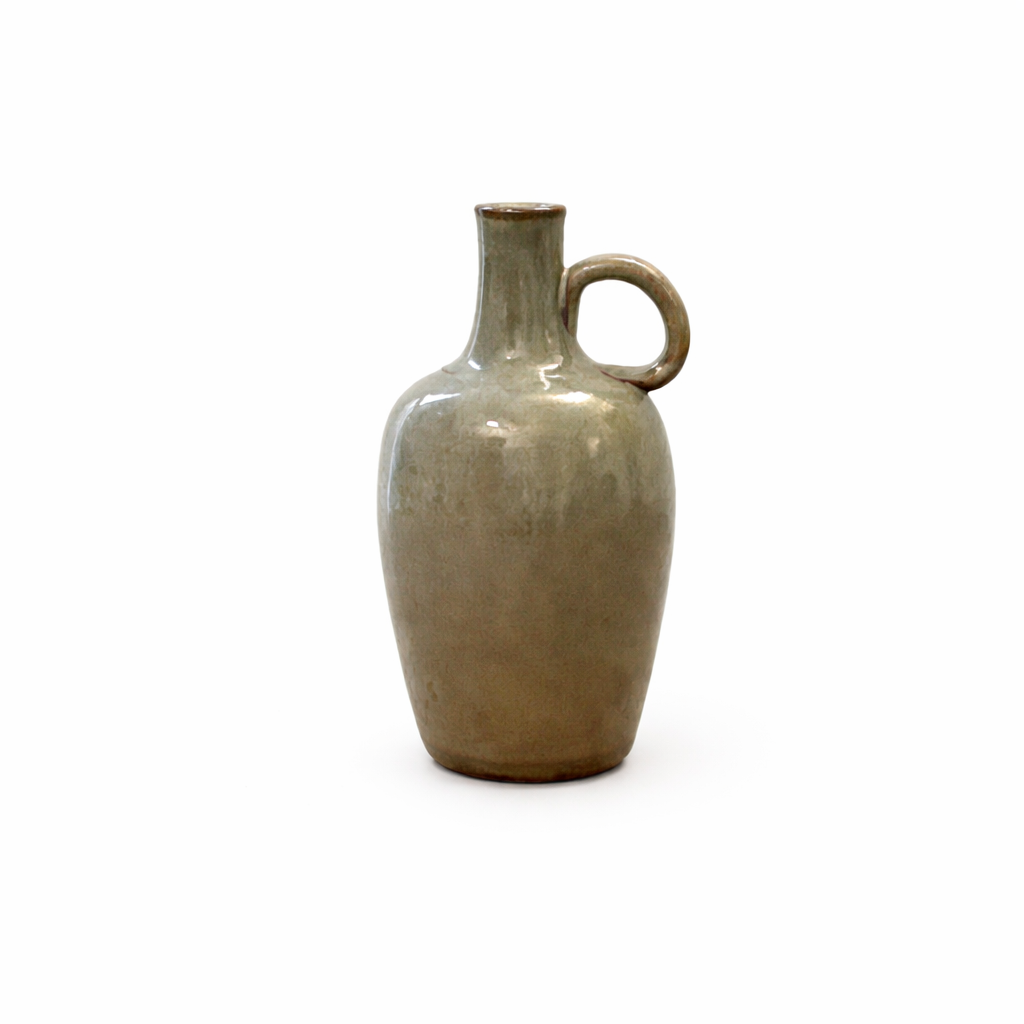
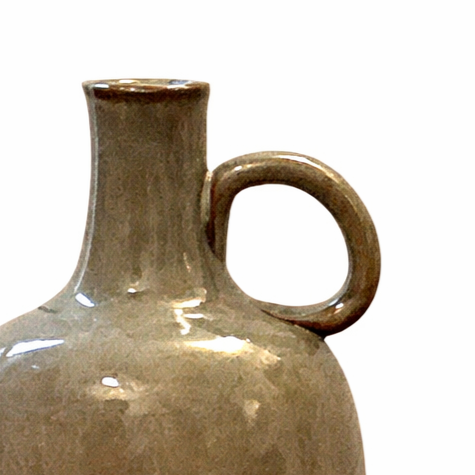
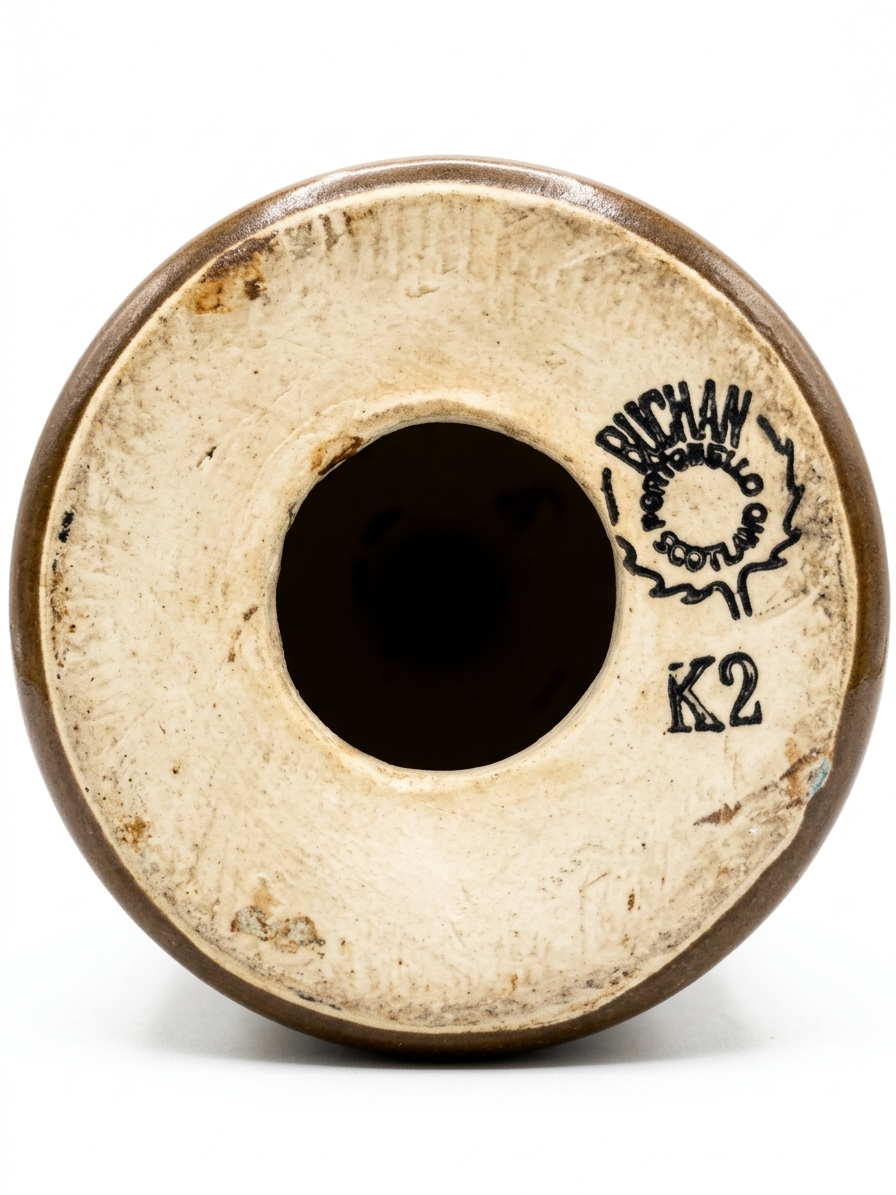
Mid-century Buchan Pottery stoneware jug vase, Portobello, Scotland, impressed “Buchan Scotland” with model designation K2.
This documented K-series form represents Buchan’s restrained mid-20th-century production, when Scottish utilitarian stoneware adopted the quiet sophistication associated with British studio and Arts & Crafts influence. Most consistent with production from the 1950s–early 1960s.
The silhouette is archetypal and disciplined: rounded shoulder, tapering cylindrical neck, and compact loop handle with confident integration. The olive-moss glaze is the defining feature—softly variegated, with subtle tonal depth and gentle pooling at transition points. The surface presents with natural kiln nuance rather than decorative excess, reinforcing its understated, architectural presence.
The impressed K2 model mark confirms this as a catalogued factory form rather than an anonymous studio piece—important for collectors of documented British ceramics.
An ideal acquisition for collectors of:
• British mid-century stoneware
• Scottish ceramics
• Arts & Crafts–influenced interiors
• Wabi-sabi / restrained modern styling
Dimensions
Height: 9 1/2 in
Width (widest point): 5 in
Base diameter: 3 in
Condition
No cracks, chips, or repairs observed.
Light, honest wear to the base consistent with age.
Glaze variation is inherent to manufacture.
Very good vintage condition.
Attribution & Market Positioning
Maker: Buchan Pottery
Origin: Portobello, Scotland
Period: circa 1950s–early 1960s
Material: High-fired glazed stoneware
Markings: Impressed “Buchan Scotland” and K2
This example is described in accordance with documented Buchan factory marks and model numbering. Valuation reflects condition, glaze quality, form integrity, and current demand for mid-century British stoneware.
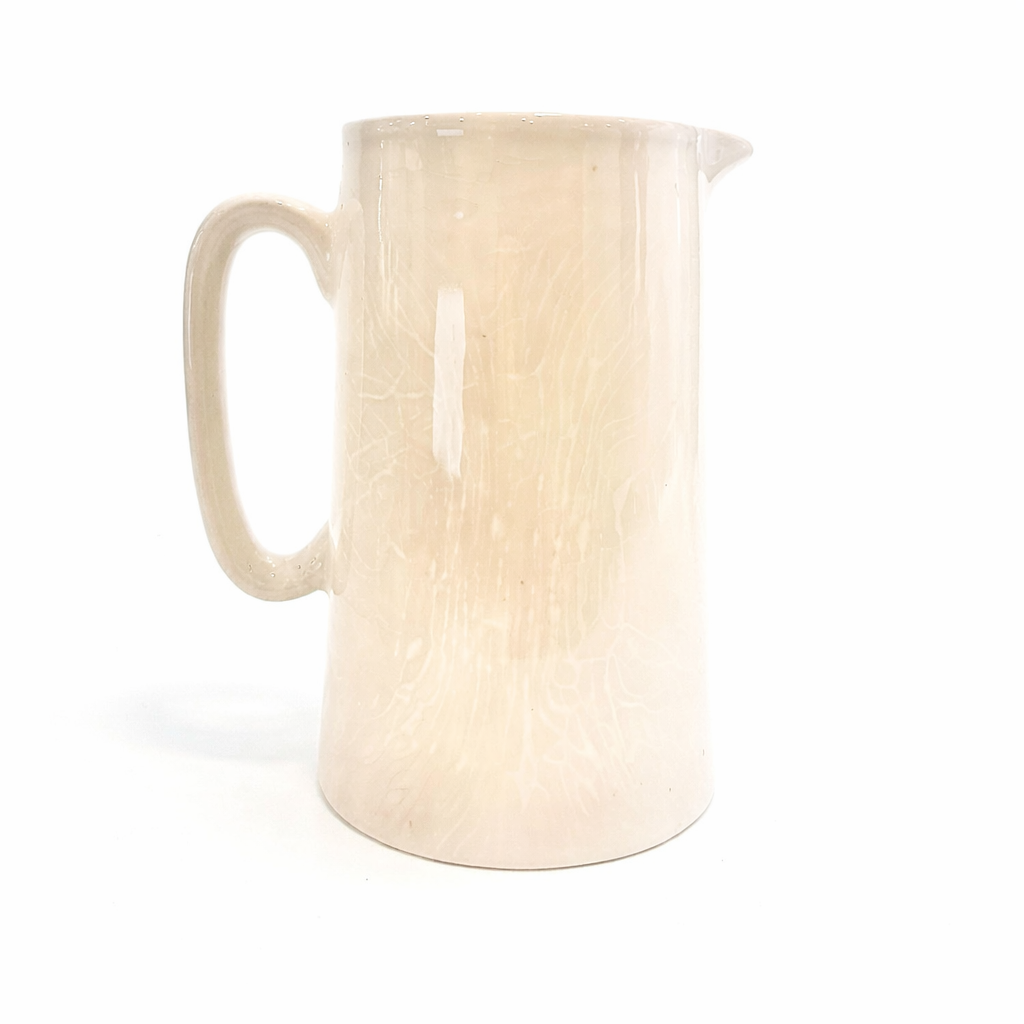
A refined ceramic pitcher defined by its restrained silhouette and softly articulated spout, this piece embodies a quiet, sculptural presence. The creamy, translucent glaze reveals subtle tonal variation and depth, catching light across its gently curved surface. Its balanced proportions and minimal handle design contribute to a composition that is both functional and architecturally composed. The surface presents a delicate network of crazing, enhancing its visual complexity and material richness.
Attribution & Period
Marked example from Lord Nelson Pottery, England, dated December 1978. The attribution is supported by the stamped base mark and inscribed date, consistent with known production from the period, including the use of high-fired ceramic bodies and softly pooled glaze finishes characteristic of English studio-influenced manufacture of the late 1970s.
Dimensions & Weight
Height: 6 in
Width / Diameter: 4.6 in (including handle and spout)
Depth / Base Diameter: 3 in
Weight:
Condition
No chips, cracks, or repairs observed. The glaze presents visible crazing throughout, with light staining within the craze lines consistent with age and use. Surface toning and minor wear are present, aligning with material age. Base shows expected wear from contact with surfaces.
Authenticity & Construction
Wheel-thrown and kiln-fired ceramic construction with a semi-translucent glaze applied prior to firing. The controlled form and even wall thickness indicate skilled production, while the glaze behavior—pooling, tonal shifts, and fine crazing—reflects both firing conditions and long-term material response. The stamped base mark and date confirm production origin and period.
Placement
Ideal as a sculptural accent within a refined interior, this piece integrates seamlessly into minimalist, wabi-sabi, or modernist settings. It functions equally well as a standalone object, part of a ceramic grouping, or styled within open shelving, kitchens, or dining environments where material subtlety and form are emphasized.
STANDARD ATTRIBUTION & VALUE DISCLOSURE
This piece is described to the best of current scholarly and market knowledge. Any maker or regional attribution is based on visual analysis, materials, construction techniques, and documented stylistic comparisons. As with many MCM and antique design objects, definitive attribution may not be possible without original labels or factory records. Pricing reflects condition, quality, decorative appeal, and current collector demand rather than guaranteed maker identification.
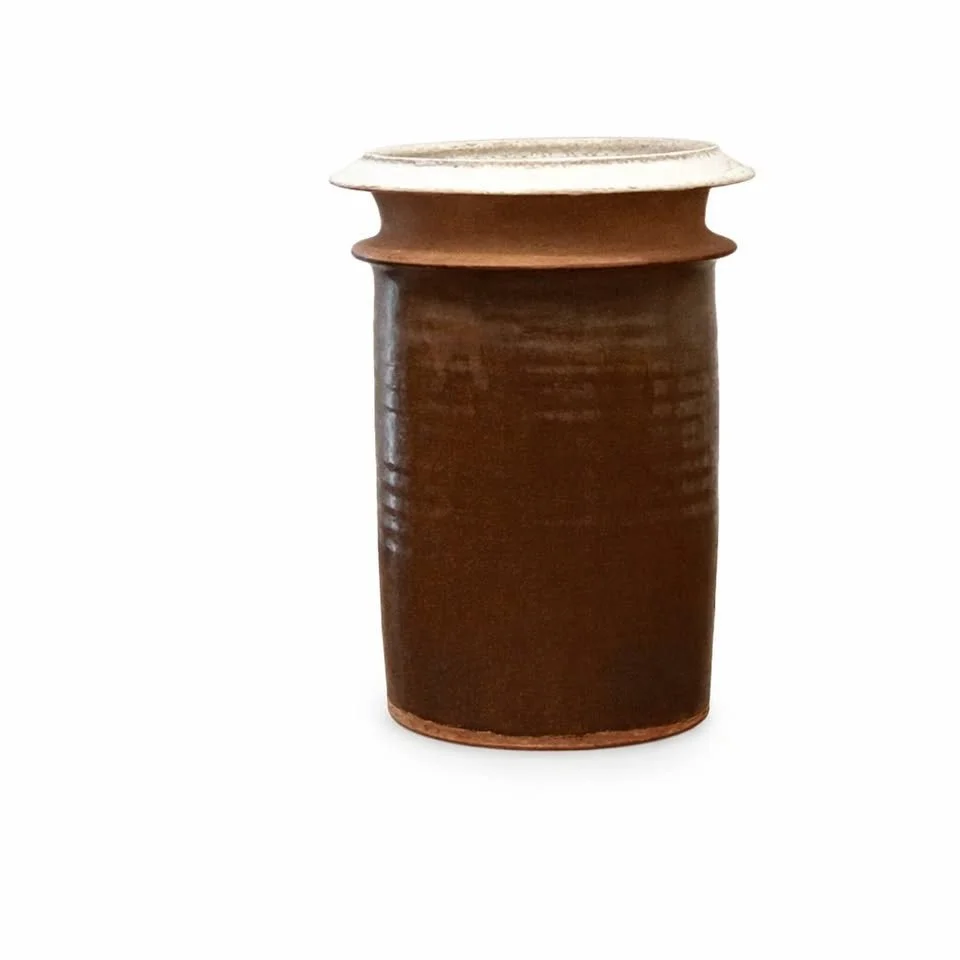
A substantial mid-century studio stoneware vessel, executed in a warm, earth-toned glaze with a contrasting pale, speckled rim. The cylindrical form is disciplined and architectural, with a wide flared lip and grounded base that read as both sculptural and functional.
The body reveals visible throwing rings and natural glaze variation—hallmarks of wheel-thrown studio production. The rich brown glaze carries depth and tonal movement, while the lighter rim introduces restraint and contrast, a glaze program consistent with 1970s studio craft aesthetics.
Its scale and weight give it presence. Equally suited for a sculptural plant installation, dried arrangement, or standalone placement in a gallery-minimal interior, the piece holds its own as an architectural ceramic form.
Attribution & Period
Unmarked studio production, circa 1970s. The glaze palette, construction, and restrained silhouette align with North American mid-century studio stoneware traditions.
Condition
Excellent condition. No cracks, repairs, or structural issues observed. Minor base wear consistent with age.
Dimensions & Weight
Height: 10 in
Top diameter (including lip): 8 in
Base diameter: 5 3/4 in
Authenticity & Construction
This is authentic mid-century studio stoneware with age-appropriate character. It is not mass-produced décor or modern reproduction pottery. The visible throwing lines and glaze movement are integral to its handmade identity.
Placement
A grounded ceramic form that layers seamlessly into Scandinavian, modernist, and gallery-minimal interiors—an ideal tonal counterpoint to saturated Murano or Bohemian art glass.
STANDARD ATTRIBUTION & VALUE DISCLOSURE; This piece is described to the best of current scholarly and market knowledge. Any maker or regional attribution is based on visual analysis, materials, construction techniques, and documented stylistic comparisons. As with many vintage and antique glass objects, definitive attribution may not be possible without original labels or factory records. Pricing reflects condition, quality, decorative appeal, and current collector demand rather than a guaranteed maker identification.
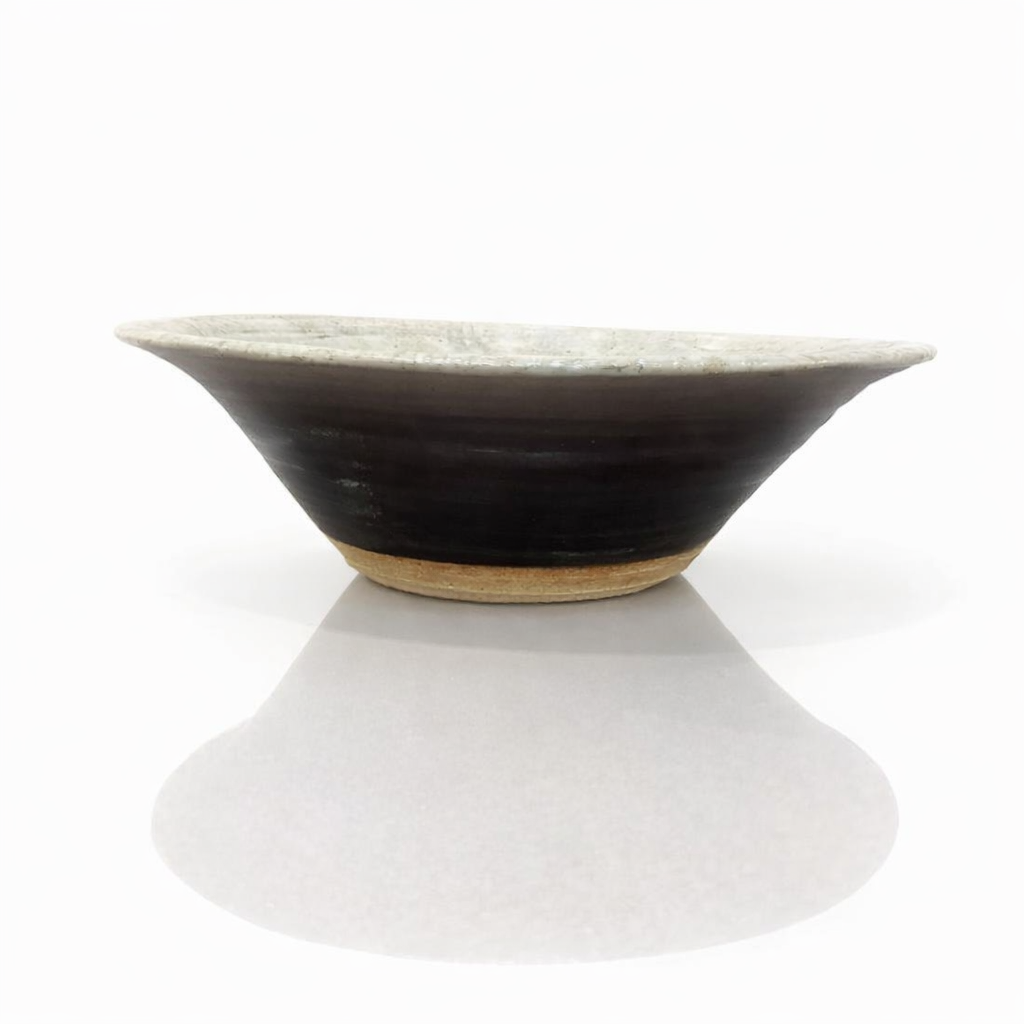
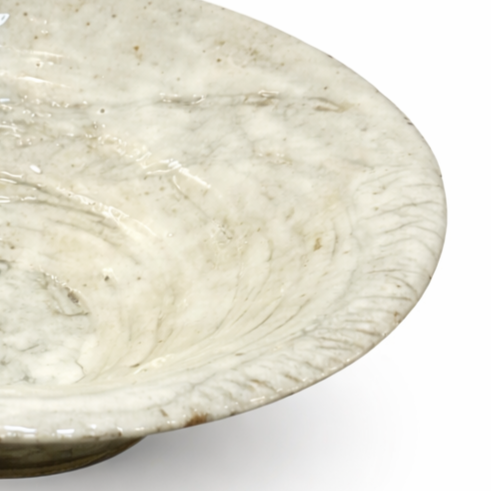
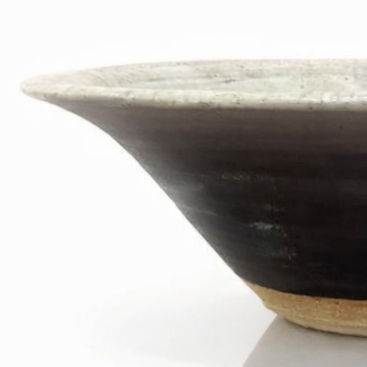
Monumental hand-thrown studio stoneware bowl of commanding scale and refined restraint, executed in a Japanese-influenced ash-glaze tradition. The form is broad and architectural, with a wide flared rim and shallow grounded profile that gives the piece quiet authority and sculptural balance.
The interior is finished in a pale, milky ash-style glaze layered with visible throwing rings, natural speckling, and soft pooling toward the well. The surface carries depth and tonal movement characteristic of high-temperature firing. The exterior transitions into warm iron-brown reduction tones, revealing kiln atmosphere variation and controlled firing mastery
The unglazed foot exposes the clay body and firing marks. A small impressed spiral near the base reads as a studio trimming or maker’s mark rather than a commercial stamp, reinforcing handmade origin. Pencil notations to the underside are consistent with studio inventory markings and are not later additions.
Attribution & Period
While unattributed, the scale, glaze chemistry, and disciplined form strongly align with late 20th-century Western studio pottery influenced by Japanese mingei and ash-glaze traditions. The restraint, surface behavior, and confident proportions indicate an experienced studio hand rather than hobby production.
Late 20th century, likely 1970s–1990s, within the Western studio pottery movement informed by Japanese aesthetics.
Dimensions & Weight
Mouth diameter: 13 in
Depth: 4 in
Base diameter: 5 in
Condition
Very good studio condition. No cracks, repairs, or structural issues observed. Minor glaze variation, kiln marks, and surface irregularities are inherent to high-fire studio production and integral to the aesthetic.
Authenticity & Construction
This is high-fired studio stoneware rooted in Japanese-influenced ash-glaze practice. It is not factory production or decorative mass-market pottery. Surface movement and firing variation confirm authentic studio origin.
Placement
A large-scale ceramic statement suited to gallery display, architectural interiors, wabi-sabi environments, or curated postwar studio collections. Equally compelling as a sculptural centerpiece or standalone vessel.
STANDARD ATTRIBUTION & VALUE DISCLOSURE; This piece is described to the best of current scholarly and market knowledge. Any maker or regional attribution is based on visual analysis, materials, construction techniques, and documented stylistic comparisons. As with many vintage and antique glass objects, definitive attribution may not be possible without original labels or factory records. Pricing reflects condition, quality, decorative appeal, and current collector demand rather than a guaranteed maker identification.
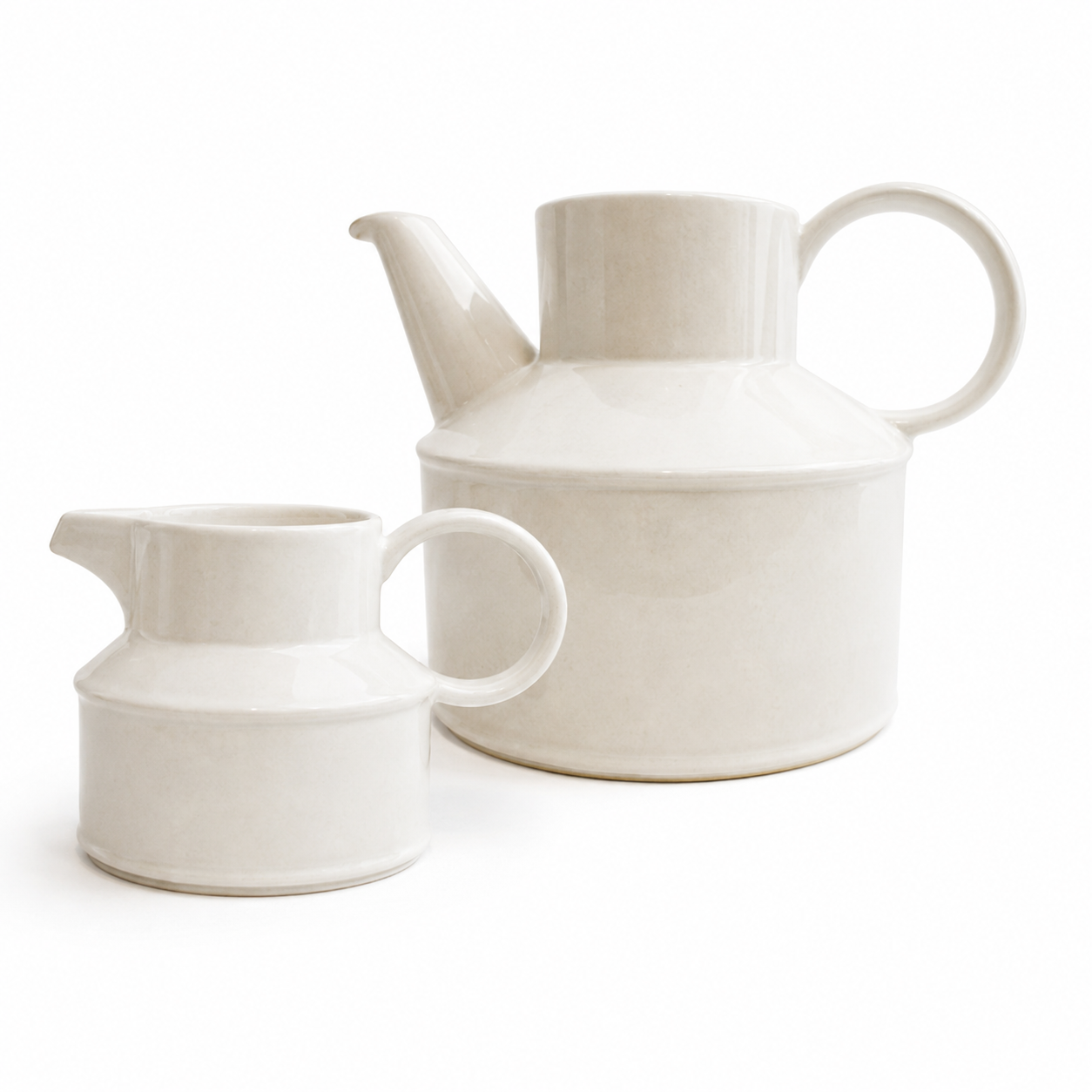
An exceptional pairing of post-war British studio-style design, this substantial ceramic coffee pot and matching creamer exhibit a captivating architectural silhouette. Defined by their wide, perfectly flat circular bases and dramatic, oversized loop handles, the forms offer an exceptional tactile quality that commands visual attention. The crisp geometries of the cylindrical bodies contrast beautifully with the sweeping curves of the handles and minimal spouts, elevating these functional vessels into a compelling set of mid-century ceramic sculpture.
Attribution & Period
Midwinter Pottery was founded in Burslem, Stoke-on-Trent, in 1910 and became especially important in the post-war period under Roy Midwinter, when the company helped reshape British tableware through modern forms and collaborations with notable designers. Stylecraft, introduced in 1953, is widely recognized as Midwinter’s first major modern tableware direction, influenced by contemporary American and California design rather than traditional English pottery forms.
This coffee pot and creamer service is by W.R. Midwinter Ltd. (part of the Wedgwood Group), produced in Staffordshire, England. The distinctive silhouettes belong to the legendary "Stonehenge" collection designed by Eve Midwinter in the early 1970s, which revolutionized British commercial pottery with its rustic, studio-pottery aesthetic. Showcasing an intentionally lidless, open-topped architectural design for the pouring vessel, this specific set features a clean, glossy glaze that beautifully accentuates the stark profiles. The coffee pot is explicitly stamped with a production date of December 1978 on the underside, securely anchoring this set to the late 1970s at the height of Mid-Century Modern kitchenware innovation.
Dimensions & Weight
Height: 7.5 inches (Coffee Pot),
4 inches (Creamer)
Width / Diameter: 7.5 inches (Coffee Pot width including handle and spout),
5.5 inches (Creamer width including handle and spout)
Depth / Base Diameter: 4.75 inches (Coffee Pot base diameter), 3.5 inches (Creamer base diameter)
Weight: 1.8 lbs (Coffee Pot),
0.75 lbs (Creamer)
Condition
Clinical and pristine. Both pieces are in excellent condition, the teapot has a tiny chip on the spout as demonstrated in one if the photographs, the creamer and remainder of the pot prove no chips, cracks, hairline fractures, or surface scratches to the glaze. The structural integrity of the oversized handles is perfect, and the flat, unglazed standing rims at the bases show virtually no shelf wear.
Authenticity & Construction
Crafted from a durable, heavy-bodied semi-porcelain ceramic compound, this set reflects Midwinter’s high-quality industrial manufacturing designed to mimic heavy hand-thrown studio pottery. The substantial weight of each piece ensures exceptional stability on flat surfaces. The bottom of the vessels features the authentic factory marks, including the precise December 1978 date stamp on the main pouring piece, confirming its origin in England.
Placement
With their bold, minimalist profiles, this coffee pot and creamer serve as an excellent graphic and sculptural accent. They are ideally styled as a pair on open oak kitchen shelving, a brutalist dining room sideboard, or displayed alongside minimalist stoneware on a refined morning room étagère.
STANDARD ATTRIBUTION & VALUE DISCLOSURE; This piece is described to the best of current scholarly and market knowledge. Any maker or regional attribution is based on visual analysis, materials, construction techniques, and documented stylistic comparisons. As with many MCM and antique design objects, definitive attribution may not be possible without original labels or factory records. Pricing reflects condition, quality, decorative appeal, and current collector demand rather than guaranteed maker identification.
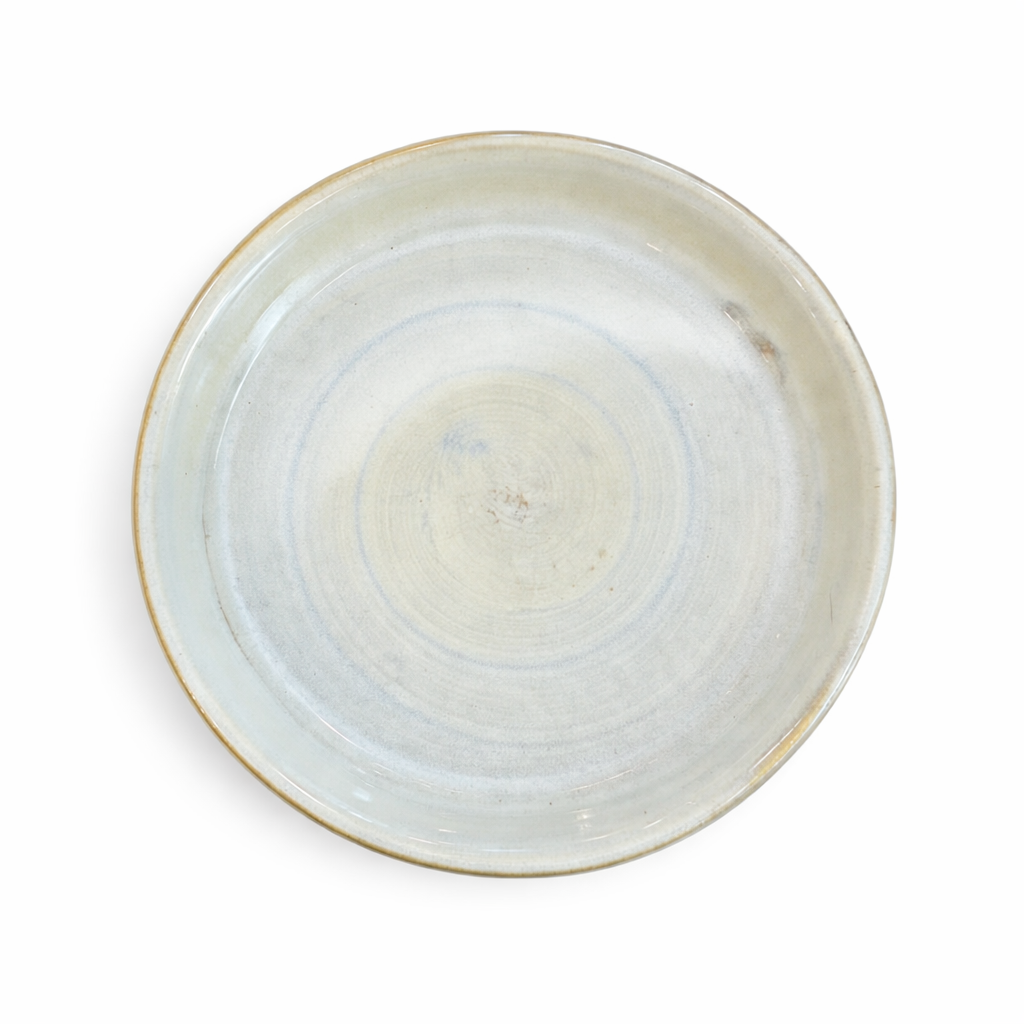
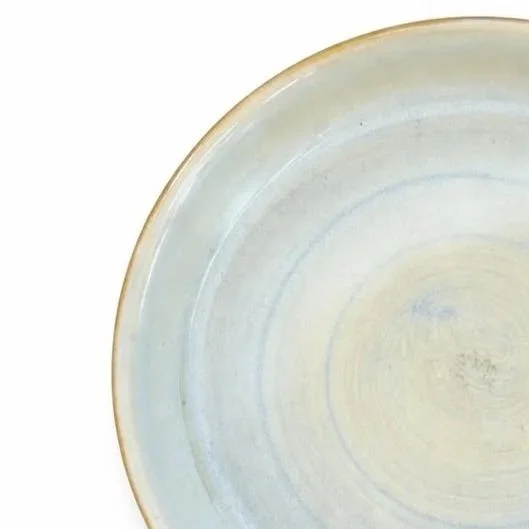
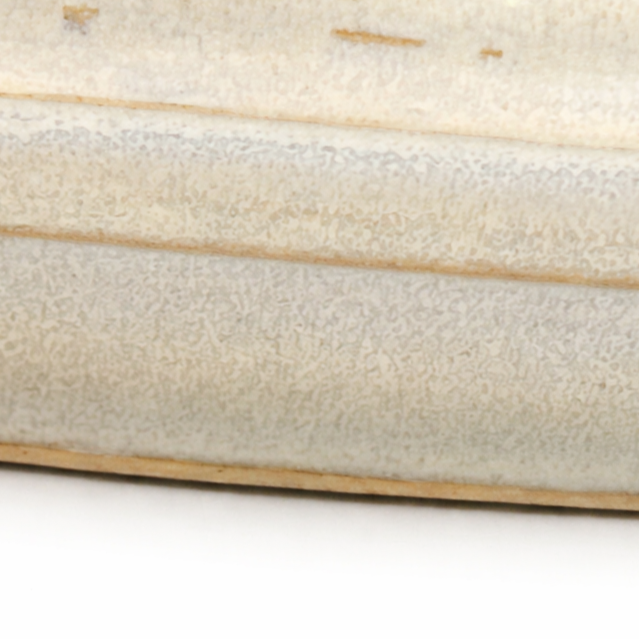
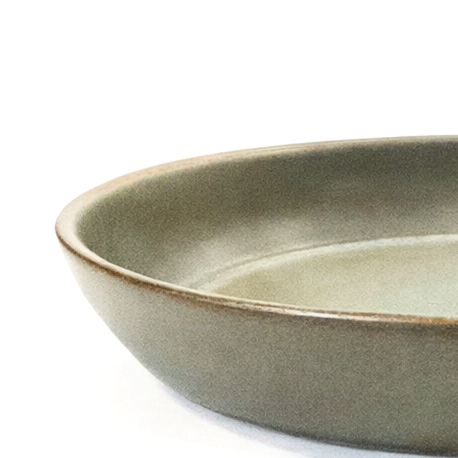
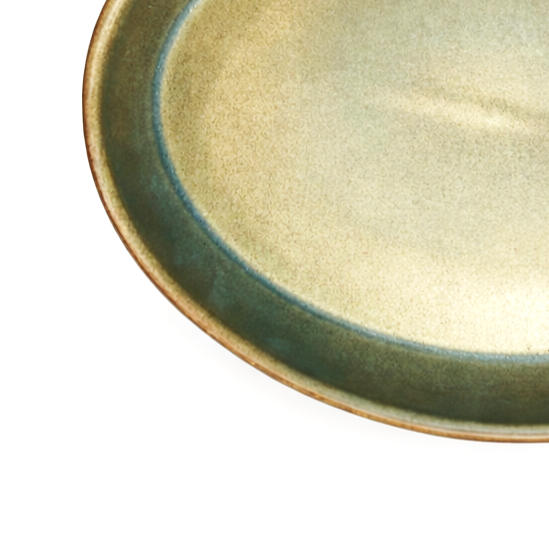
Studio pottery platter, wheel-thrown in stoneware and finished in a soft celadon-style blue-grey glaze with natural reduction variation. The surface shows subtle tonal pooling and quiet movement characteristic of late 20th-century North American studio ceramics.
Authenticity & Construction
The underside features an unglazed foot ring with a hand-drawn iron circle and a faint impressed makers stamp, now largely illegible due to age and useconfirming studio production rather than factory manufacture.
Attribution & Period
Based on clay body, glaze chemistry, and construction, this piece dates to the late 1970searly 1980s, a period when functional studio pottery emphasized restraint, everyday use, and material honesty.
A one-of-a-kind platter suitable for serving, display, or inclusion in a serious studio pottery collection.
Details
Hand-thrown stoneware platter
Unidentified studio potter
North American origin
Circa late 1970searly 1980s
Celadon-style blue-grey glaze
Unglazed foot ring with hand-drawn iron circle
Condition
Excellent condition consistent with age and use. No cracks, chips, or repairs. Surface variation and firing marks are inherent to studio pottery and part of the pieces character.
Dimensions & Weight
STANDARD ATTRIBUTION & VALUE DISCLOSURE; This piece is described to the best of current scholarly and market knowledge. Any maker or regional attribution is based on visual analysis, materials, construction techniques, and documented stylistic comparisons. As with many vintage and antique glass objects, definitive attribution may not be possible without original labels or factory records. Pricing reflects condition, quality, decorative appeal, and current collector demand rather than a guaranteed maker identification.
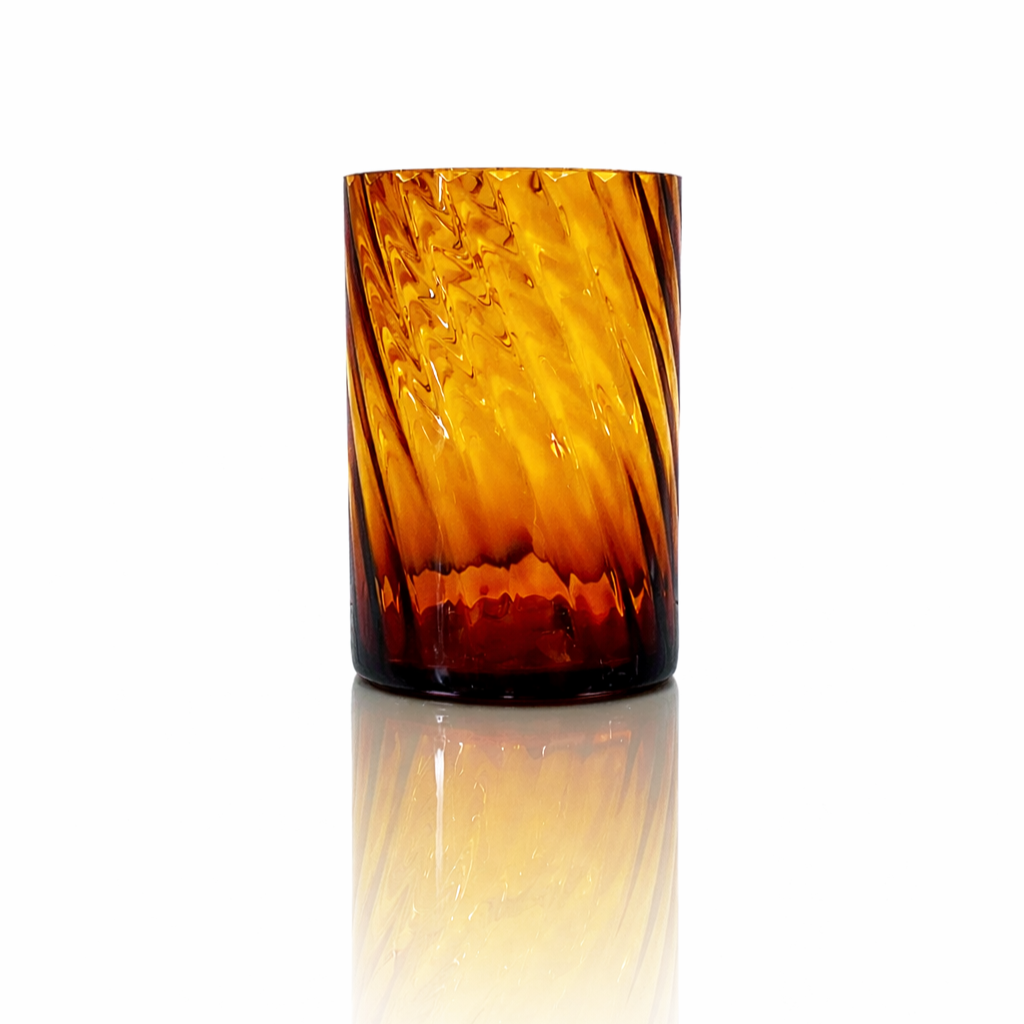
A luminous mid-century studio art glass vase featuring dramatic honey-amber coloration and a striking twisted optic pattern that animates the entire form. The body transitions from deep ruby amber at the base to radiant golden honey tones toward the rim, producing a glowing effect when illuminated. The swirling internal pattern was created using an optic mold technique, where the molten glass is blown into a patterned mold and gently twisted during formation. This process produces the fluid, flame-like movement visible throughout the vessel and gives the glass exceptional visual depth.
The vase’s cylindrical silhouette is balanced by the dynamic spiral pattern, making it both architectural and sculptural. When displayed with light behind or above it, the glass reveals rich tonal shifts from burnt amber to brilliant topaz. This style of optic swirl glass became highly popular during the mid-century studio glass movement of the late 1960s and early 1970s, particularly among Scandinavian and Italian glass studios exploring bold color and dynamic form inspired by Venetian techniques. The underside shows evidence of traditional hand-finished blown glass production, reinforcing its studio art glass character.
Attribution & Period
Studio Art Glass, Scandinavian-influenced production, Circa 1970, Unsigned
Dimensions
Height: 8.5 in
Mouth Diameter: 4 5/8 in
Condition
Very good condition overall.; A few very small flea-bite size nicks along the rim edge consistent with age and handling. No cracks or repairs. The glass remains bright with strong colour saturation. There are minor rim marks illustrated in the close up photograph which are visible only upon close inspection and do not detract from display.
Authenticity & Construction
Hand-blown art glass using an optic twist mold technique. The honey-amber colouration appears achieved through layered glass gathers where deeper ruby tones settle toward the base while lighter golden glass rises toward the rim during the blowing process. The base shows a hand-finished pontil area, typical of studio glass production.
Curation
Ideal for placement on a console, entry table, or within a curated studio glass collection, this piece achieves its full sculptural potential when positioned in mid-century or modern interior settings with directional backlighting to activate the vibrant honey-amber rim and internal spiral movement.
Provenance
Private decorative arts collection; acquired through the secondary art market
STANDARD ATTRIBUTION & VALUE DISCLOSURE; This piece is described to the best of current scholarly and market knowledge. Any maker or regional attribution is based on visual analysis, materials, construction techniques, and documented stylistic comparisons. As with many vintage and antique glass objects, definitive attribution may not be possible without original labels or factory records. Pricing reflects condition, quality, decorative appeal, and current collector demand rather than a guaranteed maker identification.
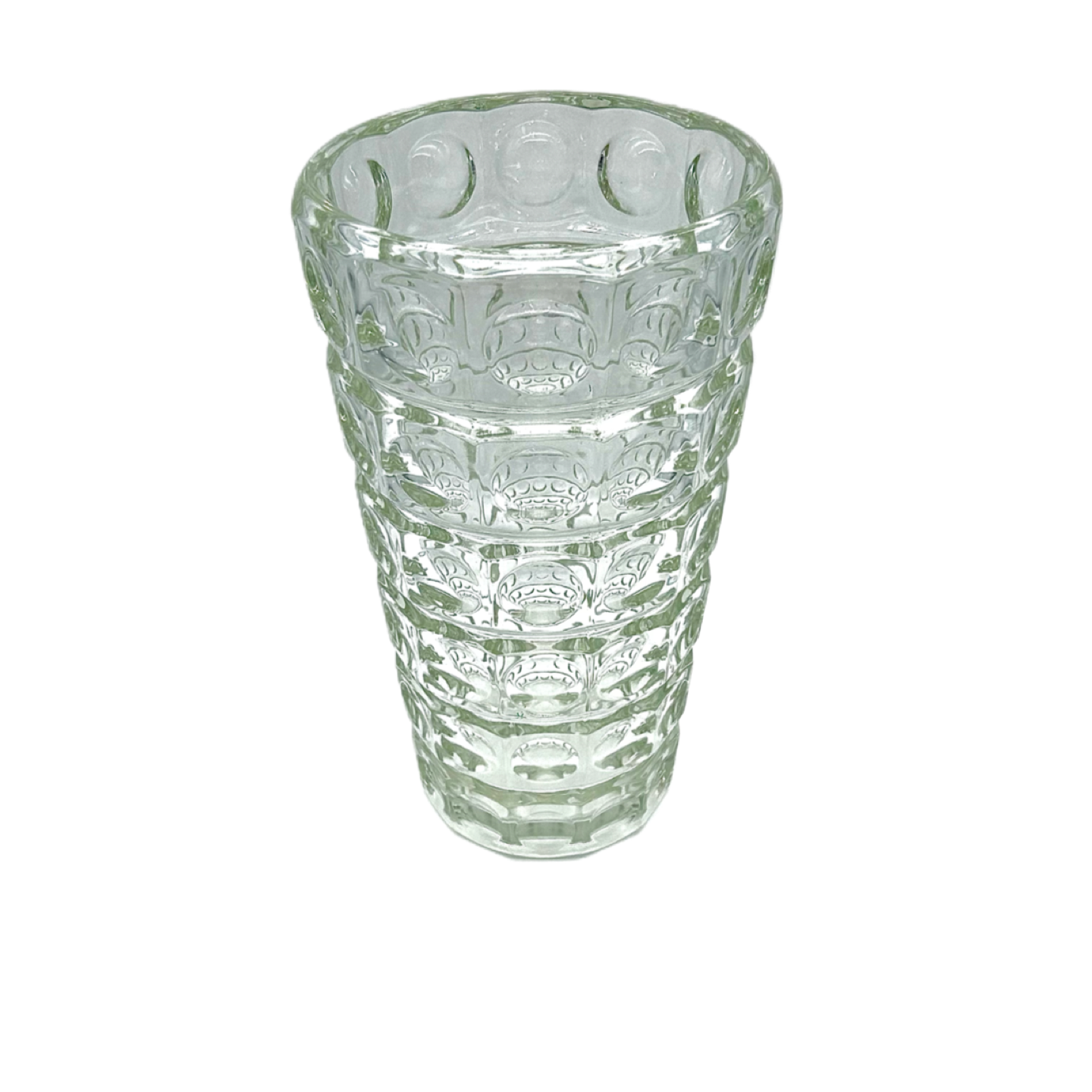
A commanding sculptural pressed glass vase defined by its architectural silhouette and deeply molded relief pattern. The vessel’s stacked geometry and repeating crescent motifs create a rhythmic surface that refracts light with dramatic clarity, transforming the piece into a luminous decorative object rather than simple tableware. Substantial in both scale and weight, the form reads as a modernist glass sculpture—equally effective as a standalone statement piece or within a curated interior arrangement.
Produced using thick-walled molded glass, the vase demonstrates the refined industrial artistry that defined Central European glassmaking in the mid-20th century. The faceted structure and strong relief pattern interact with ambient light to produce a dynamic visual presence, giving the object the character of architectural decor. Its bold vertical proportions and substantial mass allow it to anchor a space visually, making it particularly suited for design-forward interiors.
Attribution & Period
Czech / Bohemian pressed glass, mid-20th century, circa 1940–1969.
The strong geometric structure, heavy molded construction, and repeating relief ornament are consistent with pressed glass design traditions associated with Czech glassworks of the period. Factories such as Rudolfova Huť, Rosice, and other later Sklo Union group manufacturers produced similar sculptural glass objects that balanced industrial technique with modernist decorative form.
No factory mark or signature is present. Attribution is therefore based on stylistic and construction analysis rather than a confirmed catalog identification.
Dimensions & Weight
Height: 12 in
Mouth Diameter: 6.75 in
Base Diameter: 4.5 in
Weight: 7.356 lbs
The significant weight reflects thick-walled pressed glass construction typical of higher quality Central European molded glass.
Condition
This piece is in excellent overall condition, remaining structurally sound and free of chips or cracks, with only light surface scratching at the base consistent with gentle shelf contact.
Authenticity & Construction
The vase was produced using a heavy pressed-glass molding process in which molten glass is pressed into a precision steel mold to create a detailed relief surface. This technique allows for deep sculptural patterning and consistent structural clarity while producing thick, durable walls.
The sharply defined crescent motifs and crisp geometric contours indicate a high-quality mold and careful finishing after release from the mold. The substantial glass mass and balanced proportions reflect the design philosophy of Central European pressed glass—objects intended to function both as decorative sculpture and functional vessel.
Under UV light the glass displays a blue-toned response. This reaction appears inherent to the material composition of the glass rather than a surface treatment and is commonly associated with mineral content present in certain mid-20th-century glass formulations.
Placement
This piece performs best as a sculptural decorative object within a refined interior setting. Its scale and visual weight make it ideal for placement on a console, credenza, pedestal, or architectural shelf where the molded relief can interact with ambient light. It also integrates well within curated glass collections or modernist interiors where strong form and material presence are central to the composition.
STANDARD ATTRIBUTION & VALUE DISCLOSURE; This piece is described to the best of current scholarly and market knowledge. Any maker or regional attribution is based on visual analysis, materials, construction techniques, and documented stylistic comparisons. As with many MCM and antique glass objects, definitive attribution may not be possible without original labels or factory records. Pricing reflects condition, quality, decorative appeal, and current collector demand rather than a guaranteed maker identification.
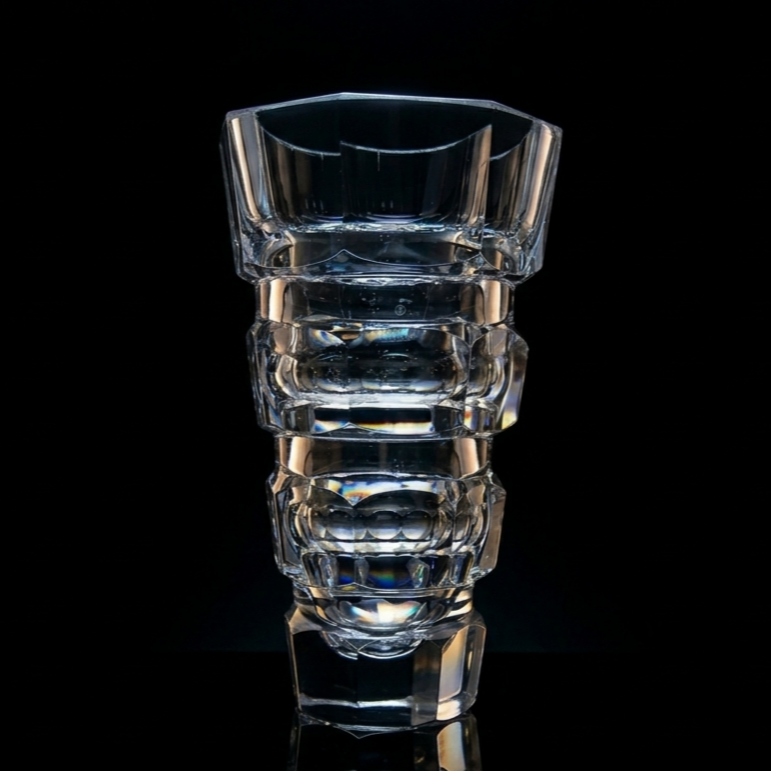
A monumental architectural cut crystal vase executed in the Bohemian glassmaking tradition of the Karlovy Vary region, circa 1955–1970. The sculptural vessel is built from heavy lead crystal and defined by a bold geometric composition: a faceted octagonal base rising through stacked cylindrical bands deeply carved with repeating oval optic lenses.
The precision cutting creates strong optical refraction throughout the body of the crystal, producing dramatic internal reflections as light passes through the layered architecture. Vertical facets frame each band, reinforcing the stepped columnar silhouette and giving the vase the visual presence of a sculptural object rather than a purely utilitarian vessel.
This architectural style emerged in mid-century Czech crystal workshops, where master cutters transformed thick crystal blanks into modernist decorative objects that balanced geometry, clarity, and light. The vase functions equally well as a vessel or as a standalone decorative sculpture placed where natural light can activate the deep cutting.
Under ultraviolet light the crystal shows a soft fluorescence typical of manganese-clarified European lead crystal used during the mid-twentieth century, confirming traditional Bohemian glass chemistry.
⸻
Attribution & Period
Czech / Bohemian luxury cut lead crystal
Karlovy Vary glassmaking tradition
circa 1955–1970
Unsigned
⸻
Dimensions & Weight
Height: approx. 8 in
Mouth diameter: approx. 4.5–4.75 in
Base diameter: approx. 2 7/8 in
Weight: approx. 3.46 lbs
⸻
Condition
Very good condition. Minor surface wear to the base consistent with age and display. No chips or cracks observed. Cutting remains crisp and bright.
⸻
Authenticity & Construction
Hand-cut lead crystal. The vase was formed from a thick blown crystal blank and subsequently cut on grinding wheels to produce the deep oval optic lenses and faceted vertical panels. The cutting depth and polishing quality are consistent with high-quality Bohemian crystal production exported from the Karlovy Vary region during the mid-twentieth century.
⸻
Placement
Ideal for architectural interiors, pedestal display, luxury console styling, illuminated cabinet presentation, or modernist decorative arrangements where the optical depth of the crystal can interact with natural light.
⸻
STANDARD ATTRIBUTION & VALUE DISCLOSURE
This piece is described to the best of current scholarly and market knowledge. Any maker or regional attribution is based on visual analysis, materials, construction techniques, and documented stylistic comparisons. As with many vintage and antique glass objects, definitive attribution may not be possible without original labels or factory records. Pricing reflects condition, quality, decorative appeal, and current collector demand rather than a guaranteed maker identification.
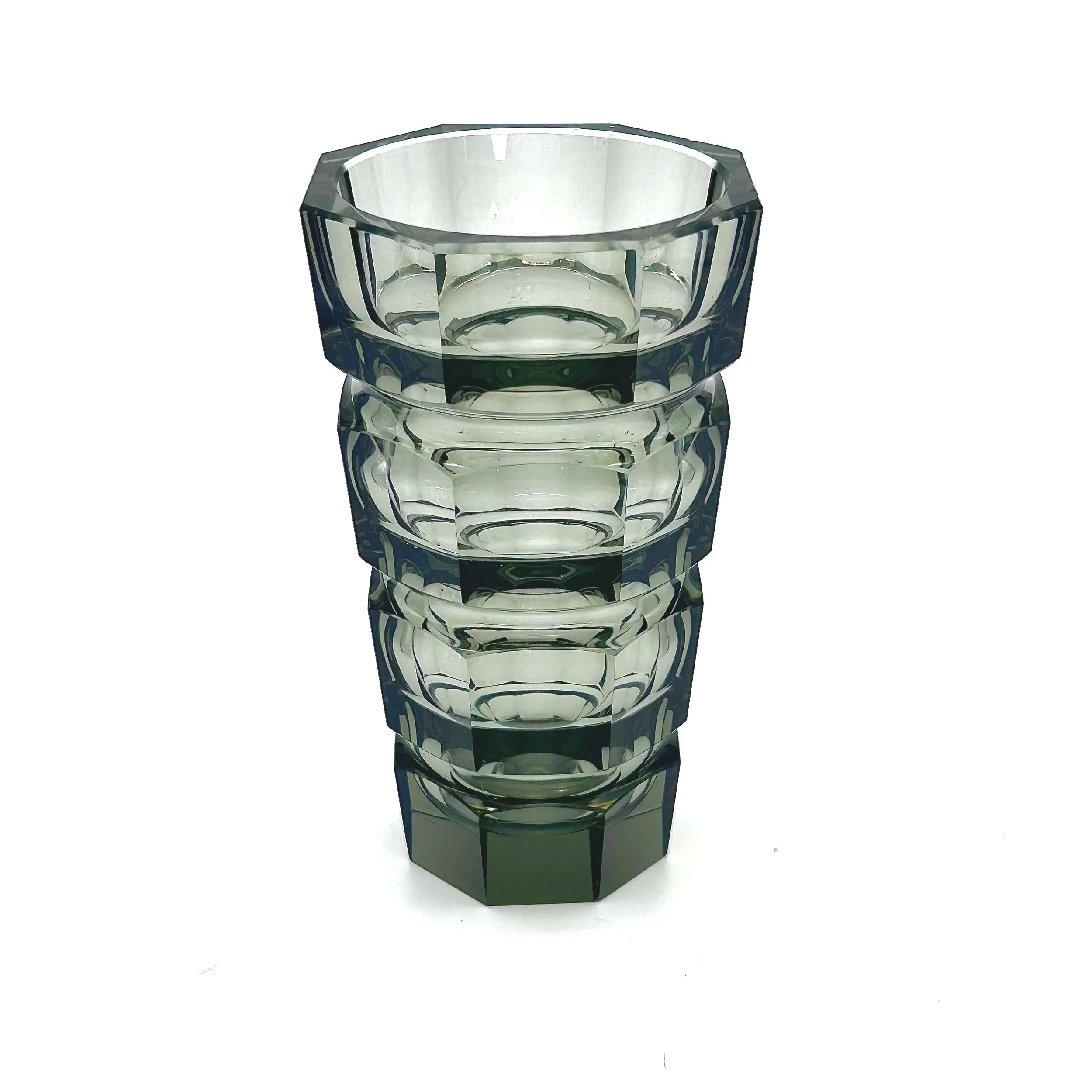
A sculptural mid-century smoky cut lead crystal vase produced in the Bohemian glassmaking tradition of the Karlovy Vary region, circa 1955–1970. The vessel presents a striking architectural composition defined by stacked cylindrical registers deeply cut with repeating oval optic lenses framed by vertical facets.
The body rises from a sharply faceted octagonal base and terminates in a wide octagonal mouth. The smoky crystal coloration enhances the geometry of the cutting, creating rich tonal contrast and dramatic light refraction across the layered structure.
This modernist cutting style became characteristic of mid-century Bohemian export crystal, where heavy crystal blanks were transformed into sculptural decorative objects through precise hand cutting and polishing.
Under ultraviolet light the crystal displays subtle fluorescence consistent with manganese-clarified European lead crystal used in mid-twentieth-century Bohemian production.
Attribution & Period
Czech / Bohemian cut lead crystal
Karlovy Vary glassmaking tradition
circa 1955–1970
Unsigned
Dimensions & Weight
Height: 6 in
Mouth diameter: approx. 3.25 in
Base diameter: approx. 3.5 in
Weight: approx. 1.73 lbs
Condition
Very good vintage condition overall. One tiny flea-bite chip to the base edge noted for accuracy; not visible in normal display.
Authenticity & Construction
Hand-cut lead crystal produced from a thick crystal blank and finished through traditional wheel-cutting techniques. The deep optic lenses and faceted geometry reflect the cutting style associated with mid-century Bohemian crystal workshops operating within the Karlovy Vary export tradition.
Placement
Ideal for console display, bookshelf styling, bar presentation, or layered decorative groupings with other sculptural crystal objects.
STANDARD ATTRIBUTION & VALUE DISCLOSURE
This piece is described to the best of current scholarly and market knowledge. Any maker or regional attribution is based on visual analysis, materials, construction techniques, and documented stylistic comparisons. As with many vintage and antique glass objects, definitive attribution may not be possible without original labels or factory records. Pricing reflects condition, quality, decorative appeal, and current collector demand rather than a guaranteed maker identification.
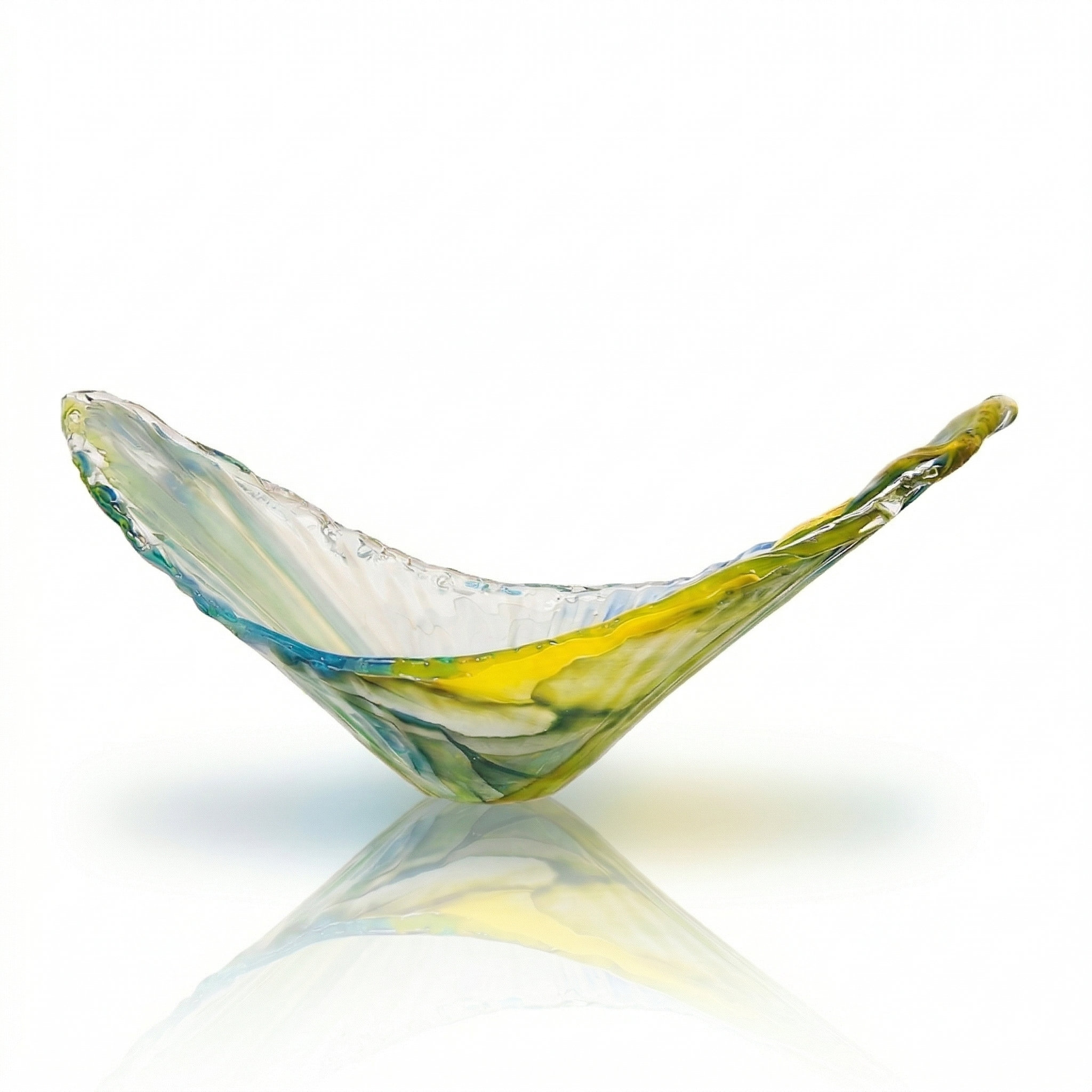
A monumental, sculptural studio art glass bowl defined by dramatic up-swept ”wing’ rims and a deep, floating basin-an object that reads as contemporary glass sculpture rather than utilitarian form. Thick clear casing amplifies the internal color fields, creating exceptional optical depth and a liquid, suspended-pigment effect as light moves through the glass. The silhouette is intentionally asymmetric, with lifted ends and a softly weighted center, presenting as a gallery-caliber statement piece for a console, cocktail table, or pedestal.
Attribution & Period
Unknown (Studio) unsigned
Attributed: Contemporary North American studio glass tradition (best-faith attribution based on form, finish, and technique)
Estimated Date & Place of Origin Circa: 1990-2010
Place of Origin: North America (attributed)
Authenticity & Construction
Hand-blown and hot-sculpted cased art glass; annealed; coldworked base.
This bowl was most likely made by gathering and blowing clear glass to establish the vessel, applying color (commonly frit/powder or thin color applications) to create the internal ribbons and veils, then adding a final clear casing layer over the color to encapsulate it and produce pronounced depth. While still hot, the rim was pulled and stretched into the winged form, then the work was annealed and finished with coldwork to the underside, resulting in a stable, refined base presentation. Color A luminous, oceanic palette with layered translucency and painterly movement:
Glacier / ice blue and pale aqua body tones with soft diffusion,
Teal and cerulean accents along the rim and edge swells
saturated chartreuse / citron / lemon-yellow ribbon suspended through the form
Subtle seafoam green transitions and milky opaline haze that bloom beneath the clear casing
high clarity crystal-clear exterior that magnifies internal striations and depth
Dimensions & Weight
Length: 23 in
Width: 10 in
Height: 8.75 in
Base diameter: 3.5 in
Condition
Excellent overall condition. No chips or hairline cracks observed. Minor surface wear to the underside consistent with careful display (typical for studio glass with a coldworked base).
Provenance
From a private collection. The work aligns with the late-20th/early-21st-century studio glass ethos; sculptural form, optical casing, and painterly color captured within clear crystal.
Placement
Striking under natural or directional light; ideal for a minimalist interior, coastal-modern palette, or as a centerpiece on dark stone, walnut, or lacquer surfaces where the casing depth reads most dramatically.
STANDARD ATTRIBUTION & VALUE DISCLOSURE
This piece is described to the best of current scholarly and market knowledge. Any maker or regional attribution is based on visual analysis, materials, construction techniques, and documented stylistic comparisons. As with many vintage and antique glass objects, definitive attribution may not be possible without original labels or factory records. Pricing reflects condition, quality, decorative appeal, and current collector demand rather than a guaranteed maker identification.
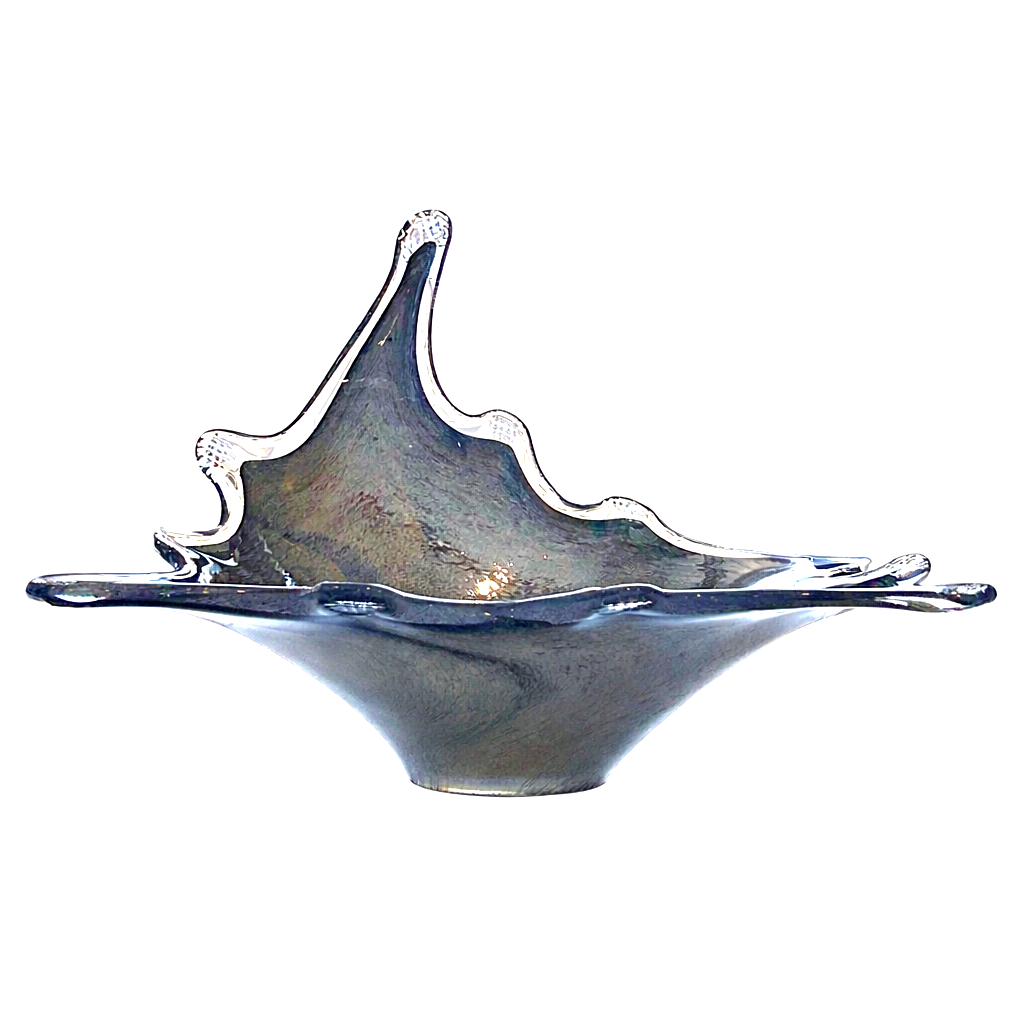
This masterfully hand-blown glass centerpiece commands attention with its dynamic, undulating "handkerchief" silhouette and ethereal sky blue hue. The interior is enriched with finely dispersed gold-leaf inclusions that create a shimmering, prismatic effect when struck by natural light. Its organic, multi-pointed rim evokes a sense of fluid movement, transforming a traditional vessel into a significant piece of glass sculpture that serves as a focal point in any sophisticated interior.
Attribution & Period
Region: Italy (Murano)
Period: 1970s
Attribution: By Murano (Labelled)
This piece retains its original foil "Hand Made in Italy - Murano" label on the base, confirming its origin from the Venetian archipelago. The construction features a "Cordonato d'Oro" style technique—integrating gold leaf into the glass—consistent with the high-production standards of mid-to-late 20th-century Murano furnaces. The specific font and layout of the sticker are characteristic of exported Venetian art glass from the 1970s.
Dimensions & Weight
Height: 9.5 inches
Width / Diameter: 16 inches
Depth / Base Diameter: 13 inches (Overall) / 2.625 inches (Base)
Weight: 4.918 lbs
Condition
The object is in excellent vintage condition. The glass body is free of chips, cracks, or professional repairs. There is minor, age-appropriate shelf wear and light scratching localized strictly to the underside of the polished base, consistent with its age and history of display. The sky blue coloration remains vibrant and uniform throughout the vessel.
Authenticity & Construction
This bowl was executed using traditional free-blown techniques. The artisan skillfully manipulated the molten glass to achieve the dramatic, asymmetric "fazzoletto" (handkerchief) folds. The inclusion of genuine gold leaf during the blowing process requires precise temperature control to ensure the leaf "shatters" into a delicate, even dust rather than clumping, a hallmark of skilled Italian glassmaking.
Placement
The expansive 16-inch scale of this piece makes it an ideal centerpiece for a large circular dining table or a minimalist credenza. Its translucent blue tones and gold-flecked interior are particularly effective when placed in a sun-drenched room or under direct gallery lighting, where the internal reflections can fully activate.
STANDARD ATTRIBUTION & VALUE DISCLOSURE; This piece is described to the best of current scholarly and market knowledge. Any maker or regional attribution is based on visual analysis, materials, construction techniques, and documented stylistic comparisons. As with many MCM and antique design objects, definitive attribution may not be possible without original labels or factory records. Pricing reflects condition, quality, decorative appeal, and current collector demand rather than guaranteed maker identification.
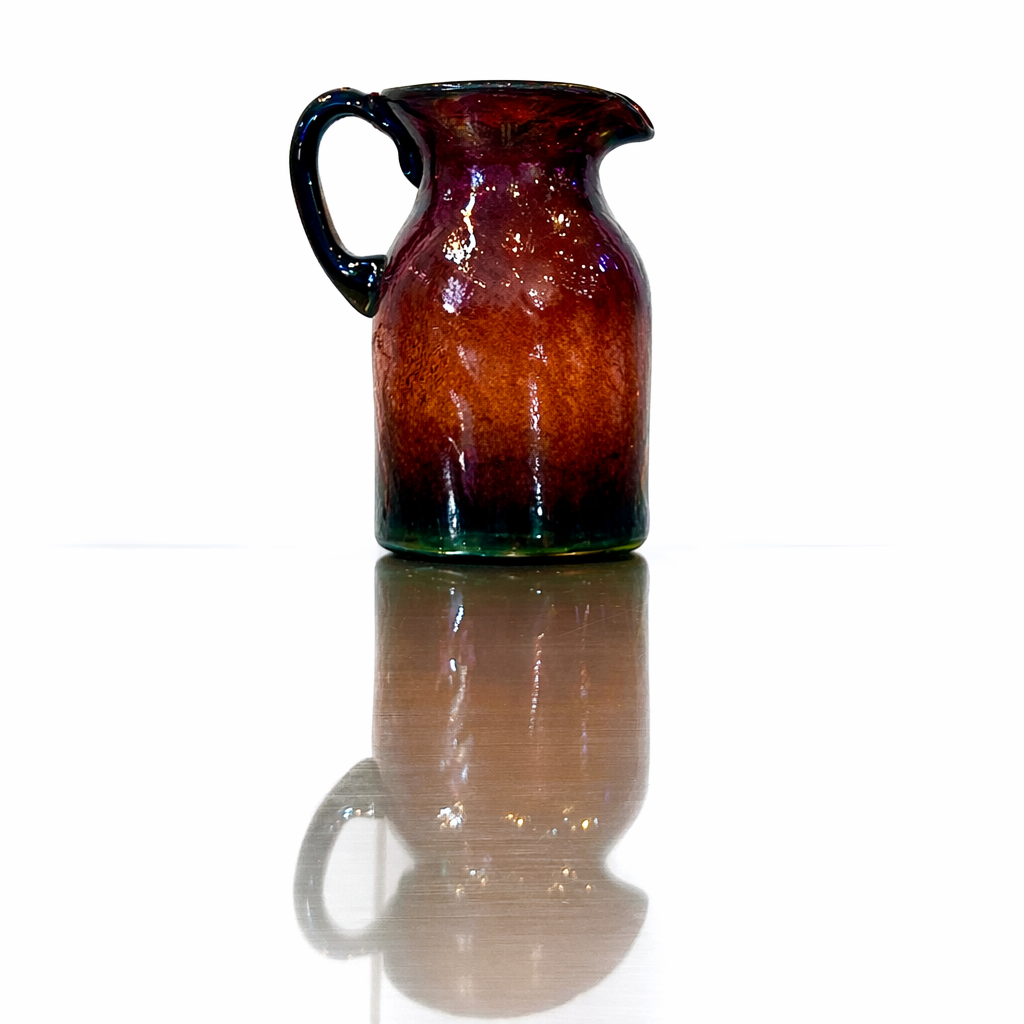
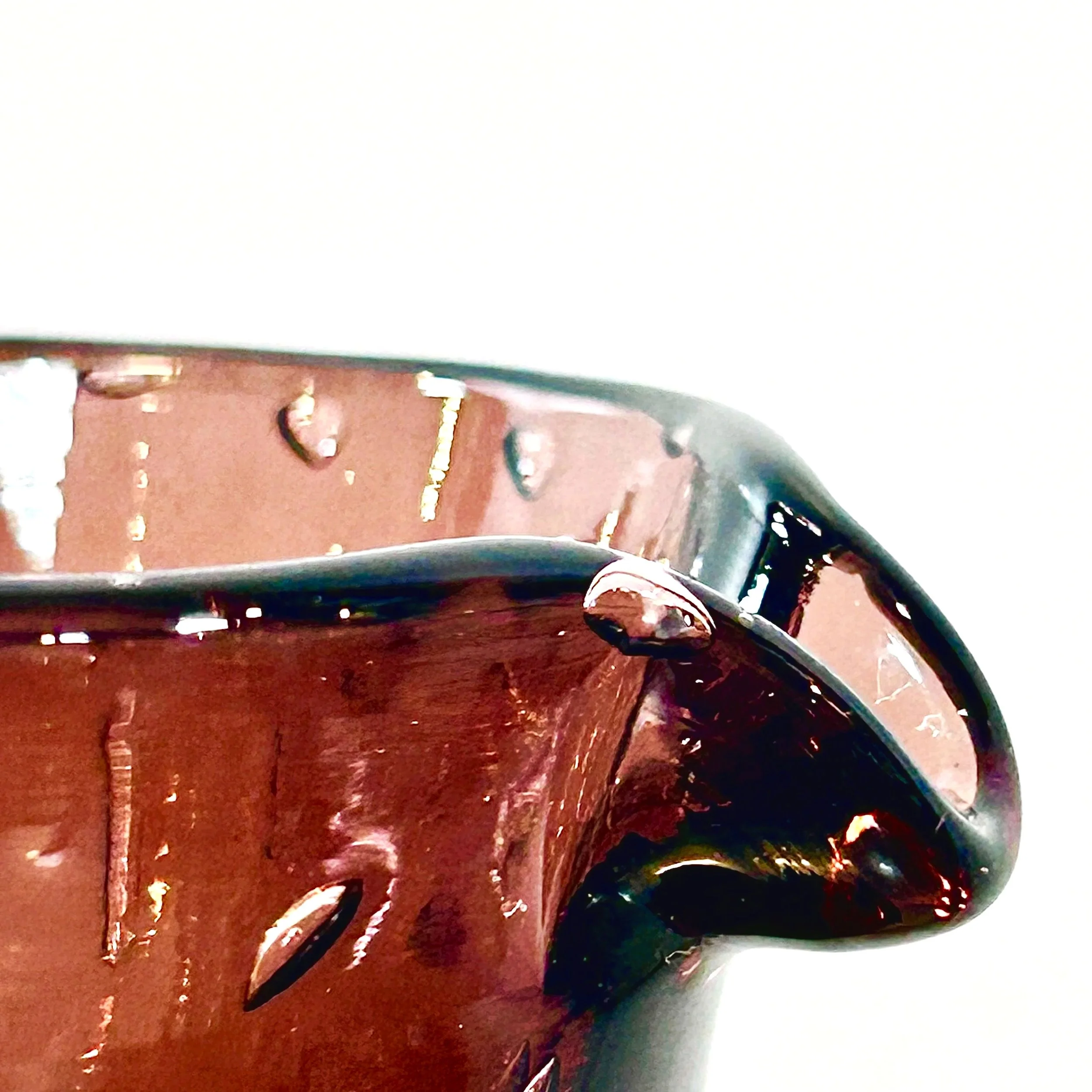
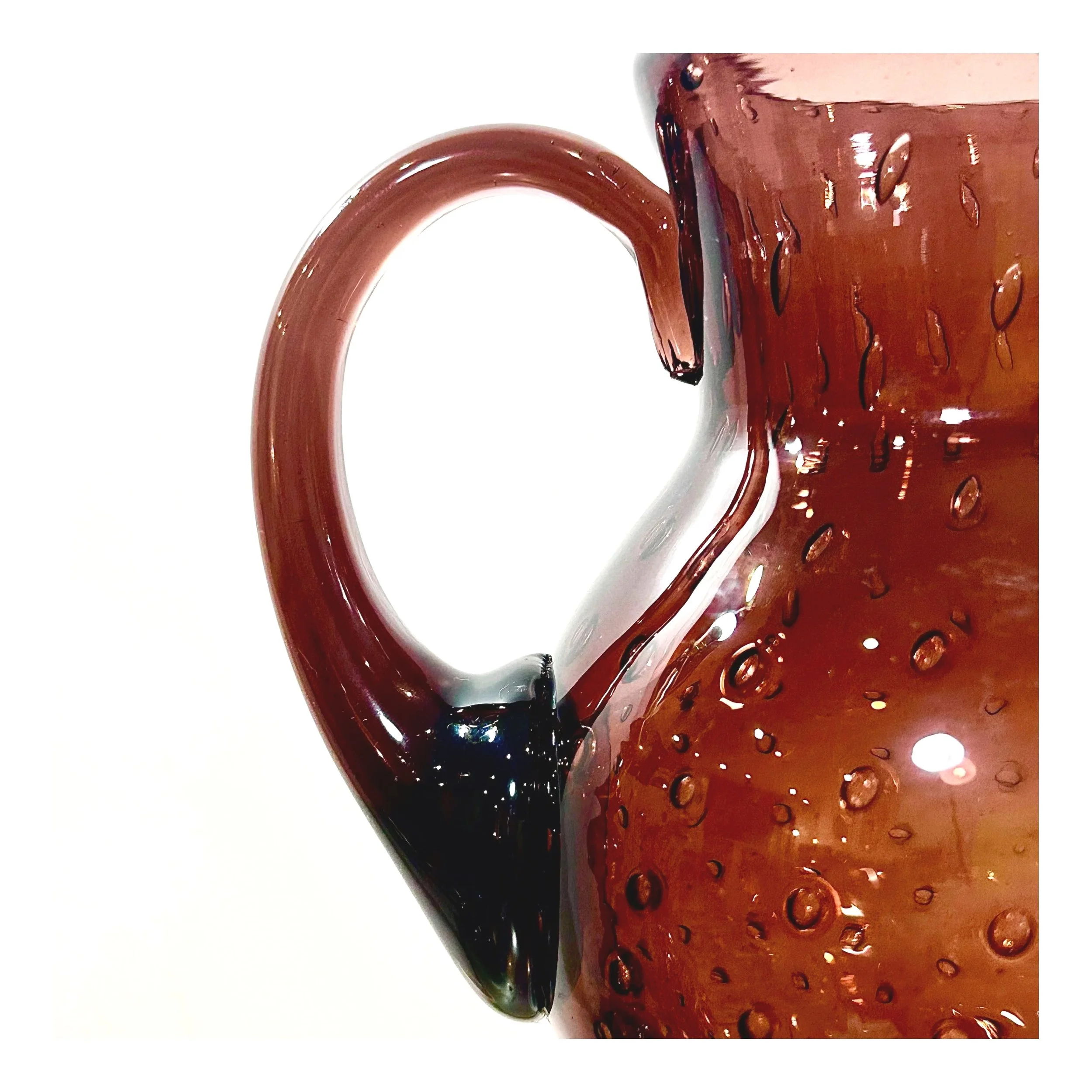
This hand-blown studio pitcher is a compelling transition piece, bridging the structural restraint of late Art Deco with the organic fluidity of Mid-Century Modernism. Executed in a deeply saturated amethyst-to-wine palette with cranberry undertones, the vessel is defined by a dense internal crackle—an intentional "iced" technique where the molten gather is plunged into water to create a light-refractive network of internal fissures. The form is anchored by a faintly green-tinted base and finished with a robust applied handle and a dramatic, flared pouring lip.
Technical Analysis & Fluorescence
Substantial in hand (exceeding 3 lbs), the pitcher exhibits the material density prized in mid-century American and European art glass. Under 365nm UV illumination, the glass reveals a subtle yellow-green fluorescence within the amethyst matrix. This reaction is a definitive marker of historic glass batch chemistry, typically indicating the presence of manganese used as a clarifying agent to achieve the purity of the violet-wine tones.
Attribution & Period
Central European / Bohemian-style decorative art glass, Circa 1935–1955
Attribution is based on construction and finishing: raw/sheared pontil, blocky applied handle join, rolled fire-polished rim, and heavy export-style decorative form. No maker mark observed.
Dimensions & Weight
Height: 7 1/8 in.
Max width (spout to handle): 6 in.
Opening diameter: 4 3/4 in.
Base diameter: 5 in.
Base thickness: 1 in.
Pontil (underside) diameter: approx. 1 in.
Weight: 3.212 lbs
Condition & Curation
The piece remains in very good decorative condition, though it features a stable hairline crack through the lower quadrant that seamlessly integrates with the intentional crackle pattern, alongside a raw pontil scar and light surface wear consistent with its hand-blown studio origins; consequently, it is best curated as a sculptural display object rather than a functional pouring vessel. Particularly effective under directional light where the crackle network becomes luminous. Pairs well with lacquer, chrome, burl, and stone—clean-lined interiors that benefit from one saturated, jewel-toned focal object.
Authenticity & Construction
Hand-blown crackle art glass with applied handle and rolled, fire-polished rim. The crackle pattern is created through thermal shock (rapid cooling followed by reheating), producing the internal crackle network that magnifies light and color depth. The observed subtle yellow-green UV fluorescence at 365nm is consistent with certain historic glassmaking additives (often manganese).
STANDARD ATTRIBUTION & VALUE DISCLOSURE; This piece is described to the best of current scholarly and market knowledge. Any maker or regional attribution is based on visual analysis, materials, construction techniques, and documented stylistic comparisons. As with many vintage and antique glass objects, definitive attribution may not be possible without original labels or factory records. Pricing reflects condition, quality, decorative appeal, and current collector demand rather than a guaranteed maker identification.
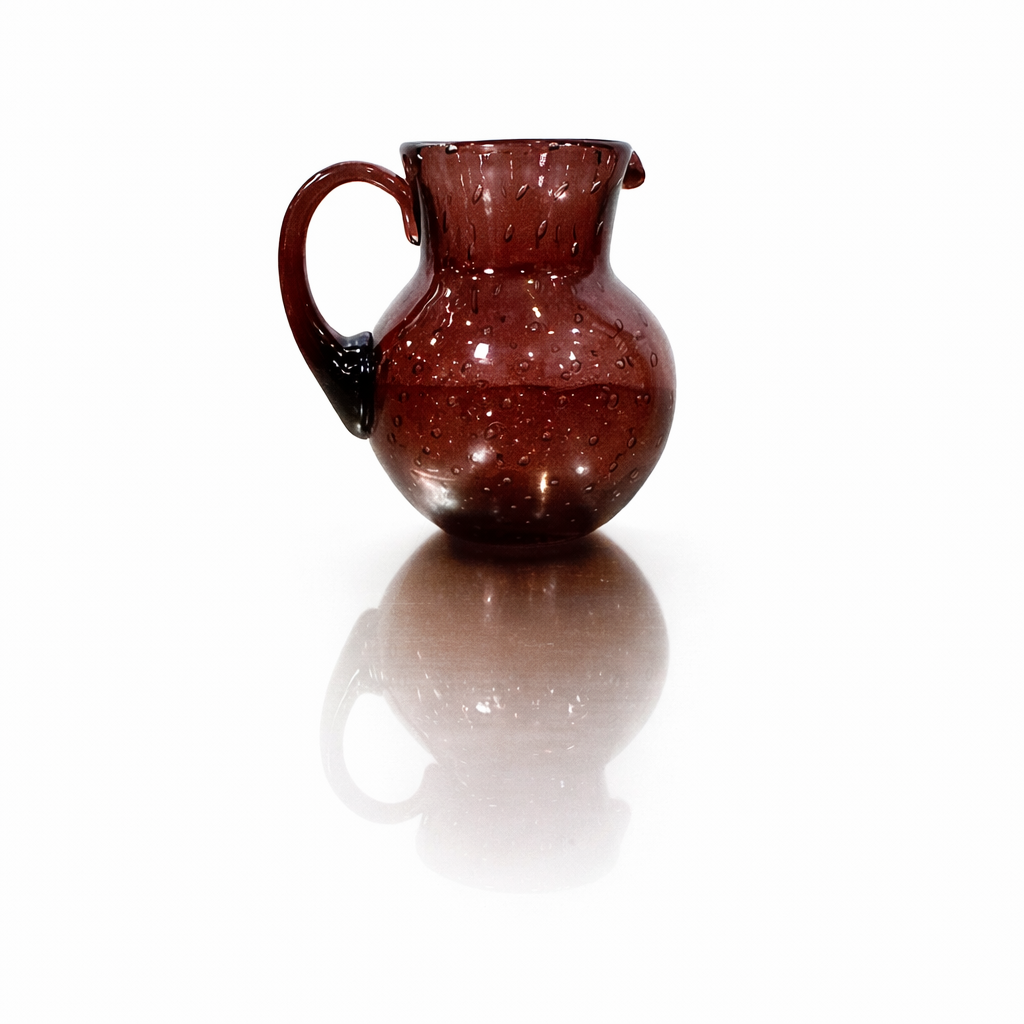
This artisanal glass jug commands attention with its substantial presence and distinctive pulegoso technique, which infuses the deep amethyst glass with a dense, frothy pattern of micro-bubbles. This texture captures light and creates a compelling visual depth, contrasted by a smoothly applied clear glass strap handle and a precisely pinched pouring spout. Adding to its complexity, the glass composition includes manganese or uranium-based agents, which allow it to emit a surprising and vivid green glow under 365nm UV light, revealing a hidden, scientific aspect to its beauty.
Attribution & Period
Consistent with Murano, Italy, 1960s
The execution of the pulegoso texture, combined with the heavy amethyst coloration and the traditional handle design, is highly characteristic of mid-century Venetian production. The specific combination of techniques and the manganese content (indicated by the UV reactive green glow) are stylistically aligned with a period of material experimentation on Murano in the 1960s. The dense, irregular bubbles distinguish it from standard controlled-bubble patterns, instead creating a foam-like appearance typical of pulegoso.
Dimensions & Weight
Height: 5 9/16 inches
Width / Diameter (Widest Point): 5 inches
Depth / Base Diameter: 2 1/2 inches
Opening Diameter: 2 1/4 inches
Weight: 1.78 lbs
Condition
Excellent antique condition. The jug is incredibly well-preserved, with no observed cracks, chips, or surface scratches to the purple or clear glass. Its considerable weight for the size confirms its high material quality. The base shows a prominent, rough pontil scar, about 3/4 of an inch in diameter, which is a desirable characteristic of true hand-blown artisanal glass.
Authenticity & Construction
Hand-blown in Murano, Italy, this jug utilizes the pulegoso technique, achieved by introducing a substance that releases gas into the molten gather just before molding. This complex process requires precise temperature control to trap the bubbles rather than let them escape. The clear handle was added while still molten and attached by hand. The base features a prominent, unpolished pontil mark where the blowpipe was detached, left raw to prove its hand-fabricated origins.
Placement
This jug should be placed on a surface where its texture can be fully appreciated—perhaps on a travertine vanity or on a floating shelf where natural light can activate its dense bubbles. It serves as an elegant standalone sculptural element and, for collectors of unusual glass, can be paired with a UV light source to showcase its rare and dramatic fluorescence, offering a conversation-starting dynamic feature to any room.
STANDARD ATTRIBUTION & VALUE DISCLOSURE; This piece is described to the best of current scholarly and market knowledge. Any maker or regional attribution is based on visual analysis, materials, construction techniques, and documented stylistic comparisons. As with many MCM and antique design objects, definitive attribution may not be possible without original labels or factory records. Pricing reflects condition, quality, decorative appeal, and current collector demand rather than guaranteed maker identification.
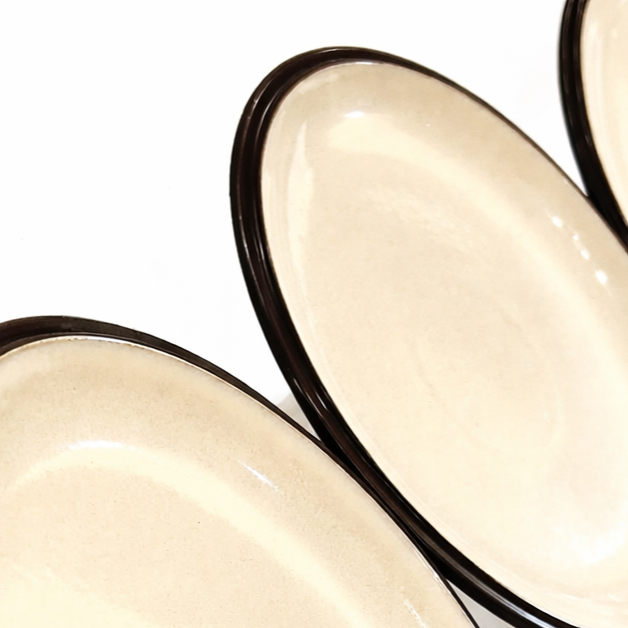
This curated six-piece collection of stoneware showcases an exceptionally tactile, sculptural presence that elevates the modern dining landscape into a decorative art form. Grounded by a rich, cream-toned surface and punctuated with organic iron-spotted speckling, each plate interacts beautifully with light, catching soft reflections across its satin-glazed plane. The defining element is the broad, expressively hand-finished rim detailing, which frames each piece with a dense, variegated iron-brown border that emphasizes its robust, architectural silhouette. These pieces function as compelling decorative accents when stacked or arranged, lending an earthy, grounded warmth to sophisticated interiors.
Attribution & Period
By J&G Meakin: This set is explicitly marked by the historic British manufacture J&G Meakin as part of their celebrated "LifeStyle" studio line, produced in England during the 1970s. The collection perfectly captures the era’s shift toward Brutalist, craft-led aesthetics, incorporating intentional speckling and iron-rich rim treatments meant to emulate studio pottery while utilizing advanced, durable manufacturing methods. Original factory stamps can be observed on the undersides as documented in image_9.png and image_10.png, cementing their design lineage.
Dimensions & Weight
Dinner Plates (Set of 2):
Height: 1.0 in (2.5 cm)
Width / Diameter: 9.75 in (24.8 cm)
Depth / Base Diameter: 6.5 in (16.5 cm)
Weight: 1.424 lbs (0.65 kg) each
Side Plates (Set of 4):
Height: 0.75 in (1.9 cm)
Width / Diameter: 6.5 in (16.5 cm)
Depth / Base Diameter: 4.25 in (10.8 cm)
Weight: 0.474 lbs (0.21 kg) each
Condition
Excellent original vintage condition. No chips, cracks, or professional restorations are present across any of the six pieces. Minor factory-inherent glaze variations, iron-spot clustering, and negligible surface micro-scratches consistent with light decorative display and age can be noted upon close inspection. Base rims show minor shelf wear.
Authenticity & Construction
Each piece in this collection is constructed from high-grade, durable English ceramic, explicitly engineered for both aesthetic longevity and thermal resilience. The iron-speckled glaze formulation reacts dynamically during the kiln firing, ensuring that while the forms maintain geometric consistency, the distribution of the mineral flecks and the textured browning of the rims remain entirely unique to each plate. This deliberate synthesis of industrial precision and organic randomness represents a key material achievement of late mid-century British ceramic production.
Placement
These plates offer striking interior-designer appeal, presenting beautifully when displayed vertically on an étagère or nested as a textured vignette on an open kitchen shelf. They are perfectly suited to ground minimalist, Scandinavian, or Wabi-Sabi-inspired environments, providing a rich, materially compelling counterpoint to sleek marble countertops or raw timber surfaces.
STANDARD ATTRIBUTION & VALUE DISCLOSURE: This piece is described to the best of current scholarly and market knowledge. Any maker or regional attribution is based on visual analysis, materials, construction techniques, and documented stylistic comparisons. As with many MCM and antique design objects, definitive attribution may not be possible without original labels or factory records. Pricing reflects condition, quality, decorative appeal, and current collector demand rather than guaranteed maker identification.