
The Signiture Gallery
This curated collection showcases a premier selection of hand-signed glassworks from the world’s most esteemed artisans.
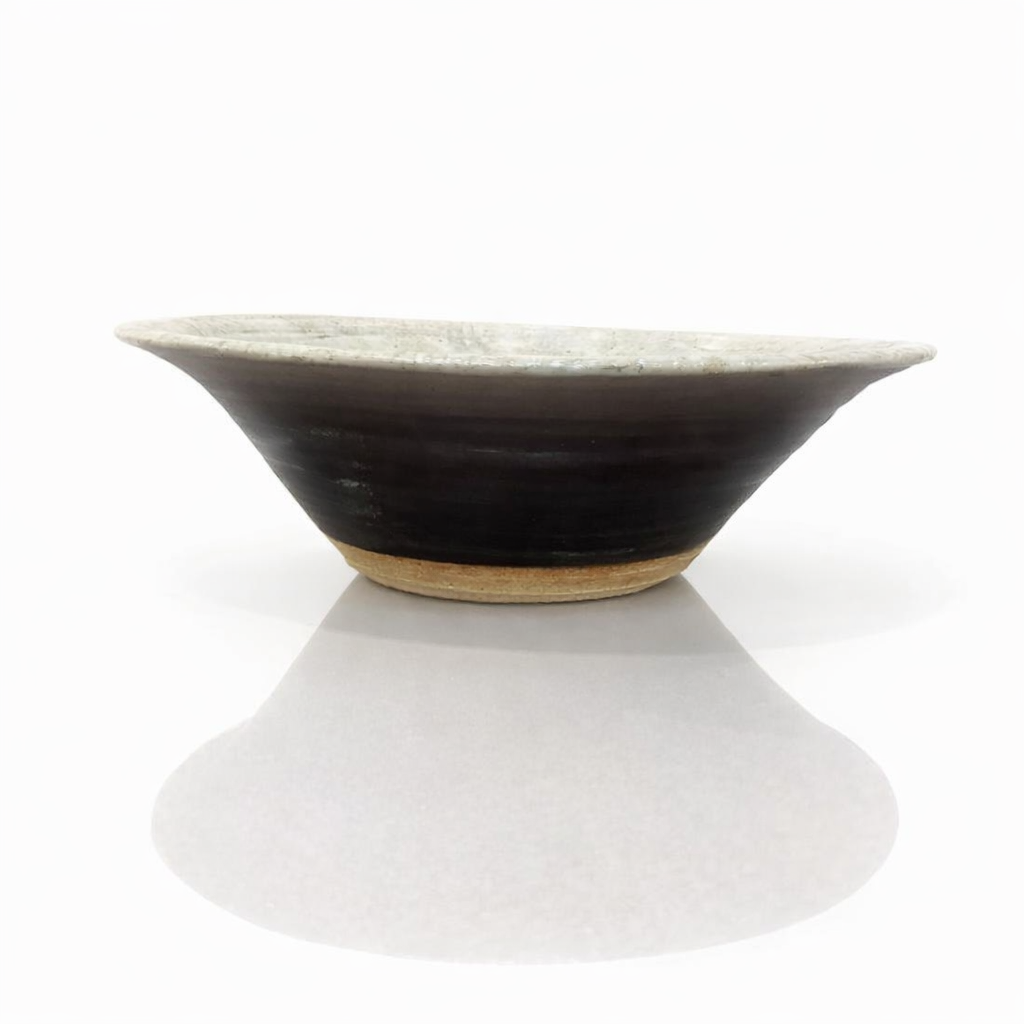
Monumental hand-thrown studio stoneware bowl of commanding scale and refined restraint, executed in a Japanese-influenced ash-glaze tradition. The form is broad and architectural, with a wide flared rim and shallow grounded profile that gives the piece quiet authority and sculptural balance.
The interior is finished in a pale, milky ash-style glaze layered with visible throwing rings, natural speckling, and soft pooling toward the well. The surface carries depth and tonal movement characteristic of high-temperature firing. The exterior transitions into warm iron-brown reduction tones, revealing kiln atmosphere variation and controlled firing mastery
The unglazed foot exposes the clay body and firing marks. A small impressed spiral near the base reads as a studio trimming or maker’s mark rather than a commercial stamp, reinforcing handmade origin. Pencil notations to the underside are consistent with studio inventory markings and are not later additions.
Attribution & Period
While unattributed, the scale, glaze chemistry, and disciplined form strongly align with late 20th-century Western studio pottery influenced by Japanese mingei and ash-glaze traditions. The restraint, surface behavior, and confident proportions indicate an experienced studio hand rather than hobby production.
Late 20th century, likely 1970s–1990s, within the Western studio pottery movement informed by Japanese aesthetics.
Dimensions & Weight
Mouth diameter: 13 in
Depth: 4 in
Base diameter: 5 in
Condition
Very good studio condition. No cracks, repairs, or structural issues observed. Minor glaze variation, kiln marks, and surface irregularities are inherent to high-fire studio production and integral to the aesthetic.
Authenticity & Construction
This is high-fired studio stoneware rooted in Japanese-influenced ash-glaze practice. It is not factory production or decorative mass-market pottery. Surface movement and firing variation confirm authentic studio origin.
Placement
A large-scale ceramic statement suited to gallery display, architectural interiors, wabi-sabi environments, or curated postwar studio collections. Equally compelling as a sculptural centerpiece or standalone vessel.
STANDARD ATTRIBUTION & VALUE DISCLOSURE; This piece is described to the best of current scholarly and market knowledge. Any maker or regional attribution is based on visual analysis, materials, construction techniques, and documented stylistic comparisons. As with many vintage and antique glass objects, definitive attribution may not be possible without original labels or factory records. Pricing reflects condition, quality, decorative appeal, and current collector demand rather than a guaranteed maker identification.
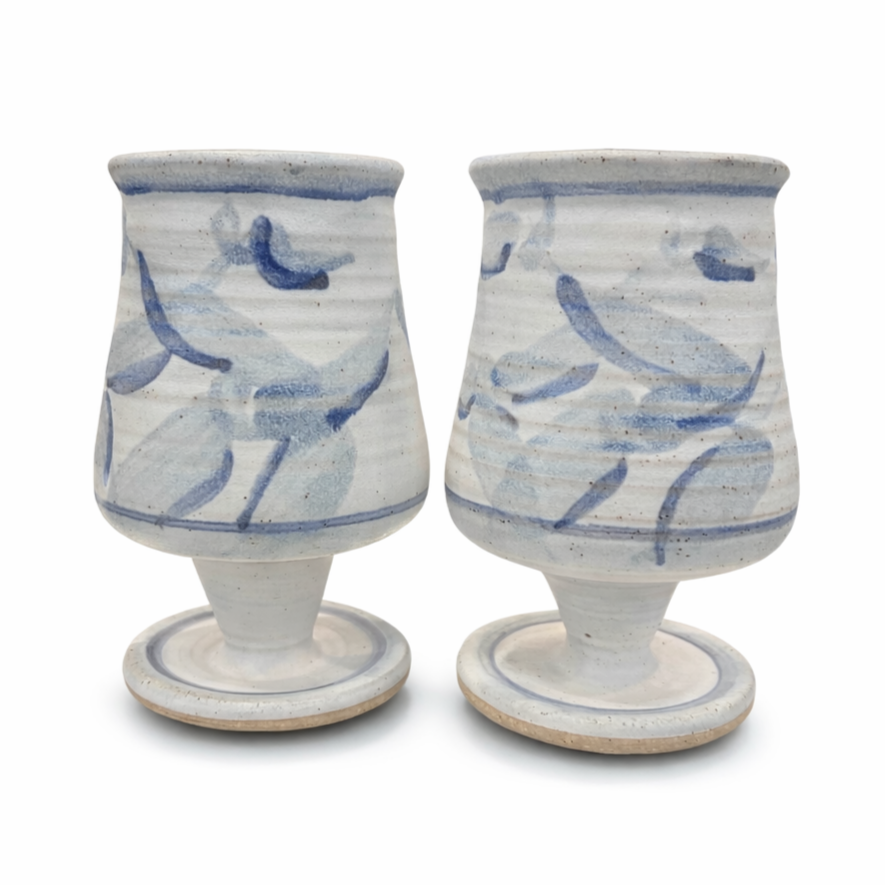
This matched pair of wheel-thrown stoneware goblets presents a compelling sculptural presence through balanced proportion and kinetic decoration. Each piece features a rounded, tactile bowl that tapers to a slender stem and a substantial pedestal foot. The ceramic surfaces are animated by hand-applied cobalt and pale blue glaze brushwork over a warm, lightly speckled stoneware ground, exhibiting a level of expressive yet disciplined execution characteristic of late 20th-century studio practice. The throwing rings are subtly integrated into the design, providing a rhythmic texture and ensuring a unique, hand-worked variation between the two forms.
Attribution & Period by Jane Snider1980s This pair is a confirmed example of the mature studio work of documented Canadian ceramic artist Jane Snider. Both goblets bear the clear, hand-incised signature "Snider" on the base, complete with central firing holes typical of studio kiln practice. The aesthetic—specifically the cobalt oxide brushwork and the functional-sculptural form—is stylistically aligned with known Snider productions from the 1980s, a period marked by increasing sophistication in Canadian studio ceramics.
Dimensions & Weight
Height: 5 inches Width / Diameter: 2 3/4 inches (Rim) Depth / Base Diameter: 2 3/4 inches (Base) Weight: 0.6 lbs (each)
Condition Excellent collector condition. Both goblets are structurally sound with no chips, cracks, or evidence of repair. Subtle, even surface wear is noted on the raised ridges of the cobalt decoration, consistent with age and gentle handling of functional studio ware. This minimal wear is honest and serves as a marker of authenticity.
Authenticity & Construction A matched pair, wheel-thrown in a high-fire stoneware body. The decorative program was achieved through direct overglaze brushwork using cobalt and a pale-blue wash, a technique requiring significant confidence as it does not allow for correction. The forms were fired in a reduction kiln, which accounts for the warm speckling in the clay body and the deep saturation of the cobalt.
Placement An ideal selection for a Scandinavian-influenced modern interior or as a centerpiece within a curated collection of North American studio pottery. Their functional nature and sculptural silhouette make them equally suited for use during an intimate gathering or for vertical display in a lit vitrine.
STANDARD ATTRIBUTION & VALUE DISCLOSURE This piece is described to the best of current scholarly and market knowledge. Any maker or regional attribution is based on visual analysis, materials, construction techniques, and documented stylistic comparisons. As with many MCM and antique design objects, definitive attribution may not be possible without original labels or factory records. Pricing reflects condition, quality, decorative appeal, and current collector demand rather than guaranteed maker identification.
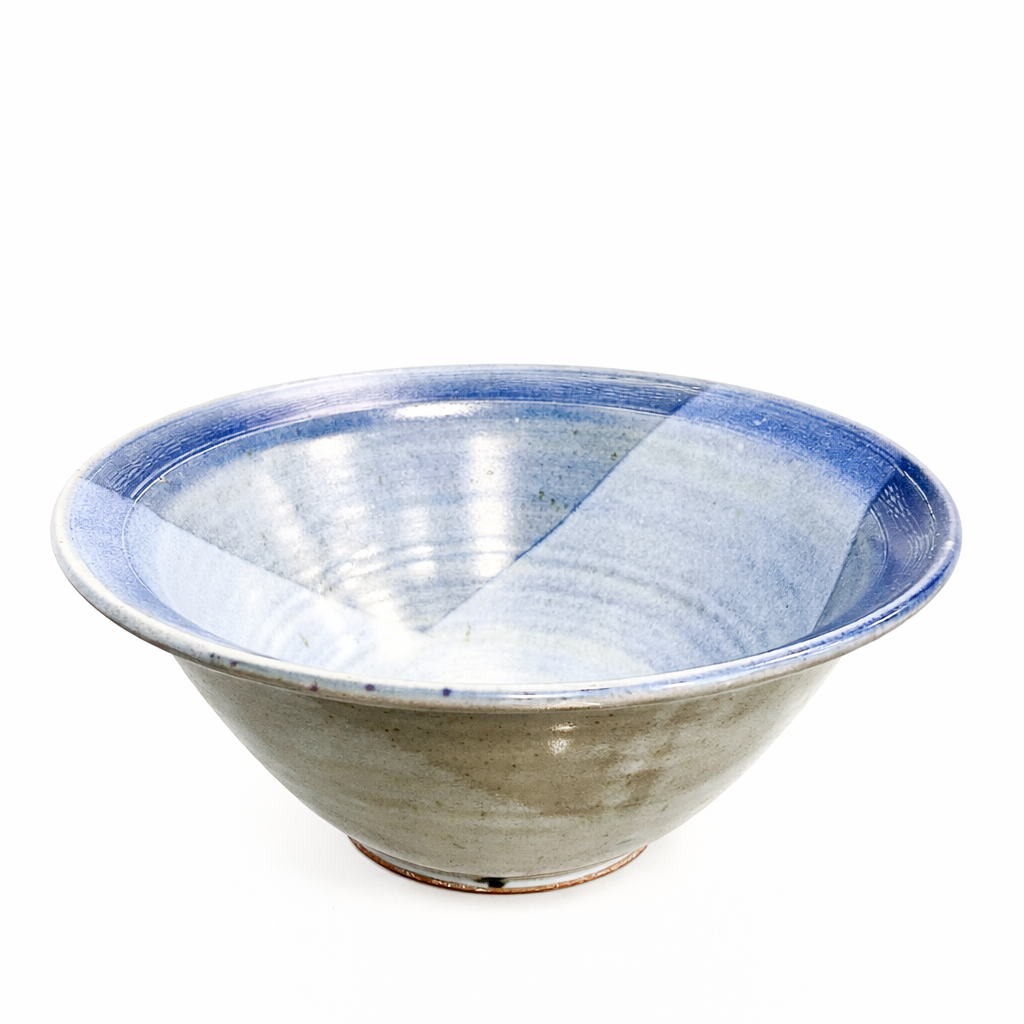
A substantial hand-thrown studio pottery bowl with a wide, gently flared form and classic wheel-thrown rings visible insidean immediate sign of studio production rather than factory ware.
The glaze is a cool, misty blue with deeper cobalt pooling at the rim, showing natural variation from the firing and the potters application. The exterior has a stoneware body with subtle speckling and a warm, exposed foot ring typical of wheel-thrown work.
Authenticity & Construction
Signature / mark (important for collectors) The underside shows an incised leaf (maple-like) motif as the makers mark. This is a true signature style mark (cut into the clay before firing), consistent with studio potters who used personal chops or carved symbols rather than printed stamps. Likely material & technique Hand-thrown stoneware (wheel-thrown; visible throwing lines) Glazed interior with a darker brushed/pooled rim band Unglazed foot ring with kiln-fired clay tone
Attribution & Period
Possible origin & dating (best-supported, without overclaiming) Based on the studio-pottery form, incised emblem mark, and blue glaze aesthetic, this bowl fits well with North American studio pottery trends that were especially popular from the mid-20th century into the late 20th century (c. 1960s1990s).
The carved leaf mark strongly suggests a potter working in a region where a leaf emblem would be meaningful (often seen with Canadian or North American makers), but without a readable name stamp, the exact maker and town can’t be stated with certainty.
Dimensions & Weight
Height: 5 1/4 in
Mouth diameter: 12 in
Base diameter: 4 1/2 in
Condition
Appears very good vintage condition from photos: no obvious cracks or repairs seen. Minor surface speckling/marks consistent with normal studio kiln firing and age. No chips, no hairlines, no repairs
Placement
Why collectors want it Large, display-worthy scale (12 mouth) Sculptural modern form suitable for MCM / minimalist interiors Artist mark (incised emblem) + handmade character from wheel-throwing and glaze variation
STANDARD ATTRIBUTION & VALUE DISCLOSURE
This piece is described to the best of current scholarly and market knowledge. Any maker or regional attribution is based on visual analysis, materials, construction techniques, and documented stylistic comparisons. As with many vintage and antique glass objects, definitive attribution may not be possible without original labels or factory records. Pricing reflects condition, quality, decorative appeal, and current collector demand rather than a guaranteed maker identification.
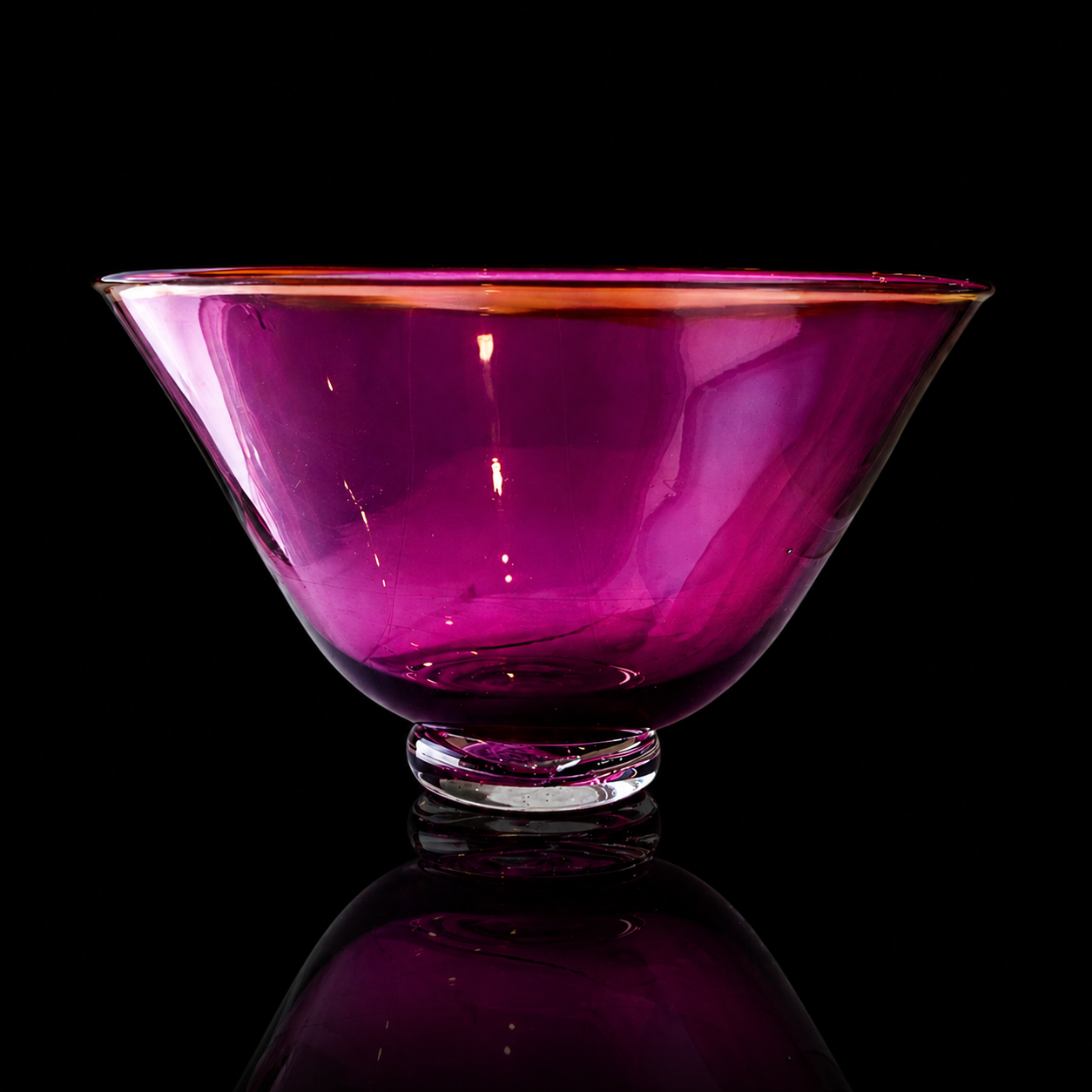
This commanding hand-blown vessel is a definitive expression of Finnish modernist glass artistry, featuring a deeply saturated cranberry core that radiates into a luminous amber rim. The architectural, wide-flaring silhouette is elevated by an intentional field of controlled internal air inclusions (bullicante), creating a rhythmic optical play that captures and refracts light. Its substantial mass and sophisticated tonal transitions from magenta-toned cranberry to golden amber reflect the peak of the Scandinavian studio glass movement.
Attribution & Period
The base features a professionally engraved presentation signature and date: "S. Kiitos 69." The "S" prefix denotes Suomi (Finland), while "Kiitos" identifies the piece as a bespoke commemorative or diplomatic gift commissioned from a premier Finnish glassworks—likely Riihimäki or Kumela—during the 1969 revival of experimental studio techniques. The elongated, stylized script is the hallmark of a master factory engraver.
Material & Fluorescence
The glass composition utilizes traditional 1960s mineral oxides, confirmed by a dual-spectrum UV reaction. Under 365nm light, the amber transitions exhibit a characteristic manganese-yellow glow, while the cranberry core reveals a vibrant cadmium-orange fluorescence, authenticating the piece’s mid-century chemical "recipe" and high-quality mineral content.
Condition & Construction
Condition: Excellent. The glass remains brilliantly clear with a high-polished luster. The base shows age-appropriate shelf contact consistent with its five-decade history as a curated object.
Base: Expertly ground and perfectly smooth polished pontil, a finish reserved for the highest grade of Finnish art glass production.
Technique: Multi-layered Sommerso gather with precisely introduced air-suspension.
Dimensions & Weight
Height: 5 1/8 inches
Mouth Diameter: 8 1/2 inches
Weight: 1.674 lbs
Presence: A substantial, balanced sculptural object with significant visual weight.
Placement
This vessel functions as a high-impact architectural centerpiece. It is ideally suited for a minimalist gallery pedestal or a mid-century teak sideboard, where backlighting can fully activate the internal bubble structure and the glowing cranberry-to-amber gradient.
STANDARD ATTRIBUTION & VALUE DISCLOSURE; This piece is described to the best of current scholarly and market knowledge. Any maker or regional attribution is based on visual analysis, materials, construction techniques, and documented stylistic comparisons. As with many vintage and antique glass objects, definitive attribution may not be possible without original labels or factory records. Pricing reflects condition, quality, decorative appeal, and current collector demand rather than a guaranteed maker identification.
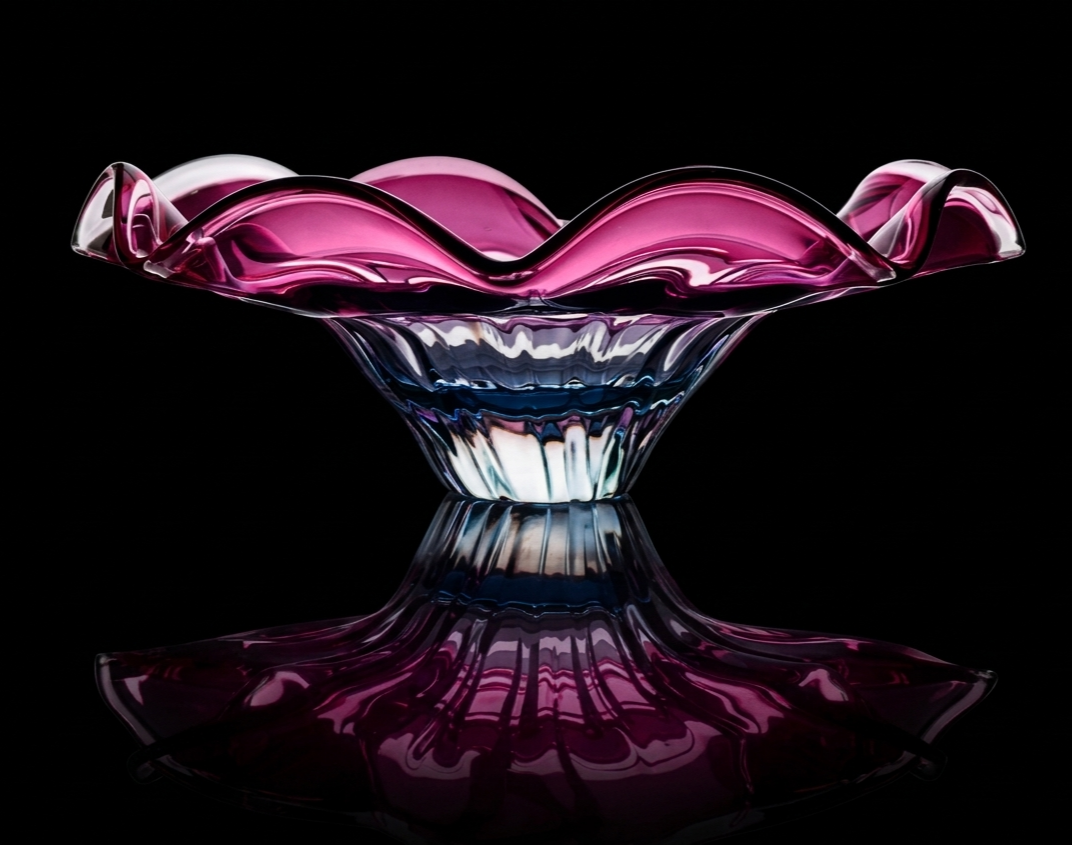
A commanding Murano glass centerpiece of architectural presence and saturated chromatic depth, executed in the Sommerso technique and signed Guarnieri. The form rises from a compact pedestal into a dramatic, undulating rim—each lobe extending five inches outward—creating a silhouette that reads as sculptural rather than functional.
The color transition is deliberate and masterful: a dense sapphire-blue core submerged beneath radiant fuchsia and crystalline casing, producing optical movement and refracted light at every angle. At 15.5 inches in diameter, this is a statement-scale Venetian work designed for visual impact in serious interiors.
Attribution & Period
Late 20th Century, 1980s The piece is signed by Guarnieri, an attribution confirmed by the diamond-point etched signature on the polished base. The Guarnieri workshop, active during the prolific post-war Venetian glass revival, is noted for a confident application of the Sommerso method. This specific work is stylistically aligned with the 1980s preference for "statement-scale" glass, moving away from mid-century minimalism toward more rhythmic, hand-manipulated organic forms that prioritize visual impact over traditional utility.
Dimensions & Weight
Diameter: 15.5 inches
Height: 6 inches
Each lobe projection: 5 inches
Base Diameter: 3 inches
Weight: Substantial, heavy-bodied sculptural glass
Condition
The object is in very good condition. Clinical inspection reveals light surface scratches to the underside of the base, consistent with appropriate shelf wear and the piece's significant weight. No cracks, chips, or structural repairs are observed. The internal color layers and the scalloped rim edges remain clean, crisp, and free of inclusions.
Authenticity & Construction
This work was executed on the island of Murano using the traditional Sommerso (submerged) technique, where a dense sapphire-blue core was dipped into molten fuchsia glass before being encased in a heavy layer of clear crystal. The piece was free-blown and then hand-manipulated at the furnace to achieve the rhythmic, five-lobed expansion. The polished pontil and the hand-etched studio signature distinguish this as a high-end artisanal production rather than a commercial mold-pressed object.
Placement
This work was executed on the island of Murano using the traditional Sommerso (submerged) technique, where a dense sapphire-blue core was dipped into molten fuchsia glass before being encased in a heavy layer of clear crystal. The piece was free-blown and then hand-manipulated at the furnace to achieve the rhythmic, five-lobed expansion. The polished pontil and the hand-etched studio signature distinguish this as a high-end artisanal production rather than a commercial mold-pressed object.
STANDARD ATTRIBUTION & VALUE DISCLOSURE
This piece is described to the best of current scholarly and market knowledge. Any maker or regional attribution is based on visual analysis, materials, construction techniques, and documented stylistic comparisons. As with many vintage and antique glass objects, definitive attribution may not be possible without original labels or factory records. Pricing reflects condition, quality, decorative appeal, and current collector demand rather than a guaranteed maker identification.
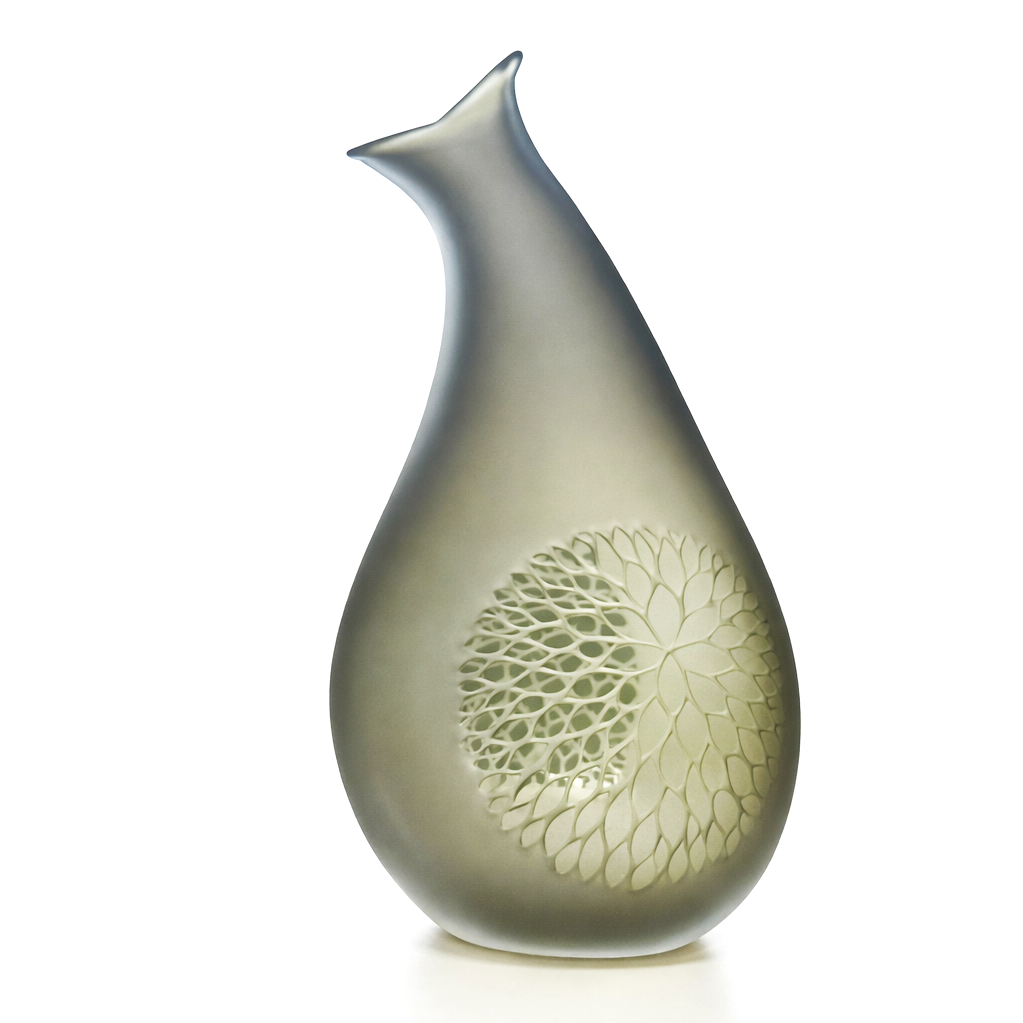
A sculptural, hand-blown studio art glass vase signed June Pham to the base, executed in an elegant fish-form silhouette with a softly articulated lip rim reminiscent of a fish’s mouth. The form is tall, tapered, and subtly asymmetrical, giving the piece a poised, forward-moving presence that reads as both organic and architectural. The body is finished in a refined smoke-to-charcoal palette with a satin, misted surface, contrasted by a deeply worked carved medallion featuring an intricate botanical lattice motif. This carved cameo-style window reveals layered glass beneath, creating depth, translucency, and tactile relief; hallmarks of high-quality contemporary studio glass. The carving is deliberate and controlled, with crisp edges and excellent dimensional balance. This piece bridges minimalist modern design and organic studio craftsmanship, making it well suited for collectors of contemporary glass, sculptural vessels, and statement objects.
Attribution
It displays beautifully as a standalone work on a pedestal, console, or curated shelf, and holds visual interest from every angle. The signature “June Pham” is clearly visible on the underside, confirming artist attribution. Signed works by June Pham appear in the secondary art market, and this example aligns stylistically with known studio glass forms attributed to the artist. Late 20th to early 21st century.
Dimensions
Height: 13 inches
Width: 9 inches
Base: 4 x 2 inches
Weight: 4.512 pounds
Condition
Very good condition. Light surface wear and handling marks visible in close-up photographs, primarily to the base, consistent with age and studio glass production. No cracks or structural damage observed. Please review all photographs carefully, as they form part of the description.
Placement
Style Contemporary; Studio Glass; Organic Modern; Sculptural; Minimalist
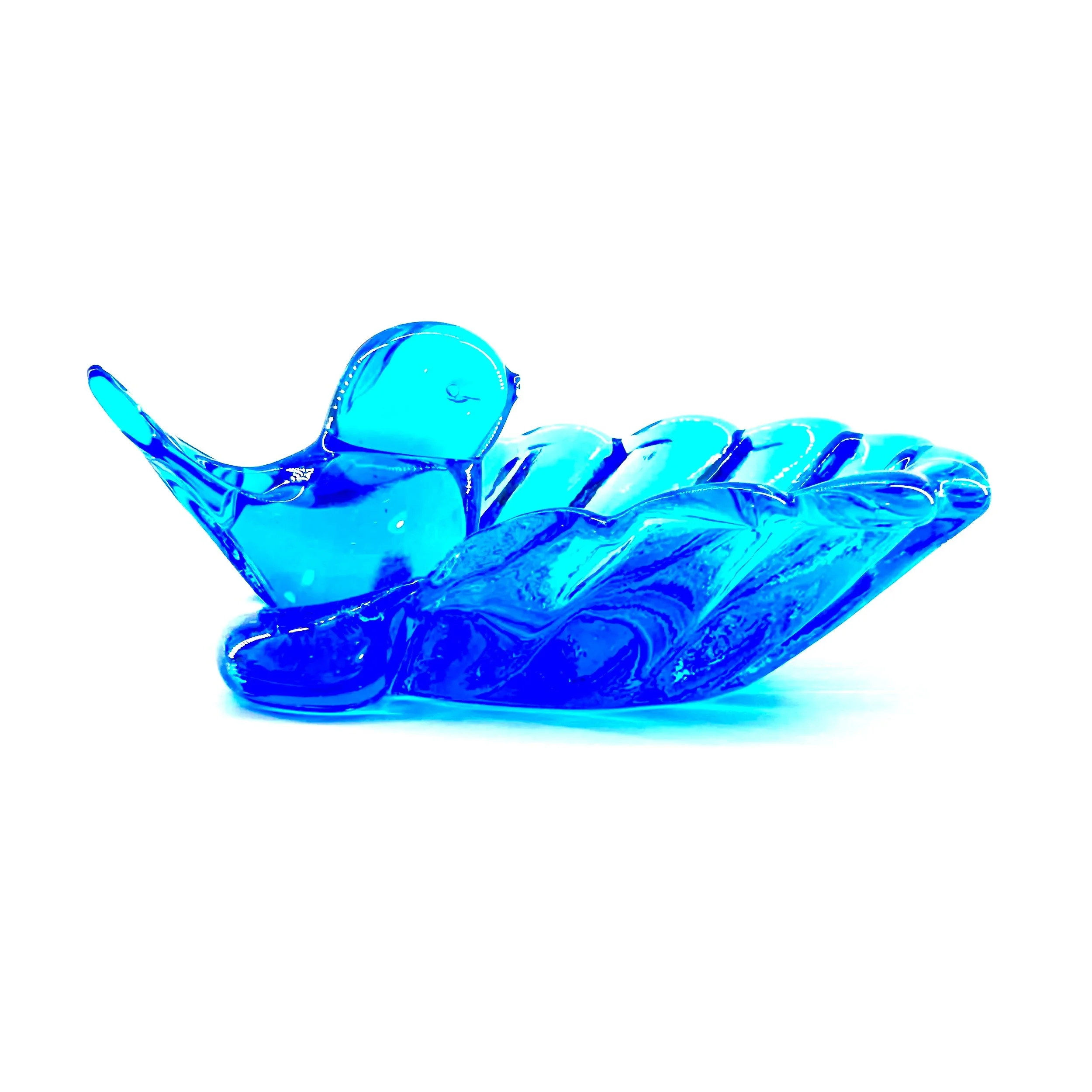
This striking sculptural dish in saturated cobalt blue features a hand-formed bird perched upon a fluid, fluted shell form. The piece exhibits exceptional light interaction, with the thick-walled glass radiating a deep luminosity that shifts with the surrounding environment. Under 365nm UV light, the glass displays a distinctive green-blue fluorescence, a hidden characteristic that adds a layer of intrigue for the discerning collector. Its organic silhouette and masterfully worked edges make it a compelling decorative statement for any refined interior.
Attribution & Period
By Gene Cuker, dated 1991. The piece is hand-signed and dated on the underside. The attribution is based on the signature "G. Cuker" and stylistic alignment with American studio art glass of the 1990s, which frequently explored zoomorphic forms and vibrant, monochromatic color palettes.
Dimensions & Weight
Height: 2.25 in
Width / Diameter: 5.5 in
Depth / Base Diameter: 3.5 in
Weight: 0.674 lbs
Condition
This piece is in excellent condition, presenting with no chips, cracks, or professional repairs. The glass retains its original high-gloss finish throughout. Clinical observation reveals only negligible, age-appropriate surface scratches to the underside of the base where it makes contact with display surfaces; no other scratches or abrasions are observed on the sculptural body.
Authenticity & Construction
Hand-blown and furnace-worked from high-clarity cobalt glass. The signature and date are incised into the polished pontil area. The glass batch contains manganese, a clarifying agent that results in the vibrant green-blue reaction under 365nm ultraviolet light. This chemical fingerprint is characteristic of premium studio glass from this era, where the purity of color was paramount.
Placement
This piece is ideally suited for a sun-drenched console or a glass display shelf where its light-reactive properties can be fully appreciated. Its sculptural presence and rich color also make it an elegant choice for a modernist desk or as a focal point within a curated collection of late 20th-century decorative arts.
STANDARD ATTRIBUTION & VALUE DISCLOSURE; This piece is described to the best of current scholarly and market knowledge. Any maker or regional attribution is based on visual analysis, materials, construction techniques, and documented stylistic comparisons. As with many MCM and antique design objects, definitive attribution may not be possible without original labels or factory records. Pricing reflects condition, quality, decorative appeal, and current collector demand rather than guaranteed maker identification.
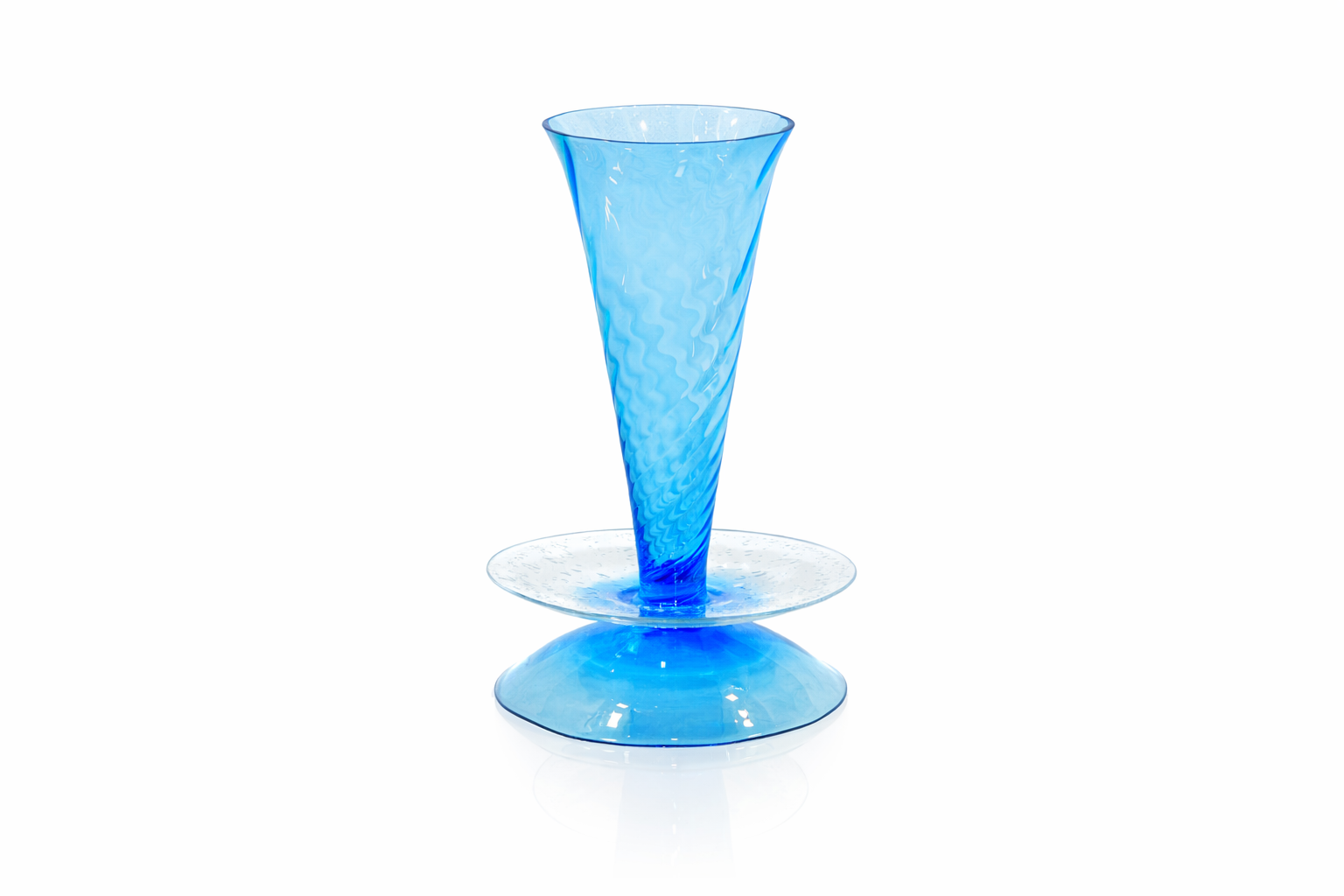
This rare art glass vase exhibits a mesmerizing sculptural presence, characterized by its luminous azure-to-clear gradient and sophisticated light interaction. The form is defined by a rhythmic, twisted optic ribbing that animates the conical body, while the wide, saucer-like mid-section features a dense field of controlled "bullicante" bubbles. Most remarkably, the glass possesses a hidden reactive quality, transitioning from a calm aquatic blue in daylight to a vibrant, electric neon green glow under 365nm UV light. This dual-nature makes it an exceptional conversation piece for high-end collectors who value both avant-garde form and rare material science.
Attribution & Period
by Oiva Toikka for Nuutajärvi Notsjö
This piece is hand-signed on the base "Oiva Toikka Nuutajärvi Notsjö," confirming its origin from Finland's most celebrated glassworks. The design language—specifically the playful use of geometry and the experimental addition of UV-reactive uranium or manganese components—stylistically aligns this work with Toikka's late-century studio experiments. Based on the signature style and the specific color palette, it is attributed to the 1980s.
History of the Artist
Oiva Toikka (1931–2019) was a titan of Finnish design and a "Nestor" of Nordic glass. While globally revered for his legendary Birds by Toikka collection (launched in 1972), he was an artist who famously sought to "break free from the functionalism" of traditional Scandinavian design. Working at Nuutajärvi, Finland’s oldest glassworks, Toikka was celebrated for his imaginative, bold, and often humorous approach. His work is held in the permanent collections of the Museum of Modern Art (MoMA) in New York and the Victoria and Albert Museum in London. This specific vase represents his "Pro Arte" spirit—where the boundaries between utility and pure sculpture are intentionally blurred.
Dimensions & Weight
Height: [Insert Height Here]
Width / Diameter: [Insert Width Here]
Depth / Base Diameter: [Insert Depth Here]
Weight: [Insert Weight Here]
Condition
The object is in impeccable condition. No chips, cracks, or fleabites are present on the flared rim or the delicate saucer edge. The base shows characteristic but minimal shelf wear, confirming its authentic age. The internal "bullicante" bubbles are perfectly suspended, and the UV reactivity is strong and consistent throughout the vessel.
Authenticity & Construction
A triumph of mouth-blown technical skill, this vase utilizes "uranium" glass properties to achieve its dramatic 365nm UV fluorescence. The construction involves a complex multi-part assembly: a ribbed conical vessel fused to a clear, bubble-inclusive disc, set upon a wide, stable domed base. The signature is diamond-point etched by hand, a standard practice for Toikka’s boutique and exhibition-grade pieces.
Placement
Given its dramatic transformation under blacklight, this piece is ideal for a modern interior with curated lighting. It serves as a sophisticated blue accent by day and a glowing neon sculpture by night, perfect for a glass-fronted display cabinet or an architecturally lit side table.
STANDARD ATTRIBUTION & VALUE DISCLOSURE This piece is described to the best of current scholarly and market knowledge. Any maker or regional attribution is based on visual analysis, materials, construction techniques, and documented stylistic comparisons. As with many MCM and antique design objects, definitive attribution may not be possible without original labels or factory records. Pricing reflects condition, quality, decorative appeal, and current collector demand rather than guaranteed maker identification.
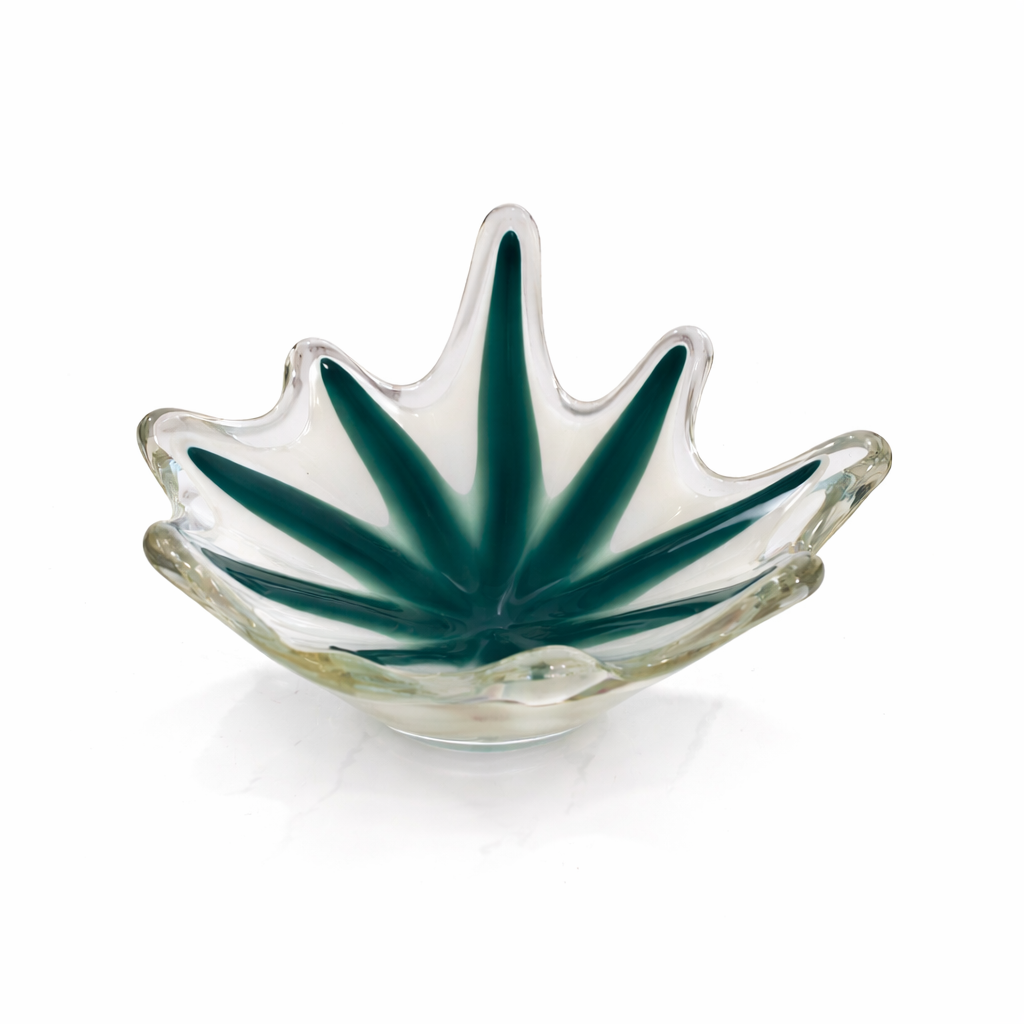
This striking mid-century centerpiece exemplifies the fluid, organic modernism that defined Swedish art glass in the 1950s. The piece features a dramatic "wing" profile, utilizing a complex cased-glass technique that creates an inner core of vibrant pigment suspended within a substantial layer of optical-grade clear glass. Its sculptural presence is amplified by its weight and scale, capturing and refracting light through its varying thicknesses and elegant, biomorphic curves.
Attribution & Period
by Paul Kedelv for Flygsfors
The piece is a definitive example of the "Coquille" series, designed by Paul Kedelv (1917–1990) for the Flygsfors glassworks in Sweden. The signature on the base is a documented factory mark for Flygsfors, dated 1956. Kedelv, who trained under the legendary Orrefors masters, launched the Coquille line in 1952; it remains his most celebrated work, characterized by these shell-like, pulled forms and the "Sommerso" style layering of colors.
Dimensions & Weight
Height: 5 1/2 inches
Width / Diameter: 11 1/4 inches
Depth / Base Diameter: 2 3/4 inches
Weight: 4.15 pounds
Condition
Excellent condition. The glass retains high clarity and luster. No chips, cracks, or significant fleabites are observed on the upper rim or body. The base exhibits light, age-appropriate shelf wear and faint surface scratches consistent with a 70-year-old decorative object. Minor internal bubbles (seeds) are present from the original hand-blowing process, typical of mid-century studio glass.
Authenticity & Construction
Hand-blown in Sweden using the cased glass technique. The artisan began with a core of colored glass, which was then dipped into clear molten glass and manipulated by hand using shears and jacks to pull the elongated "wings." The significant depth of clear glass at the base (3/4 inch) and edges (1/4 inch) is a hallmark of high-quality Flygsfors production, providing the necessary ballast and structural integrity for such a top-heavy, expressive form.
Placement
The sculptural silhouette and horizontal orientation make this an ideal centerpiece for a low-profile credenza, a mid-century teak dining table, or a sunlit architectural niche where the glass can interact with natural light.
STANDARD ATTRIBUTION & VALUE DISCLOSURE This piece is described to the best of current scholarly and market knowledge. Any maker or regional attribution is based on visual analysis, materials, construction techniques, and documented stylistic comparisons. As with many MCM and antique design objects, definitive attribution may not be possible without original labels or factory records. Pricing reflects condition, quality, decorative appeal, and current collector demand rather than guaranteed maker identification.
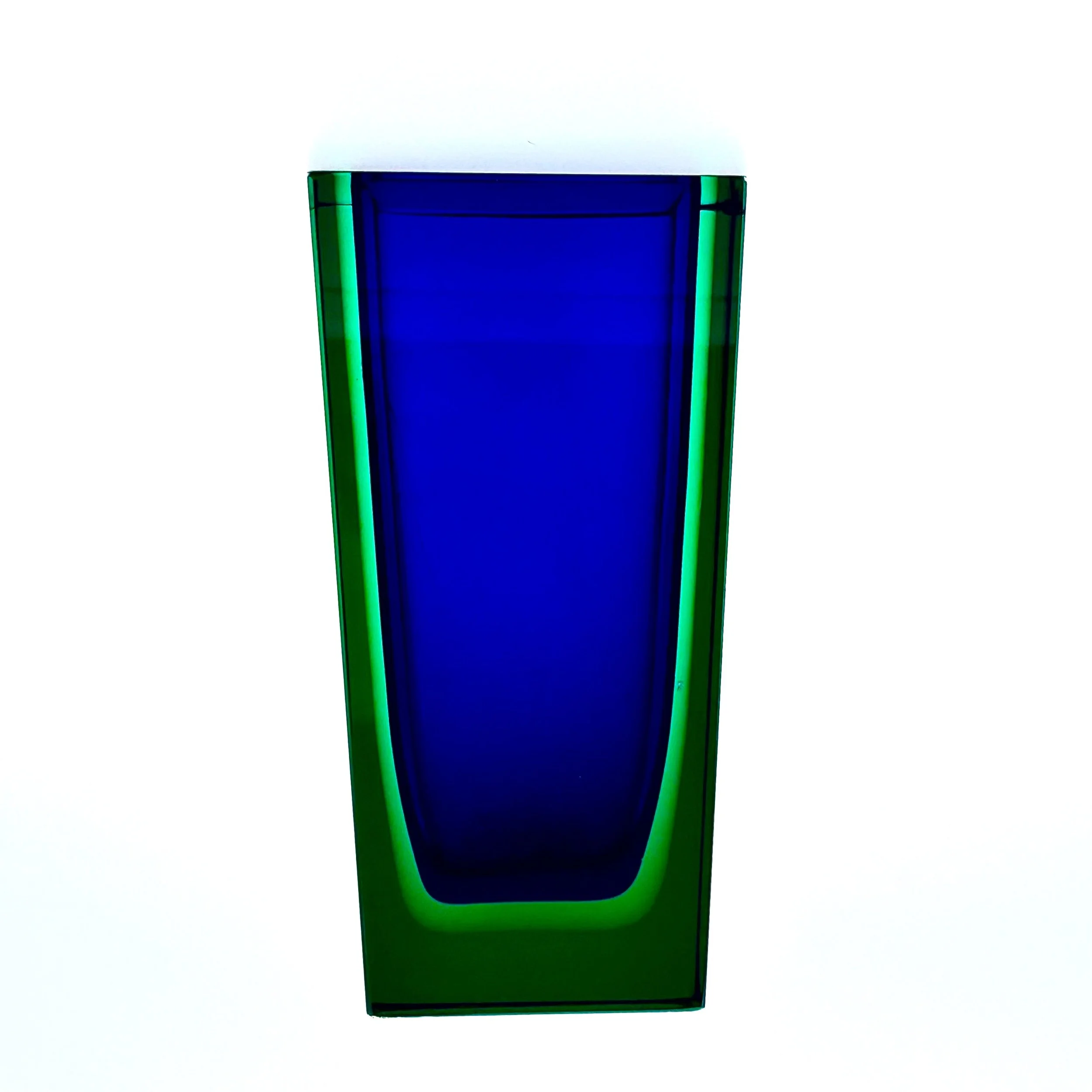
This sculptural cased glass vase possesses a commanding geometric silhouette and deep material richness. The vibrant cobalt core is suspended within a thick emerald casing, creating a luminous, two-tone interplay of light and color depth. Designed with a clean, architectural taper, it serves as a sophisticated focal point for modern or transitional interiors. Its heavy-walled construction and saturated palette make it a compelling decorative object for any curated design collection.
Attribution & Period
Severin Brørby for Hadeland Glassverk, Norway. Signed "Hadeland 7018 SB" on the base. This piece is the iconic Model 7018 (part of the "Blokk" or "K-7000" series), originally designed circa 1969. The form and "K-glass" technique are stylistically aligned with Brørby's award-winning mid-century work, which earned the Norwegian Award for Design Excellence in 1970.
Hadeland Glassverk, Norway. Signed and dated 2018. This piece is a modern archive production of the iconic "Blokk" (Block) series originally designed by Severin Brørby in 1969. The hand-etched signature "Hadeland 2018 SB" confirms its origin from the Hadeland studio, produced as part of a heritage revival of Brørby's award-winning mid-century designs. The form and "K-glass" technique are stylistically aligned with the factory's 1970 Award for Design Excellence winners.
Dimensions & Weight
• Height: 6frac{1}{16} text{ in}
• Mouth: 1frac{5}{8} text{ in} times 3frac{7}{16} text{ in}
• Base: 1frac{5}{16} text{ in} times 2frac{5}{16} text{ in}
• Weight: 1.98 text{ lbs}
Condition
The piece shows a significant internal crack extending upward from the base through the blue glass core. Minor surface shelf wear and light scratches are present on the base consistent with display. No exterior chips, fleabites, or restorations were observed.
Authenticity & Construction
Hand-crafted using the difficult cased glass technique, where a molten blue glass gather is dipped into a secondary green glass melt to create a "glass-within-glass" aesthetic. The heavy-walled construction provides the exceptional clarity and refractive power characteristic of Hadeland’s high-end studio glass. The signature remains crisp and legible on the polished base.
Placement
Ideal for a low-profile credenza, a brightly lit library shelf, or as part of a window-side grouping. This piece is best displayed where natural backlighting can fully activate the luminous contrast between the emerald exterior and cobalt interior.
STANDARD ATTRIBUTION & VALUE DISCLOSURE; This piece is described to the best of current scholarly and market knowledge. Any maker or regional attribution is based on visual analysis, materials, construction techniques, and documented stylistic comparisons. As with many MCM and antique glass objects, definitive attribution may not be possible without original labels or factory records. Pricing reflects condition, quality, decorative appeal, and current collector demand rather than a guaranteed maker identification.
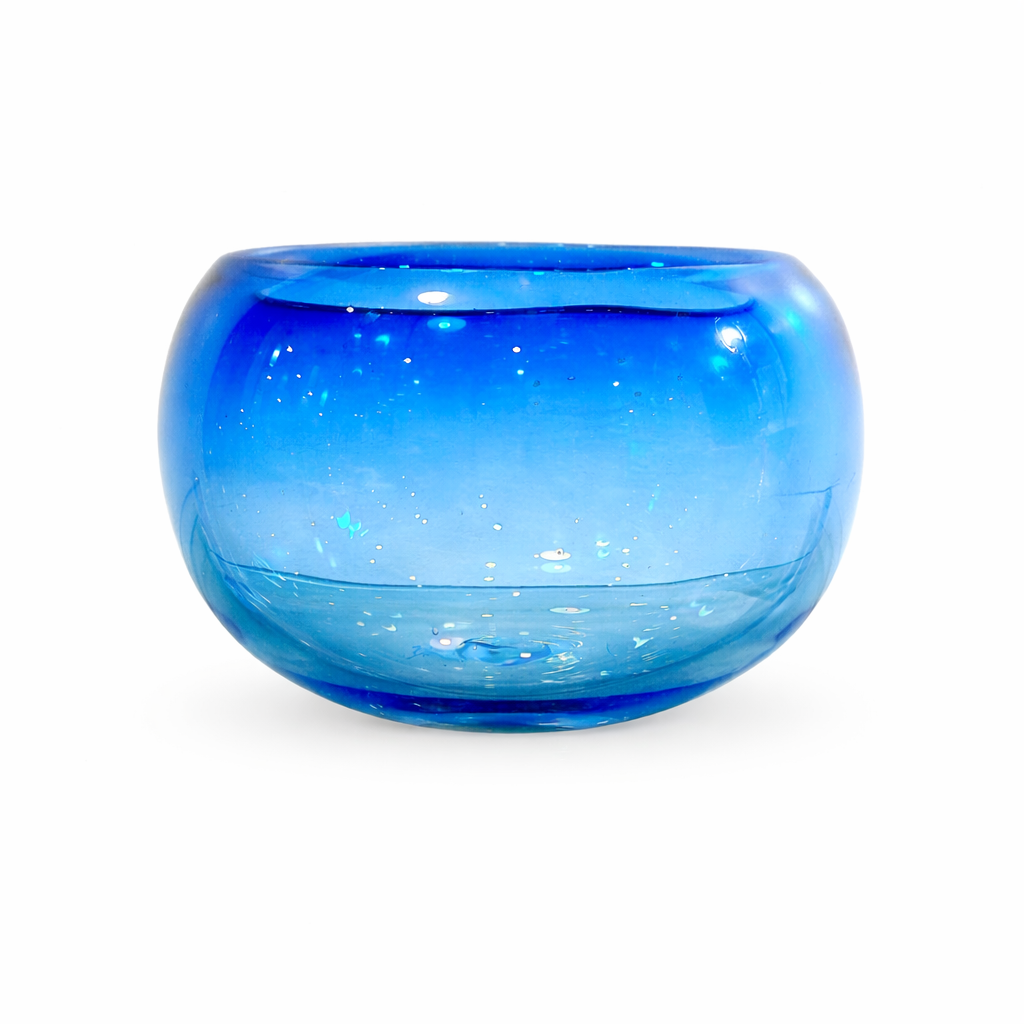
This arresting studio glass bowl showcases a luminous, oil-slick iridescence that shifts brilliantly across its feathered surface. The interior glows with a vibrant gold aurene finish, while the exterior features a complex "pulled feather" motif in contrasting white and amber tones. Its low-slung, flared silhouette and expertly scalloped rim give it a dynamic, organic presence that captures and refracts light from every angle.
Attribution & Period
by Robert Eickholt (Eickholt Glass), 2015.
The signature on the base corresponds to the renowned American glass artist Robert Eickholt, specifically dated 2015. Eickholt is celebrated for his "Eickholt Glass" studio work, which frequently utilized precious metal oxides to achieve this distinct, high-lustre iridescence. This piece was created in the final year of the studio's production (1978–2015), making it a significant example from the conclusion of his storied career.
Dimensions & Weight
Height: 4 in
Width / Diameter: 5.5 in (Body)
Mouth Diameter: 4.25 in
Weight: 1.968 lbs
Condition
Clinical and excellent. No chips, cracks, or repairs are present. The iridescent surface retains its original mirror-like finish without fading or clouding. Minor, superficial shelf-wear scratches are noted on the base, which is consistent with its age and does not affect the display quality of the piece.
Authenticity & Construction
A masterwork of American studio glassmaking, this bowl was hand-formed using the "pulled feather" technique—a method pioneered by Tiffany Studios and refined by contemporary masters like Eickholt. The base is diamond-point signed "Eickholt 2015," confirming its provenance. The heavy-walled construction and substantial 1.9 lb weight are indicative of the artist's premium "Gold Aurene" series.
Placement
This bowl functions as a high-impact sculptural accent on a dark-wood console table or within a glass-fronted vitrine with integrated lighting. Its iridescent qualities make it a perfect companion for Contemporary, Hollywood Regency, or Art Nouveau-inspired interiors.
STANDARD ATTRIBUTION & VALUE DISCLOSURE This piece is described to the best of current scholarly and market knowledge. Any maker or regional attribution is based on visual analysis, materials, construction techniques, and documented stylistic comparisons. As with many MCM and antique design objects, definitive attribution may not be possible without original labels or factory records. Pricing reflects condition, quality, decorative appeal, and current collector demand rather than guaranteed maker identification.
This monolithic vessel exerts a powerful sculptural presence through its compressed, ovoid geometry and "mirror-black" glaze. The form is a masterclass in mid-century minimalism, utilizing a low center of gravity and a precise, elongated aperture designed specifically for the structural requirements of architectural floral arrangement. Its surface depth and high-reflectivity finish create a sophisticated interplay of shadow and light, making it a definitive statement piece for a curated interior.
Attribution & Period
Mid-Century Modern (1960s)
This vessel is a definitive example of Japanese studio pottery, attributed to the Mashiko tradition. The hand-incised signature on the base is consistent with the stylized, western-facing marks used by Mashiko-based artists during the 1960s international design boom. The characteristic "pin-hole" bubbling in the glaze and the iron-rich clay body are direct signatures of the high-temperature reduction firing processes unique to the Tochigi Prefecture. This piece represents the critical era where traditional Japanese folk-craft (Mingei) transitioned into high-modernist sculptural art.
Dimensions & Weight
Height: 5.75 in
Width / Diameter: 6 in (widest area)
Depth / Base Diameter: 3.375 in x 1.625 in (base)
Weight: 0.224 lbs
Condition
The vessel is in immaculate, museum-grade condition. The high-gloss midnight glaze remains vibrant and deep with no chips, cracks, or restorations. Clinical examination reveals minor "glaze pops" or pin-hole bubbles near the shoulder, which are an authentic, sought-after result of the artisan kiln firing process. Light, appropriate shelf wear is present on the unglazed foot, confirming its vintage origin and careful residential history.
Authenticity & Construction
Hand-thrown and expertly altered, the vessel exhibits a seamless transition from its stable base to the elegantly tapered rim. The midnight glaze is applied with exceptional thickness, achieving a liquid-like depth that is a hallmark of Mashiko studio work. The hand-incised signature is deeply integrated into the clay body, providing a permanent and verifiable mark of provenance.
Placement
The dramatic silhouette and noir finish demand a prominent placement. It is exceptionally well-suited for a brutalist sideboard, a minimalist stone mantel, or a glass-top executive desk. It functions with equal strength as a standalone sculptural object or as a vessel for a singular, architectural branch to highlight its Ikebana heritage.
STANDARD ATTRIBUTION & VALUE DISCLOSURE; This piece is described to the best of current scholarly and market knowledge. Any maker or regional attribution is based on visual analysis, materials, construction techniques, and documented stylistic comparisons. As with many MCM and antique design objects, definitive attribution may not be possible without original labels or factory records. Pricing reflects condition, quality, decorative appeal, and current collector demand rather than guaranteed maker identification.