
CURATED GLASS
Explore our range of services designed to help you move forward with confidence, wherever you're headed next.
Curated By Colour
Discover the latest additions to our collection—handpicked pieces that bring new energy to your space.
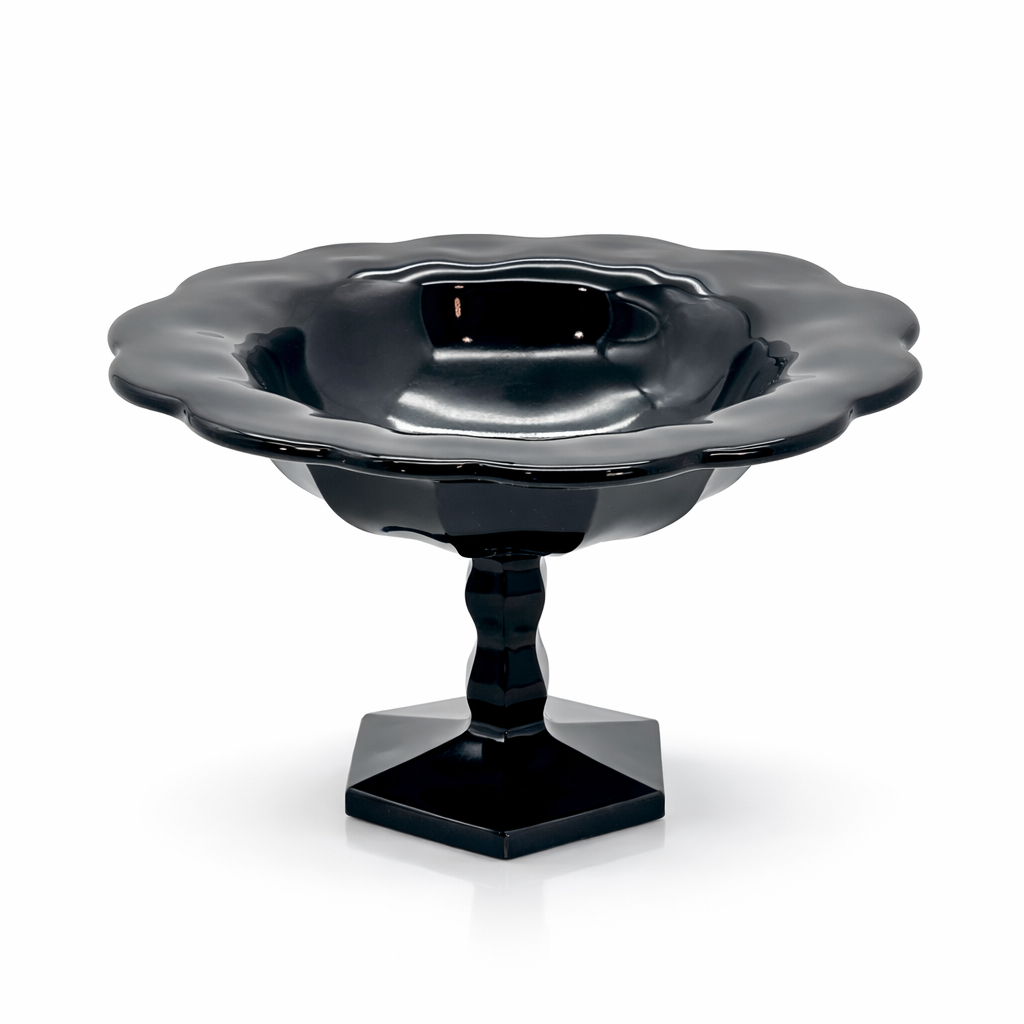
This striking centerpiece bowl exhibits a commanding sculptural presence, characterized by its deep, light-absorbing obsidian hue and substantial glass weight. The form features a bold, undulating scalloped rim that creates a rhythmic play of shadow and reflection across its polished surface. Supported by a faceted hexagonal pedestal, the object balances architectural geometry with organic fluid lines, making it a compelling focal point for a refined interior.
Attribution & Period
Stylistically aligned with American Mid-Century glass production, this piece is consistent with the high-quality press-molded techniques utilized by firms such as Tiffin or Fostoria during the 1940s. The dense "black" glass—technically a very deep purple known as black amethyst—and the precise faceting of the stem are characteristic of mid-century decorative arts from the Ohio River Valley region. No factory mark is observed, which is typical for glass of this era originally identified by paper labels.
Based on the hexagonal pedestal stem and the specific "scalloped" rim profile combined with the weight of the glass, this piece is most defensibly attributed to the 1940s.
While black glass had a surge in the 1930s (Depression era), the transition toward bolder, more geometric architectural stems like this hexagonal design became a hallmark of "Elegant Glass" manufacturers (like Tiffin and Fostoria) as they moved into the early 1940s. By the late 1950s, styles shifted toward more "free-form" or "organic" ruffles (like Viking Glass), making the structured, rhythmic scallops on your piece a classic representation of early-to-mid 1940s American glass design.
Dimensions & Weight
Height: 6 inches
Width / Diameter: 9 inches
Depth / Base Diameter: 4 1/4 inches
Weight: 2.336 lbs
Condition
The condition is excellent, presenting in collector-grade quality. Clinical observation reveals no chips, cracks, or professional repairs. The polished surface is remarkably well-preserved with no observed scratches or utensil marks. Base wear is minimal, consistent with age and careful display.
Authenticity & Construction
The object is crafted from solid, pigment-rich glass through a sophisticated molding and finishing process. The substantial weight and clarity of the mold lines signify a high standard of production, ensuring the durability and depth of color that distinguishes artisan glass from mass-market imitations. The transition from the hexagonal base to the fluted bowl demonstrates a mastery of geometric transitions.
Placement
This piece serves as an ideal architectural accent on a minimalist sideboard, a dark-stained executive desk, or as a central vessel on a contemporary dining table. Its monochromatic palette allows it to integrate seamlessly into both Brutalist and Hollywood Regency aesthetics.
STANDARD ATTRIBUTION & VALUE DISCLOSURE;This piece is described to the best of current scholarly and market knowledge. Any maker or regional attribution is based on visual analysis, materials, construction techniques, and documented stylistic comparisons. As with many MCM and antique design objects, definitive attribution may not be possible without original labels or factory records. Pricing reflects condition, quality, decorative appeal, and current collector demand rather than guaranteed maker identification.
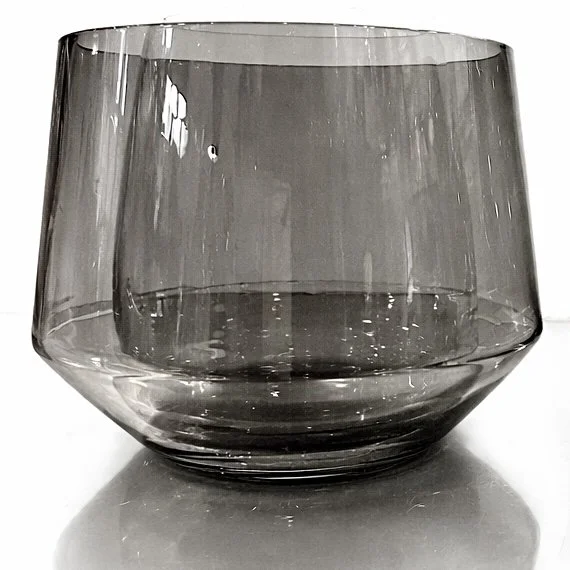
Set of two smoked glass vases defined by clean, volumetric silhouettes and subtle tonal depth. Each piece captures light with a soft grey-green tint, creating a restrained yet atmospheric presence. The contrast between the broader, faceted form and the taller, tapering vessel introduces visual rhythm while maintaining cohesion. Together, they function as a sculptural pairing suited for refined, modern interiors.
Attribution & Period
Unmarked decorative arts example, Contemporary (2000s). The forms, neutral smoked glass tone, and clean finishing are consistent with late 20th to early 21st century mass-produced decorative glass designed for interior styling rather than studio-specific authorship. The presence of a generic “Design” label supports retail production without identifiable maker attribution.
Dimensions & Weight
Taller Vase:
Height: 7 in
Diameter (mouth): 4.25 in
Base Diameter: 5.5 in
Weight: 1.956 lbs
Wider Vase:
Height: 7 in
Diameter (mouth): 7 in
Base Diameter: 4 in
Weight: 2.3 lbs
Condition
Excellent overall condition. No chips, cracks, or repairs observed. Light surface wear confined to the underside consistent with shelf contact. Minor manufacturing inclusions and faint internal bubbles typical of glass production. Surfaces remain clean and structurally sound.
Authenticity & Construction
Mold-blown glass construction with post-production finishing at the rim and base. The consistent wall thickness, smooth transitions, and controlled tinting indicate industrial glassmaking techniques. The smoked coloration is integrated within the glass rather than applied, ensuring durability and uniform tone.
Placement
Ideal as a paired composition on a console, shelving, or dining surface. Works effectively in minimalist, contemporary, or Scandinavian-inspired interiors. Can be styled empty for sculptural impact or with restrained botanical arrangements.
STANDARD ATTRIBUTION & VALUE DISCLOSURE
This piece is described to the best of current scholarly and market knowledge. Any maker or regional attribution is based on visual analysis, materials, construction techniques, and documented stylistic comparisons. As with many MCM and antique design objects, definitive attribution may not be possible without original labels or factory records. Pricing reflects condition, quality, decorative appeal, and current collector demand rather than guaranteed maker identification.
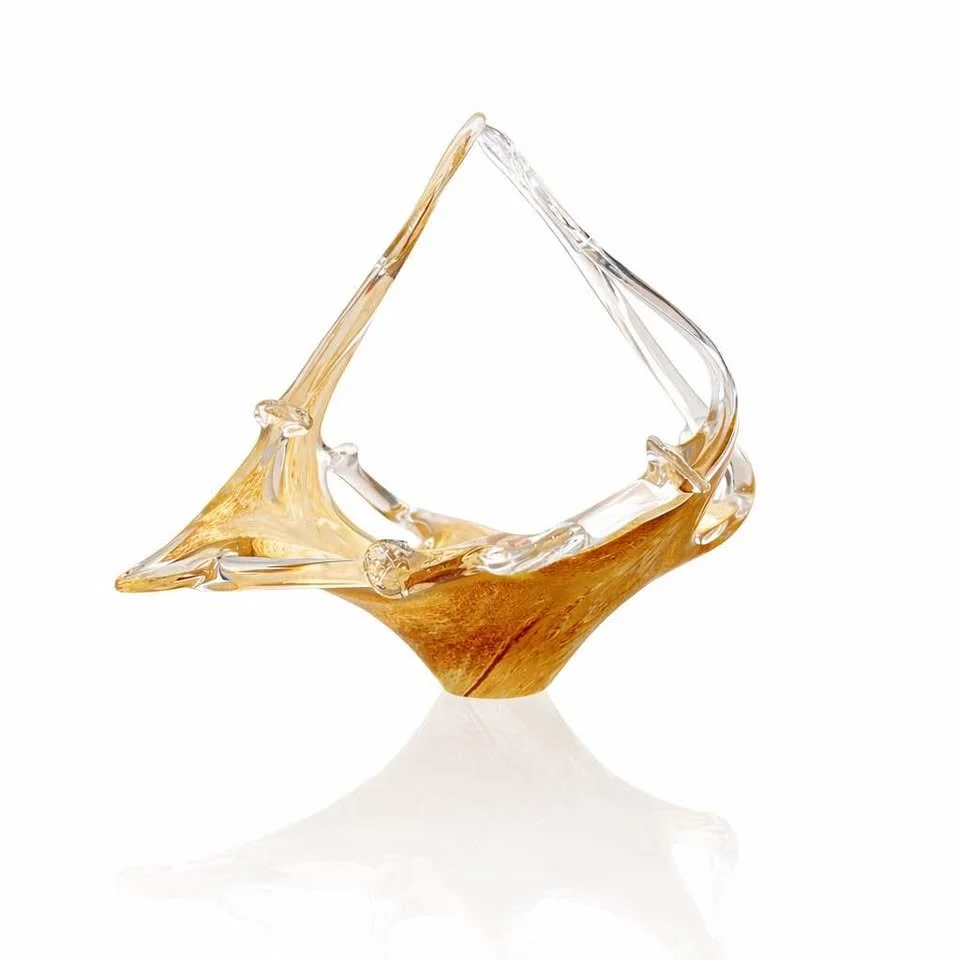
A sculptural, hand-worked art glass basket in a rich amber tone with clear, pulled-glass arms and an openwork rim. The silhouette reads like a”splash/starburst” form; thick, flowing, and intentionally irregular, with strong light play and a subtle iridescent sheen visible at certain angles (see photos).
Authenticity & Construction
The piece is notably heavy in hand, with substantial thickness at the arms and rim;more consistent with studio-worked art glass than thin, mass-made decorative glass.
Material: hand-worked (hand-blown/studio) glass
Attribution & Period
This piece is unsigned. No signature, etched mark, or label residue was found. Exact maker and age are not confirmed, so it is being offered as an unbranded studio art glass work.
DETAILS
Type: sculptural art glass basket / centerpiece / display bowl
Maker: unknown / unsigned (no marks found)
Color: amber/golden with clear elements; subtle iridescence in some light
Dimensions & Weight
Width: 9 3/4 in
Height: 8 in
Base diameter: 2 1/2 in
Condition
Excellent condition. No cracks, no chips, and no repairs observed; no surface scratches.
Please review photos for close-up details.
NOTES FOR COLLECTORS
Unmarked studio glass is common, and attribution is not guaranteed without a signature or documented provenance. This example shows strong hand-worked characteristics; pulled arms, organic asymmetry, thick gathers, and a ground/polished base; making it a compelling display object even without maker identification.
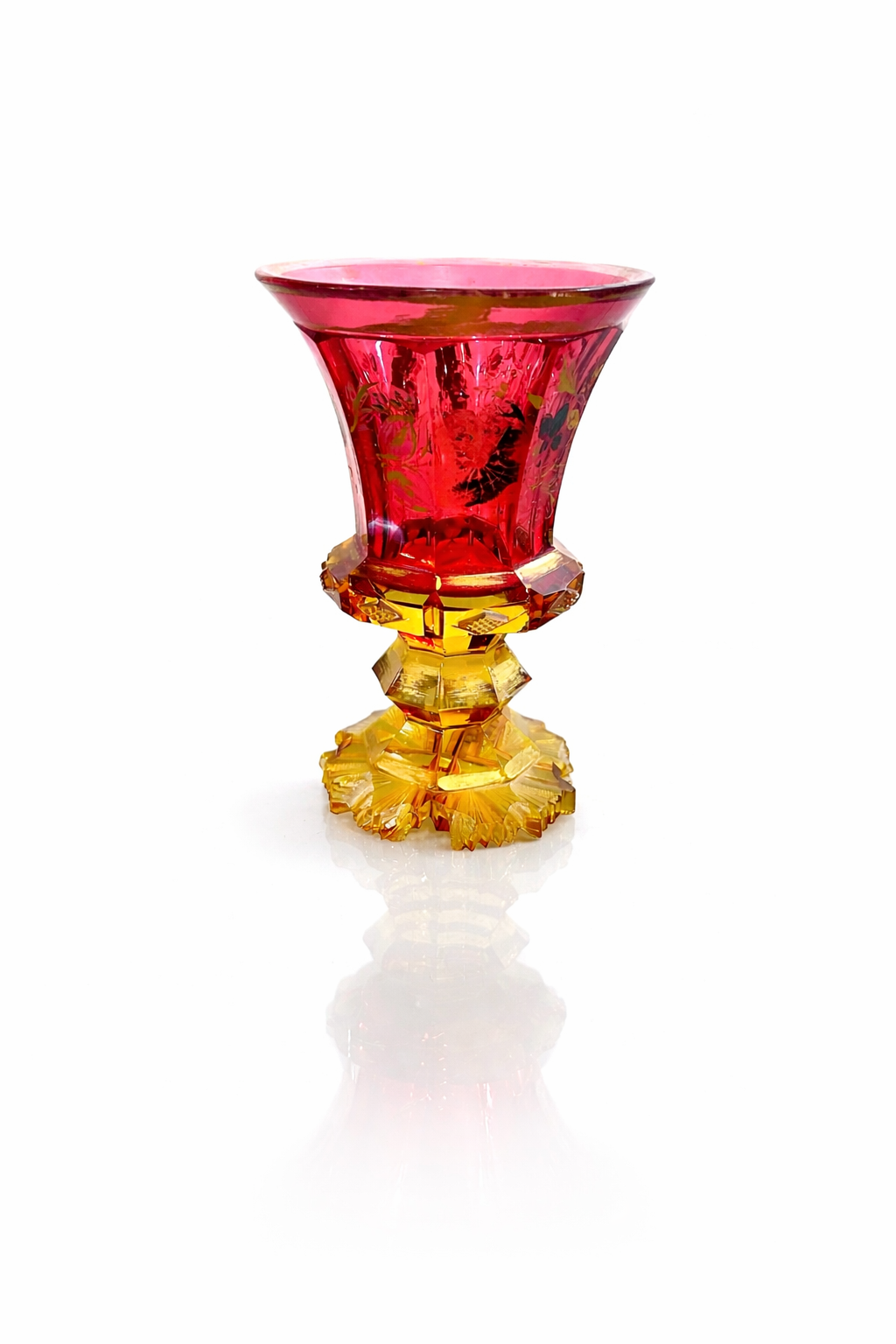
Ruby-to-amber cut crystal pedestal vase with a flared trumpet rim, deeply faceted stem, and dramatic starburst foot. The body is decorated with floral/botanical engraving (appears wheel-engraved or acid-etched), giving this piece the classic Bohemian jewel glass presencehigh sparkle, substantial weight, and strong light play from every angle.
Attribution & Period
Based on form, cutting style, color combination, and engraving technique, this vase was most likely produced circa 1950s1970s in Bohemia / Czechoslovakia (now Czech Republic). This period aligns with postwar Central European export crystal, where colored bowls paired with heavy cut stems and decorative engraving were widely produced for the international market.
UV reactivity
This vase reacts under a 365nm black light, producing a warm orange-to-red fluorescence as shown in the first image. This response is consistent with selenium-based ruby glass colorants, which may include cadmium compounds historically used in colored crystal production. The exact activator cannot be confirmed without laboratory testing, and the piece is described accordingly.
Authenticity & Construction
This form and execution strongly align with 20th-century Bohemian / Czech decorative cut crystal. The combination of a colored ruby bowl, amber-toned crystal, heavy mitre-cut faceting, and engraved decoration is characteristic of Central European export glass produced from the mid-century into the late 20th century. Comparable examples are often associated stylistically with Bohemian houses such as Egermann or Moser; however, this piece is unmarked and is therefore attributed by style only, not by maker.
Condition (read carefully)
This piece is not mint and is priced with full transparency. Three cracks around the base/foot, visible in close-up images Chips along the base/foot edge, as shown Upper bowl and decorative surfaces present well; engraving remains attractive Damage is confined to the foot.
Dimensions & Weight
Height: 6.18 in (approx. 6 3/16 in)
Mouth diameter: 4 1/2 in
Base diameter: 3 in
Weight: 1.374 lb (heavy for size)
Placement
Well-suited to Hollywood Regency, Art Deco revival, Grand Millennial, or maximalist cabinet glass interiors. Works especially well under accent lighting due to cut facets and UV response. The vase displays nicely in a cabinet or vignette but should be considered a decorative/display example, not an investment-grade specimen.
STANDARD ATTRIBUTION & VALUE DISCLOSURE
This piece is described to the best of current scholarly and market knowledge. Any maker or regional attribution is based on visual analysis, materials, construction techniques, and documented stylistic comparisons. As with many vintage and antique glass objects, definitive attribution may not be possible without original labels or factory records. Pricing reflects condition, quality, decorative appeal, and current collector demand rather than guaranteed maker identification.
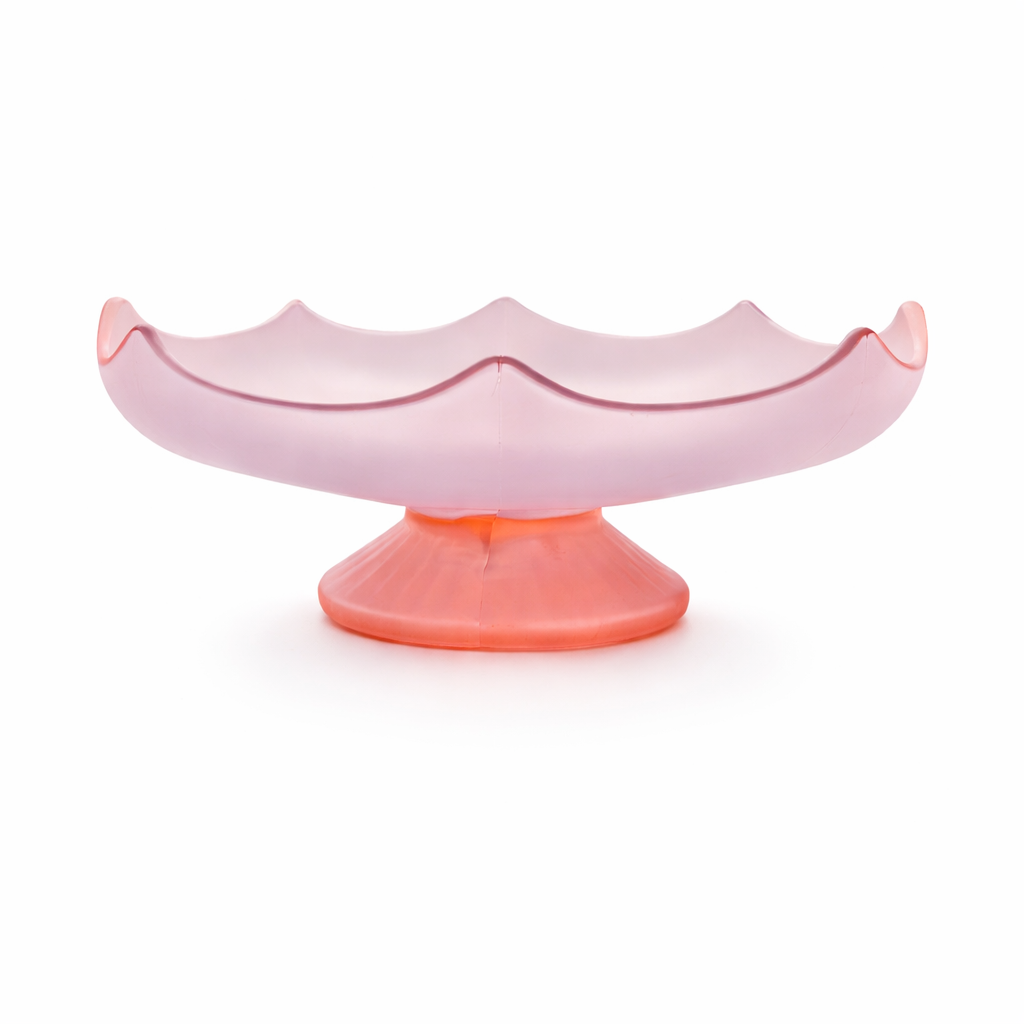
A sculptural mid-century pedestal comport defined by its architectural octagonal form and luminous cased coloration. The softly opalescent blush bowl appears suspended above a radiant coral foot, creating a subtle internal glow that intensifies under directional light. The satin “sandy” finish diffuses the surface, giving the piece a refined, almost alabaster-like presence while retaining the warmth of post-war American art glass.
Balanced, symmetrical, and quietly dramatic, this is a form rooted in mid-century optimism—where geometry met atmosphere and decorative objects were designed to anchor a room. The interplay between the glowing base and diffused upper body gives the piece depth well beyond its scale, making it equally suited to minimalist interiors and layered, moody environments.
Attribution & Period
American art glass comport, Mid Century period, circa 1945–1965. The satin “sandy” surface, glowing cased coloration (opalized blush bowl over a vivid coral/orange base), molded octagonal plan, and visible vertical mold seam strongly indicate mid-20th century American pressed and mold-blown production in the tradition of Fenton Art Glass, Viking Glass, or a comparable U.S. art glass house. No signature present. Attribution is stylistic and construction-based.
Dimensions & Weight
Diameter: 9 inches
Height: 2.75 inches
Base diameter: 3.5 inches
Each of the 8 sides: approximately 3.5 inches
Weight: 1.3 lbs
Condition
Excellent condition. No scratches, no chips, no cracks. Surface retains an even satin finish throughout. A visible mold seam is present, consistent with mid-century pressed/mold-blown production and not a condition issue. Interior and foot rim are clean and well-preserved.
Authenticity & Construction
This piece was formed in a multi-part mold, evidenced by the vertical seam visible in close inspection. The octagonal footprint and scalloped rim were integrated into the mold design rather than tooled freehand.
The coloration suggests cased glass construction: a soft opalescent pink upper layer fused over a more intensely pigmented coral/orange base. Under light, the foot glows with a saturated warmth while the bowl reads as diffused and architectural. The satin “sandy” surface is achieved through acid-etching or controlled surface treatment, a technique widely employed in American art glass factories during the mid-century era to soften form and enhance light diffusion.
The pedestal form and controlled symmetry align with post-war American decorative glass production, when companies such as Fenton and Viking explored sculptural yet accessible table forms in glowing pastels and sunset hues. While it shares characteristics with Fenton’s satin lines and Viking’s architectural silhouettes, there is no signature or original label; therefore, it is conservatively attributed to American mid-century production.
A coordinating elongated tray (shown in one image) is available separately.
Placement
Ideal as a low centerpiece, sculptural fruit bowl, or pedestal display for florals or objects. Its glowing coral foot and diffused blush bowl perform especially well under directional lighting or candlelight, where the base radiates warmth upward through the body. Works equally in restrained modern interiors and layered Art Deco-inspired settings.
STANDARD ATTRIBUTION & VALUE DISCLOSURE; This piece is described to the best of current scholarly and market knowledge. Any maker or regional attribution is based on visual analysis, materials, construction techniques, and documented stylistic comparisons. As with many vintage and antique glass objects, definitive attribution may not be possible without original labels or factory records. Pricing reflects condition, quality, decorative appeal, and current collector demand rather than a guaranteed maker identification.
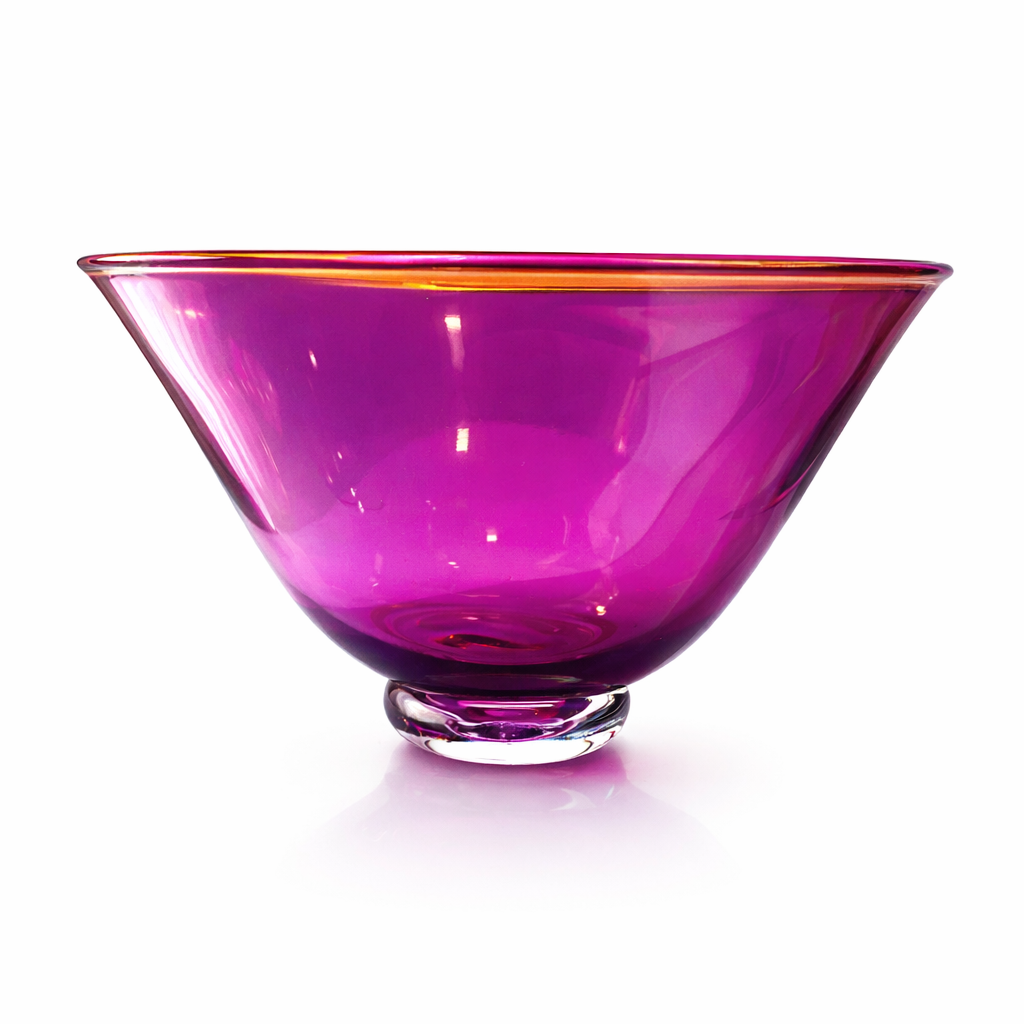
This commanding hand-blown vessel is a definitive expression of Finnish modernist glass artistry, featuring a deeply saturated cranberry core that radiates into a luminous amber rim. The architectural, wide-flaring silhouette is elevated by an intentional field of controlled internal air inclusions (bullicante), creating a rhythmic optical play that captures and refracts light. Its substantial mass and sophisticated tonal transitions from magenta-toned cranberry to golden amber reflect the peak of the Scandinavian studio glass movement.
Attribution & Period
The base features a professionally engraved presentation signature and date: "S. Kiitos 69." The "S" prefix denotes Suomi (Finland), while "Kiitos" identifies the piece as a bespoke commemorative or diplomatic gift commissioned from a premier Finnish glassworks—likely Riihimäki or Kumela—during the 1969 revival of experimental studio techniques. The elongated, stylized script is the hallmark of a master factory engraver.
Material & Fluorescence
The glass composition utilizes traditional 1960s mineral oxides, confirmed by a dual-spectrum UV reaction. Under 365nm light, the amber transitions exhibit a characteristic manganese-yellow glow, while the cranberry core reveals a vibrant cadmium-orange fluorescence, authenticating the piece’s mid-century chemical "recipe" and high-quality mineral content.
Condition & Construction
Condition: Excellent. The glass remains brilliantly clear with a high-polished luster. The base shows age-appropriate shelf contact consistent with its five-decade history as a curated object.
Base: Expertly ground and perfectly smooth polished pontil, a finish reserved for the highest grade of Finnish art glass production.
Technique: Multi-layered Sommerso gather with precisely introduced air-suspension.
Dimensions & Weight
Height: 5 1/8 inches
Mouth Diameter: 8 1/2 inches
Weight: 1.674 lbs
Presence: A substantial, balanced sculptural object with significant visual weight.
Placement
This vessel functions as a high-impact architectural centerpiece. It is ideally suited for a minimalist gallery pedestal or a mid-century teak sideboard, where backlighting can fully activate the internal bubble structure and the glowing cranberry-to-amber gradient.
STANDARD ATTRIBUTION & VALUE DISCLOSURE; This piece is described to the best of current scholarly and market knowledge. Any maker or regional attribution is based on visual analysis, materials, construction techniques, and documented stylistic comparisons. As with many vintage and antique glass objects, definitive attribution may not be possible without original labels or factory records. Pricing reflects condition, quality, decorative appeal, and current collector demand rather than a guaranteed maker identification.
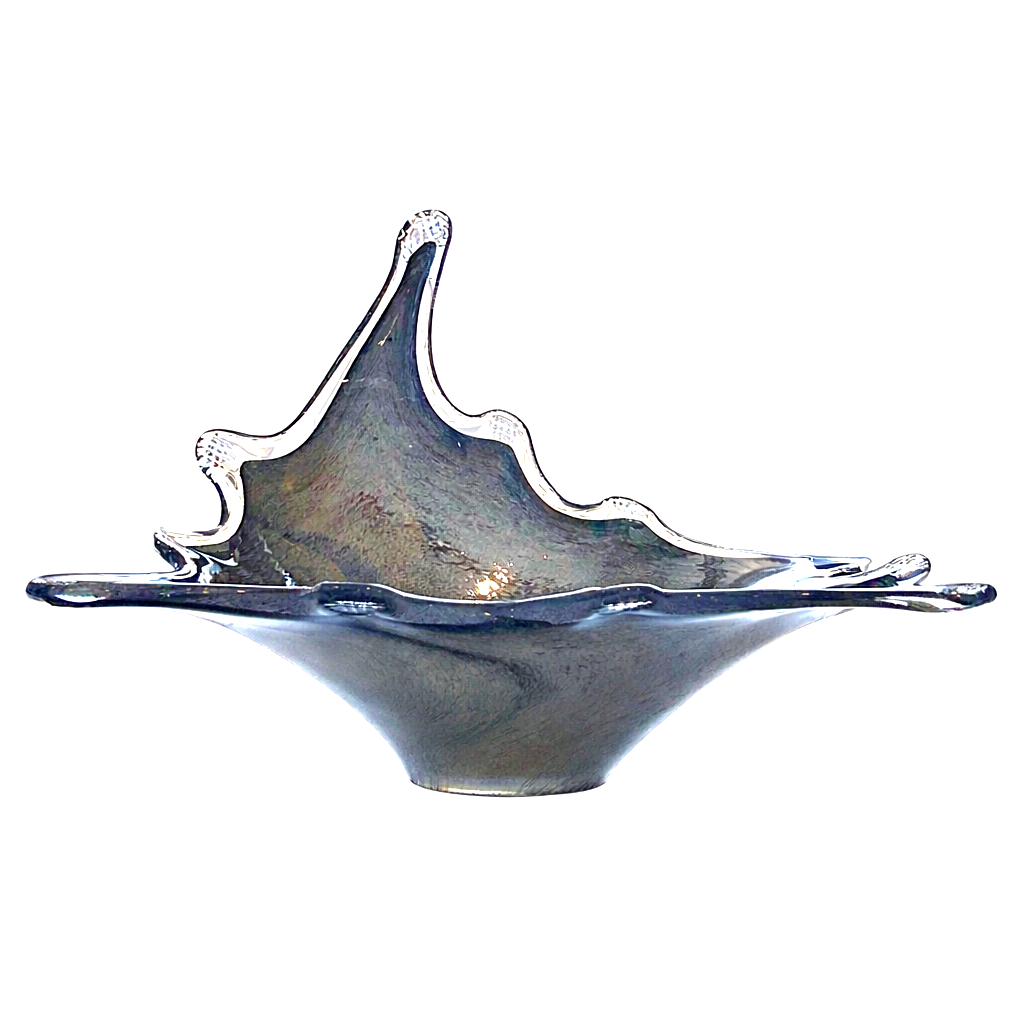
This masterfully hand-blown glass centerpiece commands attention with its dynamic, undulating "handkerchief" silhouette and ethereal sky blue hue. The interior is enriched with finely dispersed gold-leaf inclusions that create a shimmering, prismatic effect when struck by natural light. Its organic, multi-pointed rim evokes a sense of fluid movement, transforming a traditional vessel into a significant piece of glass sculpture that serves as a focal point in any sophisticated interior.
Attribution & Period
Region: Italy (Murano)
Period: 1970s
Attribution: By Murano (Labelled)
This piece retains its original foil "Hand Made in Italy - Murano" label on the base, confirming its origin from the Venetian archipelago. The construction features a "Cordonato d'Oro" style technique—integrating gold leaf into the glass—consistent with the high-production standards of mid-to-late 20th-century Murano furnaces. The specific font and layout of the sticker are characteristic of exported Venetian art glass from the 1970s.
Dimensions & Weight
Height: 9.5 inches
Width / Diameter: 16 inches
Depth / Base Diameter: 13 inches (Overall) / 2.625 inches (Base)
Weight: 4.918 lbs
Condition
The object is in excellent vintage condition. The glass body is free of chips, cracks, or professional repairs. There is minor, age-appropriate shelf wear and light scratching localized strictly to the underside of the polished base, consistent with its age and history of display. The sky blue coloration remains vibrant and uniform throughout the vessel.
Authenticity & Construction
This bowl was executed using traditional free-blown techniques. The artisan skillfully manipulated the molten glass to achieve the dramatic, asymmetric "fazzoletto" (handkerchief) folds. The inclusion of genuine gold leaf during the blowing process requires precise temperature control to ensure the leaf "shatters" into a delicate, even dust rather than clumping, a hallmark of skilled Italian glassmaking.
Placement
The expansive 16-inch scale of this piece makes it an ideal centerpiece for a large circular dining table or a minimalist credenza. Its translucent blue tones and gold-flecked interior are particularly effective when placed in a sun-drenched room or under direct gallery lighting, where the internal reflections can fully activate.
STANDARD ATTRIBUTION & VALUE DISCLOSURE; This piece is described to the best of current scholarly and market knowledge. Any maker or regional attribution is based on visual analysis, materials, construction techniques, and documented stylistic comparisons. As with many MCM and antique design objects, definitive attribution may not be possible without original labels or factory records. Pricing reflects condition, quality, decorative appeal, and current collector demand rather than guaranteed maker identification.
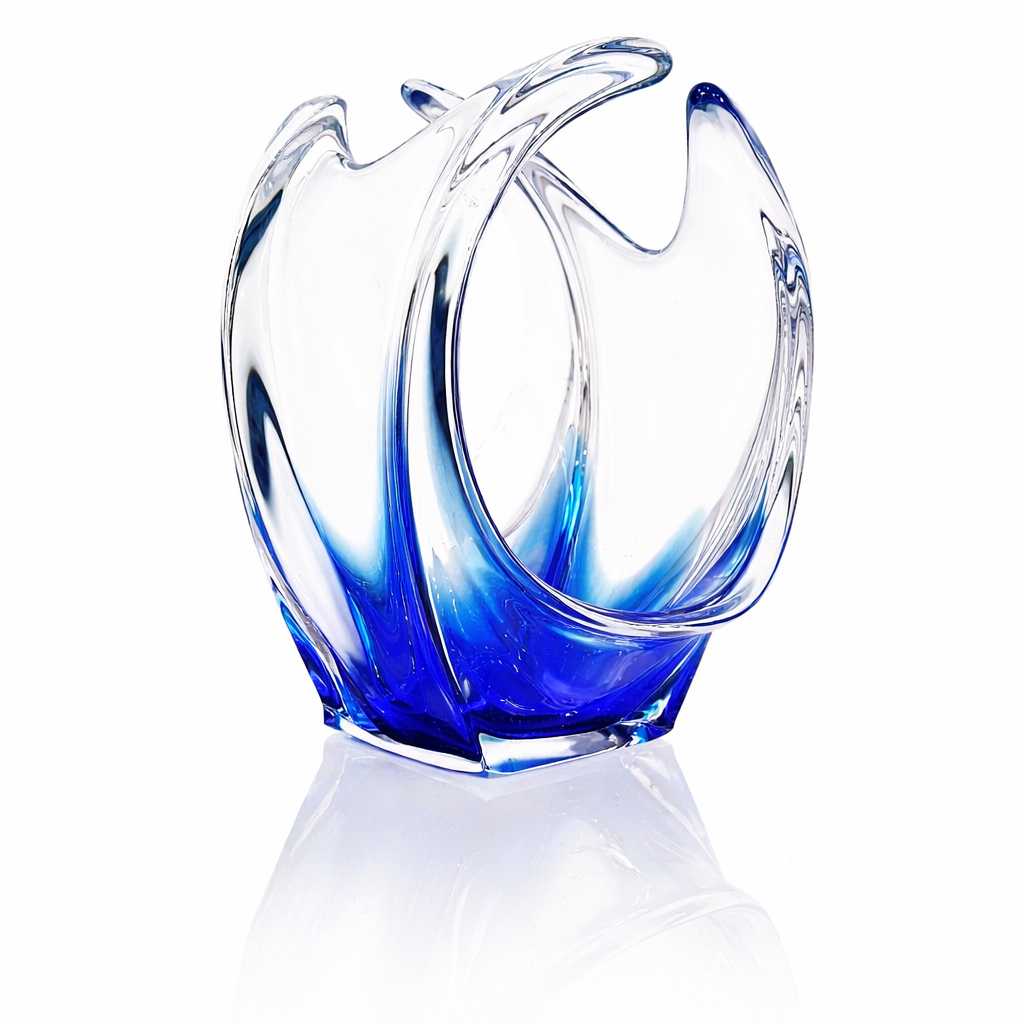
This substantial hand-formed glass sculpture commandingly interacts with light through its deeply saturated cobalt core and high-clarity crystal casing. The form is defined by sweeping, asymmetric rim articulations that create a sense of arrested motion, moving beyond functional vessel logic into pure sculptural expression. Under 365nm UV light, the outer casing reveals a vibrant neon-green fluorescence, indicating the presence of uranium oxide—a technical characteristic that adds a hidden, secondary dimension to its visual profile.
Attribution & Period
1960s. The technical execution—specifically the heavy "sommerso" style casing and the inclusion of UV-reactive agents—is stylistically aligned with mid-century Bohemian and Scandinavian studio traditions. The deliberate weighting of the base and the precision of the internal color suspension suggest a high-level production house, likely from the Zelezny Brod (ZBS) or Sklo Union regions, where experimental glass chemistry and organic "free-form" shaping were hallmarks of the era.
Dimensions & Weight
Height: 8 1/4 inches
Width: 6 inches
Depth: 3 1/2 inches
Weight: 3.362 lbs
Condition
Excellent vintage condition. The glass remains remarkably clear with no chips, cracks, or flea bites to the delicate rim. Minor surface shelf wear is restricted to the underside of the base, consistent with age and authentic handling.
Authenticity & Construction
This piece is a testament to advanced hot-working control, featuring a cased glass technique where the cobalt interior is submerged into a thick gather of uranium-infused crystal. The presence of subtle concentric working marks and internal lensing at the base confirms a hand-formed process. Unlike mass-produced pressed glass, the varying thickness of the walls creates complex prismatic effects and a sophisticated optical depth.
Placement
With its dual-tone profile and dramatic silhouette, this sculpture is ideally suited for a lit pedestal, a modernist console, or as a centerpiece in a curated glass collection. Its reactive properties make it a compelling "discovery" piece for interiors utilizing varied lighting schemes.
STANDARD ATTRIBUTION & VALUE DISCLOSURE
This piece is described to the best of current scholarly and market knowledge. Any maker or regional attribution is based on visual analysis, materials, construction techniques, and documented stylistic comparisons. As with many MCM and antique design objects, definitive attribution may not be possible without original labels or factory records. Pricing reflects condition, quality, decorative appeal, and current collector demand rather than guaranteed maker identification.
CERTIFICATE OF AUTHENTICITY & PROVENANCE REPORT
Reference Number: G-1960-CB-0824
Object Classification: Sculptural Art Glass
Period: Mid-Century Modern (Circa 1960–1969)
Material Composition: Cased Lead Crystal with Cobalt Oxide Core and Uranium Oxide Outer Gather
OBJECT DESCRIPTION & ANALYSIS
This masterwork of mid-century glassmaking is a sophisticated example of the Sommerso technique, characterized by a deep, light-absorbing cobalt interior suspended within a heavy, high-clarity crystal casing. The form is defined by an aggressive, free-form rim treatment that prioritizes sculptural silhouette over utilitarian function.
Of particular note to the collector is the rare inclusion of uranium oxide within the clear casing. While appearing colorless under natural daylight, the material exhibits a vibrant neon-green fluorescence under 365nm UV light. This dual-state characteristic identifies the piece as a product of advanced chemical experimentation common in high-end European studios during the 1960s.
TECHNICAL SPECIFICATIONS
• Method: Hand-formed, hand-tooled glass (unmarked)
• Dimensions: 8 1/4" H × 6" W
• Weight: 3.362 lbs
• Reactive Profile: 365nm UV Positive (High Luminance)
ATTRIBUTION & CURATORIAL CONTEXT
The sculptural language—specifically the interplay between the optically heavy base and the fluid, asymmetric "wings"—is stylistically aligned with the works of the Zelezny Brod (ZBS) glassworks in the former Czechoslovakia. The tension between the weighted mass and the delicate, hand-pulled rim suggests a master-level blower. The absence of a factory mark is consistent with period studio exports intended for high-end boutique markets in the United Kingdom and North America.
CONDITION SUMMARY
The specimen is in Exhibition Grade condition. No chips, fractures, or internal clouding are present. The integrity of the glass remains pristine, with only negligible surface micro-scratches on the underside of the base, verifying its authentic age and shelf-life.
VALUATION RATIONALE
The valuation of $1,250 USD reflects the specimen’s exceptional physical mass, the technical complexity of the uranium-cased layering, and the current market demand for "discovery" pieces that offer interactive light elements within a minimalist modernist framework.
Statement of Authenticity
This document serves as a formal record of the object’s characteristics and market position at the time of listing. All descriptions are based on professional visual analysis, material testing (UV), and comparative stylistic research within the field of 20th-century decorative arts.
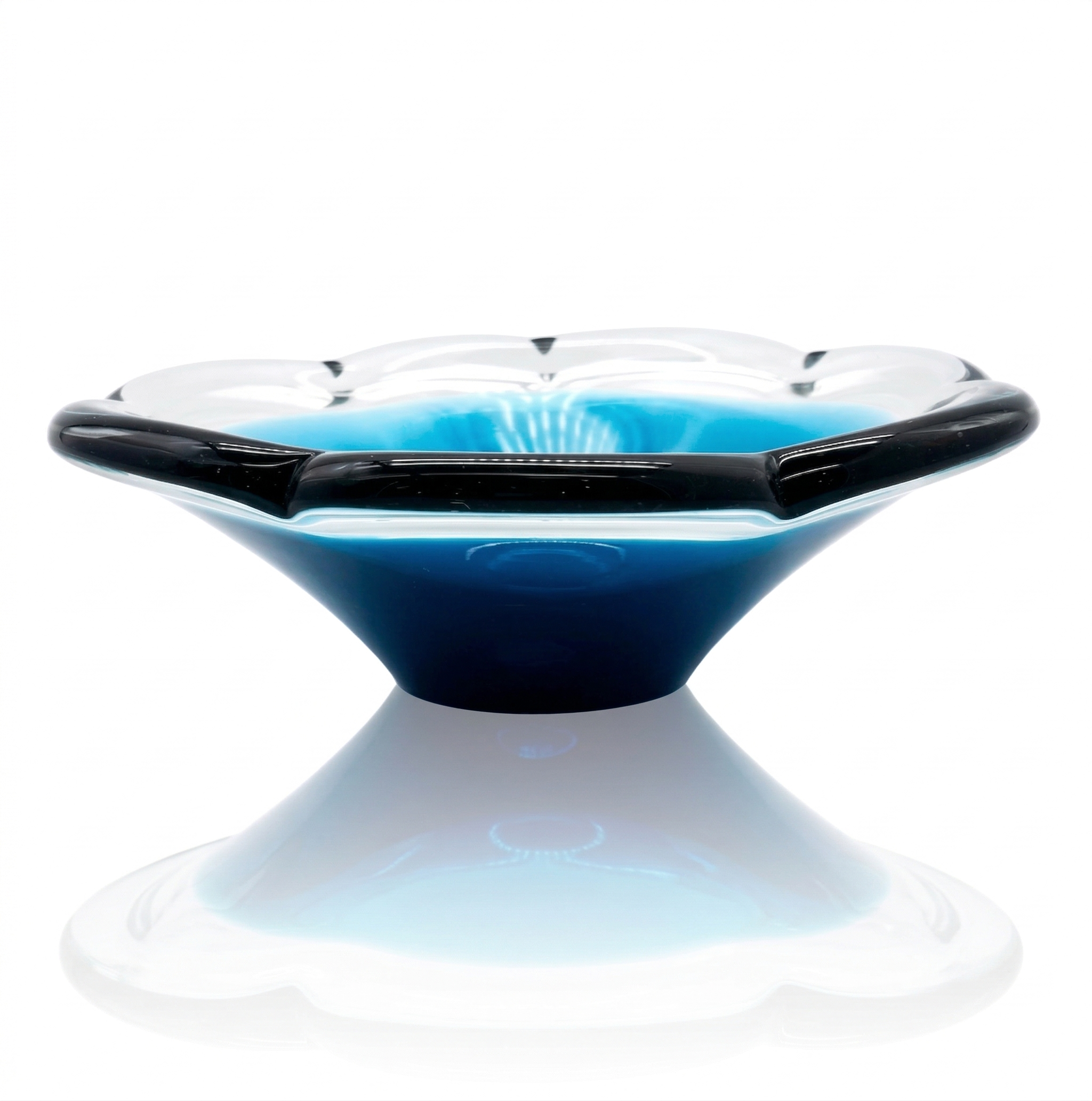
A striking sculptural art glass bowl defined by its fluid organic form and luminous blue cased body. The piece transitions from a deep, saturated blue core to a softly diffused rim, creating a glowing optical effect under light. Its petal-like silhouette and gently undulating edge give it a strong decorative presence from every angle. The interplay of thickness, curvature, and color density makes it equally compelling as a standalone object or centerpiece.
Attribution & Period
Scandinavian regional example, 1960s. The form, restrained palette, and controlled cased glass technique are consistent with mid-century Scandinavian glass design, particularly studio and factory production from Sweden and Finland. No factory mark observed; attribution remains visual rather than documented.
Dimensions & Weight
Height: 2 inches
Width / Diameter: 6 inches
Depth / Base Diameter: 1.75 inches
Weight: 1.142 lbs
Condition
Excellent condition overall. No chips, cracks, or structural damage observed. Base shows light surface scratching consistent with age and use. Minor internal inclusions and small bubbles present, inherent to hand-formed glass.
Authenticity & Construction
Hand-blown cased glass construction. The bowl is formed by layering colored glass within clear or lightly tinted outer layers, then shaped while hot to achieve the organic, petal-like rim. The polished base and visible internal transitions confirm traditional glassblowing methods rather than molded production. Variations in thickness and subtle inclusions support hand-crafted origin.
Placement
Ideal as a sculptural centerpiece on a low table, console, or credenza. Performs especially well in modernist, Scandinavian, and minimal interiors where light interaction and form are emphasized. Also suitable for layered display within a curated glass collection.
STANDARD ATTRIBUTION & VALUE DISCLOSURE; This piece is described to the best of current scholarly and market knowledge. Any maker or regional attribution is based on visual analysis, materials, construction techniques, and documented stylistic comparisons. As with many MCM and antique design objects, definitive attribution may not be possible without original labels or factory records. Pricing reflects condition, quality, decorative appeal, and current collector demand rather than guaranteed maker identification.
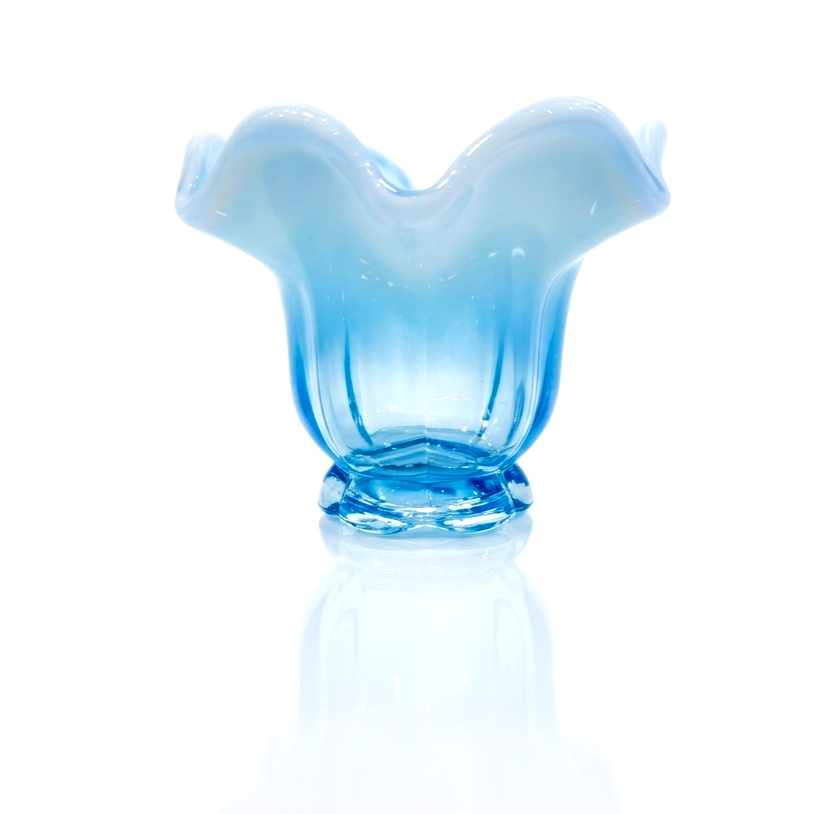
A compact, materially sophisticated art glass vase defined by its sculptural folded rim and luminous opaline body transitioning into a saturated blue cased base. The form captures light with a soft internal glow in daylight and transforms dramatically under UV, revealing clear uranium fluorescence. The layered construction and controlled thickness give the piece a refined visual weight and presence. Despite its scale, it reads as a deliberate sculptural object rather than a simple vessel.
Attribution & Period
Unmarked decorative arts example, consistent with Italian Murano glass production. The organic ruffled form, opalescent treatment, and sommerso-style tonal transition align with mid-century Murano design language. The presence of UV-reactive glass (uranium content) further supports a mid-20th century origin when such materials were more commonly incorporated into decorative glass. Attribution remains visual rather than documented due to the absence of a factory mark.
Dimensions & Weight
Height: 4.25 in
Width / Diameter: 5 in mouth diameter
Depth / Base Diameter: 2.25 in base diameter
Weight: 1.15 lb
Condition
Excellent overall condition. No chips, cracks, or repairs observed. Minor surface wear to the base consistent with handling. Internal bubbles, inclusions, and light formation marks present from manufacture. Base shows a worked central tool mark and circular formation typical of mold-assisted blown glass. Strong UV-reactive fluorescence present.
Authenticity & Construction
Mold-assisted blown and cased glass construction. The visible clear layer at the rim transitioning into opaline glass confirms layered casing rather than single-stage pressing. The blue lower section is integrated within the glass body rather than surface-applied. Uranium content is confirmed through UV fluorescence, a known material characteristic used in mid-century glass formulations to enhance optical effect.
Placement
Ideal for illuminated display, shelving, or cabinet presentation where both natural and UV light can be utilized. Particularly effective in curated glass groupings, modern interiors, or gallery-style environments where material interaction with light is emphasized.
STANDARD ATTRIBUTION & VALUE DISCLOSURE This piece is described to the best of current scholarly and market knowledge. Any maker or regional attribution is based on visual analysis, materials, construction techniques, and documented stylistic comparisons. As with many MCM and antique design objects, definitive attribution may not be possible without original labels or factory records. Pricing reflects condition, quality, decorative appeal, and current collector demand rather than guaranteed maker identification.
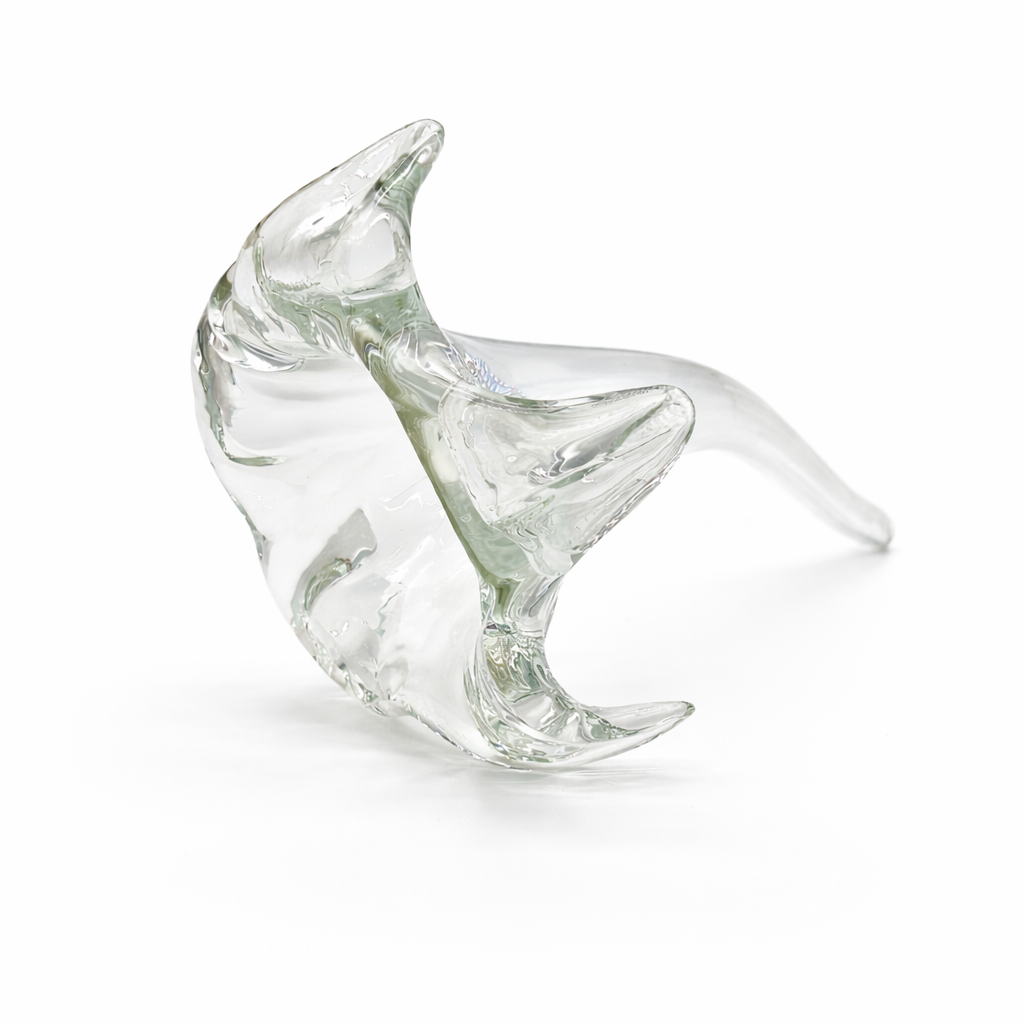
A sculptural Czech art glass decanter stopper defined by a dramatic petal-like crown and an elongated tapering stem. The folded organic edges capture and refract light, giving the clear glass a luminous presence and subtle green edge tone typical of Central European soda-lime glass. The piece reads as a small sculptural object first, with a fluid silhouette that feels architectural and modern. Whether seated in a decanter or displayed independently within a vessel, it functions as a refined decorative accent for barware and interiors alike.
Attribution & Period
Central European, most consistent with Czech art glass production, 1970s.
The organic crown form, thick clear glass with soft green edge tint, and drawn elongated stem align with the design language of postwar Bohemian decorative glass produced during the late mid-century period. Similar sculptural stoppers appear in glassworks associated with Czech factories such as Chribska, Skrdlovice, and other Bohemian producers active in the 1960s–1970s. No factory mark observed; attribution remains visual rather than documented.
Dimensions & Weight
Height: 7 in
Width / Diameter: 4 in (flower crown)
Depth: approx. 2 in
Weight: approx. 0.35 lb
Condition
Very good vintage condition. No cracks or repairs observed. Minor surface wear consistent with age and handling. Small internal bubbles and inclusions visible within the glass, typical of hand-worked art glass production. Stem tip shows expected manufacturing rounding. No restorations observed.
Authenticity & Construction
Formed from molten soda-lime glass using hot-worked techniques typical of mid-century Central European art glass. The elongated stem was drawn from the gather and finished with a rounded terminal designed to seat within a bottle or decanter neck. The crown was shaped while the glass remained malleable, creating the folded organic petal form. Variations in thickness, subtle internal bubbles, and the soft green edge tone confirm hand manipulation and contribute to the piece’s luminous sculptural character.
Placement
Ideal on a bar cart, cocktail cabinet, library shelf, or credenza as a decorative object. It can function as a decanter or carafe stopper, but its sculptural form also allows it to be displayed independently within a vessel or grouped with studio glass objects on a console or pedestal.
STANDARD ATTRIBUTION & VALUE DISCLOSURE; This piece is described to the best of current scholarly and market knowledge. Any maker or regional attribution is based on visual analysis, materials, construction techniques, and documented stylistic comparisons. As with many MCM and antique glass objects, definitive attribution may not be possible without original labels or factory records. Pricing reflects condition, quality, decorative appeal, and current collector demand rather than a guaranteed maker identification.
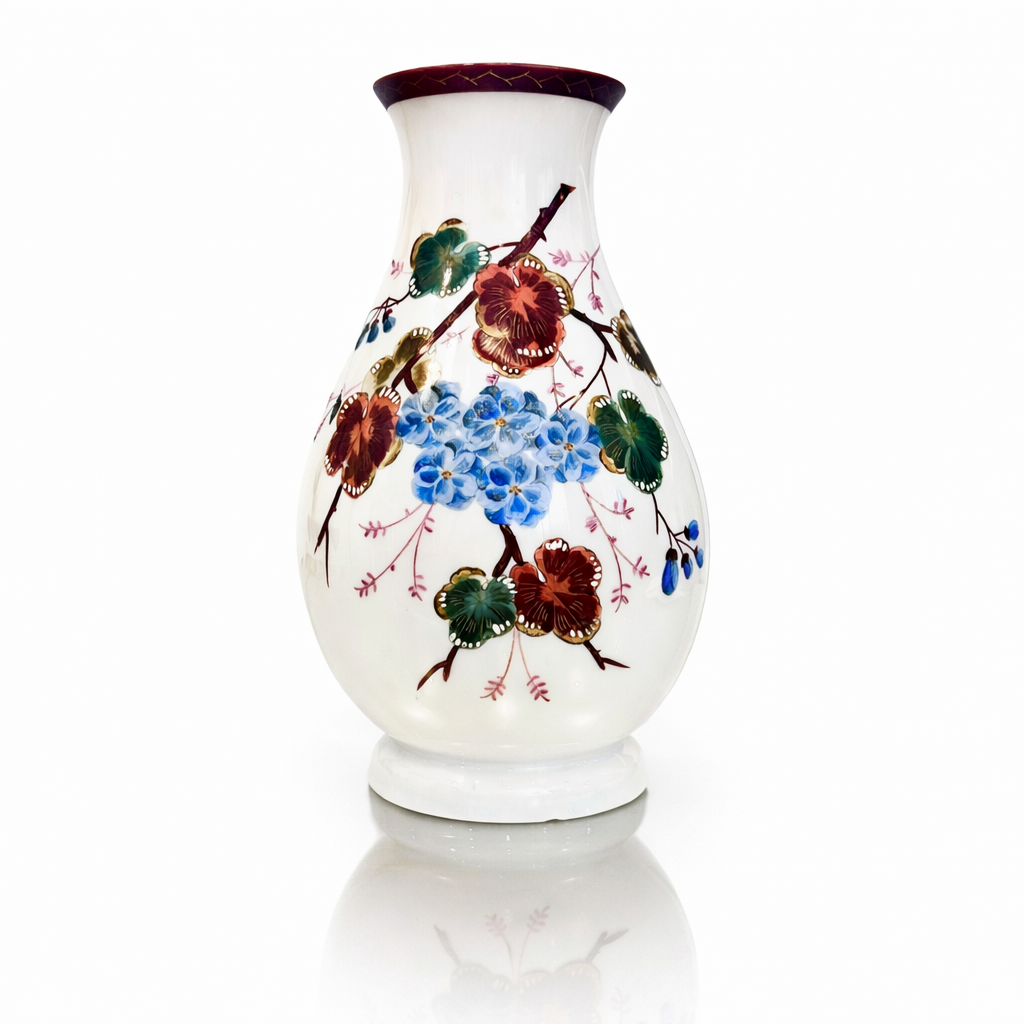
A softly luminous opaline glass vase distinguished by its rounded, sculptural body and gently flared neck, offering a refined balance between mass and delicacy. The surface is richly animated with hand-painted enamel florals in layered tones of cobalt, oxblood, and moss green, accented with raised white detailing that creates tactile depth and light-catching relief. The semi-translucent body diffuses light beautifully, giving the form a subtle inner glow. This piece reads as both decorative object and painterly surface, with strong presence on its own or within a curated grouping.
Attribution & Period
Unmarked decorative arts example, consistent with Bohemian (Czech) enamel-decorated opaline glass production, late 19th century (1880s). The milky opaline body, hand-applied enamel with raised dot accents, and naturalistic floral composition align closely with documented Bohemian export wares of the period. The polished pontil base and freehand decoration support hand-finished workshop production rather than later industrial manufacture. Attribution remains visual rather than documented due to absence of factory mark.
Dimensions & Weight
Height: 12 inches
Width / Diameter: 5.25 inches (widest belly)
Depth / Base Diameter: 4.25 inches (base), 4.25 inches (mouth)
Weight: 2.73 lbs
Condition
Good antique condition. Minor chip present along the base edge. Expected surface wear consistent with age, including light scuffing and base wear. Enamel decoration remains largely intact with minor losses and wear visible under close inspection. No major cracks or structural damage observed.
Authenticity & Construction
Hand-blown opaline glass body with hand-applied enamel decoration. The raised enamel work indicates multiple firing stages, a hallmark of 19th-century Bohemian decorative glass. The ground and polished pontil on the base confirms traditional finishing methods. The slight irregularities in form and brushwork further support hand production.
Placement
Ideal as a standalone sculptural accent on a console, mantel, or pedestal. Works particularly well in layered interiors incorporating European decorative arts, antique ceramics, or soft-toned palettes. Its scale and visual density allow it to anchor a vignette without overwhelming surrounding elements.
STANDARD ATTRIBUTION & VALUE DISCLOSURE; This piece is described to the best of current scholarly and market knowledge. Any maker or regional attribution is based on visual analysis, materials, construction techniques, and documented stylistic comparisons. As with many MCM and antique design objects, definitive attribution may not be possible without original labels or factory records. Pricing reflects condition, quality, decorative appeal, and current collector demand rather than guaranteed maker identification.
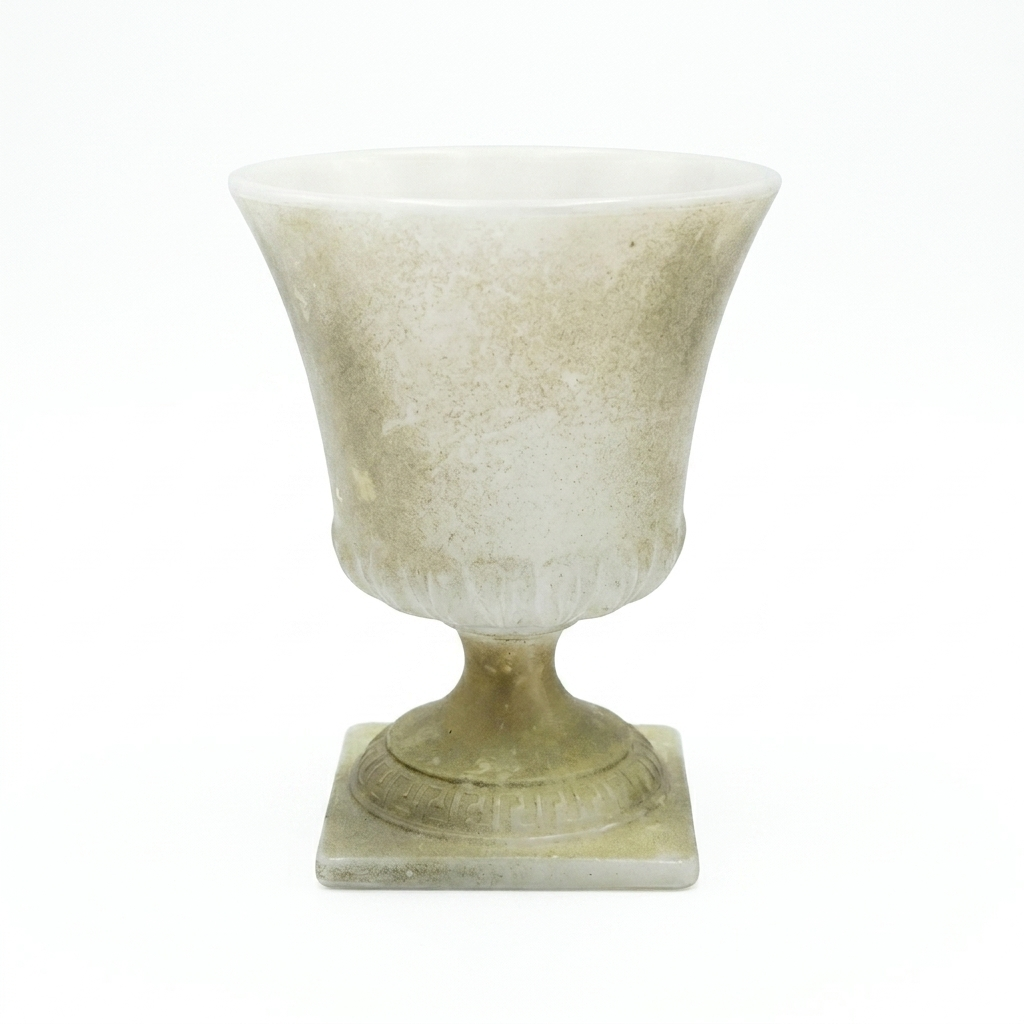
A sculptural statement piece, this pedestal compote demonstrates the substantial form and crisp detailing characteristic of mid-century American pressed milk glass. The vessel is elevated by a distinctively banded Greek key base, offering a sophisticated silhouette that bridges traditional ornamentation and modern minimalism. Its dense, opaque materiality catches ambient light, making it a compelling centerpiece for a curated interior.
Attribution & Period
By E.O. Brody Co.; 1960s. The piece is clearly marked "E.O. Brody" and "MJ-43" on the interior, with "Cleveland, Ohio USA" and "J-2519" on the base, confirming both origin and production era.
Dimensions Height: 7 in Width / Diameter: 5.75 in Depth / Base Diameter: 3.5 in Weight: N/A
Condition
Excellent condition. The surface retains a consistent, opaque finish with only minor signs of age-appropriate wear, such as faint surface scuffs consistent with light use. No chips, cracks, or repairs observed.
Authenticity & Construction
This piece is a quintessential example of mid-century American pressed glass manufacturing. The heavy, sculptural form is achieved through automated press-molding, a technique synonymous with E.O. Brody’s production of durable, geometrically precise decorative wares.
Curation
This bowl functions as a refined architectural accent. It is ideally suited for a minimalist credenza, a centerpiece for an eclectic dining arrangement, or as a textured focal point within a neutral, high-end display cabinet.
STANDARD ATTRIBUTION & VALUE DISCLOSURE This piece is described to the best of current scholarly and market knowledge. Any maker or regional attribution is based on visual analysis, materials, construction techniques, and documented stylistic comparisons. As with many MCM and antique design objects, definitive attribution may not be possible without original labels or factory records. Pricing reflects condition, quality, decorative appeal, and current collector demand rather than guaranteed maker identification.
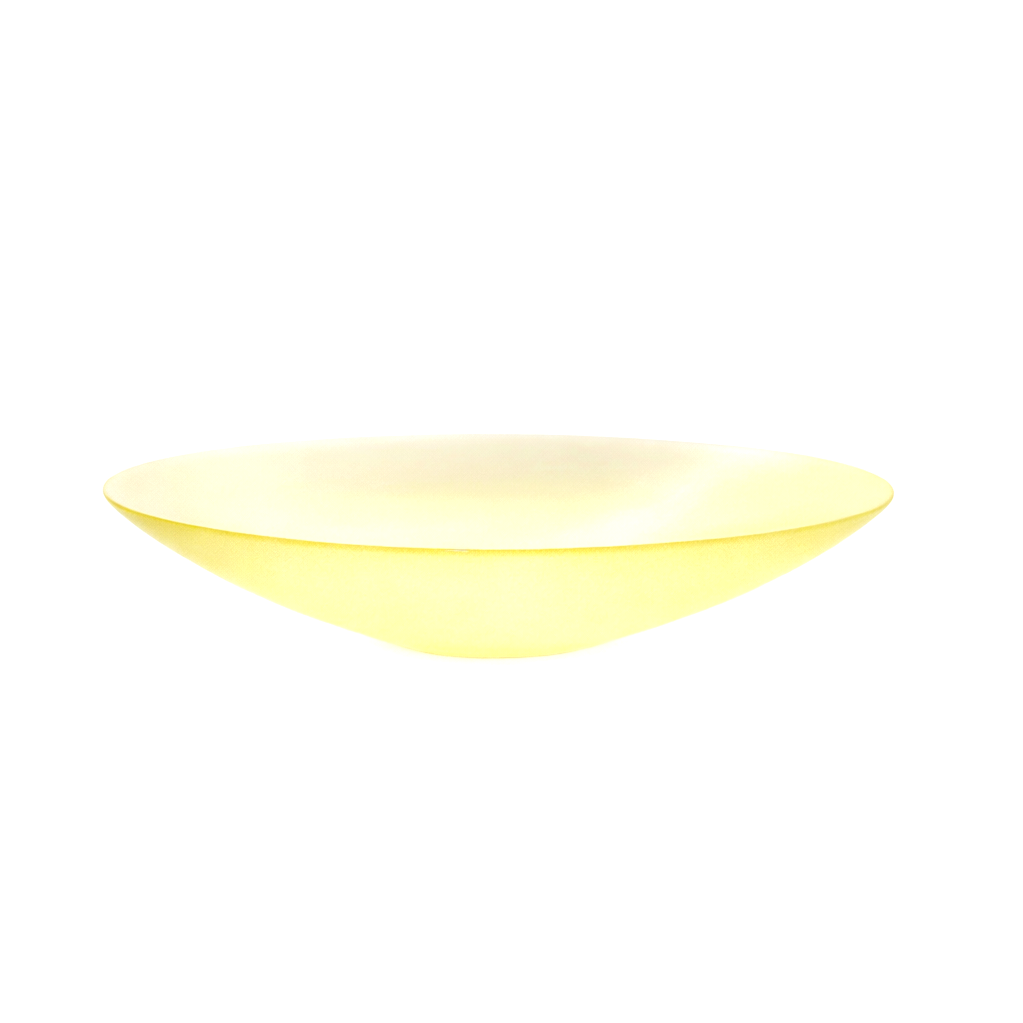
A wide, low-profile satin glass bowl with a luminous yellow tone and softly diffused surface, creating a refined interplay of light and translucency. The gently tapering form and broad diameter give it a strong sculptural presence, reading as both vessel and architectural object. Its subtle iridescence and matte finish soften reflections, enhancing its atmospheric quality. The restrained silhouette aligns with minimalist interiors while maintaining a distinctly organic character.
Attribution & Period
Scandinavian regional example, 1970s. The form, satin finish, and restrained color palette are consistent with Scandinavian art glass production of the period, particularly studio and factory work emphasizing organic profiles and diffused surfaces. No factory mark observed; attribution remains visual rather than documented.
Dimensions & Weight
Height: 2.75 in
Width / Diameter: 14 in
Depth / Base Diameter: 5.25 in
Weight: 2.85 lbs
Condition
Excellent condition. No cracks, chips, or scratches observed. Surface remains clean and consistent with original satin finish. Minor internal textural variation near the base—visible as a ripple effect from the hot glass forming process—documented in close-up imagery and inherent to manufacture.
Authenticity & Construction
Hand-formed glass, likely free-blown and shaped while hot, then finished with a satin acid-etched or sandblasted surface. The subtle ripple near the base reflects the natural movement of molten glass during shaping, supporting an authentic hand-worked process rather than pressed production. The even coloration and soft iridescence indicate controlled finishing typical of higher-quality art glass.
Placement
Ideal as a centerpiece on a dining or cocktail table, or as a sculptural accent on a console, credenza, or open shelving. Works particularly well in minimalist, Scandinavian, and contemporary interiors where material presence and form are prioritized over ornament.
STANDARD ATTRIBUTION & VALUE DISCLOSURE This piece is described to the best of current scholarly and market knowledge. Any maker or regional attribution is based on visual analysis, materials, construction techniques, and documented stylistic comparisons. As with many MCM and antique design objects, definitive attribution may not be possible without original labels or factory records. Pricing reflects condition, quality, decorative appeal, and current collector demand rather than guaranteed maker identification.
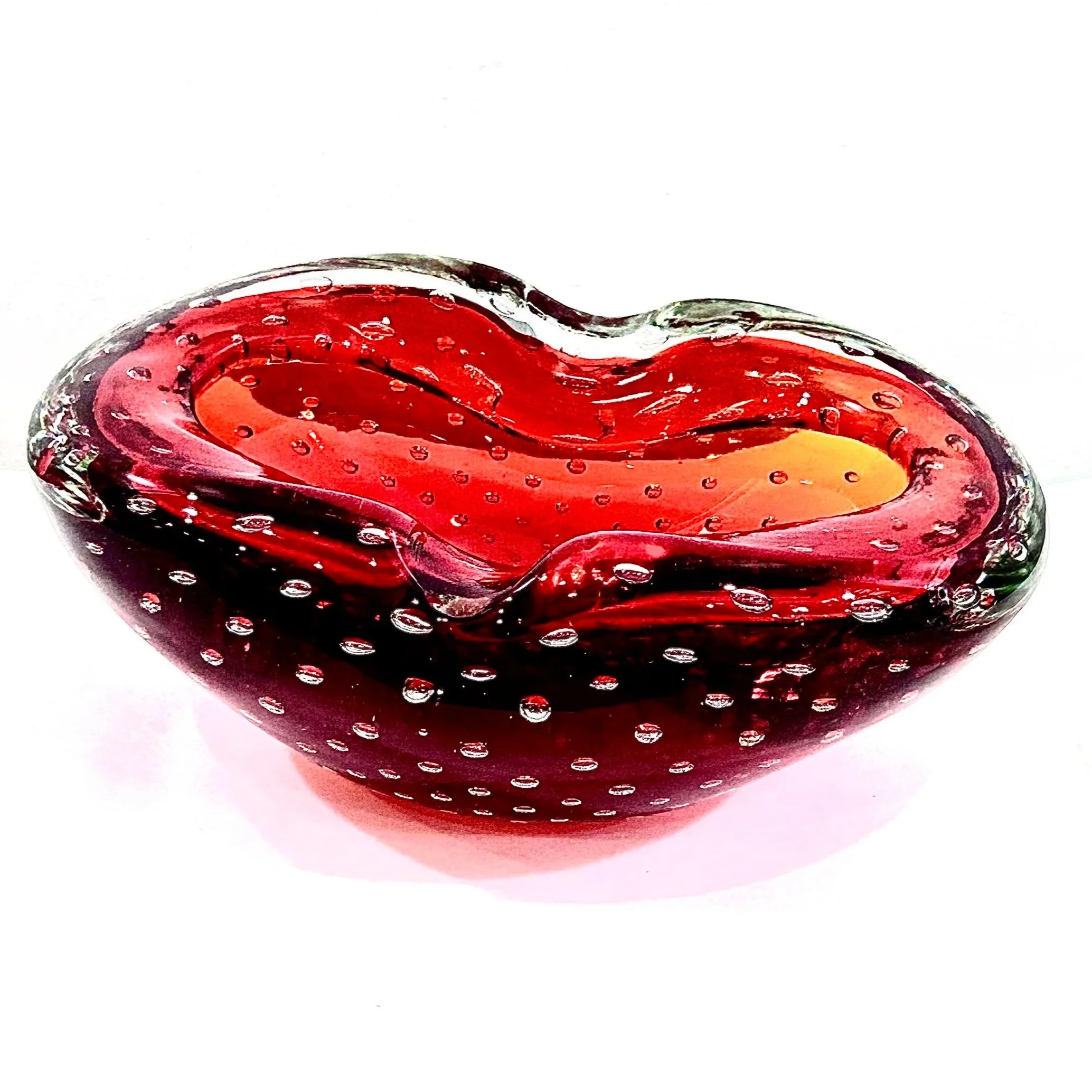
A compact yet visually powerful Murano glass bowl defined by its dense, jewel-toned red core suspended within a thick, clear casing. The form is fluid and biomorphic, with softly undulating edges that create shifting reflections and depth from every angle. Controlled air bubbles (bullicante) punctuate the surface, adding texture and optical complexity. Light passes through the clear exterior and refracts into the saturated interior, producing a luminous, almost molten effect. Despite its modest scale, the piece carries strong sculptural weight and presence.
Attribution & Period
Consistent with Murano, Italy glass production, 1960s. The sommerso technique (submerged colored core encased in clear glass) combined with controlled bullicante inclusions and thick, polished casing aligns with mid-century Murano studio practices. No factory mark observed; attribution remains visual rather than documented.
Dimensions & Weight
Height: 2.75 in
Width / Diameter: 5 in
Depth / Base Diameter: 6.25 in
Weight: 2.892 lbs
Condition
Excellent overall condition. No cracks or repairs observed. Tiny expected surface wear to the base consistent with age and use. No notable scratches to visible surfaces. Internal bubbles and inclusions are inherent to the manufacturing process. Under 365 UV light, the clear casing exhibits a subtle green fluorescence, noted for completeness.
Authenticity & Construction
Hand-blown art glass using the sommerso technique, where a colored glass core is encased within a thicker layer of clear glass. The bullicante effect is achieved through controlled air inclusion during forming. The substantial weight and clarity of the casing indicate a high-quality studio production, with careful finishing and polishing of the base.
Placement
Ideal as a sculptural accent on a cocktail table, console, or shelving within a refined interior. Works particularly well in modern, minimalist, or architecturally driven spaces where light interaction and material depth can be appreciated.
STANDARD ATTRIBUTION & VALUE DISCLOSURE; This piece is described to the best of current scholarly and market knowledge. Any maker or regional attribution is based on visual analysis, materials, construction techniques, and documented stylistic comparisons. As with many MCM and antique design objects, definitive attribution may not be possible without original labels or factory records. Pricing reflects condition, quality, decorative appeal, and current collector demand rather than guaranteed maker identification.
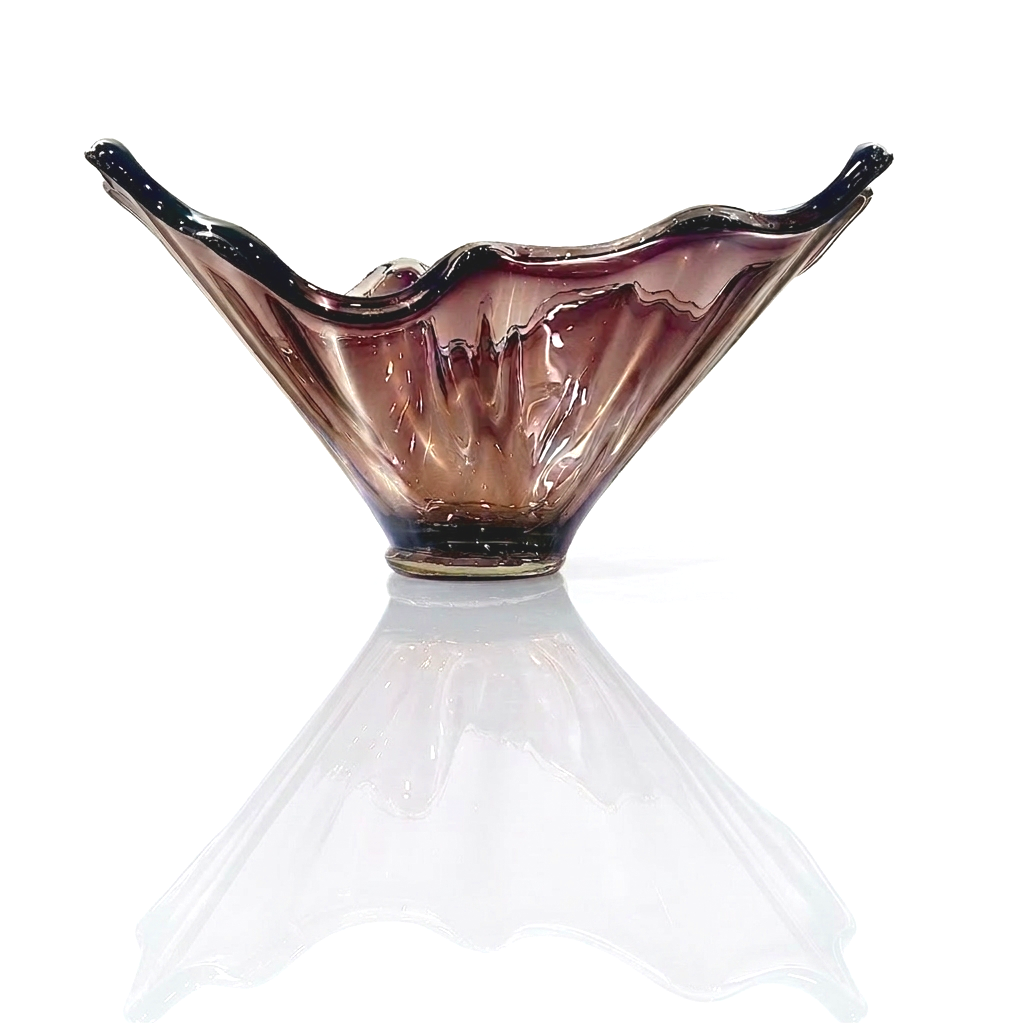
A commanding sculptural centerpiece defined by its sweeping, asymmetric form and deeply saturated amethyst tonality, this large-scale art glass bowl captures light with exceptional depth and movement. The flared, undulating rim transitions from rich purple to clear glass, creating a luminous halo effect that enhances its architectural silhouette. Subtle internal inclusions and controlled bubbles add dimensional complexity, while the thick, weighted base anchors the composition visually and physically. The piece reads as both functional vessel and standalone sculptural object, equally suited to refined interiors.
Attribution & Period
Unmarked Murano glass example, Italy, 1960s. The fluid freeform profile, sommerso-style color transition, and presence of controlled internal bubbles are consistent with mid-century Murano production. The substantial weight, polished pontil, and sculptural emphasis align with Italian studio glass practices of the period. No factory mark observed; attribution remains visual rather than documented.
Dimensions & Weight
Height: 10 inches
Width / Diameter: 18.25 inches (widest), 15 inches (narrowest)
Depth / Base Diameter: 4.25 inches
Weight: 7.256 lbs
Condition
Overall strong visual condition. One small internal crack visible within the base. Typical internal inclusions and controlled bubbles from the glassmaking process. Base shows a polished pontil with light wear consistent with age and handling. No major rim chips observed. Color transition and clarity remain vibrant.
Authenticity & Construction
Hand-blown art glass with a sculpted freeform rim and controlled cooling techniques. The polished pontil scar confirms removal from the blowpipe and finishing by grinding and polishing. The internal bubble inclusions and layered coloration indicate deliberate studio techniques rather than mass production, enhancing both visual depth and collectible appeal.
Placement
Ideal as a centerpiece on a dining or console table, or as a focal sculptural object on a plinth or glass shelf. Its scale and color make it particularly effective in minimalist, modernist, or gallery-style interiors where light interaction can be fully appreciated.
STANDARD ATTRIBUTION & VALUE DISCLOSURE; This piece is described to the best of current scholarly and market knowledge. Any maker or regional attribution is based on visual analysis, materials, construction techniques, and documented stylistic comparisons. As with many MCM and antique design objects, definitive attribution may not be possible without original labels or factory records. Pricing reflects condition, quality, decorative appeal, and current collector demand rather than guaranteed maker identification.
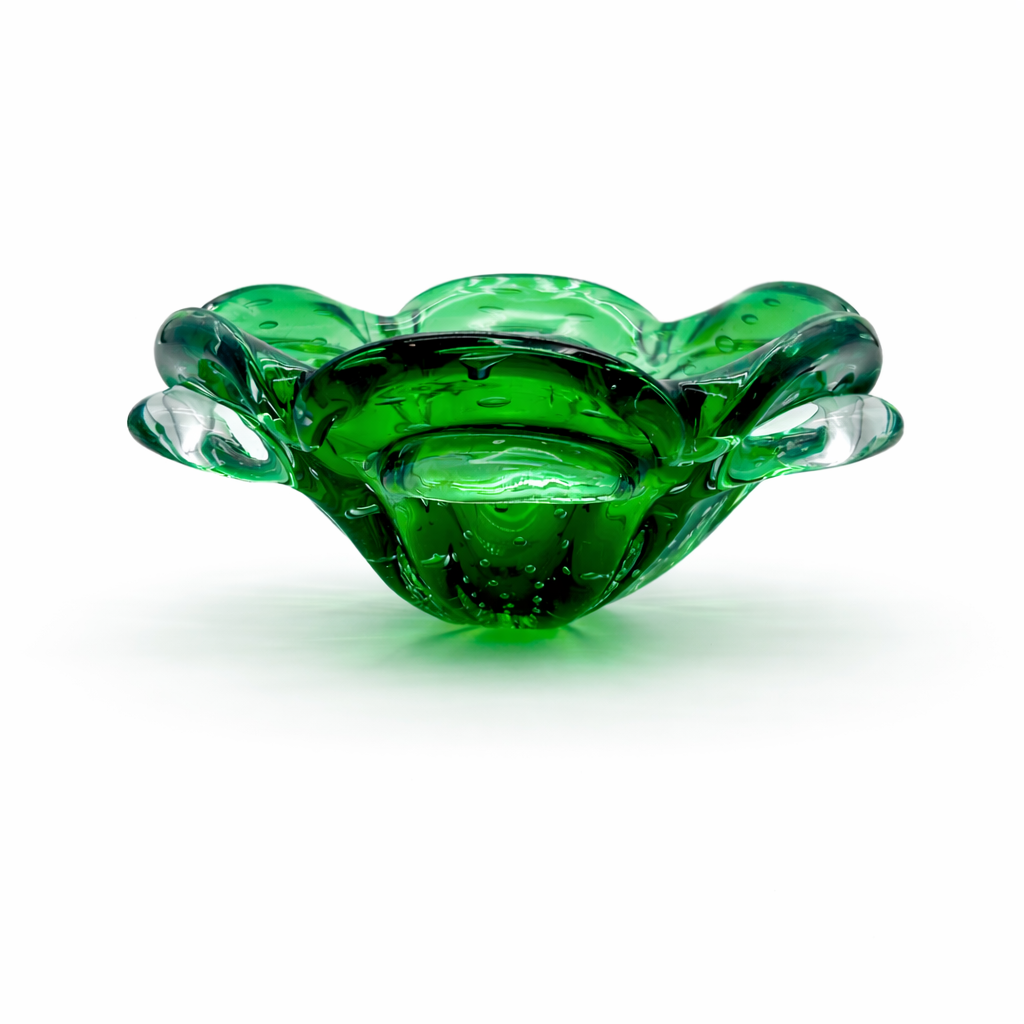
This sculptural emerald green art glass bowl presents a striking organic silhouette defined by sweeping folded lobes and a radiant internal bubble field. The heavy, luminous glass interacts dramatically with light, creating shifting tones from deep emerald to near-clear highlights along the curling rim. Viewed from above, the bowl reveals a rhythmic radial structure that reads almost floral or biomorphic in composition. The piece functions as a decorative centerpiece as much as a vessel, offering strong visual presence in both natural and artificial light.
Attribution & Period
Unmarked Czech art glass example, stylistically aligned with Central European studio and factory production of the 1960s. The saturated emerald coloration, controlled internal bubble inclusions, and thick sculptural mass are characteristic of Czech pressed and mold-assisted art glass from the mid-century period. The flowing organic rim and biomorphic symmetry reflect design language seen in Bohemian decorative glass works produced for export during this era. No factory mark was observed; attribution remains visual rather than documented.
Dimensions & Weight
Height: 3 in
Width / Diameter: 6.5 in
Depth / Base Diameter: 2 in
Weight: 2.206 lbs
Condition
Very good condition. No cracks, hairlines, chips, or repairs observed. Minor surface wear and light scratches present on the base consistent with normal shelf contact. Internal bubbles and inclusions are inherent to the manufacturing process. UV light images show optical color shift between green and blue due to glass thickness and light refraction, not damage.
Authenticity & Construction
Constructed from thick molded art glass with controlled bubble inclusions distributed throughout the body of the piece. The bowl was likely produced using a mold-assisted hot glass technique in which molten glass containing trapped air inclusions was formed into the sculptural radial mold, then hand-finished at the rim. The substantial weight and optical density confirm a solid art glass construction rather than thin blown glass.
Placement
Ideal as a sculptural centerpiece on a dining table, console, or cocktail table where directional light can activate the color depth and internal bubble structure. It also works effectively in layered interior compositions with stone, lacquer, or metal surfaces where the luminous emerald glass provides contrast and visual movement.
STANDARD ATTRIBUTION & VALUE DISCLOSURE
This piece is described to the best of current scholarly and market knowledge. Any maker or regional attribution is based on visual analysis, materials, construction techniques, and documented stylistic comparisons. As with many MCM and antique design objects, definitive attribution may not be possible without original labels or factory records. Pricing reflects condition, quality, decorative appeal, and current collector demand rather than guaranteed maker identification.
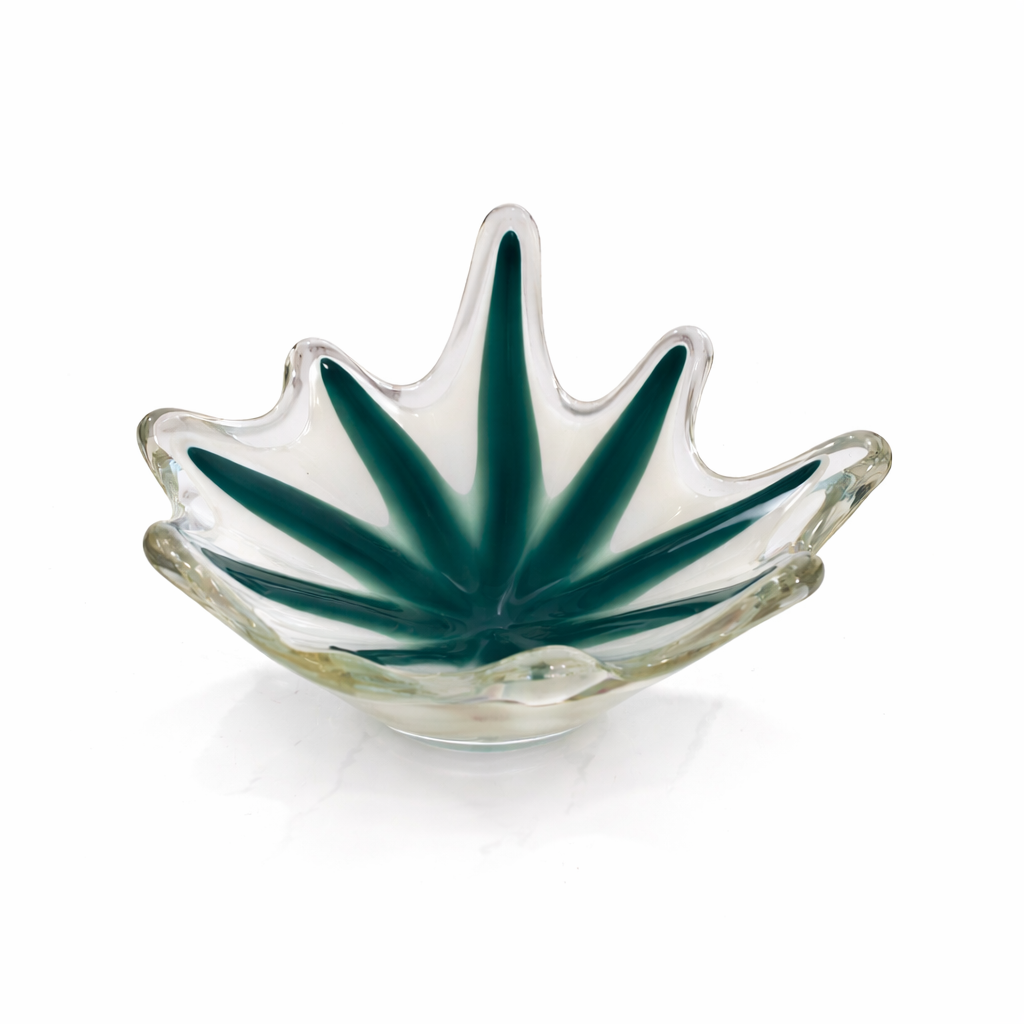
This striking mid-century centerpiece exemplifies the fluid, organic modernism that defined Swedish art glass in the 1950s. The piece features a dramatic "wing" profile, utilizing a complex cased-glass technique that creates an inner core of vibrant pigment suspended within a substantial layer of optical-grade clear glass. Its sculptural presence is amplified by its weight and scale, capturing and refracting light through its varying thicknesses and elegant, biomorphic curves.
Attribution & Period
by Paul Kedelv for Flygsfors
The piece is a definitive example of the "Coquille" series, designed by Paul Kedelv (1917–1990) for the Flygsfors glassworks in Sweden. The signature on the base is a documented factory mark for Flygsfors, dated 1956. Kedelv, who trained under the legendary Orrefors masters, launched the Coquille line in 1952; it remains his most celebrated work, characterized by these shell-like, pulled forms and the "Sommerso" style layering of colors.
Dimensions & Weight
Height: 5 1/2 inches
Width / Diameter: 11 1/4 inches
Depth / Base Diameter: 2 3/4 inches
Weight: 4.15 pounds
Condition
Excellent condition. The glass retains high clarity and luster. No chips, cracks, or significant fleabites are observed on the upper rim or body. The base exhibits light, age-appropriate shelf wear and faint surface scratches consistent with a 70-year-old decorative object. Minor internal bubbles (seeds) are present from the original hand-blowing process, typical of mid-century studio glass.
Authenticity & Construction
Hand-blown in Sweden using the cased glass technique. The artisan began with a core of colored glass, which was then dipped into clear molten glass and manipulated by hand using shears and jacks to pull the elongated "wings." The significant depth of clear glass at the base (3/4 inch) and edges (1/4 inch) is a hallmark of high-quality Flygsfors production, providing the necessary ballast and structural integrity for such a top-heavy, expressive form.
Placement
The sculptural silhouette and horizontal orientation make this an ideal centerpiece for a low-profile credenza, a mid-century teak dining table, or a sunlit architectural niche where the glass can interact with natural light.
STANDARD ATTRIBUTION & VALUE DISCLOSURE This piece is described to the best of current scholarly and market knowledge. Any maker or regional attribution is based on visual analysis, materials, construction techniques, and documented stylistic comparisons. As with many MCM and antique design objects, definitive attribution may not be possible without original labels or factory records. Pricing reflects condition, quality, decorative appeal, and current collector demand rather than guaranteed maker identification.
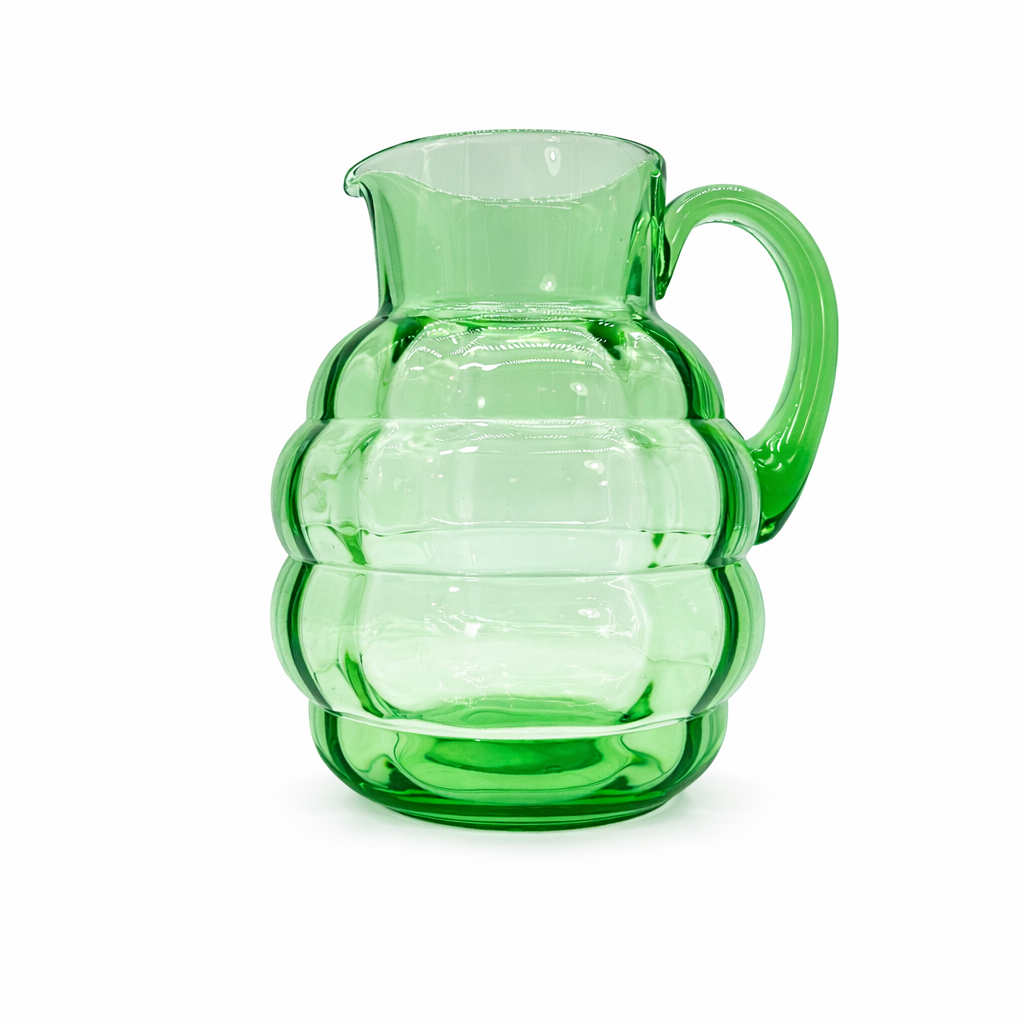
This sculptural green art glass pitcher presents a bold, architectural presence defined by its tiered, rounded body and elegantly arched handle. The luminous green glass shifts in tone from pale celadon to saturated emerald as it interacts with surrounding light, creating strong visual depth and movement. A delicately acid-etched floral and leaf motif encircles the central belly, introducing refined surface detail against the smooth molded form. Under UV 365 light, the vessel exhibits a vivid fluorescence characteristic of uranium glass, adding a dramatic collector feature. The result is a visually compelling decorative object that performs equally well as art glass sculpture or refined tabletop accent.
Attribution & Period
Circa 1930s; Unmarked decorative arts example, best described as a Central European uranium glass pitcher, stylistically aligned with Czech and Bohemian glass production of the interwar period.
The molded tiered body, integrated spout form, acid-etched botanical band, and uranium-green coloration correspond closely with decorative glass produced in Central Europe during the early twentieth century. Similar uranium glass vessels were produced in Bohemia and surrounding regions where pressed or molded forms were frequently enhanced with acid-etched ornamentation. No factory mark or label is observed on the base; attribution therefore remains visual rather than documented.
Dimensions & Weight
Height: 8.5 in
Width / Diameter: 6 in (widest measurement including handle and spout)
Depth / Base Diameter: 3.5 in base diameter
Weight: Not provided
Mouth diameter: 4 in
Condition
Excellent vintage condition. No scratches, chips, hairline cracks, or repairs observed. Surface remains glossy and clean with only minor base wear consistent with careful age and storage. Small internal bubbles and subtle mold characteristics typical of period glass production may be present and are inherent to the manufacturing process.
Authenticity & Construction
The vessel was produced using a molded glass form that created the distinctive three-tiered body profile and integrated spout geometry. The handle was applied while the glass remained hot, fusing seamlessly to the body. Following formation, the floral and leaf decoration was acid-etched into the surface, creating a soft matte motif that contrasts with the polished glass surface.
The vivid green coloration and strong fluorescence under UV 365 light indicate the presence of uranium oxide within the glass composition, a material commonly used in early twentieth-century European glassmaking to produce uranium or vaseline glass. This uranium content causes the glass to emit a bright green glow under ultraviolet light, a defining characteristic sought after by collectors.
Placement
This pitcher works exceptionally well as a sculptural decorative object on a dining credenza, bar cabinet, console table, or illuminated display shelf. When placed near natural light the glass reveals layered tonal depth, while UV display lighting dramatically activates the uranium fluorescence. The piece integrates easily into Art Deco interiors, modern decorative settings, and curated glass collections.
STANDARD ATTRIBUTION & VALUE DISCLOSURE; This piece is described to the best of current scholarly and market knowledge. Any maker or regional attribution is based on visual analysis, materials, construction techniques, and documented stylistic comparisons. As with many MCM and antique design objects, definitive attribution may not be possible without original labels or factory records. Pricing reflects condition, quality, decorative appeal, and current collector demand rather than guaranteed maker identification.

GLASS OVER THE DECADES
Maison de Valliéres presents an authoritative compendium tracing the evolution of glass over the past two centuries. This curated guide is arranged by period to assist the discerning collector in locating definitive works from each epoch — from early 19th-century innovations to contemporary studio rarities. For connoisseurs seeking provenance, technique, and stylistic lineage, begin with the era that defines your pursuit.
VICTORIAN
MID-CENTURY
ART DECO
ART NOUVEAU
MODERN
STUDIO
CONTEMPORARY