
AN INVESTMENT FOR A LIFETIME AND A LIFE

GENUINE GIFTS THAT NEVER STOP GIVING;
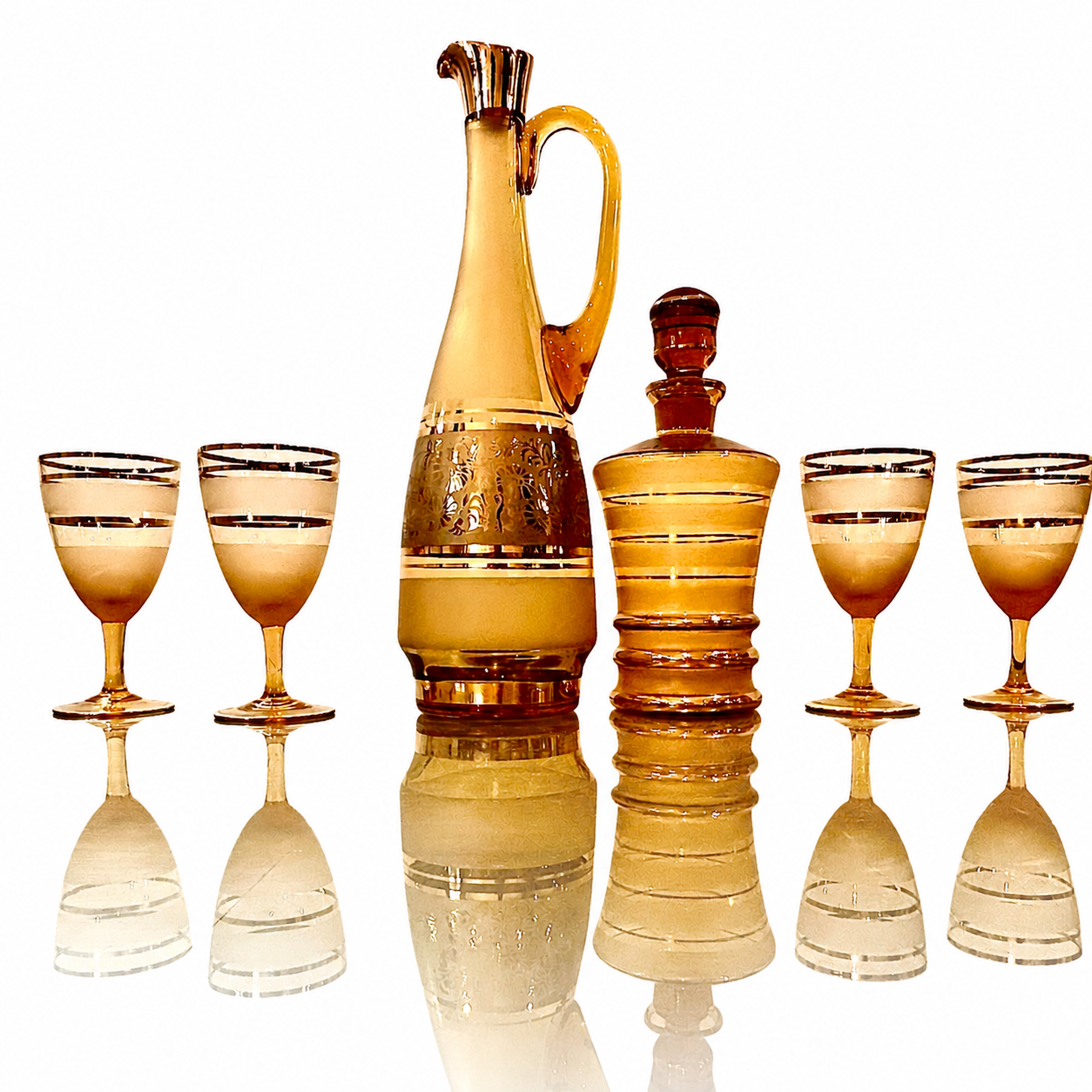
This masterfully curated six-piece cocktail entertainment suite captures the height of mid-century modern design, seamlessly blending fluid organic shapes with striking minimalist accents. The collection features two distinct, mouth-blown glass vessels—an elegant cocktail pitcher with a hand-drawn glass handle and a sculptural, bulbous decanter complete with its matching geometric stopper—complemented by a set of four tailored cocktail stems. Each piece is unified by precise, fired-gilt bands that wrap around the vessels, providing a warm, metallic contrast to the crystalline transparency of the glass. The interaction with light across the suite is incredibly sophisticated, allowing the gold-toned rings to catch ambient reflections while the ultra-clear, thin-walled bodies maintain a refined, airy presence.
Attribution & Period
Produced in Czechoslovakia during the 1960s, this comprehensive entertainment set is a definitive regional example of high-end Bohemian art glass. The design language is heavily aligned with the "Brussels Style" that emerged following Expo 58, favoring organic contours, exceptionally lightweight construction, and minimalist metallic accents over traditional heavy cutting. The technical composition, the precise execution of the "flashed" hand-painted gold bands, and the exceptional purity of the glass compound are deeply consistent with the luxury "muslin" glass lines produced by premier Czechoslovakian glassworks such as Sklárny Bohemia (Nový Bor).
Dimensions & Weight
Gilded Cocktail Pitcher / Carafe:
Height: 8 1/4 inches
Width / Diameter: 4 inches (at widest point of belly)
Depth / Base Diameter: 2 3/4 inches
Mouth Diameter: 1 1/2 inches
Weight: 0.75 pounds
Sculptural Decanter & Stopper:
Height: 8 1/4 inches (without stopper)
Width / Diameter: 4 inches (at widest point)
Depth / Base Diameter: 2 3/4 inches
Mouth Diameter: 1 1/2 inches
Weight: 0.75 pounds
Cocktail Stemware (Each of Four):
Height: 4 3/4 inches
Width / Diameter: 2 1/2 inches (mouth diameter)
Depth / Base Diameter: 2 inches
Weight: 0.192 pounds
Condition
The complete six-piece suite (seven pieces total including the original stopper) is in excellent condition, showing impeccable structural and aesthetic preservation. Clinical examination reveals no chips, cracks, clouding, or structural repairs to any of the vessels, the delicate glass handle, or the stopper plug. The hand-applied gilt detailing and horizontal accent bands remain remarkably bright and crisp, with only the most minor, age-appropriate micro-rubbing to the gold leaf in highly isolated areas and light surface scratches on the bases—both expected markers of authenticity for glass of this period.
Authenticity & Construction
This collection represents a tour de force of mouth-blown, thin-walled glass engineering. The remarkable lightness of each piece underscores the immense technical mastery required to blow glass to such a delicate, uniform thickness while maintaining structural resilience. The pitcher's fluid handle was hand-drawn and seamlessly fused to the molten body, a process requiring immense speed and precision. The ornamentation is executed by hand-applying a metallic gold compound as a "flashed" band before the pieces undergo a specialized kiln-firing, ensuring a high-bond finish typical of high-end mid-century Czechoslovakian production.
Placement
An absolute showpiece for a high-end mid-century modern home bar, this expanded cocktail set brings a powerful curated narrative to sophisticated spaces. It presents magnificently spread across a tier of a mirrored brass bar cart, housed within an illuminated teak sideboard niche, or arranged on a polished marble credenza. The uniform gold accents and clean, horizontal lines pair exceptionally well with brass hardware, natural wood tones, and contemporary stone surfaces, making it an elite addition for luxury editorial staging or high-concept entertaining.
STANDARD ATTRIBUTION & VALUE DISCLOSURE; This piece is described to the best of current scholarly and market knowledge. Any maker or regional attribution is based on visual analysis, materials, construction techniques, and documented stylistic comparisons. As with many MCM and antique design objects, definitive attribution may not be possible without original labels or factory records. Pricing reflects condition, quality, decorative appeal, and current collector demand rather than guaranteed maker identification.
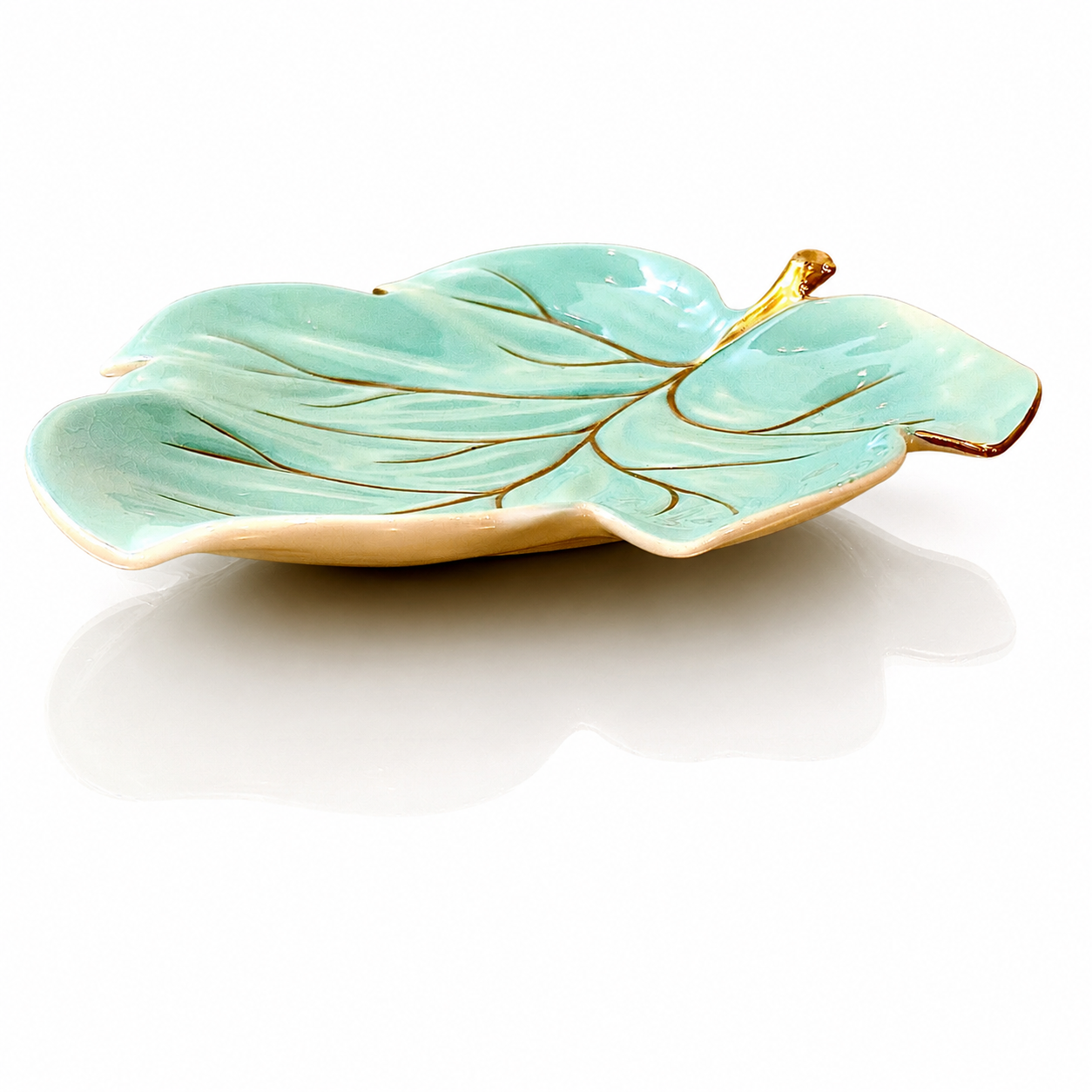
A highly sculptural Carlton Ware leaf-form dish distinguished by its softly modeled organic silhouette, celadon-to-seafoam glaze palette, and finely hand-painted branching decoration. The piece carries the coveted “Australian Design” backstamp, a designation associated with Carlton Ware’s export-oriented botanical lines produced in Stoke-on-Trent during the height of English Art Deco ceramic production. Its asymmetrical leaf profile and luminous glaze pooling create exceptional light play and strong decorative presence from every angle. The gold-accented stem and raised veining give the form a jewel-like quality that reads equally well in modernist, Palm Beach, Hollywood Regency, or European interiors.
Attribution & Period
By Carlton Ware, England, pattern/model no. 2367. Produced in Staffordshire, England, and most defensibly dating to the late 1930s to early 1940s based on the hand-painted “Australian Design” export mark, molded organic leaf form, and Carlton Ware glazing techniques associated with prewar and immediate post-Art Deco production. The “Australian Design” wording does not indicate Australian manufacture; rather, it refers to a decorative line and export-marketing designation used by Carlton Ware for botanical and floral wares intended for Commonwealth and international markets, particularly Australia. Comparable marked examples are consistently associated with Carlton Ware’s 1930s–1950s hand-painted decorative ceramics.
Dimensions & Weight
Height: 0.75 in
Width / Diameter: 7.5 in
Depth / Base Diameter: 6.75 in
Weight: 0.542 lbs
Condition
Excellent overall condition with strong glaze retention and no structural damage observed. One extremely small, unobtrusive flea bite/chip noted near the tip edge of the leaf form. Minor surface wear, kiln irregularities, and light underside wear consistent with age and careful handling. No visible repairs or restoration observed.
Authenticity & Construction
Hand-molded and hand-painted earthenware ceramic with gloss glaze finish and gilt-accented stem detailing. The underside retains the Carlton Ware hand-painted backstamp reading “Made in England,” “Trade Mark,” “Registered,” and “Australian Design,” along with impressed model number 2367. The dimensional veining, pooling glaze effects, and asymmetrical molded contour are characteristic of Carlton Ware’s higher-grade decorative production from Stoke-on-Trent.
Placement
An exceptional accent object for layered tablescapes, cocktail table styling, vanity presentation, or curated ceramic wall compositions. Particularly effective in interiors mixing English Art Deco ceramics, Italian modernist glass, Palm Beach color palettes, or organic contemporary design. Displays beautifully as a standalone sculptural object or integrated into a grouped botanical ceramic collection.
STANDARD ATTRIBUTION & VALUE DISCLOSURE; This piece is described to the best of current scholarly and market knowledge. Any maker or regional attribution is based on visual analysis, materials, construction techniques, and documented stylistic comparisons. As with many MCM and antique design objects, definitive attribution may not be possible without original labels or factory records. Pricing reflects condition, quality, decorative appeal, and current collector demand rather than guaranteed maker identification.
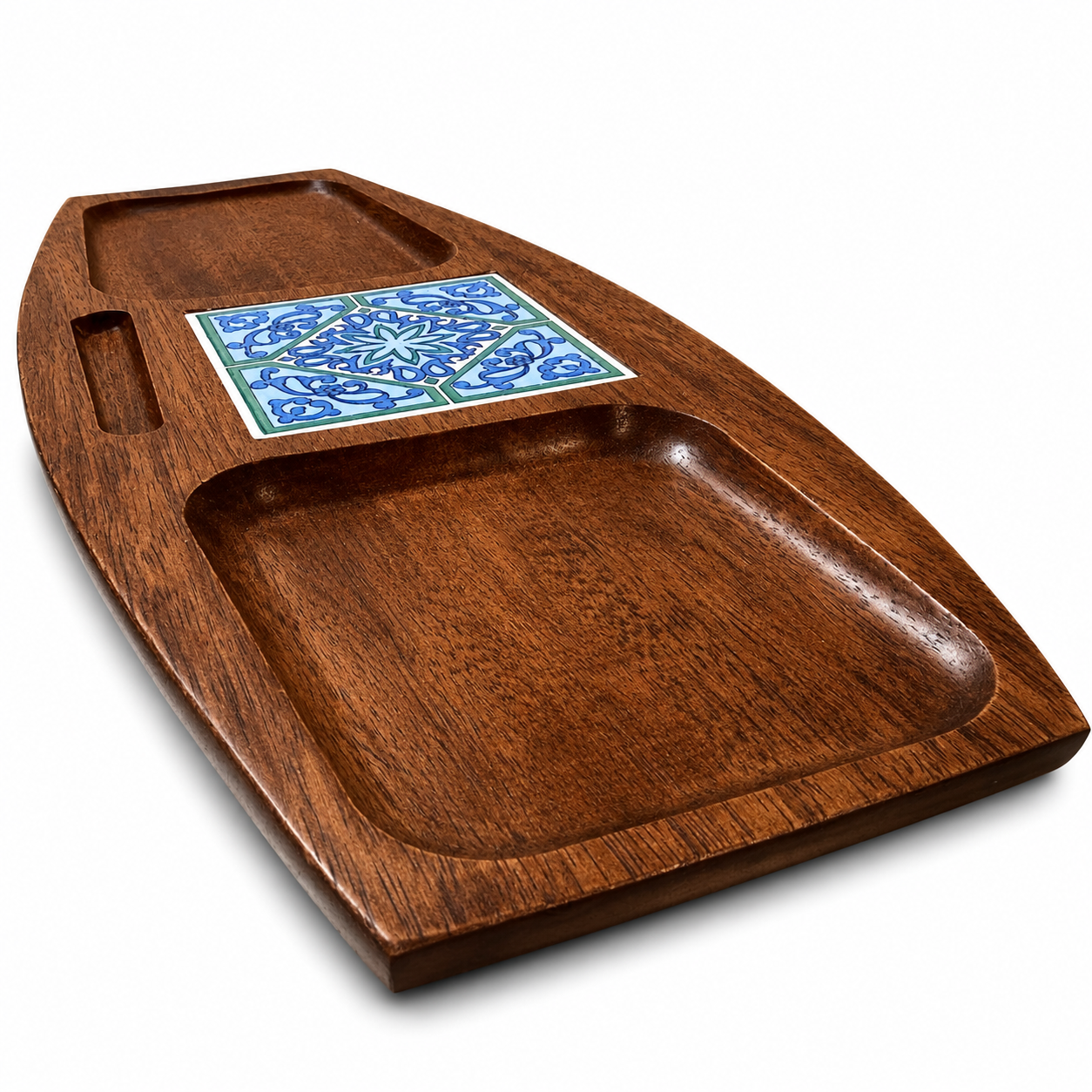
This exceptional elongated serving tray possesses a striking sculptural presence, defined by its fluid organic contours and compelling material contrast. The rich, golden-brown grain of the expertly carved solid teak frame beautifully borders a central inlay of vibrant turquoise-glazed ceramic tiles, creating a sophisticated tension between warm wood tones and cool glass-like surfaces. Light dances across the glossy, pooled glaze of the artistic tilework, accentuating the stylized abstract motifs and introducing a vivid pop of color to curated spaces. Designed with an elegant, streamlined silhouette, this versatile object serves as an architecturally interesting centerpiece or an editorial styling asset for high-end residential interiors.
Attribution & Period
Unmarked decorative arts example, stylistically aligned with Scandinavian Modern design, circa 1960s. The tray demonstrates the masterful woodworking techniques characteristic of Danish mid-century ateliers, featuring an organically carved solid teak wood frame with beautifully integrated, subtly upturned handles and a recessed central well. The rich, dense grain structure, golden-brown hue, and natural oils definitively verify the primary wood material as old-growth teak (*Tectona grandis*). The inset glazed ceramic tiles feature a stylized abstract motif against a vibrant turquoise ground, a design language highly consistent with European studio pottery of the era that integrated Mediterranean color palettes into streamlined Nordic forms. No factory marks or signatures are observed, meaning attribution remains visual and based on material quality and execution.
Dimensions & Weight
*Height:** 0.75 in
*Width / Diameter:** 18 in
*Depth / Base Diameter:** 7.6 in
*Weight:** 2.018 lbs
Condition
Excellent collector-grade condition. The solid teak frame exhibits minor, superficial scuff areas on the upper face near the edges, entirely consistent with age and light handling. The wood grain remains incredibly vibrant with a rich original patina and no structural splits, warping, or separations. The three inlaid ceramic tiles are exceptionally well-preserved, free of cracks, chips, or significant crazing, and remain securely seated flush within the carved recess. The underside shows minor shelf wear and light scuffing to the base edge, consistent with display over decades.
Authenticity & Construction
This piece is expertly crafted from a single, substantial plank of premium solid teak wood, meticulously carved and hollowed to create a seamless, fluid form with integrated handles. The precise routing of the central well allows the three hand-glazed ceramic tiles to sit perfectly flush with the surrounding timber surface. This masterful marriage of organic woodworking and studio ceramics ensures structural integrity and heat resistance, elevating the piece from a functional object into a highly collectible work of mid-century decorative art. The exceptional weight of over two pounds underscores the density and high quality of the old-growth timber utilized in its construction.
Placement
This tray is a spectacular addition to an editorial tablescape, ideally placed on a low-slung linear walnut or travertine coffee table to highlight its elongated profile. It also serves as a sophisticated textural accent on a minimalist sideboard, an entry console, or styled within an open architectural étagère alongside art books and studio pottery.
STANDARD ATTRIBUTION & VALUE DISCLOSURE; This piece is described to the best of current scholarly and market knowledge. Any maker or regional attribution is based on visual analysis, materials, construction techniques, and documented stylistic comparisons. As with many MCM and antique design objects, definitive attribution may not be possible without original labels or factory records. Pricing reflects condition, quality, decorative appeal, and current collector demand rather than guaranteed maker identification.
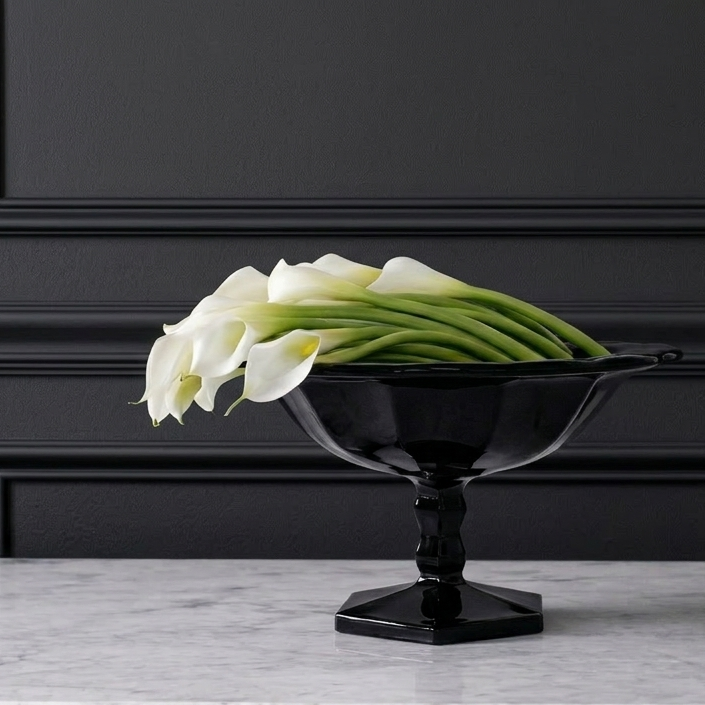
This striking centerpiece bowl exhibits a commanding sculptural presence, characterized by its deep, light-absorbing obsidian hue and substantial glass weight. The form features a bold, undulating scalloped rim that creates a rhythmic play of shadow and reflection across its polished surface. Supported by a faceted hexagonal pedestal, the object balances architectural geometry with organic fluid lines, making it a compelling focal point for a refined interior.
Attribution & Period
Stylistically aligned with American Mid-Century glass production, this piece is consistent with the high-quality press-molded techniques utilized by firms such as Tiffin or Fostoria during the 1940s. The dense "black" glass—technically a very deep purple known as black amethyst—and the precise faceting of the stem are characteristic of mid-century decorative arts from the Ohio River Valley region. No factory mark is observed, which is typical for glass of this era originally identified by paper labels.
Based on the hexagonal pedestal stem and the specific "scalloped" rim profile combined with the weight of the glass, this piece is most defensibly attributed to the 1940s.
While black glass had a surge in the 1930s (Depression era), the transition toward bolder, more geometric architectural stems like this hexagonal design became a hallmark of "Elegant Glass" manufacturers (like Tiffin and Fostoria) as they moved into the early 1940s. By the late 1950s, styles shifted toward more "free-form" or "organic" ruffles (like Viking Glass), making the structured, rhythmic scallops on your piece a classic representation of early-to-mid 1940s American glass design.
Dimensions & Weight
Height: 6 inches
Width / Diameter: 9 inches
Depth / Base Diameter: 4 1/4 inches
Weight: 2.336 lbs
Condition
The condition is excellent, presenting in collector-grade quality. Clinical observation reveals no chips, cracks, or professional repairs. The polished surface is remarkably well-preserved with no observed scratches or utensil marks. Base wear is minimal, consistent with age and careful display.
Authenticity & Construction
The object is crafted from solid, pigment-rich glass through a sophisticated molding and finishing process. The substantial weight and clarity of the mold lines signify a high standard of production, ensuring the durability and depth of color that distinguishes artisan glass from mass-market imitations. The transition from the hexagonal base to the fluted bowl demonstrates a mastery of geometric transitions.
Placement
This piece serves as an ideal architectural accent on a minimalist sideboard, a dark-stained executive desk, or as a central vessel on a contemporary dining table. Its monochromatic palette allows it to integrate seamlessly into both Brutalist and Hollywood Regency aesthetics.
STANDARD ATTRIBUTION & VALUE DISCLOSURE;This piece is described to the best of current scholarly and market knowledge. Any maker or regional attribution is based on visual analysis, materials, construction techniques, and documented stylistic comparisons. As with many MCM and antique design objects, definitive attribution may not be possible without original labels or factory records. Pricing reflects condition, quality, decorative appeal, and current collector demand rather than guaranteed maker identification.
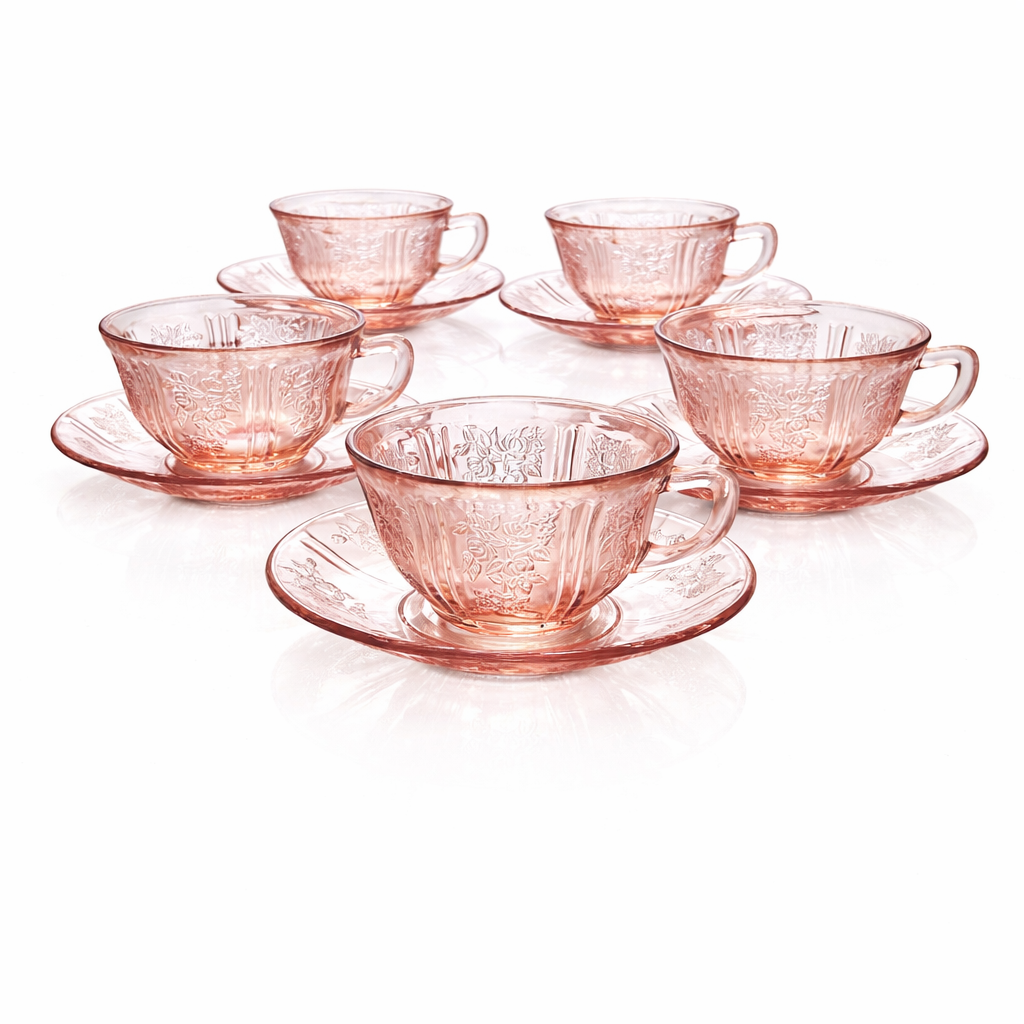
A complete and exceptionally preserved service of six pink Depression glass teacups with matching saucers, executed in a warm blush tone with molded rose garlands framed by vertical fluting.
Each cup presents a gently tapered bowl with crisp floral relief panels alternating with elongated vertical ribs. The handles are elegantly proportioned and seamlessly integrated. The matching saucers echo the same rose motif around the perimeter, anchored by a circular well and structured radial segmentation.
The glass displays luminous transparency with even color saturation and excellent mold clarity — a strong indicator of quality American pressed glass production of the 1930s–1940s. The rose relief pattern and panel structure are consistent with classic Depression-era elegant glass patterns produced by major American houses such as Federal Glass, Hocking Glass Company, or similar manufacturers.
Attribution & Period
Height of the American Depression-era "Elegant Glass" movement, this service features a rhythmic, panel-fluted structure and a delicately molded rose garland motif characteristic of the 1930s. The blush-pink coloration, integrated loop handles, and radial segmented saucers reflect the sophisticated aesthetic of the period's principal domestic manufacturers, blending period charm with architectural precision.
Dimensions & Weight
Each Cup:
Height: 2 1/2 inches
Base Diameter: 2 inches
Each Saucer:
Diameter: 5 3/4 inches
Footed Base Diameter: 2 3/4 inches
Balanced scale appropriate for tea service or refined display.
Condition
Excellent condition. No chips, cracks, or scratches observed on any of the six cups or saucers. Mold definition remains crisp. Surfaces retain strong clarity and even coloration throughout. A rare opportunity to acquire a fully intact service of this type in such preserved condition.
Authenticity & Construction
Pressed glass construction; the relief roses and vertical fluting are mold-pressed with clean definition and consistent repetition across all six examples, indicating original matched production rather than assembled replacements. The blush tone is characteristic of Depression-era pink glass, achieved through controlled mineral coloration within the molten batch. Subtle internal light refraction confirms period pressed glass technique.
Placement
Thick cased crystal, precision-cut with starburst and lens motifs and finished with machine-assisted decorative cutting and a ground, polished base; the clarity, refraction, and cutting depth confirm crystal construction, with a rich pink casing over clear crystal producing pronounced depth and tonal intensity.
STANDARD ATTRIBUTION & VALUE DISCLOSURE; This piece is described to the best of current scholarly and market knowledge. Any maker or regional attribution is based on visual analysis, materials, construction techniques, and documented stylistic comparisons. As with many vintage and antique glass objects, definitive attribution may not be possible without original labels or factory records. Pricing reflects condition, quality, decorative appeal, and current collector demand rather than a guaranteed maker identification.
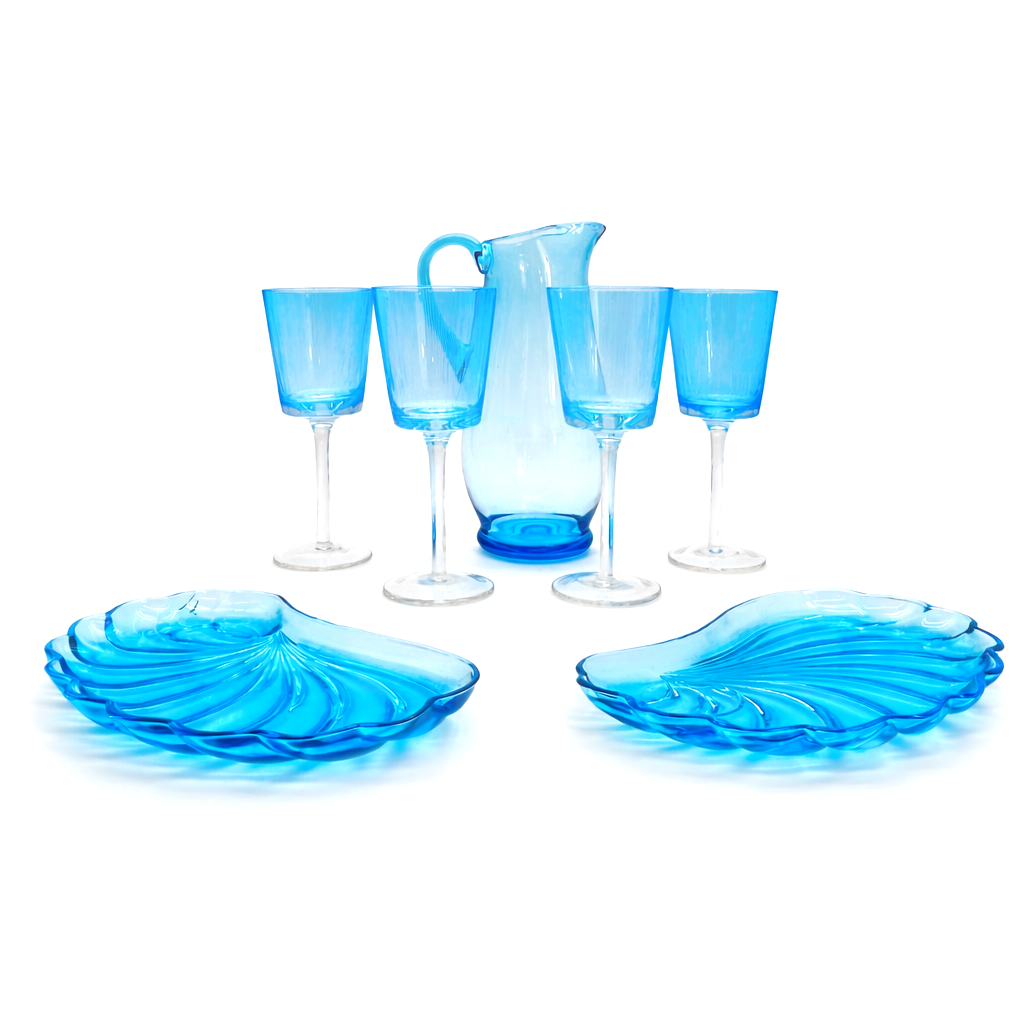
This curated seven-piece suite presents a masterclass in monochrome aquamarine glass, anchoring an interior with its luminous translucency and varied rhythmic textures. The collection—comprising a handblown opaline pitcher, a pair of shell-form dishes, and four optic ribbed wine glasses—is united by a shared tonal depth that shifts from ethereal sky blue to deep cerulean. Each element contributes to a cohesive, sculptural tablescape, offering a sophisticated interplay of smooth opaline surfaces, organic shell motifs, and architectural ribbing that interacts dynamically with both natural and UV light.
Attribution & Period Consistent with European decorative arts of the 1960s. The suite represents a curated assembly of mid-to-late 20th-century production, ranging from handblown Italian opaline glass (pitcher), stylistically aligned with Empoli-area workshops, to refined pressed glass examples (dishes and stemware). The attribution is based on a visual analysis of material composition—including manganese-bearing and uranium-reactive glass—and manufacturing techniques characteristic of the period.
Dimensions & Weight
Pitcher: 9" H x 5.5" W (including handle)
Shell Dishes (Pair): 10" L x 6.5" W x 1" H (each)
Wine Glasses (Set of 4): 7.75" H x 3.25" Diameter
Total Collection Weight: Approx. 6.5 lbs
Condition The suite is in overall excellent collector-grade condition. The pitcher and wine glasses show no chips, cracks, or repairs, with minor interior surface wear to the pitcher consistent with age. One shell-form dish exhibits a small, stable crack as documented; however, it does not compromise the structural or display integrity of the piece.
Authenticity & Construction This collection showcases a sophisticated range of glassmaking techniques. The pitcher features handblown construction with an elegantly applied handle and tooled spout, while the dishes and stemware utilize high-quality pressed-mold techniques to achieve their precise, symmetrical ribbing. The material integrity is confirmed through UV reactivity, with the stemware exhibiting a vivid green uranium fluorescence and the shells showing a soft manganese-driven glow under 365nm light.
Placement This assemblage is designed for high-concept entertaining or as a permanent sculptural installation on a minimalist sideboard, illuminated shelving, or a sun-drenched coastal console. While curated as a singular aesthetic statement, each component of this suite is also available for individual acquisition for those seeking a specific accent piece.
STANDARD ATTRIBUTION & VALUE DISCLOSURE This piece is described to the best of current scholarly and market knowledge. Any maker or regional attribution is based on visual analysis, materials, construction techniques, and documented stylistic comparisons. As with many MCM and antique design objects, definitive attribution may not be possible without original labels or factory records. Pricing reflects condition, quality, decorative appeal, and current collector demand rather than guaranteed maker identification.
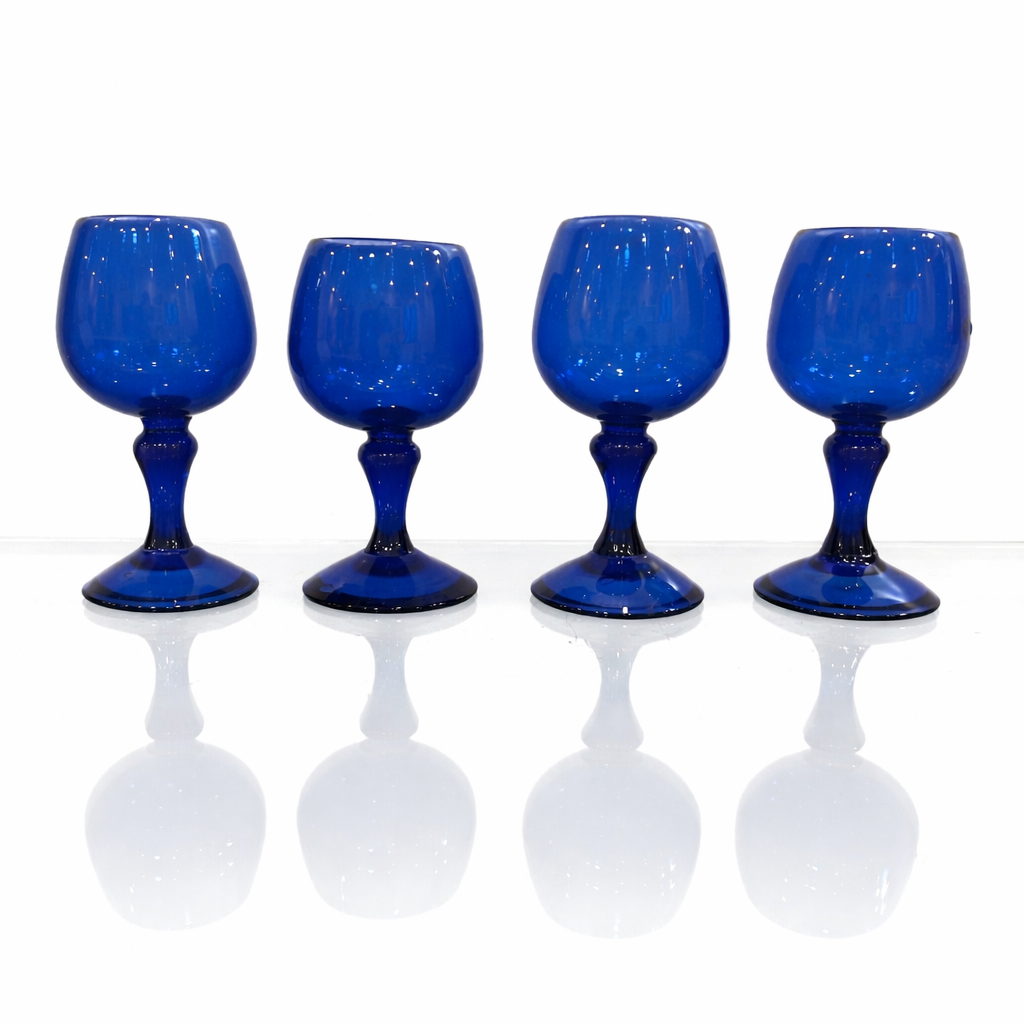
Set of four hand-blown cobalt blue glass goblets, each individually formed with subtle variations in scale and proportion, underscoring their artisanal manufacture. The goblets present a classic rounded bowl atop a slender, baluster-form stem and a gently flared foot, executed in richly saturated cobalt glass with excellent depth and clarity.
Each example shows a clearly defined pontil mark to the underside, visible in the close-up photographs, confirming hand-blown production rather than mold-formed manufacture. As expected with studio or small-batch glassmaking, no two goblets are identical: the bowls vary slightly in height and mouth diameter, lending the set a lively, organic character that collectors value.
The cobalt glass is evenly colored throughout, without flashing or surface application. Internal light play and soft striations visible under magnification are inherent to hot-worked glass and consistent with skilled freehand blowing. The weight and balance are excellent, making these both visually compelling and fully functional as tableware or display objects.
While unmarked, the form, material, and workmanship align with European hand-blown glass traditions, likely mid-20th century, and the set is offered unattributed to maintain accuracy.
⸻
Matched sets of hand-blown cobalt goblets are increasingly difficult to find, particularly with visible pontil marks and consistent color saturation. These occupy a desirable middle ground between decorative studio glass and usable stemware, appealing equally to interior designers, collectors of European glass, and those assembling refined bar or dining presentations.
⸻
This set of four hand-blown cordial glasses possesses a deep, mesmerizing cobalt hue that commands attention through its intense saturation and light-filtering properties. Each vessel exhibits a unique, organic silhouette, where the slight variations in scale and mouth opening emphasize the soulful, hand-wrought nature of the collection. The heavy-walled construction and spherical bowls create a compelling tactile experience, transforming functional stemware into a rhythmic sculptural installation for the modern sideboard.
⸻
Attribution & Condition Disclosure
All attributions regarding origin and date are offered in good faith based on observed construction and comparative examples and should be considered informed opinions rather than guarantees. Hand-blown glass naturally exhibits variation in form, thickness, and internal character. Buyers are encouraged to review all photographs carefully prior to purchase.
⸻
Dimensions & Weight
Quantity: Set of 4 goblets
Material: Hand-blown cobalt blue glass
Construction: Free-blown with visible pontil marks
Origin: Europe, likely studio or small-batch production
Date: Mid-20th century (circa 1950s–1970s)
Height: 4.5 in – 5 in (Variable)
Mouth Diameter: 1.625 in – 1.75 in (Variable)
Base Diameter: 2.5 in (Approximate)
Weight: 1.33 lbs (Collective)
Condition
The set is in excellent condition. No chips, cracks, or surface scratches are observed. The glass contains intentional, uncontrolled seed bubbles throughout the bowls and stems, characteristic of the hand-blowing process. The undersides feature authentic, rough-textured pontil marks where the glass was separated from the blowpipe, confirming handmade provenance.
⸻
Authenticity & Construction
These pieces are the result of traditional free-blown glassmaking. The variability in height and diameter serves as a testament to the maker's hand, ensuring no two pieces are identical. The inclusion of atmospheric bubbles within the molten glass adds a layered, "Brutalist" texture that captures and refracts light differently in every vessel.
Placement
Ideally suited for a contemporary bar cart or a minimalist open-shelf display. Their rich color provides a sophisticated "pop" against white marble or dark wood textures, making them an excellent choice for interior designers seeking to add depth and artisanal history to a dining space.
STANDARD ATTRIBUTION & VALUE DISCLOSURE; This piece is described to the best of current scholarly and market knowledge. Any maker or regional attribution is based on visual analysis, materials, construction techniques, and documented stylistic comparisons. As with many MCM and antique design objects, definitive attribution may not be possible without original labels or factory records. Pricing reflects condition, quality, decorative appeal, and current collector demand rather than guaranteed maker identification.
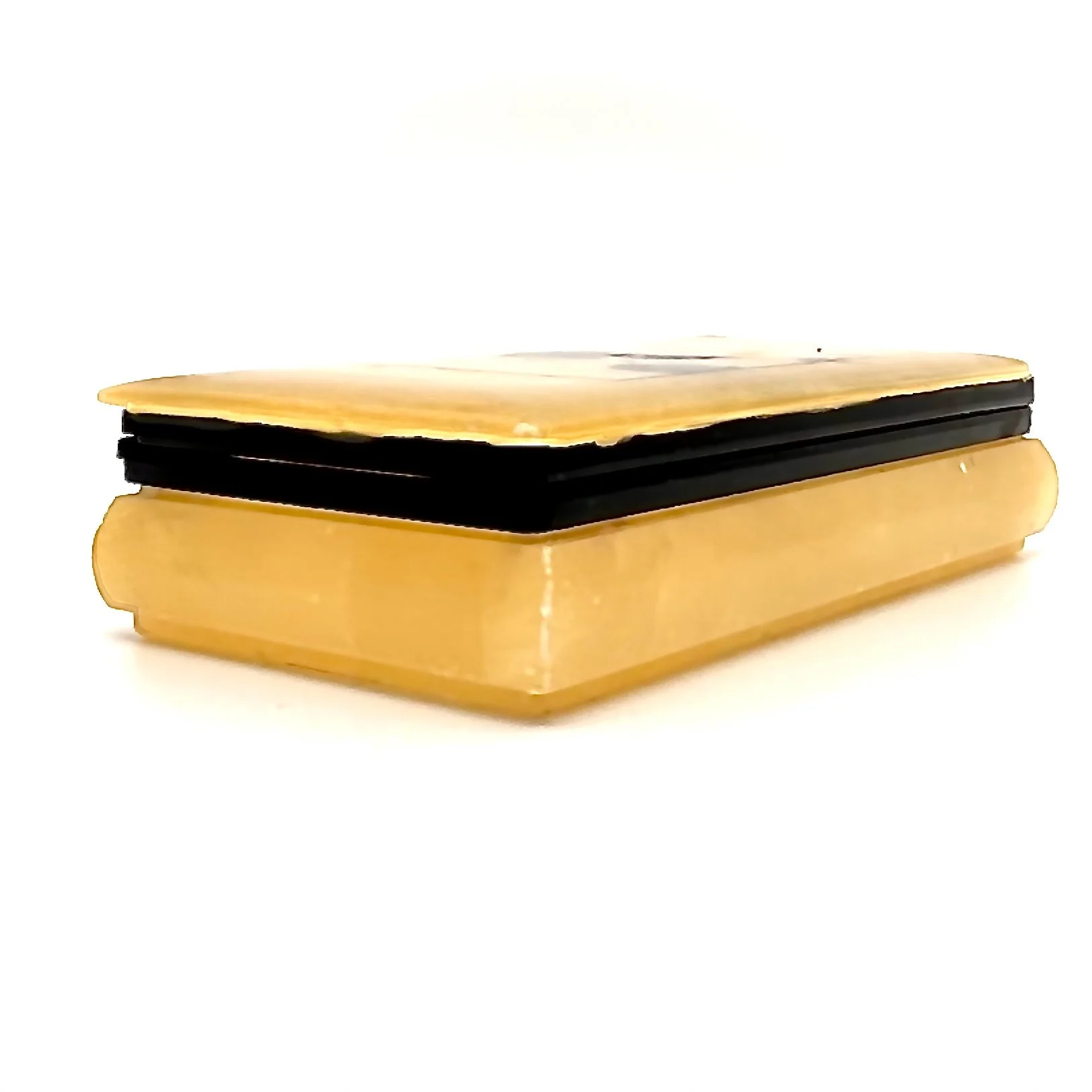
This substantial box showcases the ethereal, translucent properties of genuine Italian alabaster, characterized by its soft, milky veining and smooth, honed finish. The lid features a sophisticated low-relief carving that interacts beautifully with ambient light, revealing the natural crystalline structure of the stone. Its significant weight and cool-to-the-touch surface provide a tactile sense of luxury, transforming a traditional storage object into a piece of functional sculpture.
Attribution & Period
Consistent with Volterra Alabaster, Mid-Century Modern. The piece is marked "Hand Carved in Italy" and "Genuine Alabaster" on the underside, placing its origin in the Tuscan region of Volterra, renowned for its alabaster quarries since the Etruscan era. The lid bears the signature of R. Morelli (often phonetically transcribed as Motol), a prolific Italian artisan whose studio specialized in high-quality carved stone objects during the 1960s and 1970s.
Dimensions & Weight
Height: 4 in
Width: 7 1/8 in
Depth / Base Diameter: 3 1/4 in
Weight: 1.6 lbs
Condition
Clinical and polished. The alabaster maintains its original matte-to-satin finish with a seemlingly diagonal crack through the top of the lid that does not interfear with the art work or functionality of the box; minor chip present at the corners, but no skeletal repairs. The price is reflective of these notes. The internal compartment is clean, and the lid seats flush against the base. Minor natural inclusions are present within the stone, which are characteristic of authentic mineral formation rather than damage.
Authenticity & Construction
Hand-carved from a single block of natural alabaster. Unlike cast resin imitations, this piece was formed using traditional reductive carving techniques, evidenced by the crispness of the relief work on the lid and the natural variation in the stone's translucency. The hinge mechanism and stone-to-stone contact points reflect the precision of Italian mid-century lapidary work.
Placement
The architectural silhouette and neutral palette make this an ideal centerpiece for a brutalist coffee table or a refined executive desk. It serves as a sophisticated vessel for stationary, jewelry, or as a standalone decorative element in a minimalist or Neoclassical-inspired interior.
STANDARD ATTRIBUTION & VALUE DISCLOSURE; This piece is described to the best of current scholarly and market knowledge. Any maker or regional attribution is based on visual analysis, materials, construction techniques, and documented stylistic comparisons. As with many MCM and antique design objects, definitive attribution may not be possible without original labels or factory records. Pricing reflects condition, quality, decorative appeal, and current collector demand rather than guaranteed maker identification.
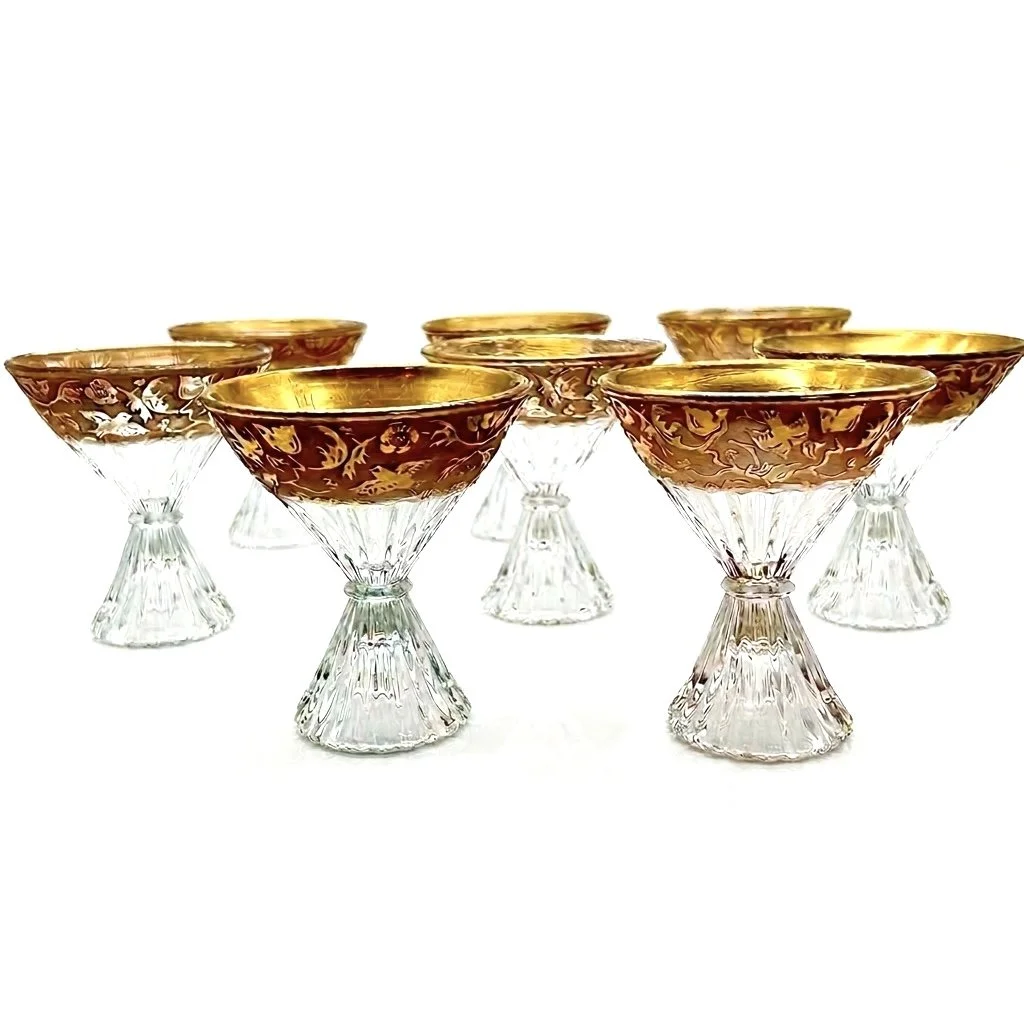
This exquisite set of cocktail stems represents the pinnacle of the American Elegant Glass movement. Defined by a dramatic "corset" or hourglass silhouette, each piece features a rhythmic, optic-ribbed body that creates a kaleidoscopic play of light. The focal point is the PC#545 "Spring Orchard" frieze—a deep-etched, 22K gold-encrusted masterpiece depicting a whimsical landscape of songbirds amidst flowering branches. These are not merely vessels; they are sculptural artifacts that bridge the gap between functional barware and high-end Depression-era decorative art.
Attribution & Period
Manufacturer: Paden City Glass Manufacturing Company, West Virginia, USA.
Pattern: No. 545 "Spring Orchard" (Gold Encrusted).
Circa: 1930–1949.
The "Spring Orchard" etching is one of Paden City’s most coveted designs, characterized by its "Minton-style" encrustation—a labor-intensive process where the pattern is acid-etched into the glass and then filled with heavy gold paste. This specific corset-shape stem is a hallmark of the Art Deco influence on Paden City’s production, offering a more avant-garde profile than the traditional stems of the era.
Dimensions & Weight
Height: 3.0 in
Rim Diameter: 2.94 in
Base Diameter: 2.5 in
Composition: High-clarity lead crystal with 22K gold application.
Condition Report
Excellent Vintage Condition. Clinical inspection reveals the crystal remains in a pristine state with no chips, cracks, or "flea bites." The glass maintains its original transparency with no signs of "sick" glass or mineral clouding. Regarding the gold encrustation: The heavy 22K gilding remains remarkably vibrant. Consistent with age and authentic use, some pieces may show microscopic thinning at the extreme interior rim, though the primary etched frieze remains dense, tactile, and highly reflective.
Authenticity & Construction
Hand-blown into a specialized mold to achieve the internal optic ribbing, these glasses demonstrate the technical prowess of West Virginia glassmakers. The "Spring Orchard" motif is achieved through a multi-stage firing process. Unlike standard gold wash, this gold-encrusted method results in a jewelry-like texture that is raised to the touch, providing a luxurious sensory experience for the collector.
Curation & Placement
These stems are ideally suited for a high-gloss lacquer bar or a mirrored Art Deco sideboard. Their architectural "corset" shape and metallic luster make them a perfect choice for a Hollywood Regency-inspired interior or a curated collection of "Elegant Glass." They are best displayed under direct gallery lighting to fully realize the "fire" within the gold-etched pattern.
STANDARD ATTRIBUTION & VALUE DISCLOSURE; This piece is described to the best of current scholarly and market knowledge. Any maker or regional attribution is based on visual analysis, materials, construction techniques, and documented stylistic comparisons. As with many MCM and antique glass objects, definitive attribution may not be possible without original labels or factory records. Pricing reflects condition, quality, decorative appeal, and current collector demand rather than a guaranteed maker identification.
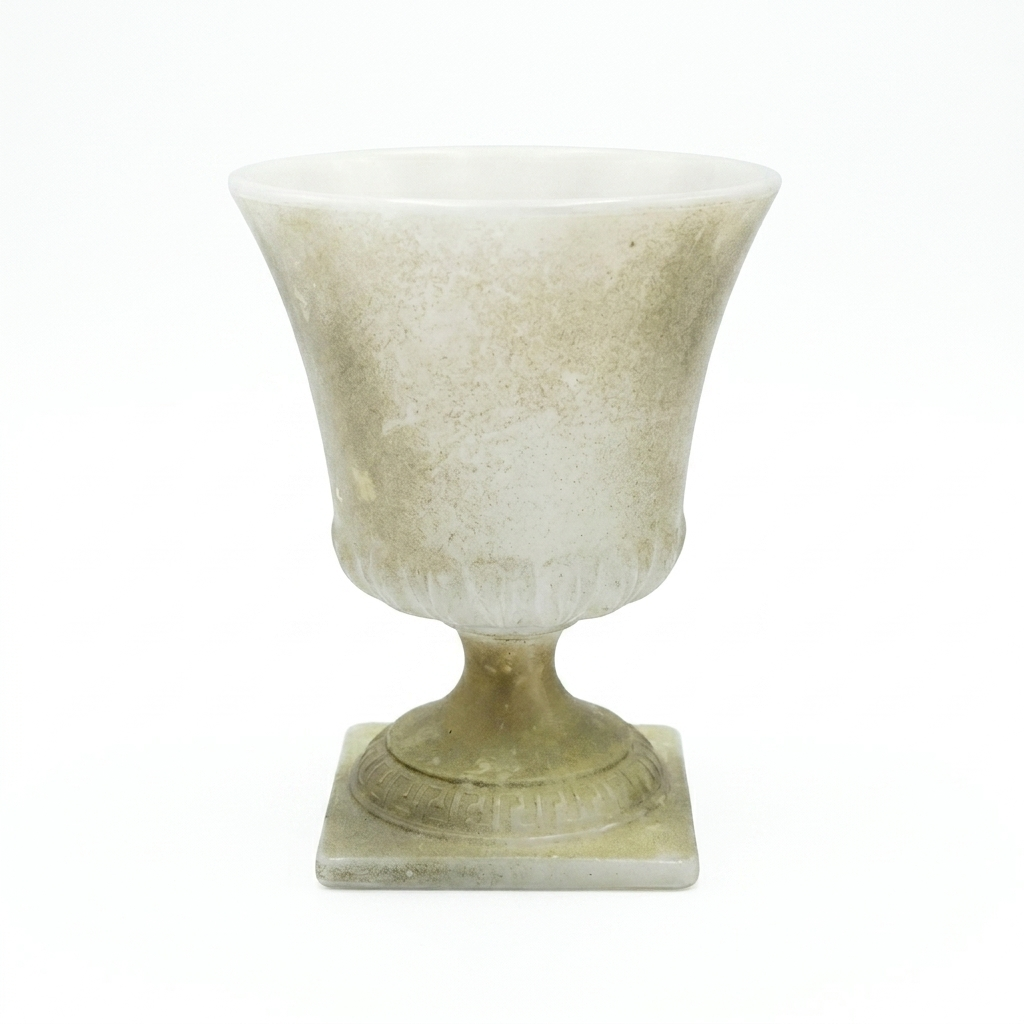
A sculptural statement piece, this pedestal compote demonstrates the substantial form and crisp detailing characteristic of mid-century American pressed milk glass. The vessel is elevated by a distinctively banded Greek key base, offering a sophisticated silhouette that bridges traditional ornamentation and modern minimalism. Its dense, opaque materiality catches ambient light, making it a compelling centerpiece for a curated interior.
Attribution & Period
By E.O. Brody Co.; 1960s. The piece is clearly marked "E.O. Brody" and "MJ-43" on the interior, with "Cleveland, Ohio USA" and "J-2519" on the base, confirming both origin and production era.
Dimensions Height: 7 in Width / Diameter: 5.75 in Depth / Base Diameter: 3.5 in Weight: N/A
Condition
Excellent condition. The surface retains a consistent, opaque finish with only minor signs of age-appropriate wear, such as faint surface scuffs consistent with light use. No chips, cracks, or repairs observed.
Authenticity & Construction
This piece is a quintessential example of mid-century American pressed glass manufacturing. The heavy, sculptural form is achieved through automated press-molding, a technique synonymous with E.O. Brody’s production of durable, geometrically precise decorative wares.
Curation
This bowl functions as a refined architectural accent. It is ideally suited for a minimalist credenza, a centerpiece for an eclectic dining arrangement, or as a textured focal point within a neutral, high-end display cabinet.
STANDARD ATTRIBUTION & VALUE DISCLOSURE This piece is described to the best of current scholarly and market knowledge. Any maker or regional attribution is based on visual analysis, materials, construction techniques, and documented stylistic comparisons. As with many MCM and antique design objects, definitive attribution may not be possible without original labels or factory records. Pricing reflects condition, quality, decorative appeal, and current collector demand rather than guaranteed maker identification.
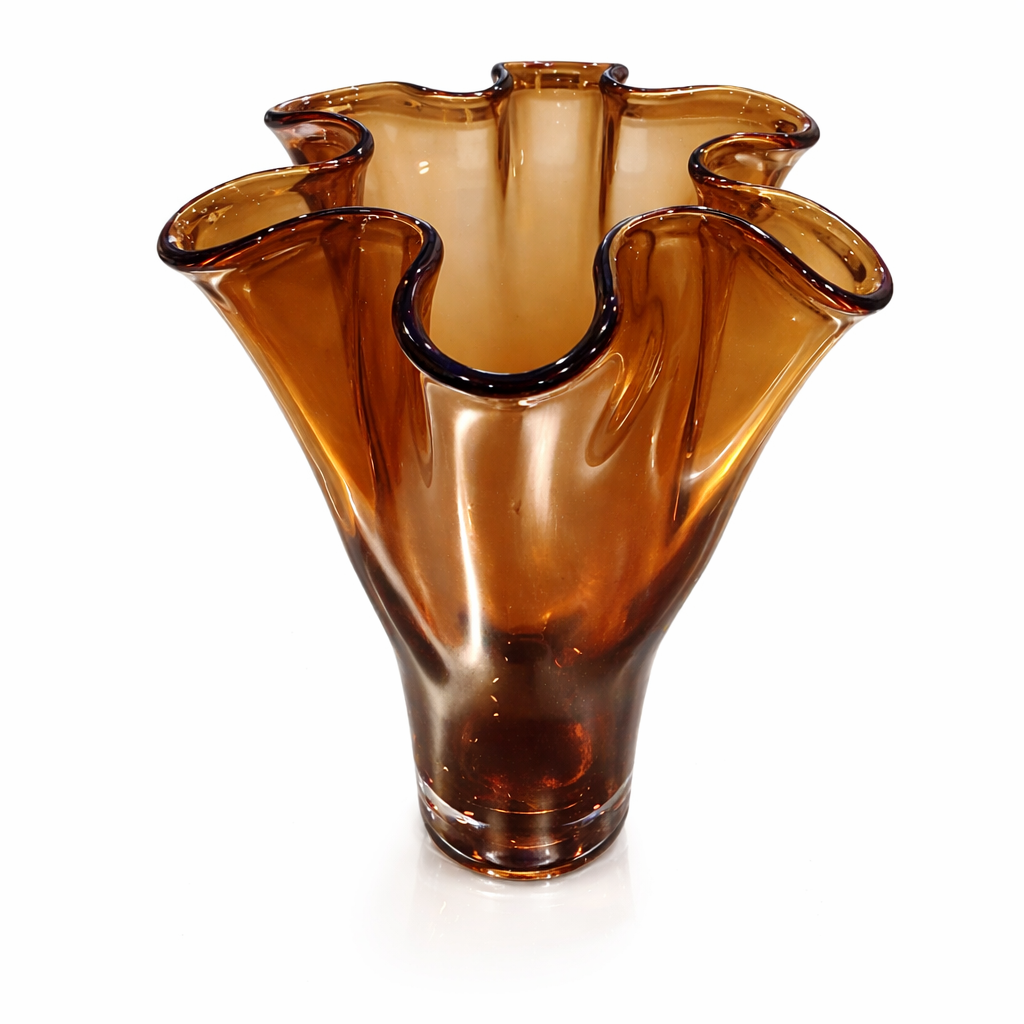
A dramatic mid-century, inspired hand-blown art glass vase in rich amber, shaped in the celebrated fazzoletto (handkerchief) tradition, with a six-lobed, ruffled rim finished in a deep cobalt-to-amethyst edge. The silhouette is all movement; folded, wave-like shoulders that rise from a substantial, thick-walled base, giving the piece real architectural presence and the satisfying weight collectors look for in quality art glass.
Authenticity & Construction
The vase shows uncontrolled air bubbles throughout the body;an honest studio-glass hallmark that confirms hot-worked production rather than factory-pressed glass. The base appears exceptionally thick and polished, with a subtle symmetrical vertical groove/optic suggestion rising upward, adding depth and light-play when displayed near a window or under gallery lighting.
Attribution & Period
Design context and dating The ”fazzoletto” form is historically associated with Italian Murano design; the handkerchief concept was jointly conceived by Fulvio Bianconi and Paolo Venini in 1948, and the style was produced in many variations afterward. (The Metropolitan Museum of Art) Based on the profile, heavy base, and color treatment, this example is best placed as late 20th century, circa 1960s-1970s, in the Murano taste. Maker is unattributed due to the absence of a signature or label.
Dimensions & Weight
Height: 12 inches
Width: 9.5 inches
Base diameter: 3.5 inches
Weight: 5.692 pounds
Condition
Very good overall condition. Light scratching to the underside/base only; no other surface scratching noted. No signature observed. Air bubbles are present throughout and are inherent to the making.
Placement
Style Mid-Century Modern “Italian Modern” Murano taste; Organic Modern; Sculptural
STANDARD ATTRIBUTION & VALUE DISCLOSURE
Disclosure All maker attributions, dates, and origins are offered in good faith based on visible construction details and comparative market research, and should be considered informed opinions rather than guarantees. Studio glass is hand-formed and may exhibit natural variations including asymmetry, surface texture, air bubbles, or minor inclusions inherent to the process. Buyers are encouraged to review all images and request additional details prior to purchase.
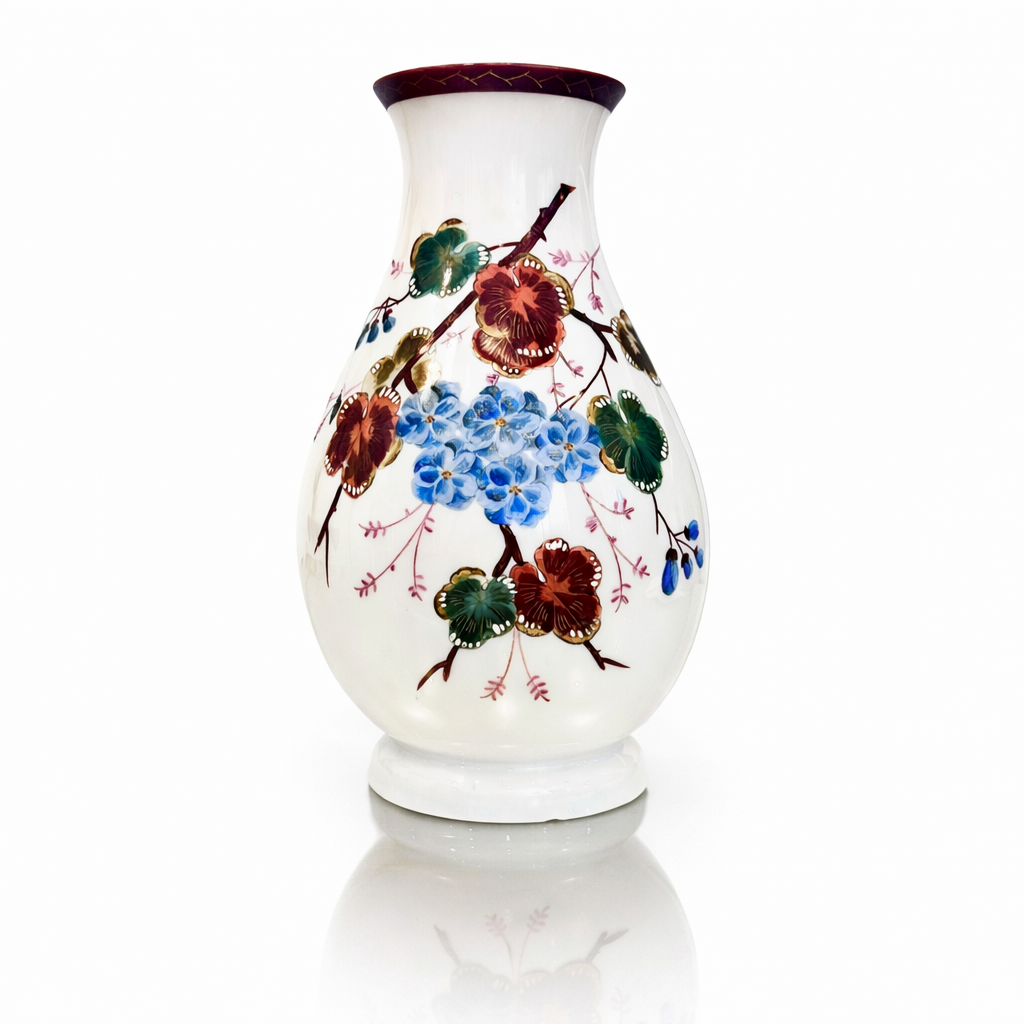
A softly luminous opaline glass vase distinguished by its rounded, sculptural body and gently flared neck, offering a refined balance between mass and delicacy. The surface is richly animated with hand-painted enamel florals in layered tones of cobalt, oxblood, and moss green, accented with raised white detailing that creates tactile depth and light-catching relief. The semi-translucent body diffuses light beautifully, giving the form a subtle inner glow. This piece reads as both decorative object and painterly surface, with strong presence on its own or within a curated grouping.
Attribution & Period
Unmarked decorative arts example, consistent with Bohemian (Czech) enamel-decorated opaline glass production, late 19th century (1880s). The milky opaline body, hand-applied enamel with raised dot accents, and naturalistic floral composition align closely with documented Bohemian export wares of the period. The polished pontil base and freehand decoration support hand-finished workshop production rather than later industrial manufacture. Attribution remains visual rather than documented due to absence of factory mark.
Dimensions & Weight
Height: 12 inches
Width / Diameter: 5.25 inches (widest belly)
Depth / Base Diameter: 4.25 inches (base), 4.25 inches (mouth)
Weight: 2.73 lbs
Condition
Good antique condition. Minor chip present along the base edge. Expected surface wear consistent with age, including light scuffing and base wear. Enamel decoration remains largely intact with minor losses and wear visible under close inspection. No major cracks or structural damage observed.
Authenticity & Construction
Hand-blown opaline glass body with hand-applied enamel decoration. The raised enamel work indicates multiple firing stages, a hallmark of 19th-century Bohemian decorative glass. The ground and polished pontil on the base confirms traditional finishing methods. The slight irregularities in form and brushwork further support hand production.
Placement
Ideal as a standalone sculptural accent on a console, mantel, or pedestal. Works particularly well in layered interiors incorporating European decorative arts, antique ceramics, or soft-toned palettes. Its scale and visual density allow it to anchor a vignette without overwhelming surrounding elements.
STANDARD ATTRIBUTION & VALUE DISCLOSURE; This piece is described to the best of current scholarly and market knowledge. Any maker or regional attribution is based on visual analysis, materials, construction techniques, and documented stylistic comparisons. As with many MCM and antique design objects, definitive attribution may not be possible without original labels or factory records. Pricing reflects condition, quality, decorative appeal, and current collector demand rather than guaranteed maker identification.
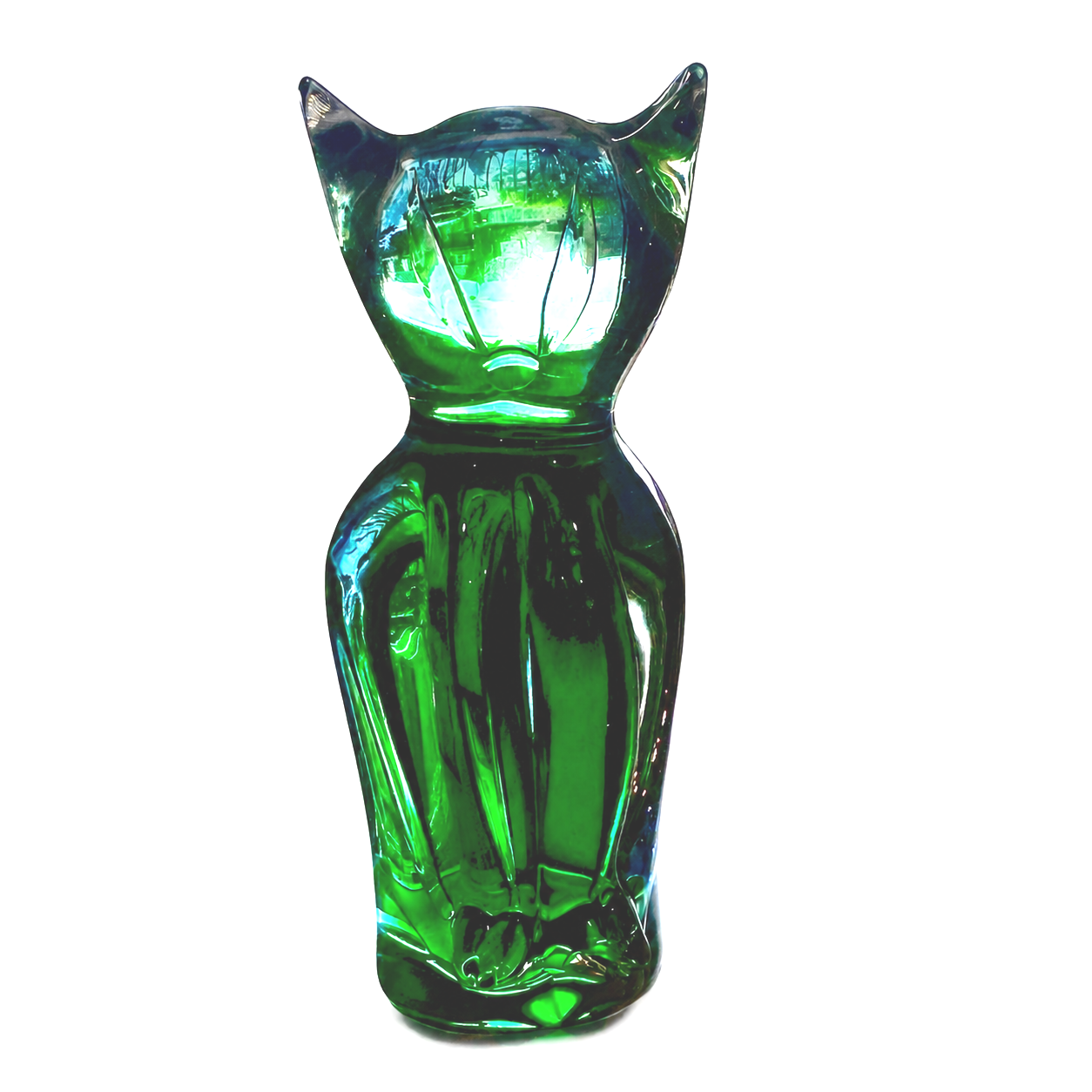
A deeply sculptural Italian art glass cat figure executed in saturated emerald green and cobalt blue tones with exceptional optical density and luminous light refraction. The elongated feline silhouette combines stylized modernist proportions with heavy hand-blown glass construction, producing dramatic internal reflections and jewel-like color transitions throughout the body. Clear pulled glass details at the ears, tail, paws, and facial contours create striking dimensional contrast against the darker sommerso-style core. Viewed from different angles, the sculpture shifts between vivid emerald, teal, sapphire, and near-black tonalities, giving the piece exceptional architectural presence.
The substantial weight relative to scale and the fluid pulled-glass detailing strongly align the work with high-quality Italian studio glass traditions associated with Murano production during the mid-to-late 20th century. The form reads equally as decorative sculpture and collectible design object, with strong compatibility for modernist, Hollywood Regency, and gallery-driven interiors.
Attribution & Period
Italian hand-blown art glass feline sculpture, stylistically aligned with Murano sommerso and sculptural animal-form production of the 1960s–1970s. No factory signature or label observed. Attribution remains visual rather than documented, based on the density of the glass, internal color layering, controlled pulled detailing, and biomorphic modernist styling characteristic of Venetian art glass workshops of the period.
The highly saturated green-blue coloration, substantial clear sculptural applications, and heavy solid-glass construction are consistent with elevated Italian decorative art glass rather than lightweight contemporary reproductions.
Dimensions & Weight
Height: 7 in.
Width / Diameter: 5 in.
Depth / Base Diameter: 2 in. base diameter
Weight: 2.742 lbs.
Condition
Excellent condition overall. One small chip present to a front foot, visible under close inspection. No observed cracks or repairs. Surface remains exceptionally clean with no notable scratches or clouding. Strong gloss retention throughout with minimal handling wear consistent with age.
Authenticity & Construction
Hand-blown solid art glass construction with pulled and tooled sculptural detailing. The body displays heavy optical density and controlled internal color transitions consistent with sommerso-influenced Venetian glassworking techniques. Clear applied elements at the ears, tail, and paws demonstrate skilled hot-work manipulation and finishing. The substantial weight and polished presentation support late 20th century Italian artisan production.
Placement
An ideal sculptural accent for pedestal display, cocktail tables, illuminated shelving, modernist libraries, or curated glass collections. Particularly effective in interiors incorporating Italian modernism, Miami glamour, postwar European decorative arts, or monochromatic contemporary spaces requiring a saturated jewel-tone focal object.
STANDARD ATTRIBUTION & VALUE DISCLOSURE
This piece is described to the best of current scholarly and market knowledge. Any maker or regional attribution is based on visual analysis, materials, construction techniques, and documented stylistic comparisons. As with many MCM and antique design objects, definitive attribution may not be possible without original labels or factory records. Pricing reflects condition, quality, decorative appeal, and current collector demand rather than guaranteed maker identification.
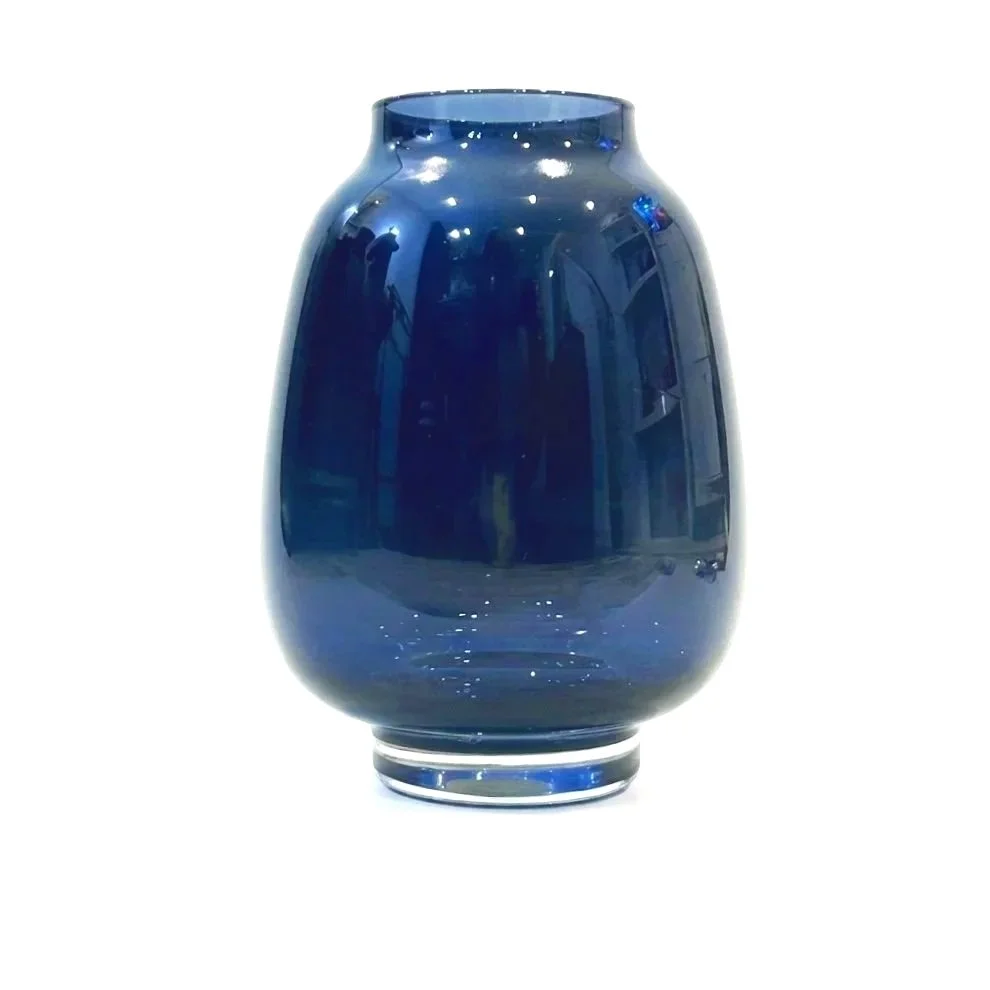
This striking vessel possesses a deep, saturated cobalt presence that commands attention through its substantial mass and light-trapping depth. The transition from the dense, midnight-blue body to the exceptionally thick, one-inch clear glass base creates a sophisticated optical lift, allowing the piece to appear as if it is hovering just above the surface. Its rounded, "belly" silhouette provides a generous canvas for light play, making it a compelling focal point for both minimalist and layered interior compositions.
Attribution & Period
Late 20th Century Polish Art Glass
The piece is a regional example of Polish glassmaking, confirmed by the original "Handmade in Poland" transparency label. Stylistically, the form is consistent with the mid-to-late 20th-century tradition of European cased glass, where weight and color saturation are prioritized over intricate surface decoration. The clean, fire-polished rim and the heavy, solid-cast base align with the high-quality export wares produced in the Krosno or Tarnowiec regions during the 1980s and 1990s.
Dimensions & Weight
Height: 8 inches
Width / Diameter: 6 inches (at widest point)
Depth / Base Diameter: 2 7/8 inches
Opening Diameter: 2 7/8 inches
Weight: 1.318 lbs
Condition
The vase is in excellent condition, appearing unused with no chips, cracks, or visible repairs. The glass remains remarkably clear with no clouding or internal "sickness." Minor, microscopic shelf wear may be present on the underside of the base, and characteristic small air bubbles (seeds) are trapped within the glass, inherent to the handmade blowing process.
Authenticity & Construction
This vessel was hand-blown using traditional furnace-working techniques, evidenced by the slight variations in glass thickness and the application of a thick, solid-glass "foot." The deep blue pigment is integrated into the melt rather than applied as a surface coating, ensuring a permanent, light-fast color. The contrast between the saturated body and the crystal-clear base highlights the artisan's control over heat and material viscosity.
Placement
The height and bold tonality of this piece make it an ideal candidate for a sun-drenched console table, a deep bookshelf, or as a central element in a professional office setting. It pairs exceptionally well with brushed brass accents, natural oak, or monochromatic marble surfaces.
STANDARD ATTRIBUTION & VALUE DISCLOSURE
This piece is described to the best of current scholarly and market knowledge. Any maker or regional attribution is based on visual analysis, materials, construction techniques, and documented stylistic comparisons. As with many MCM and antique design objects, definitive attribution may not be possible without original labels or factory records. Pricing reflects condition, quality, decorative appeal, and current collector demand rather than guaranteed maker identification.
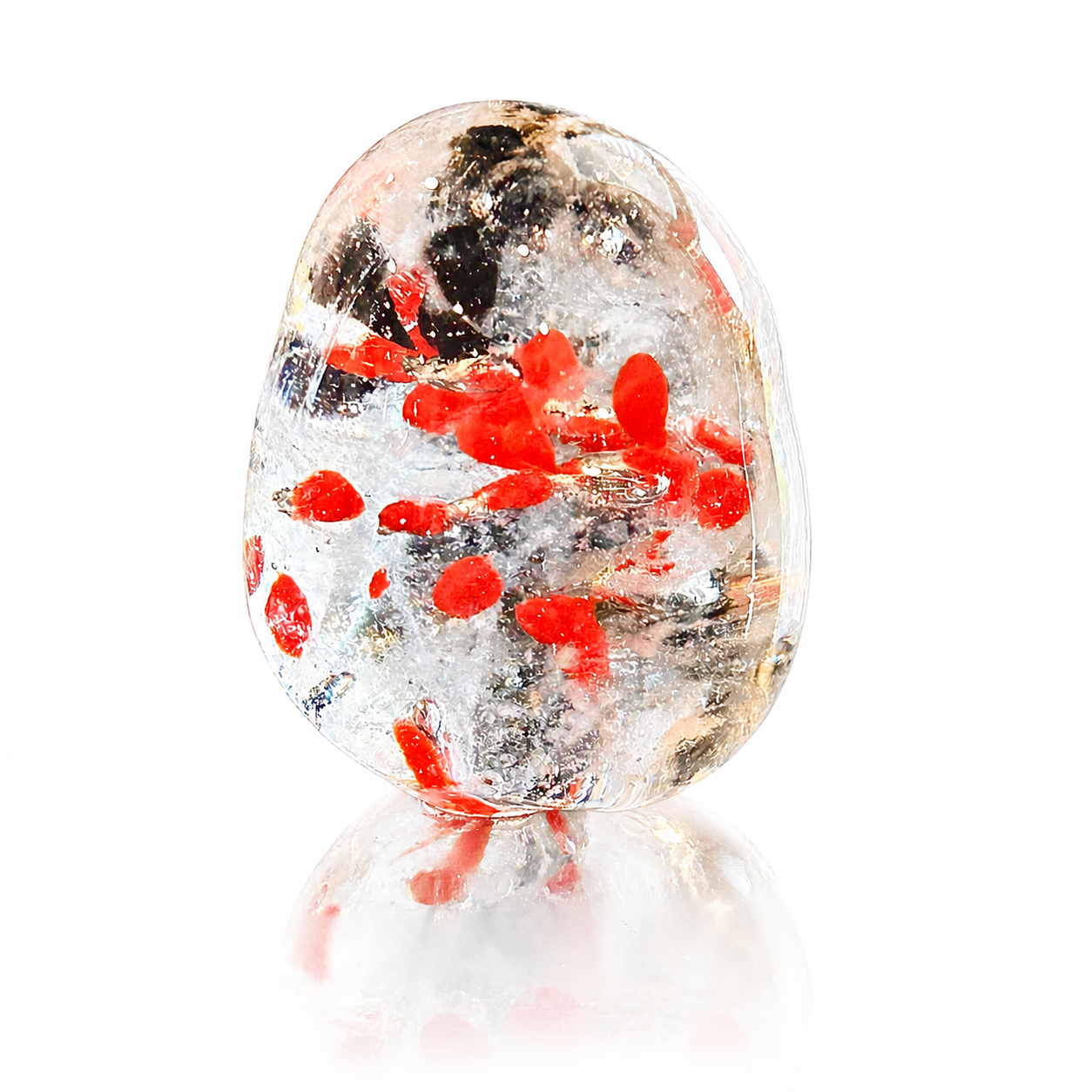
This commanding work of Italian art glass is an exercise in chromatic depth and deliberate, sculptural asymmetry. The piece features a high-impact "Sommerso" interior—a suspended core of vivid crimson enveloped in smoke-obsidian veils—trapped within a massive, light-refracting crystal exterior. Its hand-sculpted, uneven silhouette defies conventional geometry, offering a bold, architectural presence that shifts dynamically when viewed from different angles, making it a premier choice for high-concept curation.
Attribution & Period
Consistent with Murano, 1970s. The technical execution of the multi-layered internal suspension and the flawlessly polished surface is stylistically aligned with the experimental furnace-work of Murano’s Golden Era. During this period, masters moved away from rigid symmetry to embrace "organic" or "free-form" silhouettes that showcased the direct manipulation of molten glass. This piece represents the high-end studio output intended for the sophisticated European design markets of the late 20th century.
Dimensions & Weight
Height: 3 inches
Width / Diameter: 3.25 inches (variable due to form)
Depth / Base Diameter: 0.34 inches
Weight: 0.774 lbs
Condition
Excellent condition. The crystal casing maintains superior clarity with no observed scratches, surface abrasions, or internal stress fractures. The base is expertly finished and polished, showing negligible shelf wear. The intentional asymmetry of the form is crisp and well-defined.
Authenticity & Construction
This is a hand-sculpted work of heavy lead-crystal glass. The piece was constructed using the difficult Sommerso technique, requiring multiple submersions into varied color crucibles. The "uneven" profile is a deliberate design choice, achieved through hand-tooling while the glass was in a semi-molten state, ensuring that no two examples are identical. Its significant density and refractive index are hallmarks of authentic, high-quality Venetian production.
Placement
This sculptural object is designed as a jewel-like accent for the refined interior. It serves as a powerful standalone "objet d'art" on a minimalist pedestal, a weighted textural element for a bespoke library shelf, or a centerpiece on a dark-wood executive desk where the crimson core can provide a sharp, luxurious contrast.
STANDARD ATTRIBUTION & VALUE DISCLOSURE
This piece is described to the best of current scholarly and market knowledge. Any maker or regional attribution is based on visual analysis, materials, construction techniques, and documented stylistic comparisons. As with many MCM and antique design objects, definitive attribution may not be possible without original labels or factory records. Pricing reflects condition, quality, decorative appeal, and current collector demand rather than guaranteed maker identification.
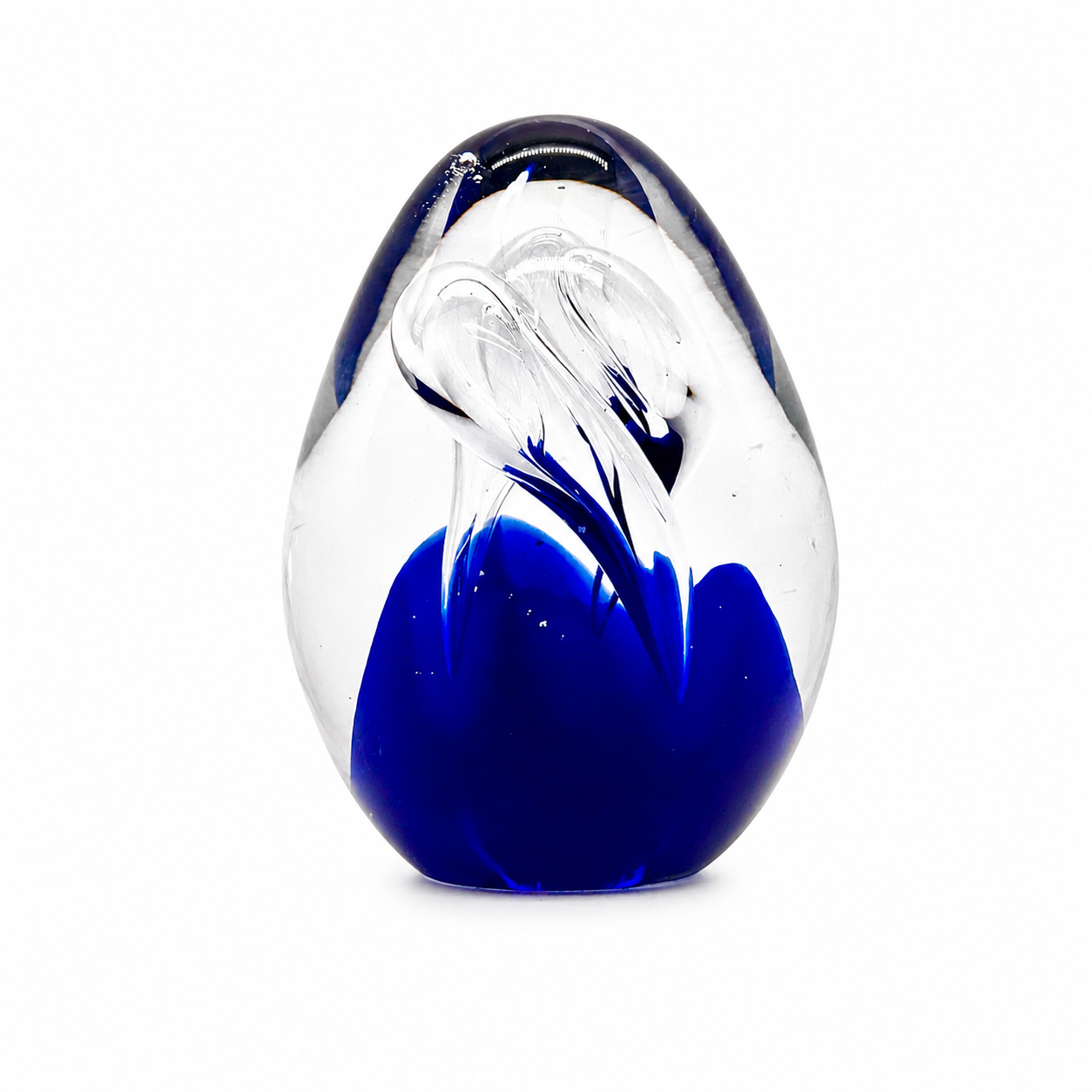
This luminous work of Italian glass artistry is a study in saturated color and crystalline clarity. Utilizing the prestigious Sommerso technique, the sculpture features a suspended interior of deep cobalt blue encased within a thick, light-refracting crystal exterior. Its hand-sculpted, asymmetric profile offers a sophisticated architectural presence, where the interplay of light and dense glass creates a shifting, jewel-like brilliance that serves as a captivating focal point in any curated space.
Attribution & Period
Consistent with Murano, 1970s. The expert execution of the submerged color layers and the flawlessly polished base are hallmark characteristics of the high-end Venetian furnaces. The move toward organic, asymmetric silhouettes—often referred to as "Freeform" or "Block" glass—is emblematic of 1970s Italian Modernism, where masters like Flavio Poli and the Seguso family pioneered the use of clean, non-geometric contours to emphasize the prismatic quality of heavy lead glass.
Dimensions & Weight
Height: 3.5 inches
Width / Diameter: 2.75 inches
Depth / Base Diameter: 1 inch
Weight: 0.68 lbs
Condition
Excellent condition. The glass presents with exceptional clarity and a high-luster finish. There are no observed scratches, surface abrasions, or internal stress fractures. The base is polished smooth and remains in superb state, reflecting the meticulous care and premium quality of the piece.
Authenticity & Construction
This is a hand-sculpted work of heavy lead-crystal glass, constructed using the difficult Sommerso (submerged) method. This process requires a master glassblower to dip a colored gather into a crucible of molten clear glass, carefully maintaining temperatures to ensure a flawless fusion. The intentional asymmetry and substantial weight relative to its size are definitive markers of authentic Murano production, designed to maximize internal light reflection and color depth.
Placement
This sculptural object is a versatile "objet d'art" for the modern luxury interior. Its deep blue tones provide a cooling, sophisticated accent on a sunlit windowsill, a minimalist mantelpiece, or as a weighted architectural element within a bespoke library. It pairs exceptionally well with polished chrome, white lacquer, or warm walnut textures.
STANDARD ATTRIBUTION & VALUE DISCLOSURE
This piece is described to the best of current scholarly and market knowledge. Any maker or regional attribution is based on visual analysis, materials, construction techniques, and documented stylistic comparisons. As with many MCM and antique design objects, definitive attribution may not be possible without original labels or factory records. Pricing reflects condition, quality, decorative appeal, and current collector demand rather than guaranteed maker identification.
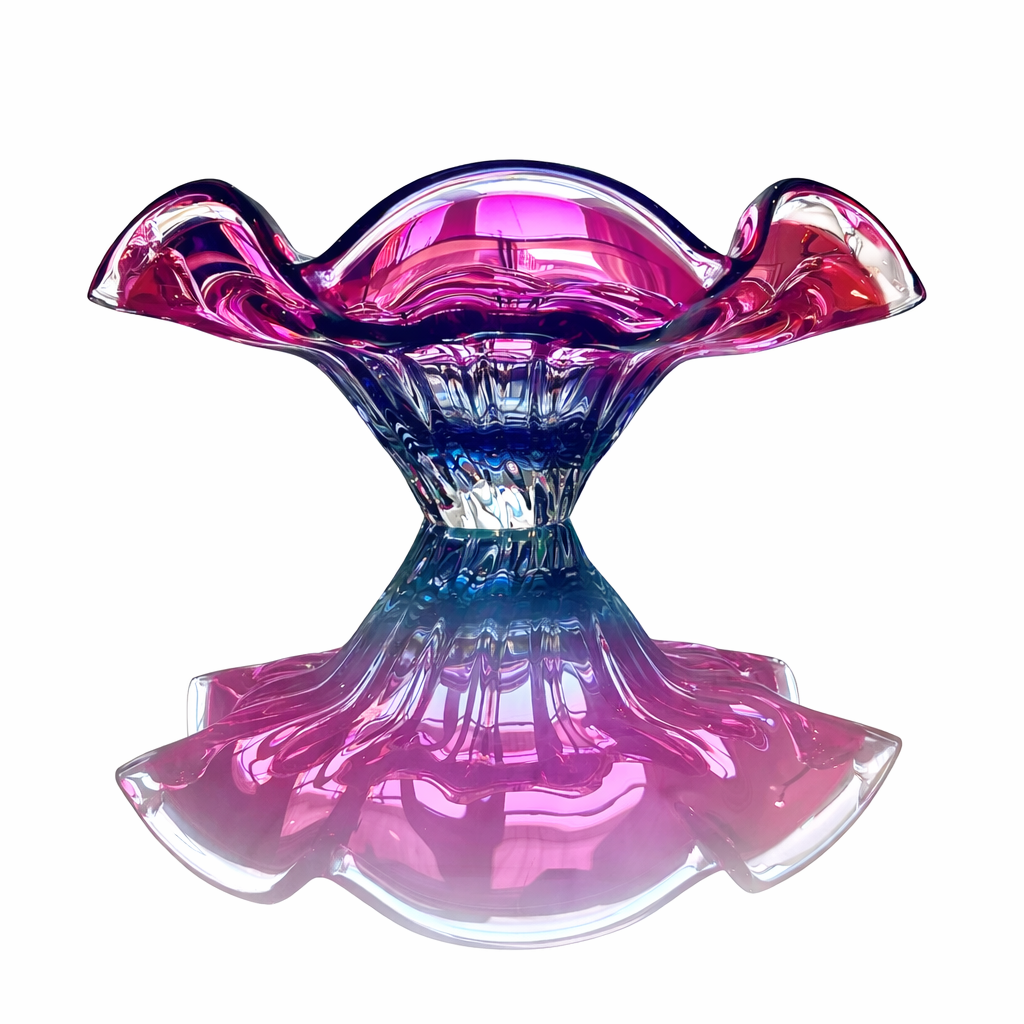
A commanding Murano glass centerpiece of architectural presence and saturated chromatic depth, executed in the Sommerso technique and signed Guarnieri. The form rises from a compact pedestal into a dramatic, undulating rim—each lobe extending five inches outward—creating a silhouette that reads as sculptural rather than functional.
The color transition is deliberate and masterful: a dense sapphire-blue core submerged beneath radiant fuchsia and crystalline casing, producing optical movement and refracted light at every angle. At 15.5 inches in diameter, this is a statement-scale Venetian work designed for visual impact in serious interiors.
Attribution & Period
Late 20th Century, 1980s The piece is signed by Guarnieri, an attribution confirmed by the diamond-point etched signature on the polished base. The Guarnieri workshop, active during the prolific post-war Venetian glass revival, is noted for a confident application of the Sommerso method. This specific work is stylistically aligned with the 1980s preference for "statement-scale" glass, moving away from mid-century minimalism toward more rhythmic, hand-manipulated organic forms that prioritize visual impact over traditional utility.
Dimensions & Weight
Diameter: 15.5 inches
Height: 6 inches
Each lobe projection: 5 inches
Base Diameter: 3 inches
Weight: Substantial, heavy-bodied sculptural glass
Condition
The object is in very good condition. Clinical inspection reveals light surface scratches to the underside of the base, consistent with appropriate shelf wear and the piece's significant weight. No cracks, chips, or structural repairs are observed. The internal color layers and the scalloped rim edges remain clean, crisp, and free of inclusions.
Authenticity & Construction
This work was executed on the island of Murano using the traditional Sommerso (submerged) technique, where a dense sapphire-blue core was dipped into molten fuchsia glass before being encased in a heavy layer of clear crystal. The piece was free-blown and then hand-manipulated at the furnace to achieve the rhythmic, five-lobed expansion. The polished pontil and the hand-etched studio signature distinguish this as a high-end artisanal production rather than a commercial mold-pressed object.
Placement
This work was executed on the island of Murano using the traditional Sommerso (submerged) technique, where a dense sapphire-blue core was dipped into molten fuchsia glass before being encased in a heavy layer of clear crystal. The piece was free-blown and then hand-manipulated at the furnace to achieve the rhythmic, five-lobed expansion. The polished pontil and the hand-etched studio signature distinguish this as a high-end artisanal production rather than a commercial mold-pressed object.
STANDARD ATTRIBUTION & VALUE DISCLOSURE
This piece is described to the best of current scholarly and market knowledge. Any maker or regional attribution is based on visual analysis, materials, construction techniques, and documented stylistic comparisons. As with many vintage and antique glass objects, definitive attribution may not be possible without original labels or factory records. Pricing reflects condition, quality, decorative appeal, and current collector demand rather than a guaranteed maker identification.
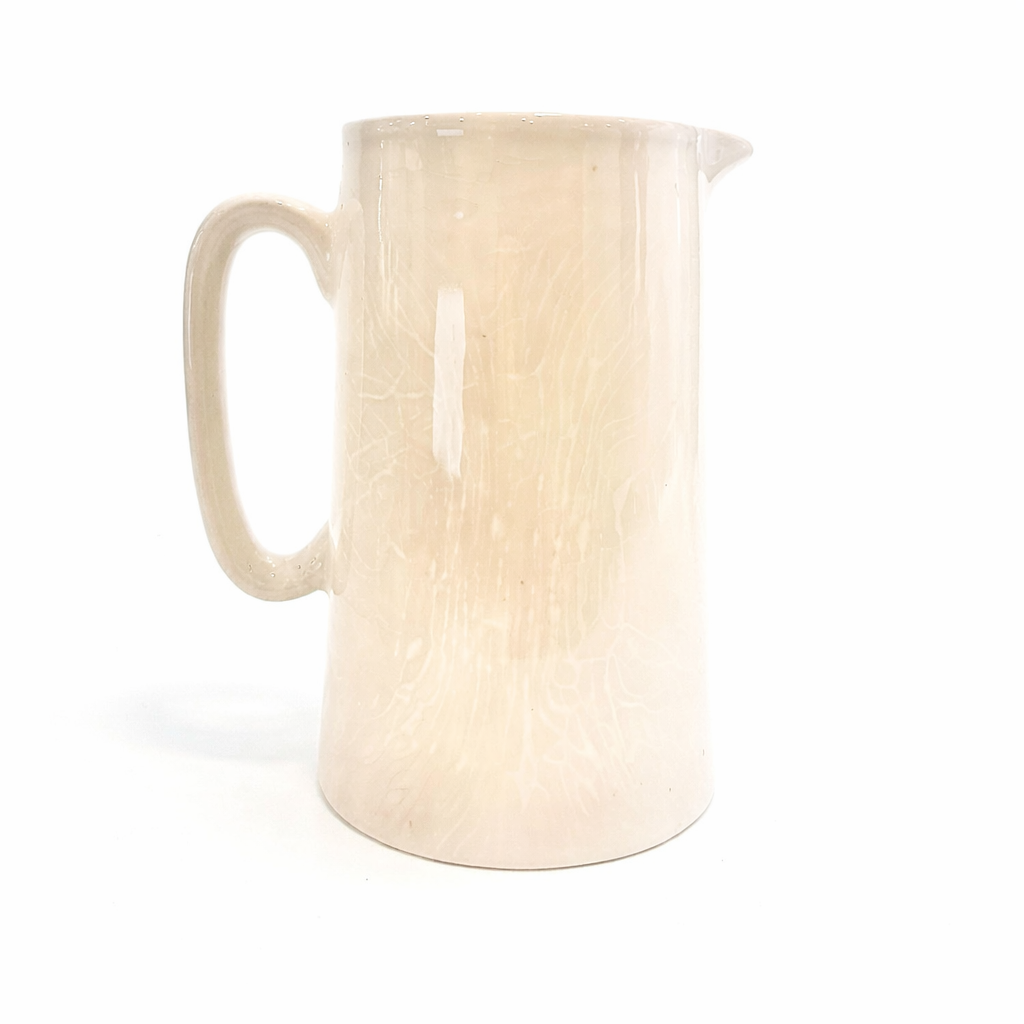
A refined ceramic pitcher defined by its restrained silhouette and softly articulated spout, this piece embodies a quiet, sculptural presence. The creamy, translucent glaze reveals subtle tonal variation and depth, catching light across its gently curved surface. Its balanced proportions and minimal handle design contribute to a composition that is both functional and architecturally composed. The surface presents a delicate network of crazing, enhancing its visual complexity and material richness.
Attribution & Period
Marked example from Lord Nelson Pottery, England, dated December 1978. The attribution is supported by the stamped base mark and inscribed date, consistent with known production from the period, including the use of high-fired ceramic bodies and softly pooled glaze finishes characteristic of English studio-influenced manufacture of the late 1970s.
Dimensions & Weight
Height: 6 in
Width / Diameter: 4.6 in (including handle and spout)
Depth / Base Diameter: 3 in
Weight:
Condition
No chips, cracks, or repairs observed. The glaze presents visible crazing throughout, with light staining within the craze lines consistent with age and use. Surface toning and minor wear are present, aligning with material age. Base shows expected wear from contact with surfaces.
Authenticity & Construction
Wheel-thrown and kiln-fired ceramic construction with a semi-translucent glaze applied prior to firing. The controlled form and even wall thickness indicate skilled production, while the glaze behavior—pooling, tonal shifts, and fine crazing—reflects both firing conditions and long-term material response. The stamped base mark and date confirm production origin and period.
Placement
Ideal as a sculptural accent within a refined interior, this piece integrates seamlessly into minimalist, wabi-sabi, or modernist settings. It functions equally well as a standalone object, part of a ceramic grouping, or styled within open shelving, kitchens, or dining environments where material subtlety and form are emphasized.
STANDARD ATTRIBUTION & VALUE DISCLOSURE
This piece is described to the best of current scholarly and market knowledge. Any maker or regional attribution is based on visual analysis, materials, construction techniques, and documented stylistic comparisons. As with many MCM and antique design objects, definitive attribution may not be possible without original labels or factory records. Pricing reflects condition, quality, decorative appeal, and current collector demand rather than guaranteed maker identification.
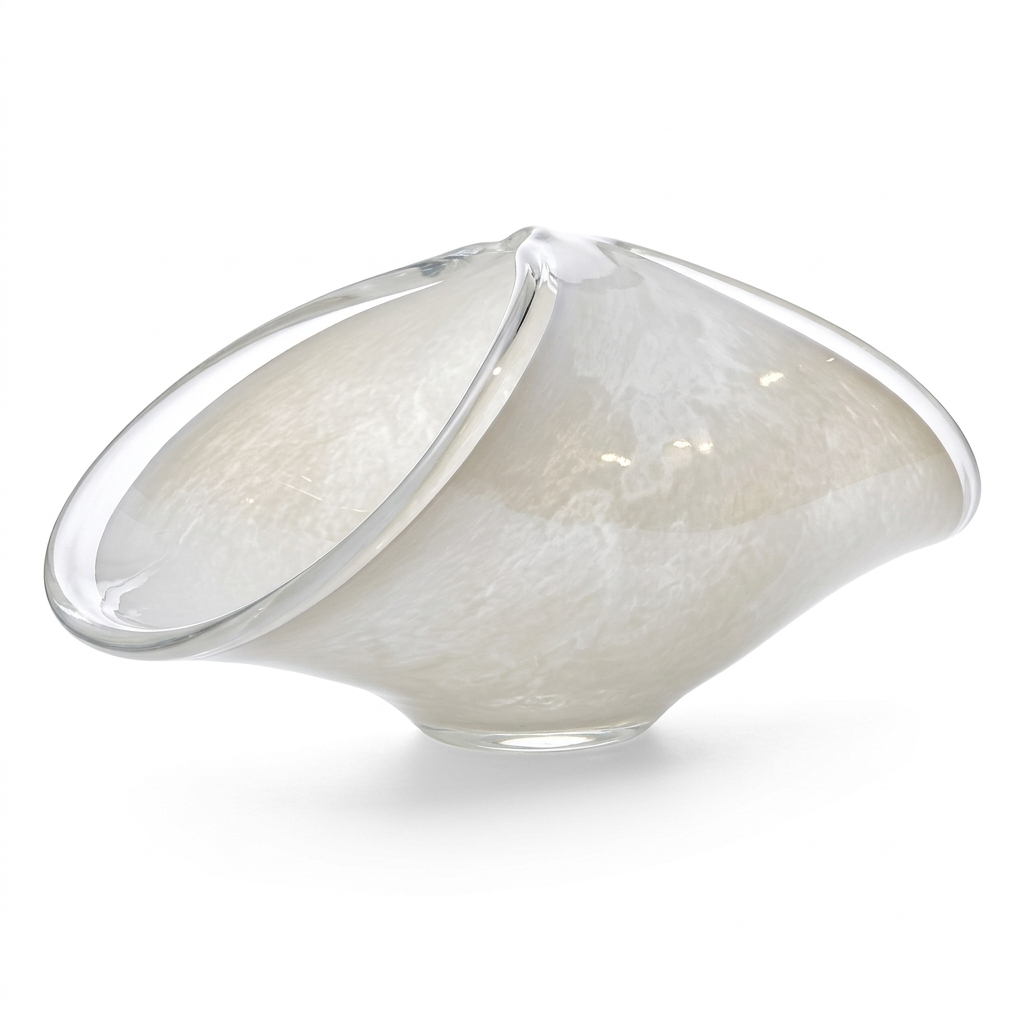
This substantial Murano glass centerpiece commands attention through its fluid, biomorphic silhouette and sophisticated play of light. The piece features a masterful "Sommerso" technique, where a dense, ethereal white lattimo core is suspended within thick, brilliantly clear glass walls. Its sweeping, wing-like proportions create a sense of kinetic energy, transforming from every angle to reveal soft gradients and crisp, hand-finished edges.
Attribution & Period
Consistent with Murano production, Italy, 1970s. The piece bears a "Murano / Hand Made in Italy" foil label and a secondary "White Cristal" distributor label. The construction utilizes the Sommerso (submerged) method typical of mid-to-late 20th-century Venetian workshops, while the sweeping, aerodynamic form is stylistically aligned with the organic modernism popularized by masters like Seguso or Barbini during this era.
Dimensions & Weight
Height: 6.75 in
Width / Diameter: 13.25 in
Depth / Base Diameter: 2.75 in (7 cm)
Weight: 4.83 lbs
Condition
Excellent condition. No chips, cracks, or structural repairs observed. Light shelf wear consistent with age is present on the polished base. Minimal internal carbon deposits and microscopic air bubbles (seeds) are present, characteristic of the hand-blown manufacturing process.
Authenticity & Construction
This centerpiece is a hand-worked "Euvre Réalisée selon la Technique des Maîtres" (Work created according to the technique of the masters). It was formed by layering molten glass of different densities and manually stretching the rim to create the dramatic, asymmetrical peaks. The base is expertly ground and polished to ensure stability and optical clarity.
Placement
This architecturally significant bowl serves as a luminous focal point on a minimalist dining table, a low-profile coffee table, or an entryway console. Its neutral palette and sculptural profile make it a versatile acquisition for interiors ranging from High-Modernist to Contemporary Chic.
STANDARD ATTRIBUTION & VALUE DISCLOSURE;This piece is described to the best of current scholarly and market knowledge. Any maker or regional attribution is based on visual analysis, materials, construction techniques, and documented stylistic comparisons. As with many MCM and antique design objects, definitive attribution may not be possible without original labels or factory records. Pricing reflects condition, quality, decorative appeal, and current collector demand rather than guaranteed maker identification.
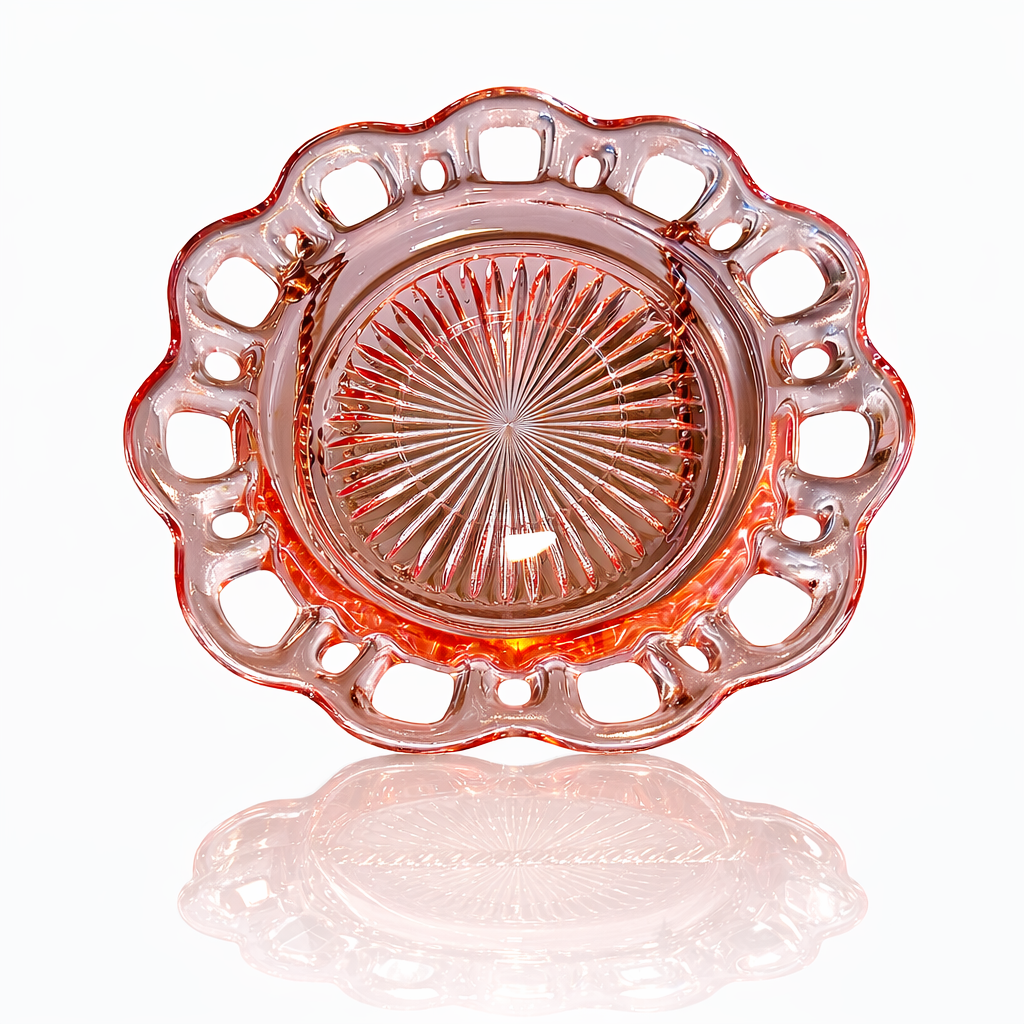
An exquisite specimen of American interwar artistry, this 6-inch "Old Colony" vessel represents the pinnacle of the Hocking Glass Company’s 1930s technical production. Distinguished by an intricate reticulated "Open Lace" border and a precision-pressed radial sunburst core, the piece captures light with a soft, ethereal rose-blush luminosity. This pattern represents a significant moment in industrial glass history, transitioning from utilitarian pressed ware into highly ornamental, sculptural forms during the peak of the American Art Deco period.
Attribution & Research
Produced by the Hocking Glass Company in Lancaster, Ohio, between 1935 and 1938, the Old Colony pattern (often referenced as "Lace Edge") is a masterclass in press-mold complexity. The design features a signature pierced rim achieved through a sophisticated, multi-part mold-release process that was revolutionary for high-volume American glasshouses. By mimicking the delicate, hand-cut open work of expensive European crystal, Hocking successfully democratized high-modernist elegance for the 1930s domestic interior.
Dimensions & Weight
Diameter: 6 inches (15.2 cm)
Height: 0.5 inches (1.3 cm)
Base Diameter: 3.5 inches (8.9 cm)
Weight: 0.74 lbs (0.33 kg)
Condition
Exceptional Preservation / Museum Quality. This specimen is free of the structural compromises common to this fragile pattern. The delicate lace loops remain entirely intact with no chips, hairline fractures, or surface abrasions. The glass retains its original factory luster, devoid of "sick" clouding or mineral deposits, representing a rare survive of interwar table glass in pristine state.
Authenticity & Construction
This authentic press-molded vessel features a high-relief sunburst motif that radiates toward a structural 3.5-inch base, providing a grounded counterpoint to the airy, pierced periphery. The rose-blush coloration is consistent with the manganese-decolorized batch formulas of the late 1930s, producing a subtle, warm glow under natural and directional gallery lighting.
Placement
Optimally positioned as a decorative charger, a sculptural vanity tray, or a focal point within a curated gallery cabinet, this piece achieves its full potential when backlit to emphasize the reticulated lace border and radial geometry. Its soft-pink palette creates a sophisticated dialogue with marble, light woods, and polished brass in a modern or Art Deco interior.
STANDARD ATTRIBUTION & VALUE DISCLOSURE; This piece is described to the best of current scholarly and market knowledge. Any maker or regional attribution is based on visual analysis, materials, construction techniques, and documented stylistic comparisons. As with many vintage and antique glass objects, definitive attribution may not be possible without original labels or factory records. Pricing reflects condition, quality, decorative appeal, and current collector demand rather than a guaranteed maker identification.
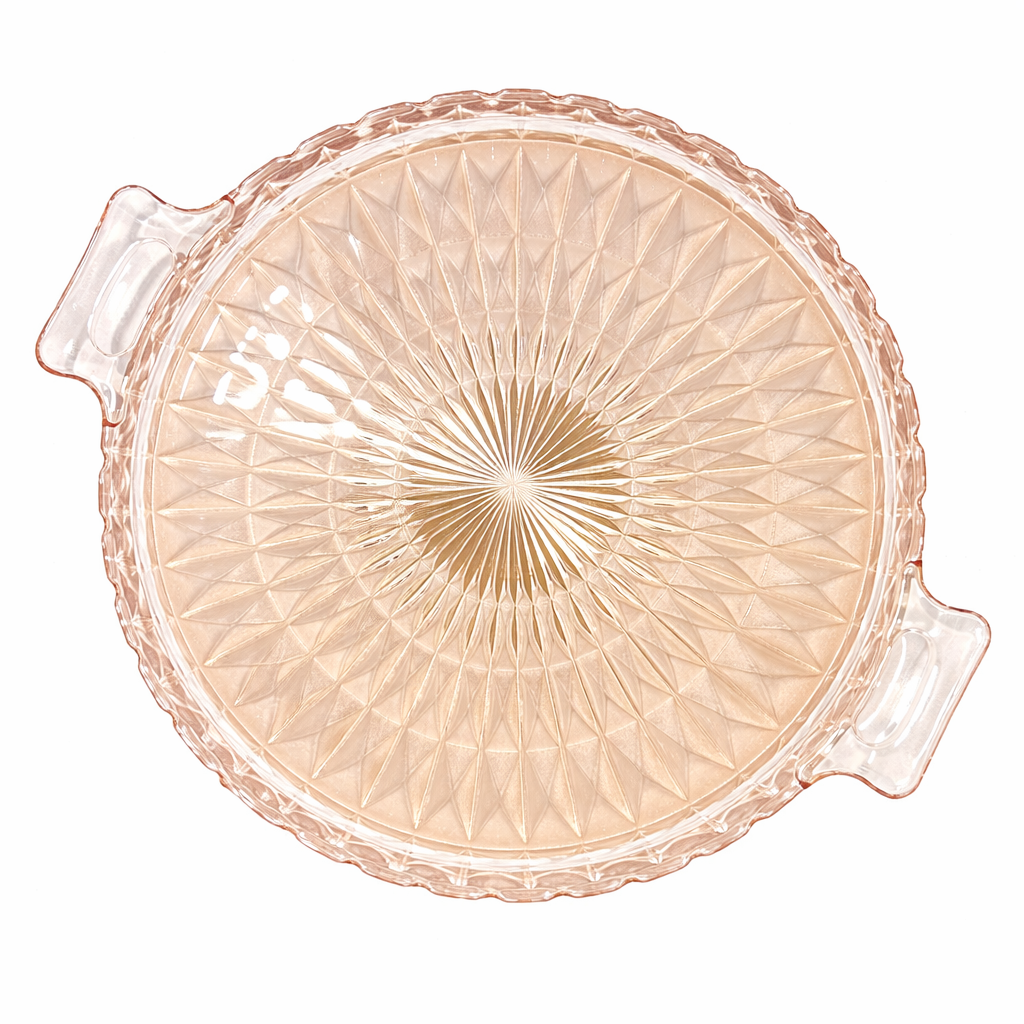
This elegant serving tray possesses a striking sculptural presence, defined by its radiant blush hue and intricate geometric faceting. The expansive surface captures and refracts light through a dense "Diamond Point" or "Miss America" style pattern, creating a shimmering optical effect that changes with the viewing angle. Its low-profile, handled form balances functional utility with a sophisticated Mid-Century decorative aesthetic, making it a compelling centerpiece for a refined interior.
Attribution & Period
This piece is stylistically aligned with American Depression-era glassware, specifically consistent with the "Miss America" pattern produced by the Hocking Glass Company (now Anchor Hocking). Given the material quality, the specific pink "Flamingo" saturation, and the pressed geometric construction, it is most defensibly attributed to the 1930s. This period saw a transition from traditional Victorian motifs toward the cleaner, repetitive geometric symmetries that would later influence Mid-Century Modern design.
Dimensions & Weight
Height: 1 inch
Width / Diameter: 10 inches (Diameter)
Length: 12 inches (Handle to Handle)
Weight: 1.418 lbs
Condition
The object is in excellent condition. The pressed glass remains vibrant with a high degree of clarity and no observed chips, cracks, or hairline fractures. The interior serving surface shows minimal signs of use, with very few superficial scratches or utensil marks. Shelf wear on the base is negligible, consistent with careful preservation.
Authenticity & Construction
The tray is constructed of pressed pink glass, a hallmark of 20th-century American glass manufacturing. The "Diamond Point" texture is molded into the underside of the vessel, leaving the top surface smooth for use while allowing the crystalline facets to catch light from beneath. The integral tab handles are seamless, indicating a high-quality single-press mold process characteristic of the Hocking Glass Company’s premier Depression-era lines.
Placement
This piece serves as a luminous accent on a dark-finished sideboard or a minimalist glass coffee table, where the contrast highlights the delicacy of the pink glass. It is ideally suited for a Hollywood Regency or Mid-Century Modern interior, functioning equally well as a vanity tray for perfumes or as a sophisticated element in a curated tablescape.
STANDARD ATTRIBUTION & VALUE DISCLOSURE This piece is described to the best of current scholarly and market knowledge. Any maker or regional attribution is based on visual analysis, materials, construction techniques, and documented stylistic comparisons. As with many MCM and antique design objects, definitive attribution may not be possible without original labels or factory records. Pricing reflects condition, quality, decorative appeal, and current collector demand rather than guaranteed maker identification.
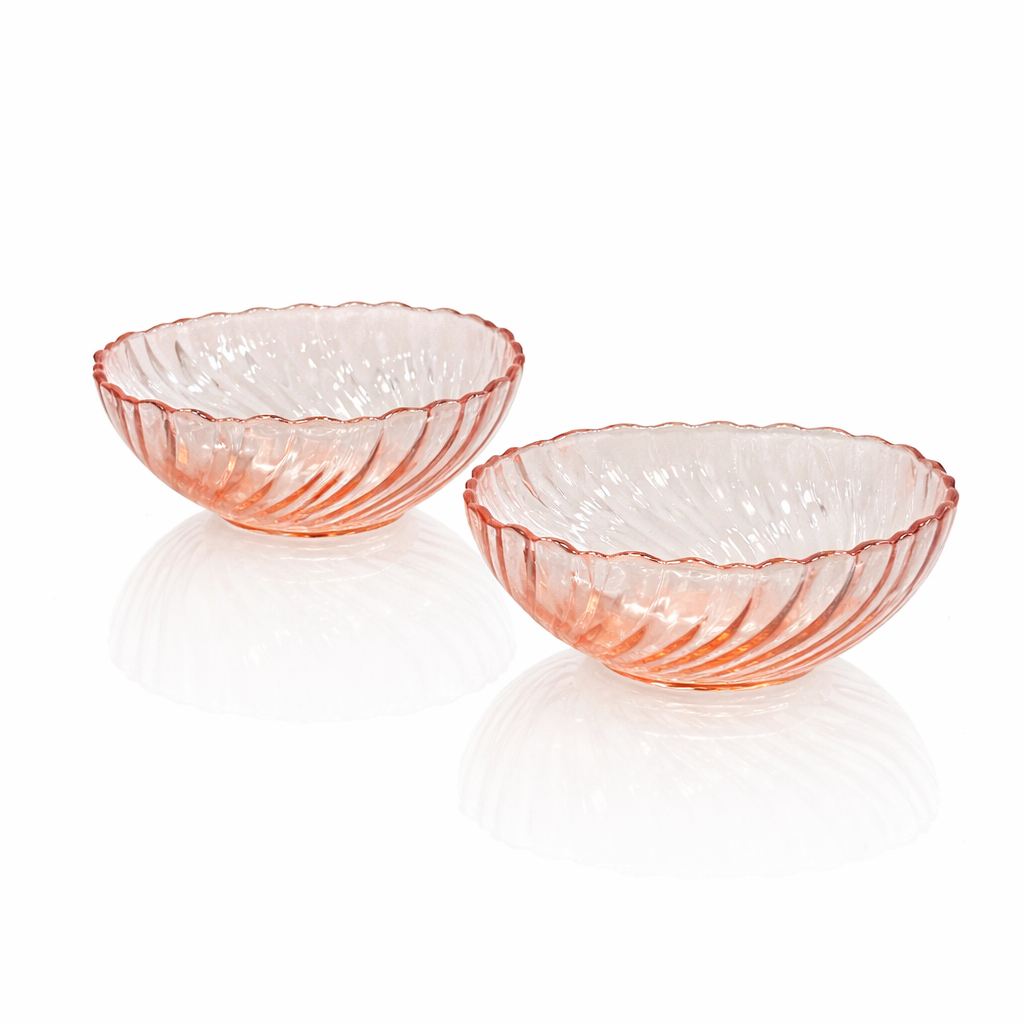
A visually striking pair of blush-toned glass bowls defined by dynamic spiral ribbing and softly scalloped rims. The translucent pink glass captures and refracts light with a warm, luminous glow, emphasizing the fluid, vortex-like movement of the form. Each bowl presents a low, wide silhouette that reads as both sculptural object and refined tabletop accent. The interplay of optical texture and subtle coloration gives these pieces strong decorative presence in both minimal and layered interiors.
Attribution & Period
Unmarked decorative arts example, marked “Indonesia” to the base. The construction, pressed glass technique, and decorative swirl motif are consistent with late 20th century Southeast Asian export glass production. The form and coloration align with mass-produced yet design-conscious decorative glassware of the 1980s–1990s, where molded ribbing and tinted glass were widely used to achieve visual depth and light interaction.
Dimensions & Weight
Height: 1.75 in
Width / Diameter: 4.75 in
Depth / Base Diameter: 2.25 in
Weight: 0.7 lbs (combined)
Condition
Excellent condition. No scratches, chips, or cracks observed. Clean surfaces with minimal to no base wear. Typical minor internal bubbles consistent with pressed glass manufacturing.
Authenticity & Construction
Pressed glass construction, formed in molds to create the continuous spiral ribbing and scalloped rim. This method allows for uniformity across both pieces while producing a pronounced optical effect. The tinted glass is integral to the material rather than applied, ensuring durability of color and finish.
Placement
Ideal as a paired accent on a cocktail table, console, or open shelving. Works effectively in modern, postmodern, or eclectic interiors, particularly where light interaction and reflective surfaces are emphasized. Also suitable as small serving vessels or decorative catchalls.
STANDARD ATTRIBUTION & VALUE DISCLOSURE
This piece is described to the best of current scholarly and market knowledge. Any maker or regional attribution is based on visual analysis, materials, construction techniques, and documented stylistic comparisons. As with many MCM and antique design objects, definitive attribution may not be possible without original labels or factory records. Pricing reflects condition, quality, decorative appeal, and current collector demand rather than guaranteed maker identification.
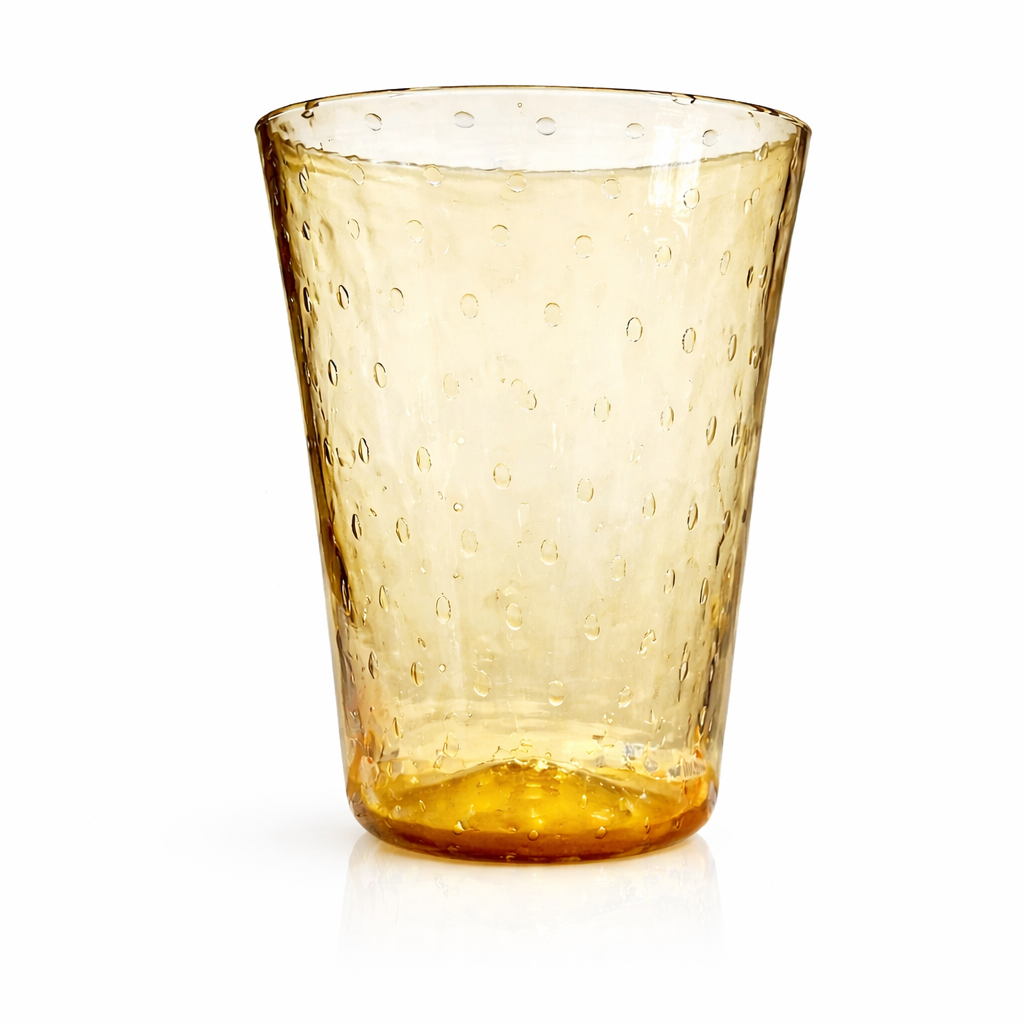
A large, luminous hand-blown art glass vase executed in a golden yellow to honey tone, distinguished by an all-over bullicante-style bubble pattern that animates the surface with depth and light. When placed alongside true amber glass, this example reads intentionally lighter and brighter, an effect consistent with mid-century European glassmaking rather than darker amber formulations. The form is generously scaled with a softly flared mouth and gently tapered body, grounded by a substantial, thick-walled base that gives the piece visual and physical presence without heaviness.
Authenticity & Construction
The bubbles are integral to the glass, varying subtly in size and spacing, confirming hot-worked studio production rather than mold-blown manufacture. The underside shows a hand-finished pontil area, visible through the clear base, further supporting hand-blown origin.
Attribution & Period
This combination of color clarity, bubble work, and form aligns closely with mid-20th-century European bullicante production, particularly in the Italian Murano tradition, though no signature or label is present to allow definitive maker attribution.
Estimated period Mid- to late 20th century, circa 1960s-1970s.
Origin Unattributed; made in the Murano taste (Italian/European).
Dimensions & Weight
Height: 9.75 inches
Mouth diameter: 6.78 inches
Base diameter: 4.75 inches
Weight: 2.336 pounds
Condition
Very good vintage condition.
No chips or cracks observed.
Light surface scratching to the underside/base only, consistent with shelf wear.
All bubbles, inclusions, and internal variations are inherent to the making and not flaws.
Placement
Style Mid-Century Modern, Italian Modern; Organic Modern; Studio Glass; Sculptural
STANDARD ATTRIBUTION & VALUE DISCLOSURE
All maker attributions, dates, and origins are offered in good faith based on visible construction details and comparative market research and should be considered informed opinions rather than guarantees. Hand-blown glass may exhibit natural variations including bubbles, inclusions, asymmetry, or subtle tooling marks inherent to the process. Buyers are encouraged to review all photographs carefully prior to purchase.
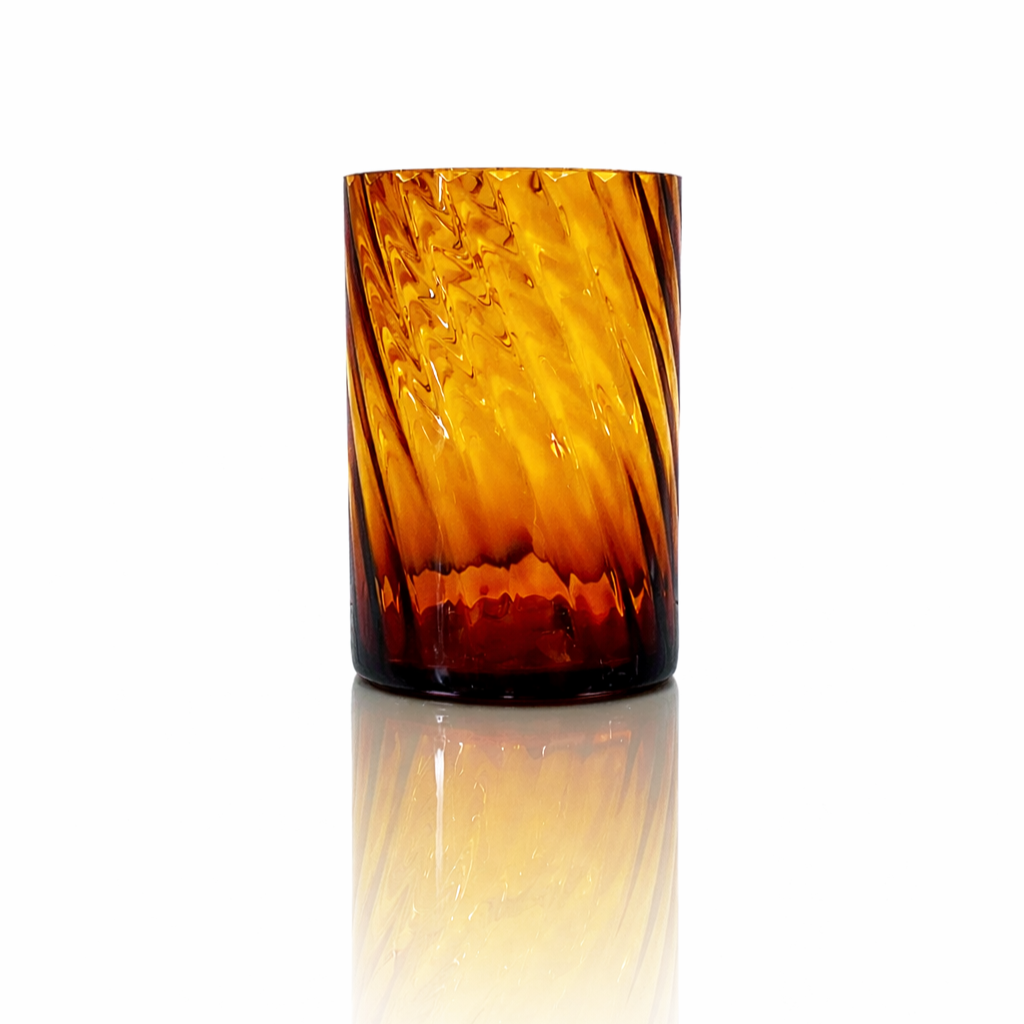
A luminous mid-century studio art glass vase featuring dramatic honey-amber coloration and a striking twisted optic pattern that animates the entire form. The body transitions from deep ruby amber at the base to radiant golden honey tones toward the rim, producing a glowing effect when illuminated. The swirling internal pattern was created using an optic mold technique, where the molten glass is blown into a patterned mold and gently twisted during formation. This process produces the fluid, flame-like movement visible throughout the vessel and gives the glass exceptional visual depth.
The vase’s cylindrical silhouette is balanced by the dynamic spiral pattern, making it both architectural and sculptural. When displayed with light behind or above it, the glass reveals rich tonal shifts from burnt amber to brilliant topaz. This style of optic swirl glass became highly popular during the mid-century studio glass movement of the late 1960s and early 1970s, particularly among Scandinavian and Italian glass studios exploring bold color and dynamic form inspired by Venetian techniques. The underside shows evidence of traditional hand-finished blown glass production, reinforcing its studio art glass character.
Attribution & Period
Studio Art Glass, Scandinavian-influenced production, Circa 1970, Unsigned
Dimensions
Height: 8.5 in
Mouth Diameter: 4 5/8 in
Condition
Very good condition overall.; A few very small flea-bite size nicks along the rim edge consistent with age and handling. No cracks or repairs. The glass remains bright with strong colour saturation. There are minor rim marks illustrated in the close up photograph which are visible only upon close inspection and do not detract from display.
Authenticity & Construction
Hand-blown art glass using an optic twist mold technique. The honey-amber colouration appears achieved through layered glass gathers where deeper ruby tones settle toward the base while lighter golden glass rises toward the rim during the blowing process. The base shows a hand-finished pontil area, typical of studio glass production.
Curation
Ideal for placement on a console, entry table, or within a curated studio glass collection, this piece achieves its full sculptural potential when positioned in mid-century or modern interior settings with directional backlighting to activate the vibrant honey-amber rim and internal spiral movement.
Provenance
Private decorative arts collection; acquired through the secondary art market
STANDARD ATTRIBUTION & VALUE DISCLOSURE; This piece is described to the best of current scholarly and market knowledge. Any maker or regional attribution is based on visual analysis, materials, construction techniques, and documented stylistic comparisons. As with many vintage and antique glass objects, definitive attribution may not be possible without original labels or factory records. Pricing reflects condition, quality, decorative appeal, and current collector demand rather than a guaranteed maker identification.
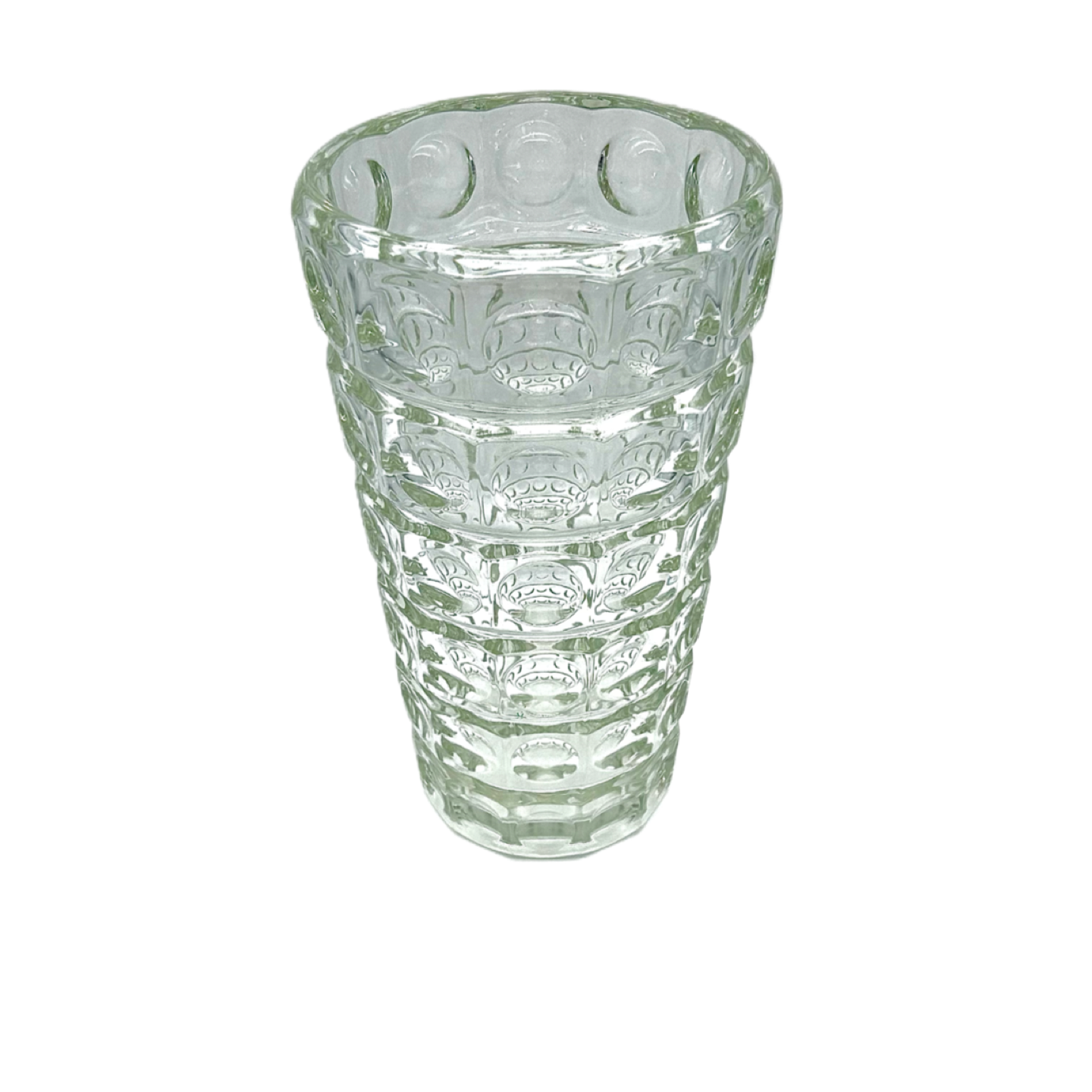
A commanding sculptural pressed glass vase defined by its architectural silhouette and deeply molded relief pattern. The vessel’s stacked geometry and repeating crescent motifs create a rhythmic surface that refracts light with dramatic clarity, transforming the piece into a luminous decorative object rather than simple tableware. Substantial in both scale and weight, the form reads as a modernist glass sculpture—equally effective as a standalone statement piece or within a curated interior arrangement.
Produced using thick-walled molded glass, the vase demonstrates the refined industrial artistry that defined Central European glassmaking in the mid-20th century. The faceted structure and strong relief pattern interact with ambient light to produce a dynamic visual presence, giving the object the character of architectural decor. Its bold vertical proportions and substantial mass allow it to anchor a space visually, making it particularly suited for design-forward interiors.
Attribution & Period
Czech / Bohemian pressed glass, mid-20th century, circa 1940–1969.
The strong geometric structure, heavy molded construction, and repeating relief ornament are consistent with pressed glass design traditions associated with Czech glassworks of the period. Factories such as Rudolfova Huť, Rosice, and other later Sklo Union group manufacturers produced similar sculptural glass objects that balanced industrial technique with modernist decorative form.
No factory mark or signature is present. Attribution is therefore based on stylistic and construction analysis rather than a confirmed catalog identification.
Dimensions & Weight
Height: 12 in
Mouth Diameter: 6.75 in
Base Diameter: 4.5 in
Weight: 7.356 lbs
The significant weight reflects thick-walled pressed glass construction typical of higher quality Central European molded glass.
Condition
This piece is in excellent overall condition, remaining structurally sound and free of chips or cracks, with only light surface scratching at the base consistent with gentle shelf contact.
Authenticity & Construction
The vase was produced using a heavy pressed-glass molding process in which molten glass is pressed into a precision steel mold to create a detailed relief surface. This technique allows for deep sculptural patterning and consistent structural clarity while producing thick, durable walls.
The sharply defined crescent motifs and crisp geometric contours indicate a high-quality mold and careful finishing after release from the mold. The substantial glass mass and balanced proportions reflect the design philosophy of Central European pressed glass—objects intended to function both as decorative sculpture and functional vessel.
Under UV light the glass displays a blue-toned response. This reaction appears inherent to the material composition of the glass rather than a surface treatment and is commonly associated with mineral content present in certain mid-20th-century glass formulations.
Placement
This piece performs best as a sculptural decorative object within a refined interior setting. Its scale and visual weight make it ideal for placement on a console, credenza, pedestal, or architectural shelf where the molded relief can interact with ambient light. It also integrates well within curated glass collections or modernist interiors where strong form and material presence are central to the composition.
STANDARD ATTRIBUTION & VALUE DISCLOSURE; This piece is described to the best of current scholarly and market knowledge. Any maker or regional attribution is based on visual analysis, materials, construction techniques, and documented stylistic comparisons. As with many MCM and antique glass objects, definitive attribution may not be possible without original labels or factory records. Pricing reflects condition, quality, decorative appeal, and current collector demand rather than a guaranteed maker identification.
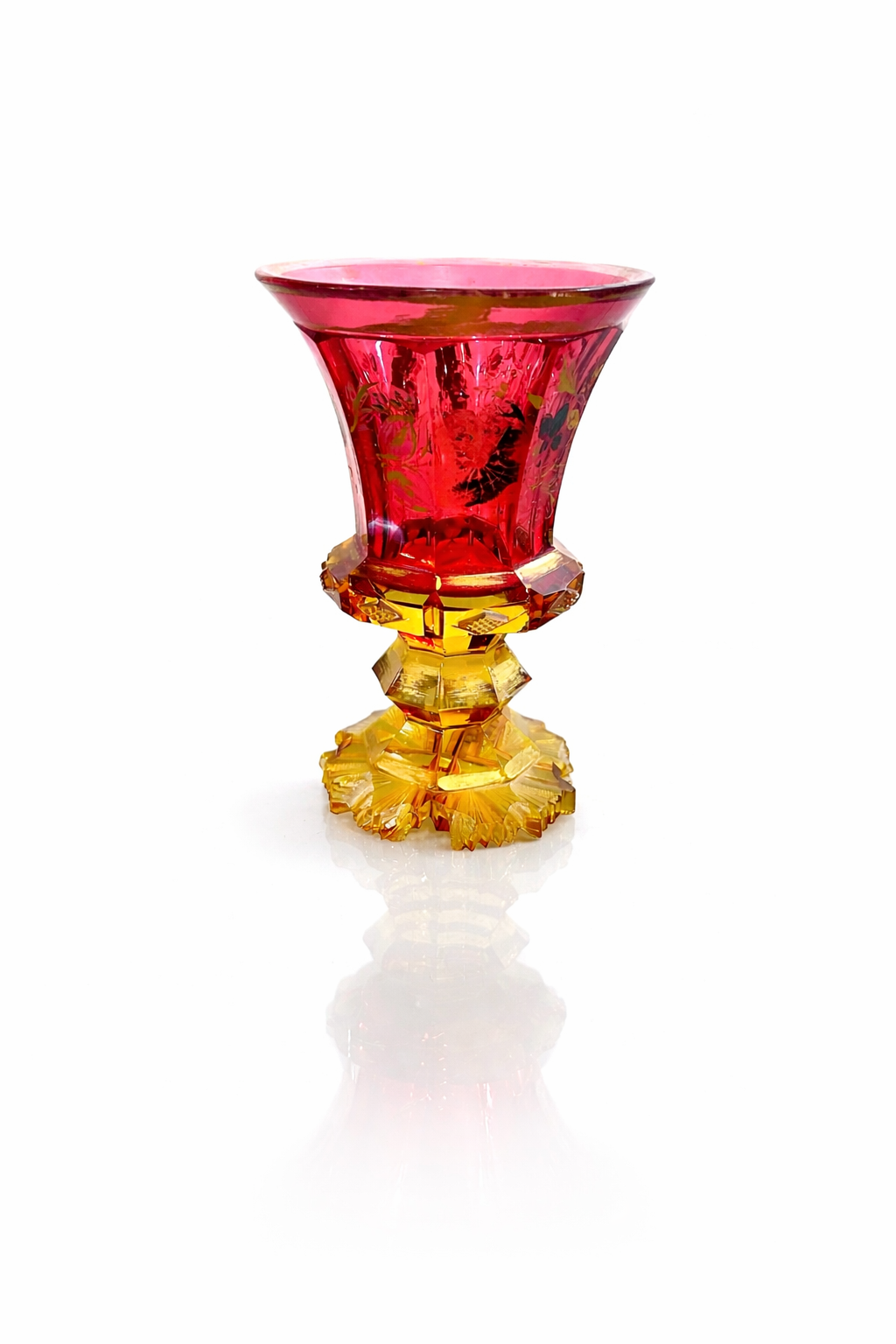
Ruby-to-amber cut crystal pedestal vase with a flared trumpet rim, deeply faceted stem, and dramatic starburst foot. The body is decorated with floral/botanical engraving (appears wheel-engraved or acid-etched), giving this piece the classic Bohemian jewel glass presencehigh sparkle, substantial weight, and strong light play from every angle.
Attribution & Period
Based on form, cutting style, color combination, and engraving technique, this vase was most likely produced circa 1950s1970s in Bohemia / Czechoslovakia (now Czech Republic). This period aligns with postwar Central European export crystal, where colored bowls paired with heavy cut stems and decorative engraving were widely produced for the international market.
UV reactivity
This vase reacts under a 365nm black light, producing a warm orange-to-red fluorescence as shown in the first image. This response is consistent with selenium-based ruby glass colorants, which may include cadmium compounds historically used in colored crystal production. The exact activator cannot be confirmed without laboratory testing, and the piece is described accordingly.
Authenticity & Construction
This form and execution strongly align with 20th-century Bohemian / Czech decorative cut crystal. The combination of a colored ruby bowl, amber-toned crystal, heavy mitre-cut faceting, and engraved decoration is characteristic of Central European export glass produced from the mid-century into the late 20th century. Comparable examples are often associated stylistically with Bohemian houses such as Egermann or Moser; however, this piece is unmarked and is therefore attributed by style only, not by maker.
Condition (read carefully)
This piece is not mint and is priced with full transparency. Three cracks around the base/foot, visible in close-up images Chips along the base/foot edge, as shown Upper bowl and decorative surfaces present well; engraving remains attractive Damage is confined to the foot.
Dimensions & Weight
Height: 6.18 in (approx. 6 3/16 in)
Mouth diameter: 4 1/2 in
Base diameter: 3 in
Weight: 1.374 lb (heavy for size)
Placement
Well-suited to Hollywood Regency, Art Deco revival, Grand Millennial, or maximalist cabinet glass interiors. Works especially well under accent lighting due to cut facets and UV response. The vase displays nicely in a cabinet or vignette but should be considered a decorative/display example, not an investment-grade specimen.
STANDARD ATTRIBUTION & VALUE DISCLOSURE
This piece is described to the best of current scholarly and market knowledge. Any maker or regional attribution is based on visual analysis, materials, construction techniques, and documented stylistic comparisons. As with many vintage and antique glass objects, definitive attribution may not be possible without original labels or factory records. Pricing reflects condition, quality, decorative appeal, and current collector demand rather than guaranteed maker identification.
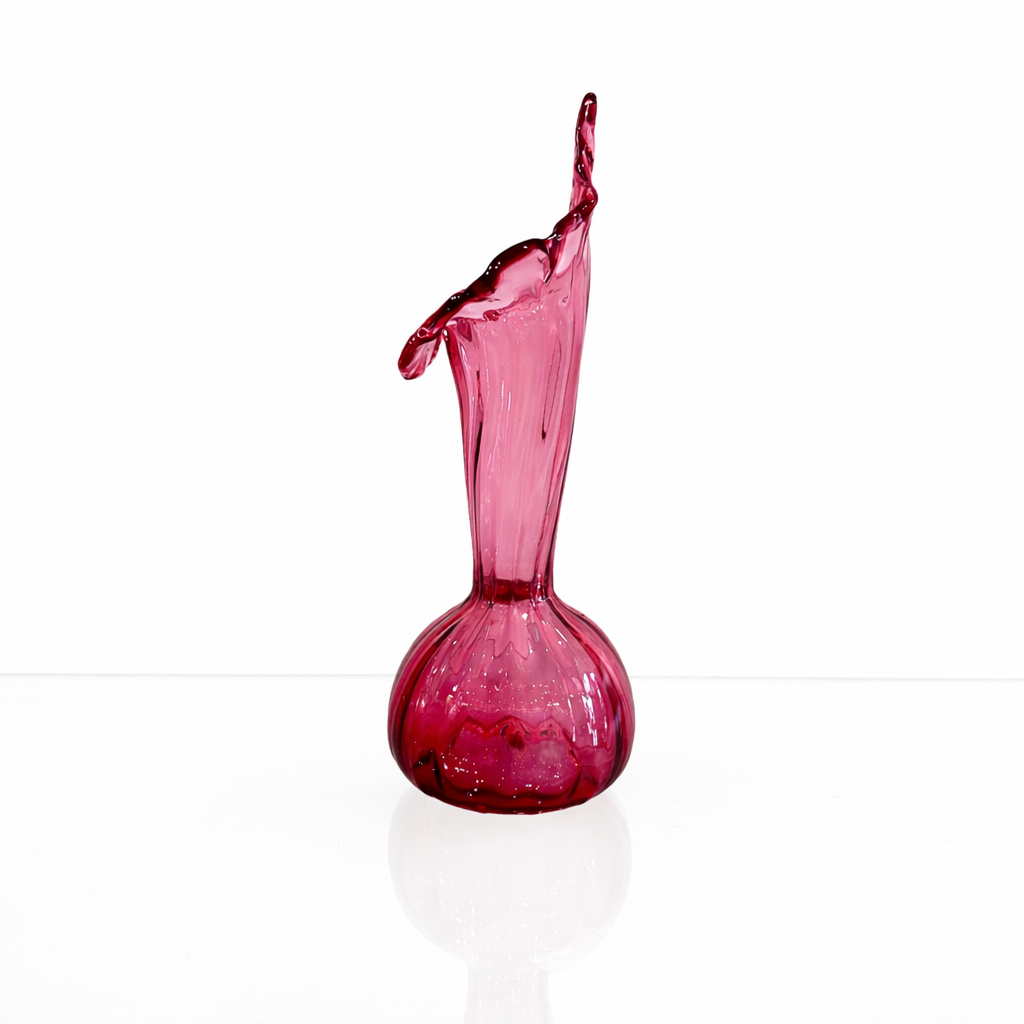
A collector-grade mid-century cranberry art glass vase of sculptural, free-formed presence, executed in richly saturated ruby-cranberry batch glass. This is a true hand-blown example with visible hot-worked character—confidently formed, weight-balanced, and materially expressive.
The silhouette is tall and architectural: a narrowed neck rising into a gently flared, organically articulated rim, flowing downward into a rounded, weighty lower body that anchors the form visually. The rim remains intentionally irregular, shaped while molten rather than mechanically cut—an authentic indicator of studio handling rather than factory standardization.
The cranberry tone is integral to the glass itself, not surface-treated, displaying internal movement, tonal depth, and subtle striations created during the blowing process. Fine flow lines and chromatic variation are visible throughout, reinforcing its hand-crafted origin. The base retains a clearly defined pontil scar, documented in close view, confirming individual finishing after removal from the blowpipe and distinguishing it from pressed or mold-finished production.
The glass carries notable heft relative to scale, consistent with controlled mid-century studio or continental art glass practice. No maker’s mark is present; as with many quality studio and export pieces of the period, attribution is based on construction and material analysis rather than signature.
In the 2026 collector market, saturated monochrome studio glass—particularly cranberry and ruby tones—continues to perform strongly due to its compatibility with both modernist and Murano-influenced interiors.
Attribution & Period
Studio / art glass production, likely mid-20th century (circa 1950s–1960s).
Unattributed; described strictly by observable manufacturing characteristics and period form language.
Dimensions
Height: 10 in.
Width at rim (widest point): 2 3/5 in.
Width at base (widest point): 3 1/4 in.
Substantial weight for size, indicative of quality glass mass.
Condition
Excellent vintage condition.
No scratches
No cracks
No chips
No hairlines
No repairs
Glass remains clean, structurally sound, and display-ready.
Authenticity & Construction
Hand-blown cranberry batch glass with free-formed rim and visible internal striations. Pronounced pontil scar confirms traditional blowpipe removal and finishing. Absence of mold seams supports non-pressed production. Color depth and tonal layering consistent with authentic mid-century studio or continental art glass techniques.
Placement
An ideal statement object for:
Modernist interiors
Murano-influenced collections
Scandinavian and continental studio glass groupings
Monochrome tonal displays
Standalone pedestal or console presentation
Its vertical discipline and saturated hue allow it to function as both sculptural form and focal accent.
STANDARD ATTRIBUTION & VALUE DISCLOSURE
This piece is described to the best of current scholarly and market knowledge. Any maker or regional attribution is based on visual analysis, materials, construction techniques, and documented stylistic comparisons. As with many vintage and antique glass objects, definitive attribution may not be possible without original labels or factory records. Pricing reflects condition, quality, decorative appeal, and current collector demand rather than a guaranteed maker identification.
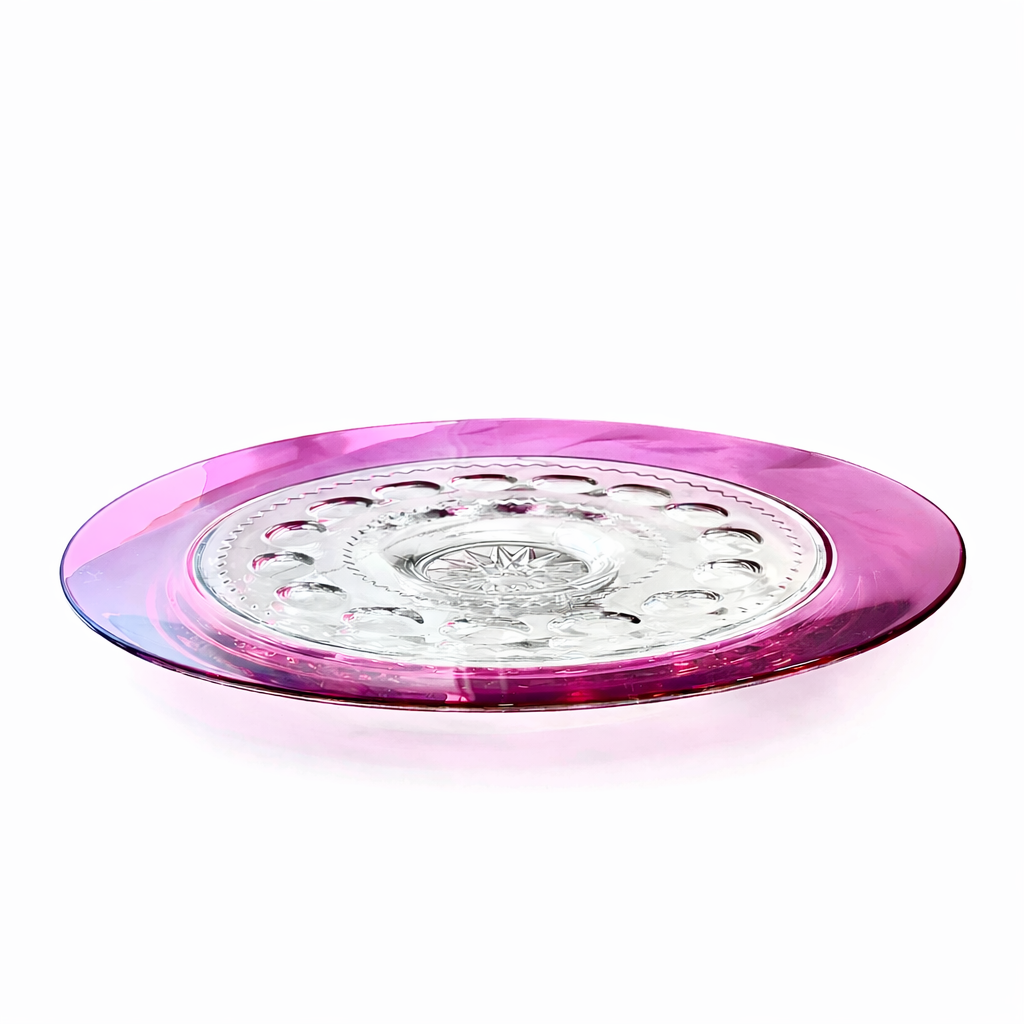
A luminous Venetian cased crystal underplate executed in saturated fuchsia-pink over clear crystal, centered with a precision-cut radial starburst and encircled by alternating oval lenses and zig-zag banding. The composition reflects mid-century Murano-region decorative production, where bold color saturation met architectural cutting for dramatic tabletop presentation.
The vibrant pink perimeter frames the crystalline interior, creating strong optical contrast and refraction. When styled beneath the coordinating pedestal vessel (shown separately), the pairing forms a cohesive Italian modern vignette consistent with 1960s luxury entertaining aesthetics.
Attribution & Period
Italy (Murano), circa 1965. exhibiting construction, coloration, and cutting consistent with mid-century Venetian glasshouse production for export, with attribution remaining at the regional level in the absence of factory documentation.
Dimensions & Weight
Diameter: 4 inches
Height: 1.25 inches
Base Diameter: 3.5 inches
Weight: 3.856 lbs
The substantial weight relative to scale supports crystal-grade composition rather than standard pressed glass.
Condition
Excellent condition overall; fine, hair-like annealing lines (“haylines”) are visible within the clear crystal base under magnification and raking light. These are stable internal cooling lines characteristic of thicker mid-century glass production and are not cracks. There is very minor wear to the pink perimeter in one small area, consistent with age and careful prior use. No chips, fractures, or structural concerns observed.
Authenticity & Construction
Thick cased crystal, precision-cut with starburst and lens motifs and finished with machine-assisted decorative cutting and a ground, polished base; the clarity, refraction, and cutting depth confirm crystal construction, with a rich pink casing over clear crystal producing pronounced depth and tonal intensity.
Placement
Ideal as a sculptural underplate beneath a Murano centerpiece, or displayed independently as a jewel-toned accent on marble, lacquer, or glass surfaces. Particularly compelling when paired with the coordinating Venetian vessel for a curated 1960s Italian presentation.
STANDARD ATTRIBUTION & VALUE DISCLOSURE; This piece is described to the best of current scholarly and market knowledge. Any maker or regional attribution is based on visual analysis, materials, construction techniques, and documented stylistic comparisons. As with many vintage and antique glass objects, definitive attribution may not be possible without original labels or factory records. Pricing reflects condition, quality, decorative appeal, and current collector demand rather than a guaranteed maker identification.
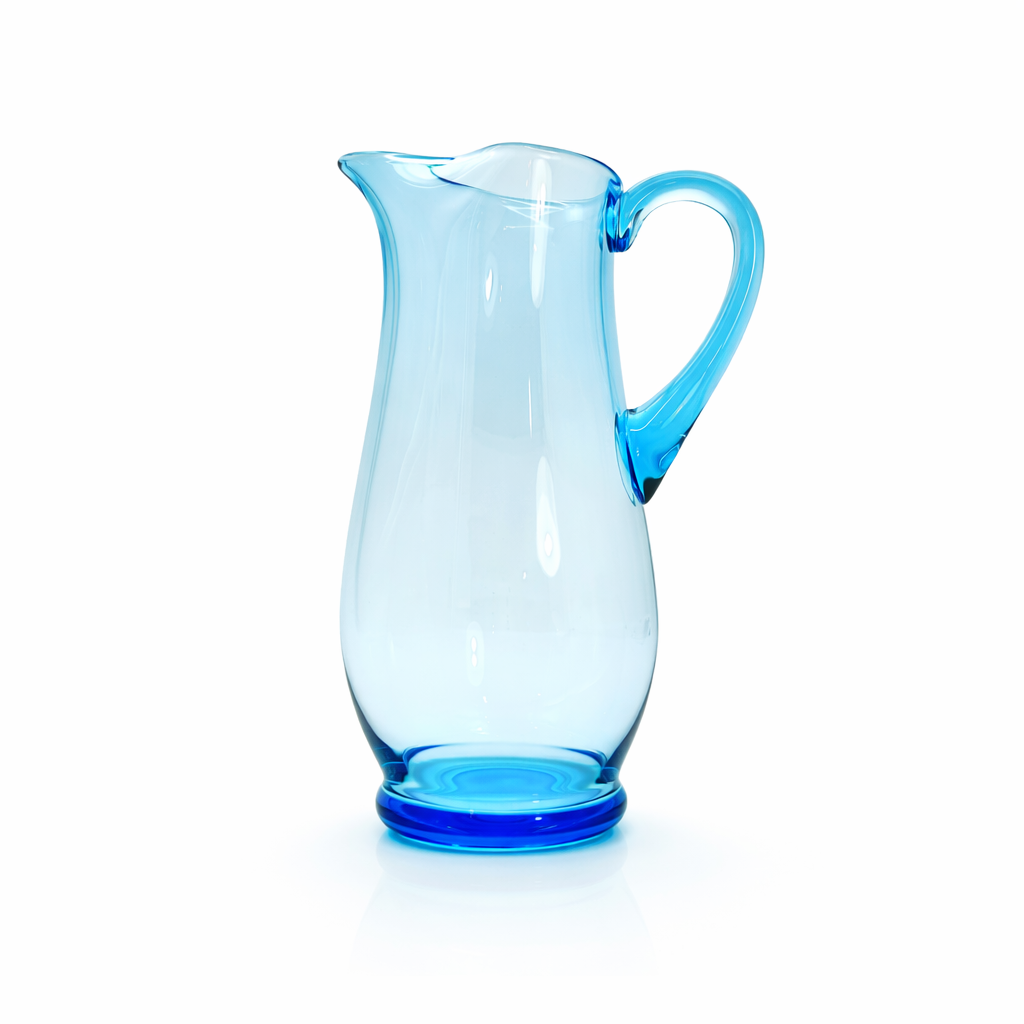
A finely proportioned aquamarine opaline glass pitcher with a tall tapering body, flared pouring lip, and elegantly drawn applied handle. The vessel carries strong sculptural presence, with the milky blue body deepening to more saturated cobalt-toned accents at the rim, handle joins, and foot. Its clean silhouette and luminous translucency give it a refined decorative effect even when not in use. Under 365nm UV light the glass shows a reflective glow, adding another layer of visual interest without, on its own, proving a specific glass formula.
Attribution & Period
Stylistically aligned with Italian opaline art glass, most closely comparable to Empoli-area decorative pitchers offered as 1960s handblown examples with similar pale blue opaline bodies, darker blue handle junctions, and applied handles. Comparable market examples identified as Empoli blue opaline pitchers from circa 1960 and the 1960s show closely related colour handling, silhouette, and construction, though this example bears no factory mark and no documented maker has been confirmed. Attribution therefore remains visual rather than documented, and the most defensible working date is the 1960s.
Dimensions & Weight
Height: 9 in
Width / Diameter: 5.5 in overall width including handle and spout; 3 in mouth diameter
Depth / Base Diameter: 2.625 in base diameter
Weight: 1.468 lbs
Condition
Excellent condition. No cracks, chips, or repairs observed. There appear to be light scratches to the interior belly, consistent with past cleaning by an abrasive cloth. Minor surface wear consistent with careful handling and age.
Authenticity & Construction
Handblown glass with an applied handle and tooled spout. The visible transitions at the handle attachments, the fluid shaping at the lip, and the concentrated colour at the joins and foot are consistent with studio or workshop hand-forming rather than pressed production. The opaline body and deeper blue accents create a materially rich effect that responds especially well to direct light and display lighting. Comparable Italian opaline pitchers from the 1960s are also described in the market as handblown with applied handles, supporting this construction reading.
Placement
Ideal for a refined bar cart, open shelving, dining console, or coastal-modern interior where coloured glass can function as a sculptural accent. It also presents well grouped with the separately offered matching aquamarine ribbed wine glasses and shell-form serving trays shown in the photographs, creating a cohesive monochrome tablescape while remaining individually sold. Under directional or UV lighting, the vessel takes on added atmospheric presence.
STANDARD ATTRIBUTION & VALUE DISCLOSURE
This piece is described to the best of current scholarly and market knowledge. Any maker or regional attribution is based on visual analysis, materials, construction techniques, and documented stylistic comparisons. As with many MCM and antique design objects, definitive attribution may not be possible without original labels or factory records. Pricing reflects condition, quality, decorative appeal, and current collector demand rather than guaranteed maker identification.
This rare Irish ceramic set, comprising a matched bowl and mug, projects a charming and sculptural presence that elevates it beyond simple children's tableware. Crafted with an Stefan-era geometric logic in the mid-20th century, the set acts as a narrative canvas, capturing light across its creamy glaze and highlighting a detailed polychrome frieze of multiple nursery rhyme vignettes. The beautifully preserved transfers include meticulous representations of 'Humpty Dumpty' and 'Little Miss Muffet' on the main body panels, paired alongside 'Baa, Baa, Black Sheep' and a whimsical depiction of 'Pease Porridge Hot.' Its playful decorative impact and sophisticated form make it a compelling, designer-friendly artifact for refined interior curation.
Attribution & Period
Attribution: by Arklow Pottery; Period: 1950s (circa 1952–1959)
Reasoning: The set features the definitive green underglaze backstamp "ARKLOW" above "REPUBLIC OF IRELAND," a factory mark strictly utilized in this specific configuration by the Co. Wicklow studio between 1952 and 1959. Stylistically, the specific shape of the mug—featuring an integrated, angular geometric handle—and the shallow, wide profile of the bowl are structurally aligned with Arklow's mid-century aesthetic, demonstrating a unique Art Deco design hangover that successfully persisted in regional European factories into the 1950s.
Dimensions & Weight
Bowl
Height: 1.75 inches
Width / Diameter: 6 inches
Depth / Base Diameter: 2.5 inches
Weight: 0.424 pounds
Mug
Height: 2.75 inches
Width / Diameter: 4 inches (including handle)
Depth / Base Diameter: 2.75 inches
Weight: 0.336 pounds
Condition
Clinical and direct. The ceramic bodies of both the bowl and mug remain structurally sound and free of body cracks, hairline fractures, or professional restorations. A single, minor, shallow chip is observed strictly confined to the bottom unglazed foot rim of the mug, not impacting structural integrity or vertical presentation. The intricate polychrome transfer decoration remains exceptionally clear with vibrant colors; light, age-consistent rubbing is observed to the delicate gold-gilt accent banding on the rim profiles.
Authenticity & Construction
This set is constructed of durable Irish earthenware, utilizing precise slip-casting to achieve its integrated, structurally significant handle design. The decoration represents an authentic mid-century transferware technique, where complex nursery rhyme vignettes—including Humpty Dumpty, Little Miss Muffet, Baa Baa Black Sheep, and Pease Porridge Hot—were meticulously layered onto the glazed ceramic body before a secondary firing. This multi-step workshop application process explains why this set features such a captivating density of specific characters, ensuring that every angle offers a new sculptural or narrative detail, rather than mere repetitive industrial patterns.
Placement
The low profile and narrative strength of this set make it ideal for curated placement on an architectural console, an illuminated modernist étagère, or a child’s bedroom display. Its warm palette and historical resonance make it a perfect selection for interior designers seeking to inject unique, culturally significant textures into a sophisticated residential interior.
STANDARD ATTRIBUTION & VALUE DISCLOSURE; This piece is described to the best of current scholarly and market knowledge. Any maker or regional attribution is based on visual analysis, materials, construction techniques, and documented stylistic comparisons. As with many MCM and antique design objects, definitive attribution may not be possible without original labels or factory records. Pricing reflects condition, quality, decorative appeal, and current collector demand rather than guaranteed maker identification.