
EARTH + STONE
Explore our range of services designed to help you move forward with confidence, wherever you're headed next.

EARTH AND STONE
THE EDITIONS
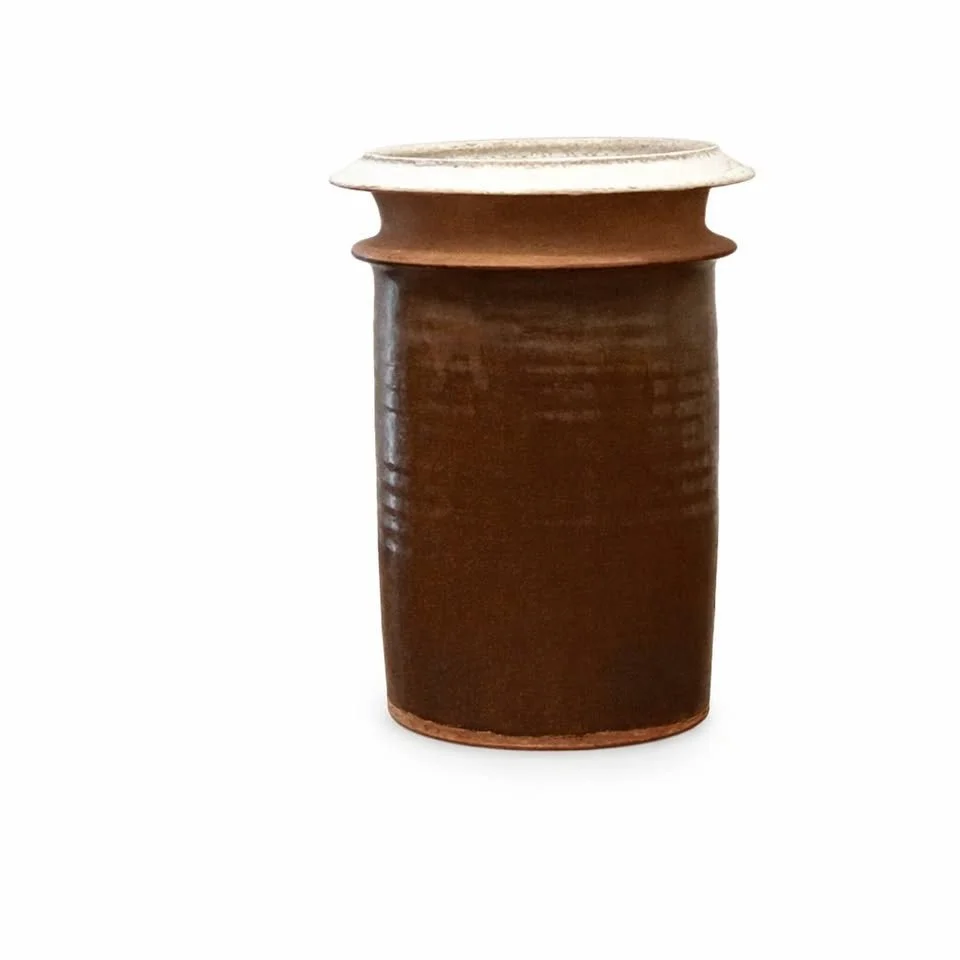
A substantial mid-century studio stoneware vessel, executed in a warm, earth-toned glaze with a contrasting pale, speckled rim. The cylindrical form is disciplined and architectural, with a wide flared lip and grounded base that read as both sculptural and functional.
The body reveals visible throwing rings and natural glaze variation—hallmarks of wheel-thrown studio production. The rich brown glaze carries depth and tonal movement, while the lighter rim introduces restraint and contrast, a glaze program consistent with 1970s studio craft aesthetics.
Its scale and weight give it presence. Equally suited for a sculptural plant installation, dried arrangement, or standalone placement in a gallery-minimal interior, the piece holds its own as an architectural ceramic form.
Attribution & Period
Unmarked studio production, circa 1970s. The glaze palette, construction, and restrained silhouette align with North American mid-century studio stoneware traditions.
Condition
Excellent condition. No cracks, repairs, or structural issues observed. Minor base wear consistent with age.
Dimensions & Weight
Height: 10 in
Top diameter (including lip): 8 in
Base diameter: 5 3/4 in
Authenticity & Construction
This is authentic mid-century studio stoneware with age-appropriate character. It is not mass-produced décor or modern reproduction pottery. The visible throwing lines and glaze movement are integral to its handmade identity.
Placement
A grounded ceramic form that layers seamlessly into Scandinavian, modernist, and gallery-minimal interiors—an ideal tonal counterpoint to saturated Murano or Bohemian art glass.
STANDARD ATTRIBUTION & VALUE DISCLOSURE; This piece is described to the best of current scholarly and market knowledge. Any maker or regional attribution is based on visual analysis, materials, construction techniques, and documented stylistic comparisons. As with many vintage and antique glass objects, definitive attribution may not be possible without original labels or factory records. Pricing reflects condition, quality, decorative appeal, and current collector demand rather than a guaranteed maker identification.
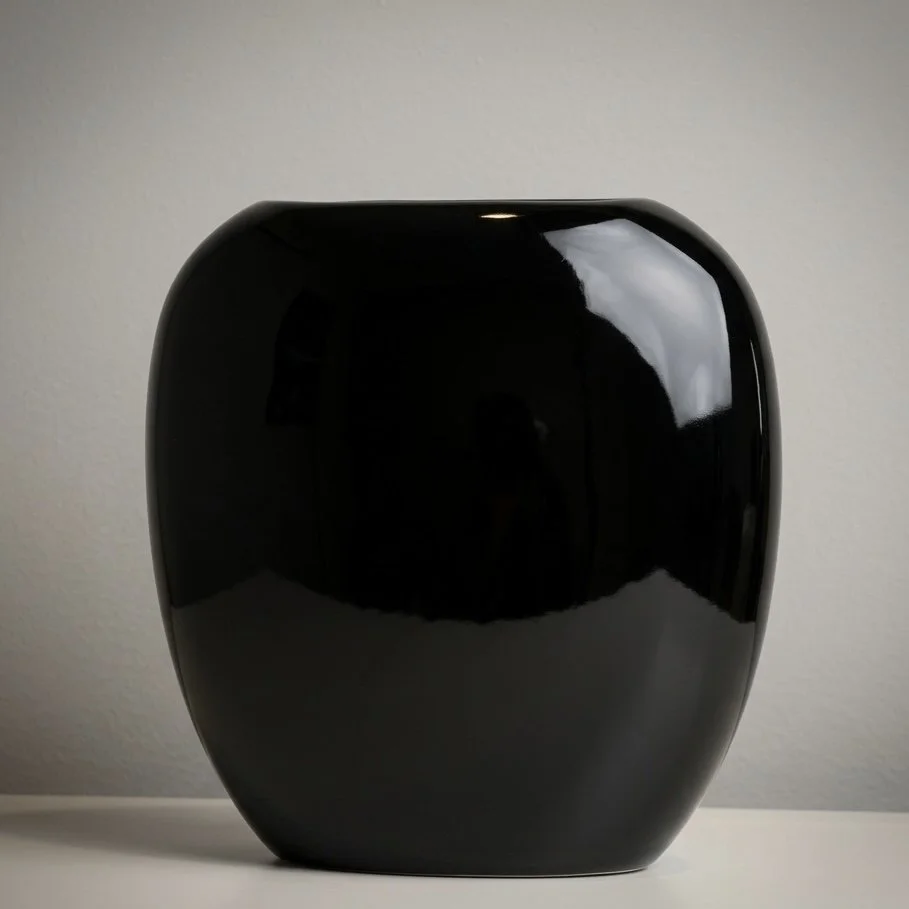
This monolithic vessel exerts a powerful sculptural presence through its compressed, ovoid geometry and "mirror-black" glaze. The form is a masterclass in mid-century minimalism, utilizing a low center of gravity and a precise, elongated aperture designed specifically for the structural requirements of architectural floral arrangement. Its surface depth and high-reflectivity finish create a sophisticated interplay of shadow and light, making it a definitive statement piece for a curated interior.
Attribution & Period
Mid-Century Modern (1960s)
This vessel is a definitive example of Japanese studio pottery, attributed to the Mashiko tradition. The hand-incised signature on the base is consistent with the stylized, western-facing marks used by Mashiko-based artists during the 1960s international design boom. The characteristic "pin-hole" bubbling in the glaze and the iron-rich clay body are direct signatures of the high-temperature reduction firing processes unique to the Tochigi Prefecture. This piece represents the critical era where traditional Japanese folk-craft (Mingei) transitioned into high-modernist sculptural art.
Dimensions & Weight
Height: 5.75 in
Width / Diameter: 6 in (widest area)
Depth / Base Diameter: 3.375 in x 1.625 in (base)
Weight: 0.224 lbs
Condition
The vessel is in immaculate, museum-grade condition. The high-gloss midnight glaze remains vibrant and deep with no chips, cracks, or restorations. Clinical examination reveals minor "glaze pops" or pin-hole bubbles near the shoulder, which are an authentic, sought-after result of the artisan kiln firing process. Light, appropriate shelf wear is present on the unglazed foot, confirming its vintage origin and careful residential history.
Authenticity & Construction
Hand-thrown and expertly altered, the vessel exhibits a seamless transition from its stable base to the elegantly tapered rim. The midnight glaze is applied with exceptional thickness, achieving a liquid-like depth that is a hallmark of Mashiko studio work. The hand-incised signature is deeply integrated into the clay body, providing a permanent and verifiable mark of provenance.
Placement
The dramatic silhouette and noir finish demand a prominent placement. It is exceptionally well-suited for a brutalist sideboard, a minimalist stone mantel, or a glass-top executive desk. It functions with equal strength as a standalone sculptural object or as a vessel for a singular, architectural branch to highlight its Ikebana heritage.
STANDARD ATTRIBUTION & VALUE DISCLOSURE; This piece is described to the best of current scholarly and market knowledge. Any maker or regional attribution is based on visual analysis, materials, construction techniques, and documented stylistic comparisons. As with many MCM and antique design objects, definitive attribution may not be possible without original labels or factory records. Pricing reflects condition, quality, decorative appeal, and current collector demand rather than guaranteed maker identification.
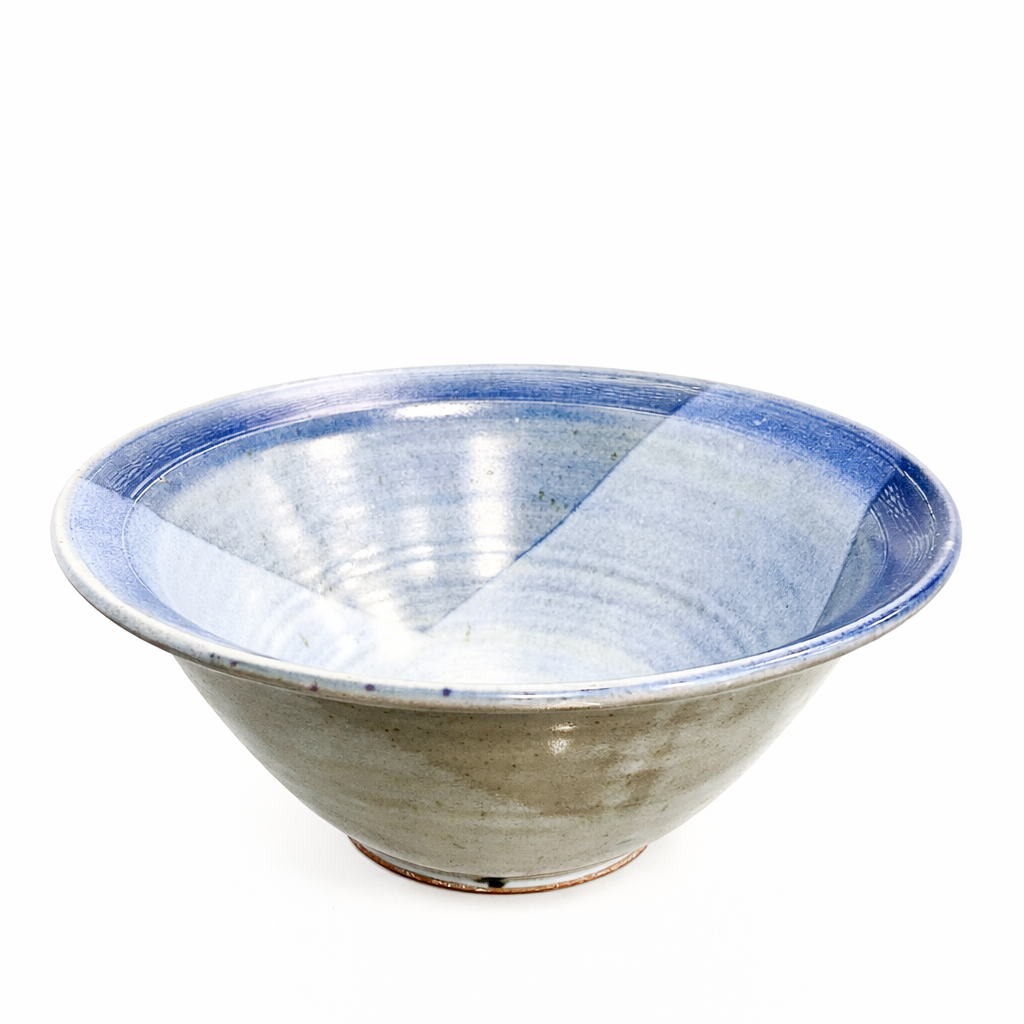
A substantial hand-thrown studio pottery bowl with a wide, gently flared form and classic wheel-thrown rings visible insidean immediate sign of studio production rather than factory ware.
The glaze is a cool, misty blue with deeper cobalt pooling at the rim, showing natural variation from the firing and the potters application. The exterior has a stoneware body with subtle speckling and a warm, exposed foot ring typical of wheel-thrown work.
Authenticity & Construction
Signature / mark (important for collectors) The underside shows an incised leaf (maple-like) motif as the makers mark. This is a true signature style mark (cut into the clay before firing), consistent with studio potters who used personal chops or carved symbols rather than printed stamps. Likely material & technique Hand-thrown stoneware (wheel-thrown; visible throwing lines) Glazed interior with a darker brushed/pooled rim band Unglazed foot ring with kiln-fired clay tone
Attribution & Period
Possible origin & dating (best-supported, without overclaiming) Based on the studio-pottery form, incised emblem mark, and blue glaze aesthetic, this bowl fits well with North American studio pottery trends that were especially popular from the mid-20th century into the late 20th century (c. 1960s1990s).
The carved leaf mark strongly suggests a potter working in a region where a leaf emblem would be meaningful (often seen with Canadian or North American makers), but without a readable name stamp, the exact maker and town can’t be stated with certainty.
Dimensions & Weight
Height: 5 1/4 in
Mouth diameter: 12 in
Base diameter: 4 1/2 in
Condition
Appears very good vintage condition from photos: no obvious cracks or repairs seen. Minor surface speckling/marks consistent with normal studio kiln firing and age. No chips, no hairlines, no repairs
Placement
Why collectors want it Large, display-worthy scale (12 mouth) Sculptural modern form suitable for MCM / minimalist interiors Artist mark (incised emblem) + handmade character from wheel-throwing and glaze variation
STANDARD ATTRIBUTION & VALUE DISCLOSURE
This piece is described to the best of current scholarly and market knowledge. Any maker or regional attribution is based on visual analysis, materials, construction techniques, and documented stylistic comparisons. As with many vintage and antique glass objects, definitive attribution may not be possible without original labels or factory records. Pricing reflects condition, quality, decorative appeal, and current collector demand rather than a guaranteed maker identification.
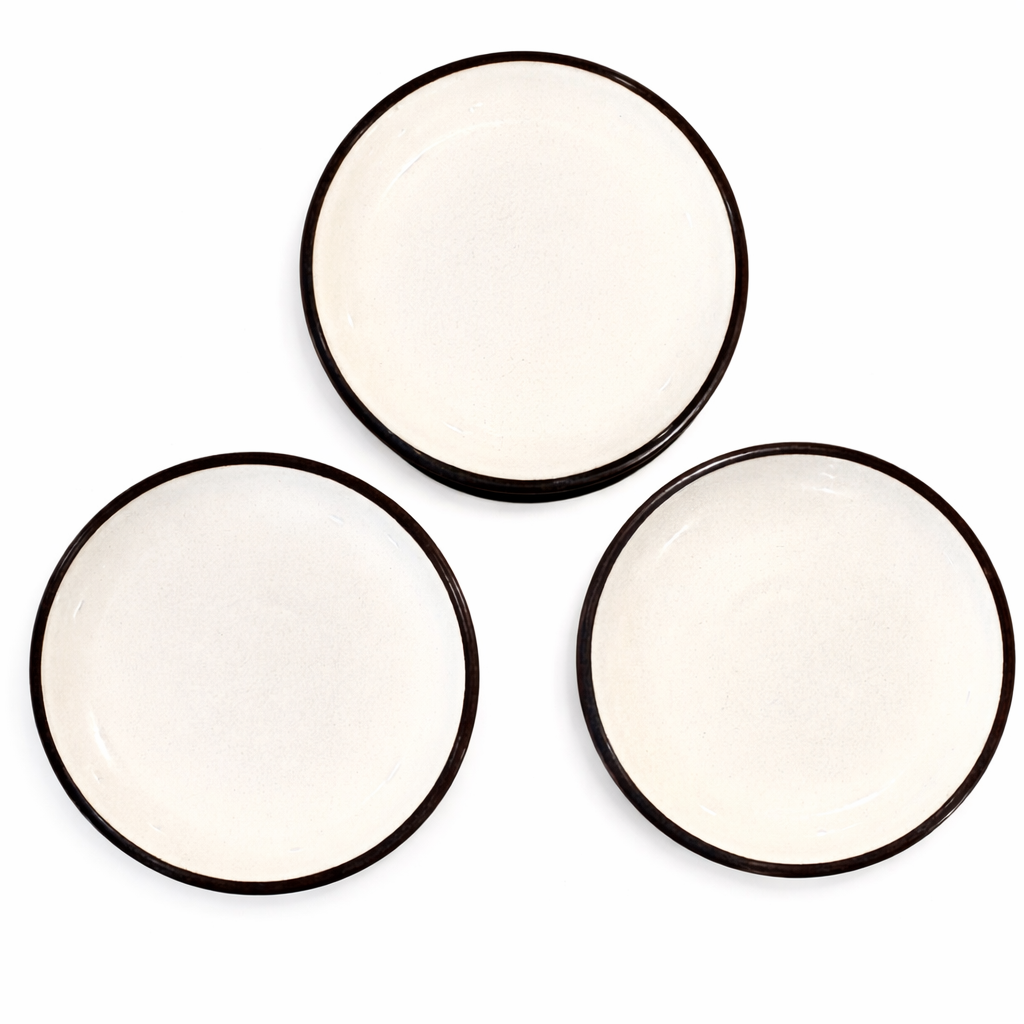
Service for three Denby England stoneware plates, produced in Derbyshire; one of Britain’s most respected ceramic regions. Denby, established in 1809, is internationally recognized for its durable, design-forward stoneware that bridges utilitarian function and refined modern table aesthetics.
These plates feature a warm ivory interior with subtle speckling and a deep charcoal/black outer rim, creating strong contrast and architectural framing. The glaze exhibits natural tonal movement and kiln variation; hallmarks of authentic mid-20th-century Denby production. Each example shows slight individual variation consistent with hand-controlled firing rather than contemporary mass uniformity.
The reverse stamp reads “Denby England” with classic concentric foot rings associated with mid-century production, when Denby balanced traditional Derbyshire craftsmanship with emerging modern table design. Earlier production periods are especially desirable due to thicker stoneware bodies and richer glaze depth.
Attribution & Period
Denby Pottery, Derbyshire, England. Established 1809.
Materials
High-fired glazed stoneware.
Dimensions & Weight
Standard salad plate format. Please refer to ruler image for confirmation of exact diameter.
Condition
One plate has a small edge chip located on the underside only, clearly shown in photographs. The chip is stable and does not affect structural integrity or front-facing presentation. No cracks, hairlines, or repairs observed on the remaining plates. Glaze wear is minimal and appropriate for age. Foot rings intact and clearly stamped.
Authenticity & Construction
This is authentic mid-20th-century Denby stoneware from Derbyshire. It is not contemporary reproduction. Variations in glaze tone and speckling are inherent to original firing and confirm period production.
Placement
A restrained English stoneware grouping that integrates seamlessly into Scandinavian-modern, rustic-modern, and gallery-minimal interiors. The high-contrast rim profile photographs exceptionally well and layers beautifully with teak, walnut, and linen-forward tablescapes.
Discover the latest —hand selected pieces to our collection; here to bring new energy to your space.
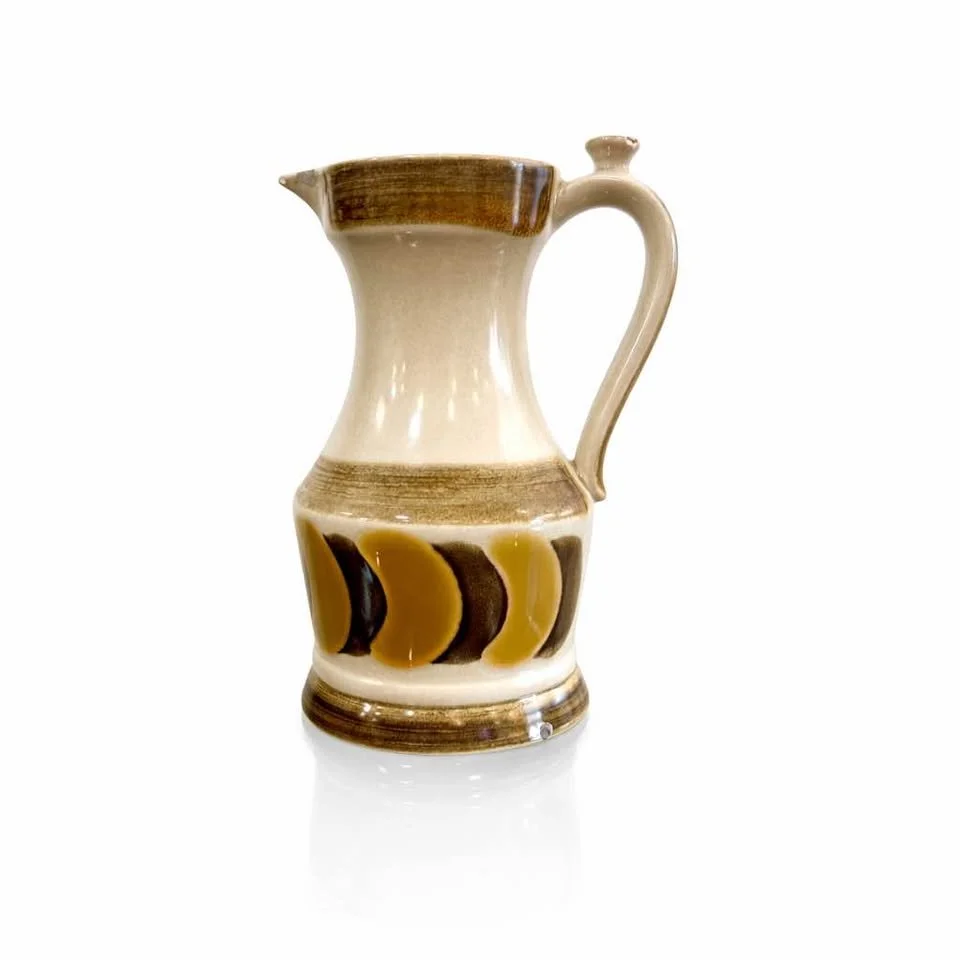
Hand-glazed mid-century West German stoneware jug, produced during the 1950s-1960s modernist period and marked “W. Germany” to the underside. The form is architectural and sculptural, defined by a softly flared neck, articulated pouring lip, and a strong integrated handle that balances weight and proportion with precision. The surface displays layered hand-applied glaze in a restrained palette of cream, sand, ochre, and deep espresso brown. A bold abstract band encircles the lower body, creating visual rhythm against the neutral ground. Fine, even crackle throughout the glaze is inherent to the firing process and contributes tonal depth and authenticity characteristic of postwar West German stoneware. Unlike high-gloss mass-market examples, this piece reflects the quieter, organic modern direction within West German ceramics; grounded, tactile, and intentionally minimal. The hand-glazed execution and balanced silhouette give it strong display presence beyond simple utility.
Attribution & Period
West Germany, circa 1950s-1960s. Underside stamped “W. Germany”
Dimensions & Weight
Height: 9.5 in (24.1 cm)
Width (handle to spout): 6 in (15.2 cm)
Base diameter: 4 5/8 in (11.7 cm)
Mouth diameter: 3 1/4 in (8.3 cm)
Condition
Excellent condition consistent with age and studio firing. Fine glaze crackle present throughout. Two small chips are present; one within the brown glazed band near the base and one at the spout lip; both documented clearly in photographs. No structural cracks or repairs observed. The piece remains stable and display-forward.
Authenticity
This is authentic mid-century West German stoneware, hand-glazed and kiln-fired. It is not contemporary reproduction. Surface crackle and tonal variation are inherent to period production. High-fired hand-glazed stoneware.
Placement
A sculptural ceramic vessel that integrates seamlessly into organic modern, minimalist, and architectural interiors. Particularly strong when styled against travertine, plaster, walnut, or neutral-toned stoneware collections.
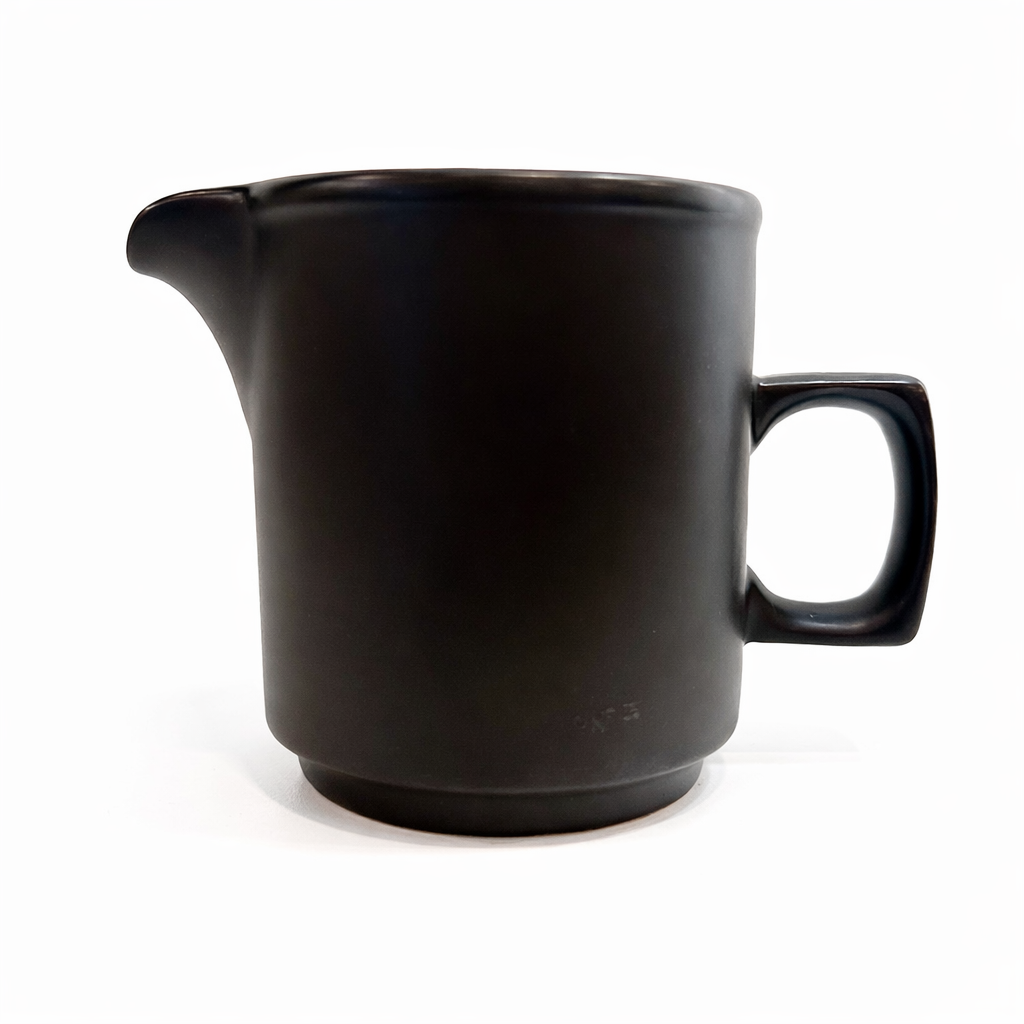
A highly sculptural, collector-grade Crown Lynn (New Zealand) milk jug / creamer in an unusual matte black glaze associated with the Titian era. This is the kind of piece that reads like small-scale architecture on a shelfminimal, graphic, and very designer’s object.
What makes this example especially desirable is the handle design: instead of a standard loop, its a bold, squared-off, D/rectangular portal handle with crisp geometrymore Bauhaus / Brutalist than traditional tableware. Paired with the pinched beak spout and clean cylindrical body, it has a strong modern silhouette that works equally well as functional serveware or a standalone decorative object.
Attribution & Period
The base shows an impressed circular mark consistent with Crown Lynns Titan New Zealand Crown Lynn was based in New Lynn, Auckland, New Zealand, and is widely collected as a Kiwi design icon.
Dating (researched):
This form and finish align with Crown Lynns Titian period in the mid-to-late 1970s; one referenced example notes a Titian black matte-glazed jug with the shape dating to 1976. c. 1970s (likely mid-1970s) rather than stating an exact year as fact.)
Authenticity & Construction
Heavy molded/slip-cast ceramic/stoneware with a studio-look matte black glaze (a finish that shows subtle tonal shifts under light). Crown Lynn is known for large-scale domestic production and design-forward tableware lines that have become increasingly collectible.
Decor / Style Keywords: Mid-Century Modern Brutalist Minimalist Scandinavian Modern Postmodern Modernist Wabi-Sabi Monochrome Black Architectural Form New Zealand Studio/Art Pottery Look
Dimensions & Weight
Height: 3 1/2 in
Width (spout to handle): 4 1/4 in
Opening diameter: 2 3/4 in
Condition
Good condition with expected light surface wear from age/use; underside shows typical shelf/base wear. No chips or cracks,
Placement
Crown Lynn has a strong collector market due to its place in New Zealand design history and the relative scarcity of certain shapes/glazesespecially uncommon matte black finishes and strongly sculptural forms.
STANDARD ATTRIBUTION & VALUE DISCLOSURE
This piece is described to the best of current scholarly and market knowledge. Any maker or regional attribution is based on visual analysis, materials, construction techniques, and documented stylistic comparisons. As with many vintage and antique glass objects, definitive attribution may not be possible without original labels or factory records. Pricing reflects condition, quality, decorative appeal, and current collector demand rather than a guaranteed maker identification.