
French Coastal
This is coastal without cliché — structured yet effortless, painterly yet precise. Designed for layered, elevated interiors, the collection pairs beautifully with natural stone, linen, and oak, bringing a composed, sea-inflected elegance to any setting.
The French Coastal collection captures the atmosphere of European shoreline living with collector-level refinement. Cobalt brushwork, luminous glazes, and hand-painted florals meet architectural forms and quietly modern silhouettes. Surfaces range from softly crackled and provincial to clean and studio-driven, Each piece is unified by light, movement and disciplined craftmanship.
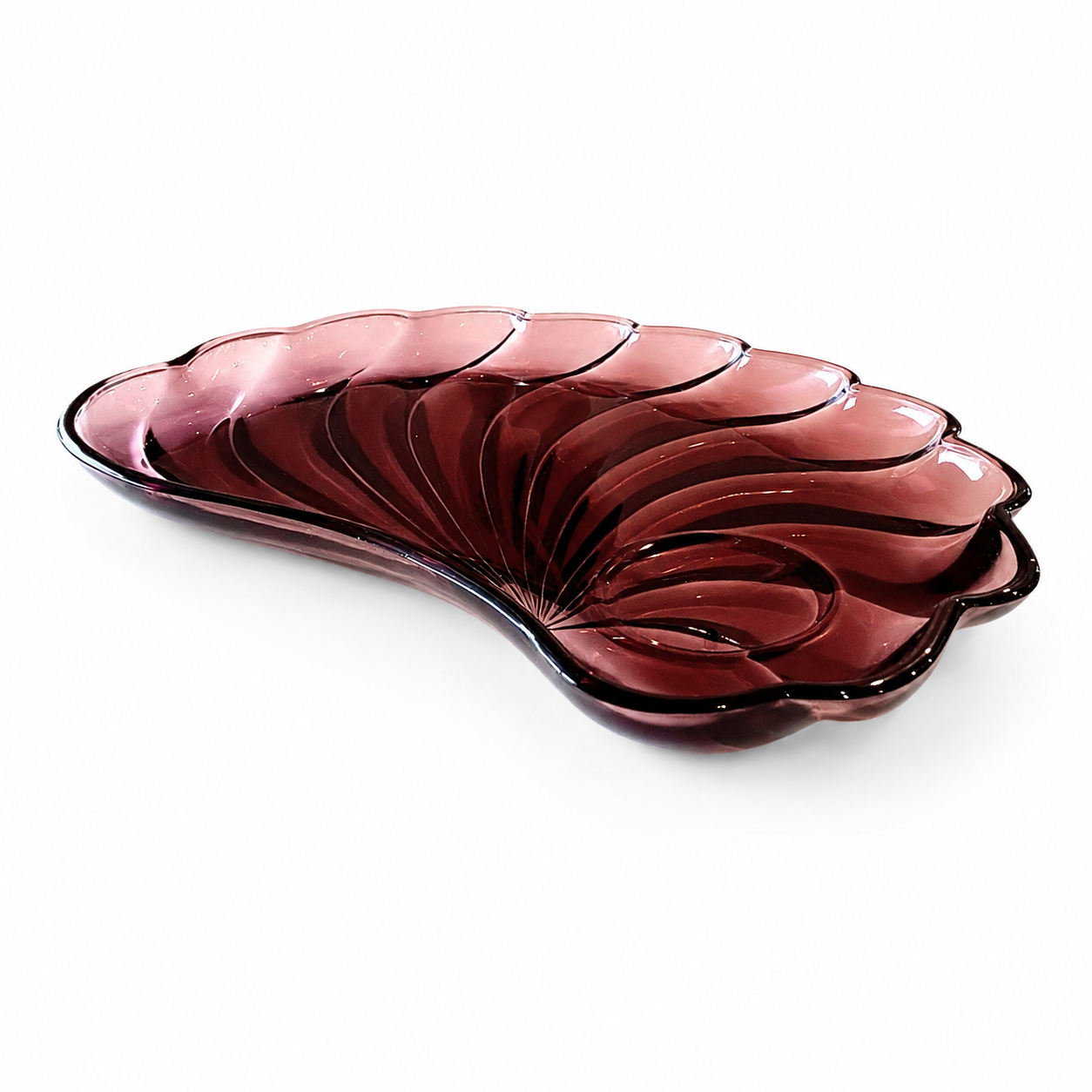
This exceptional art glass dish captures the fluid brilliance of marine life through a beautifully stylized oyster shell form, executed in a deep, captivating amethyst hue. The vessel possesses a remarkable sculptural presence, utilizing dramatic molded ridges that catch and refract ambient light to create a shifting play of tonal depth and shadow across its contours. Its organic silhouette features a gracefully shallow profile, offering both an arresting visual impact and a highly versatile canvas for sophisticated interior styling. Whether serving as a standalone statement piece or reflecting soft light on a curated surface, its rich material quality lends an elegant touch of mid-century coastal refinement to contemporary spaces.
Attribution & Period
This piece is an excellent regional example of mid-century European decorative art glass, stylistically aligned with Italian Murano productions of the 1960s. The manufacturing method utilizes a precision pressed-glass technique to achieve uniform, crisp structural ribbing on the reverse while maintaining a perfectly polished, glassy smooth interior surface. No factory mark or original paper label is observed—which is characteristic of export art glass from this vibrant design era. The sophisticated use of rich amethyst coloration and the fluid, stylized interpretation of marine iconography are highly consistent with decorative objects produced during this decade to cater to the booming international luxury resort and high-end boutique markets.
Dimensions & Weight
Height:** 1 inch
Width / Diameter:** 6 1/2 inches
Depth / Base Diameter:** 10 inches (length)
Weight:** 0.912 pounds
Condition
The dish is in excellent condition, showing no chips, cracks, or structural repairs. The molded glass body retains its original clarity, high-gloss luster, and deep amethyst color uniformity. Minimal, negligible shelf wear is present on the resting points of the base, consistent with light display and careful handling over the decades.
Authenticity & Construction
Exhibiting masterful mid-century manufacturing, this dish is crafted from a single gather of high-clarity colored glass pressed into a custom, intricately carved mold. This precise method allows the dramatic fluting and undulating rim of the shell to achieve an architectural sharpness that hand-blown glass alone cannot replicate. The deliberate thickness of the glass gives the piece a satisfying heft and enhances its light-gathering capabilities, allowing the amethyst pigment to deepen at the ridges and soften beautifully along the translucent slopes.
Placement
An impeccable choice for interior designers, this sculptural shell dish effortlessly grounds a variety of upscale environments. It makes a stunning statement on a sunlit console table, a mirrored dressing vanity, or a lacquered cocktail table where its deep jewel tones can contrast against lighter surfaces. Its low profile and sophisticated maritime motif also make it highly suitable for an elegant coastal-modern étagère or as a luxurious catchall in a refined guest suite.
STANDARD ATTRIBUTION & VALUE DISCLOSURE
This piece is described to the best of current scholarly and market knowledge. Any maker or regional attribution is based on visual analysis, materials, construction techniques, and documented stylistic comparisons. As with many MCM and antique design objects, definitive attribution may not be possible without original labels or factory records. Pricing reflects condition, quality, decorative appeal, and current collector demand rather than guaranteed maker identification.
Collector’s Note: Connoisseurship & Regional Attribution
To connect an unmarked piece of mid-century pressed glass to an authentic Italian (Murano) origin, glass historians and decorative arts dealers evaluate specific design DNA, material properties, and historical market contexts. This attribution is supported by several key factors:
The Marine Motif as a Murano Signature: While many global factories produced shell-shaped dishes, the specific stylized interpretation of marine life—especially oysters, clams, and conchs—was a foundational staple of 1950s and 1960s Venetian glass design. Master designers like Alfredo Barbini and firms like Seguso Vetri d'Arte pioneered high-end, heavy sculptural shells. This sparked a highly successful export market where Murano factories used specialized molds to press thick, high-gloss glass objects to meet the soaring global demand for Italian luxury resort decor.
High-Clarity "Amethyst" Mineral Coloration: Mid-century Italian factories were world-renowned for their chemical mastery of color. The deep, intense purple seen in this piece is a classic manganese-formulated amethyst typical of Venetian furnaces from this era. It exhibits a sophisticated, warm tonal shift under varied lighting conditions—transitioning from a smoky, velvety violet in shadow to a bright, brilliant magenta-purple where light passes through the contoured edges.
The "Vide-Poche" Luxury Market Context: During the 1960s, Italian glass captured a significant footprint in the international high-society market as boutique imports and luxury travel souvenirs from Venice. These stylized shell dishes were rarely marketed as utilitarian tablewares; they were curated for high-end department stores and design salons as sculptural vides-poches (vanity trays and catchalls) tailored for luxury hotels and sophisticated mid-century interiors.
Archival Design & Color Matrix: This precise mold pattern is documented within a specific mid-century production series that features quintessential Mediterranean coastal colorways, primarily issued side-by-side in deep amethyst and rich aquamarine. The existence of these dual color pairings reinforces the piece’s heritage within the coordinated luxury glassware lines of the 1960s.
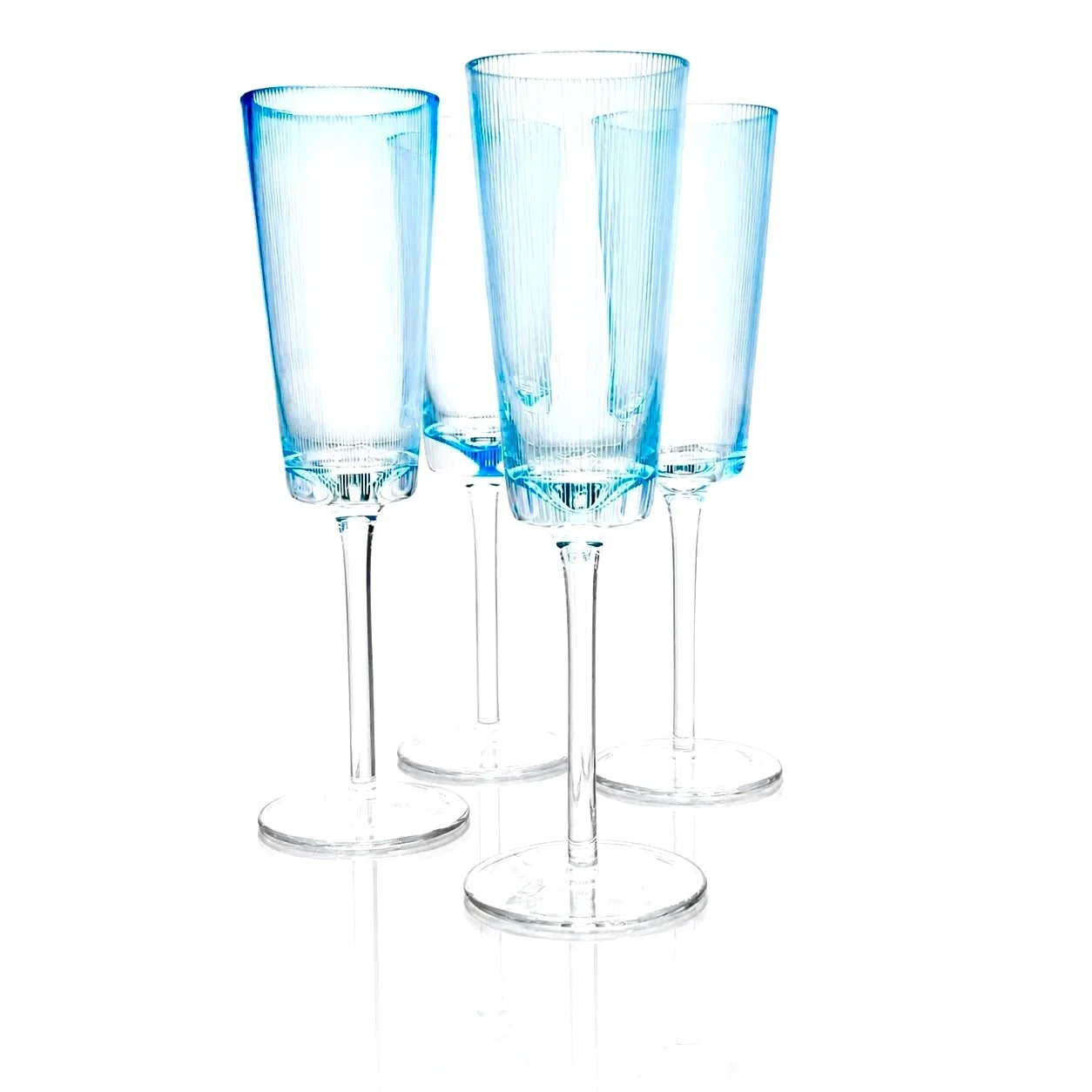
This commandingservice for four champagne flutes features a striking architectural height and a luminous aquamarine hue. The vessels are defined by a vertical optic ribbing that creates a rhythmic, tactile exterior, allowing for a sophisticated play of light and shadow across the glass. With their elongated stems and saturated color, these flutes offer a significant sculptural presence that elevates them from functional stemware to high-end decorative art.
Attribution & Period
Regional European Art Glass, 1970s. The design language—specifically the use of bold optic ribbing and a tapered, oversized silhouette—is stylistically aligned with the high-end crystalline glass production of the late 20th century. The material exhibits a distinct fluorescent blue reaction under 365nm UV light, which is a hallmark characteristic of high-quality lead crystal (lead oxide), used historically to enhance brilliance and clarity. This set is consistent with the artisanal output from refined Italian or Scandinavian workshops of the era.
Dimensions & Weight
Height: 9 in
Width / Diameter: 2 1/4 in (Mouth)
Depth / Base Diameter: 2 1/2 in
Weight: 0.368 lbs each (Approx. 1.47 lbs total set)
Condition
Excellent condition. This set has been meticulously maintained, showing no chips, cracks, or structural repairs. The glass maintains exceptional clarity and the optic ridges are crisp and uniform. Surfaces are free of significant scratches or clouding, reflecting minimal use.
Authenticity & Construction
These flutes are expertly crafted from lead crystal, evidenced by their significant weight and characteristic blue UV resonance. The "optic rib" texture is achieved by blowing the molten glass into a secondary mold before final shaping, creating the internal and external vertical ridges that catch the light. The seamless transition from the bowl to the elongated stem indicates high-level hand-finishing techniques common in 1970s luxury glass production.
Placement
Due to their dramatic 9-inch height and vibrant aquamarine color, these flutes are ideal for grand-scale dining settings or as vertical anchors on a modern bar cart. They pair beautifully with chrome, silver, or white marble surfaces, where their cool tones and rhythmic shadows can be fully appreciated.
STANDARD ATTRIBUTION & VALUE DISCLOSURE
This piece is described to the best of current scholarly and market knowledge. Any maker or regional attribution is based on visual analysis, materials, construction techniques, and documented stylistic comparisons. As with many MCM and antique design objects, definitive attribution may not be possible without original labels or factory records. Pricing reflects condition, quality, decorative appeal, and current collector demand rather than guaranteed maker identification.
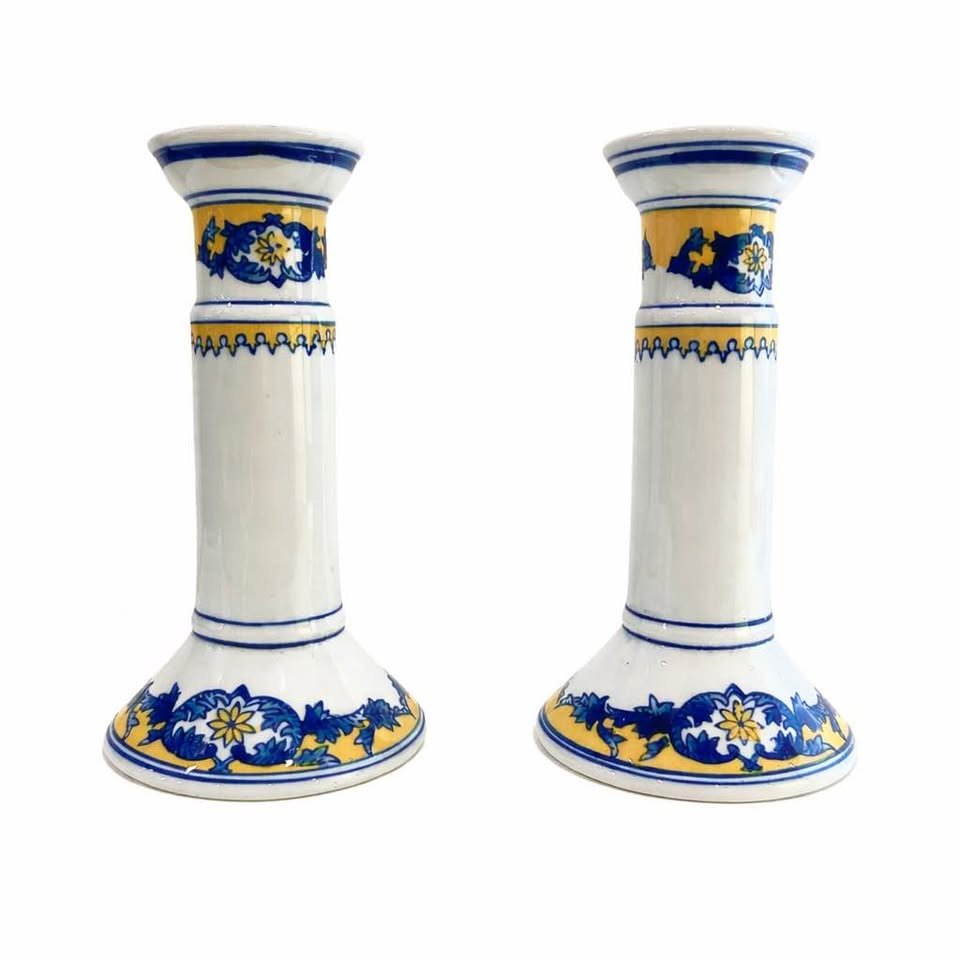
Pair of late 19th-century French faience candlesticks, executed in a commanding cobalt blue, ivory-white, and warm ochre palette with finely painted foliate banding and disciplined border work. The forms are architectural and confident, with flared circular bases, elongated shafts, and restrained upper collars that give them strong vertical presence.
Both examples carry a hand-painted underglaze blue mark reading “Choisy … Poterie” within an oval cartouche. The script and format strongly indicate production associated with Choisy-le-Roi, one of the most significant French faience centers of the 19th century. Given the hand-rendered nature of the mark, the pair is conservatively offered as Choisy-le-Roi attributed rather than factory-line certified without in-hand archival confirmation.
Attribution & Period
The decoration reflects traditional northern French tin-glazed earthenware practice: opaque white ground, hand-painted cobalt floral reserves, ochre accent banding, and rhythmic geometric borders. The glaze displays the soft depth and subtle surface variation characteristic of period faience firing.
Estimated late 19th to early 20th century, circa 1880–1910, based on glaze quality, decorative vocabulary, and hand-painted mark style.
Dimensions & Weight
Taller example : 12 in (30 cm)
Shorter example: 9–9.5 in (22–23 cm)
The intentional variation in height aligns with period decorative pairings rather than later machine-matched production. Glossy glaze with age-appropriate wear consistent with antique faience.
Condition
No major structural cracks observed in photographs. Expected minor edge wear consistent with handling over time. Please review images closely.
Authenticity & Construction
These candlesticks are antique French tin-glazed earthenware produced in the Choisy-le-Roi tradition. They are not later decorative reproductions. Visible surface variation, painterly brushstroke nuance, and glaze pooling are inherent to hand-painted faience manufacture and support period production. Minor kiln and production irregularities visible at the base mark areas, including glaze pooling.
Placement
A commanding mantel or cabinet pair with strong French provincial authority. Particularly effective layered into traditional European interiors, curated blue-and-white collections, or maximalist antique displays.
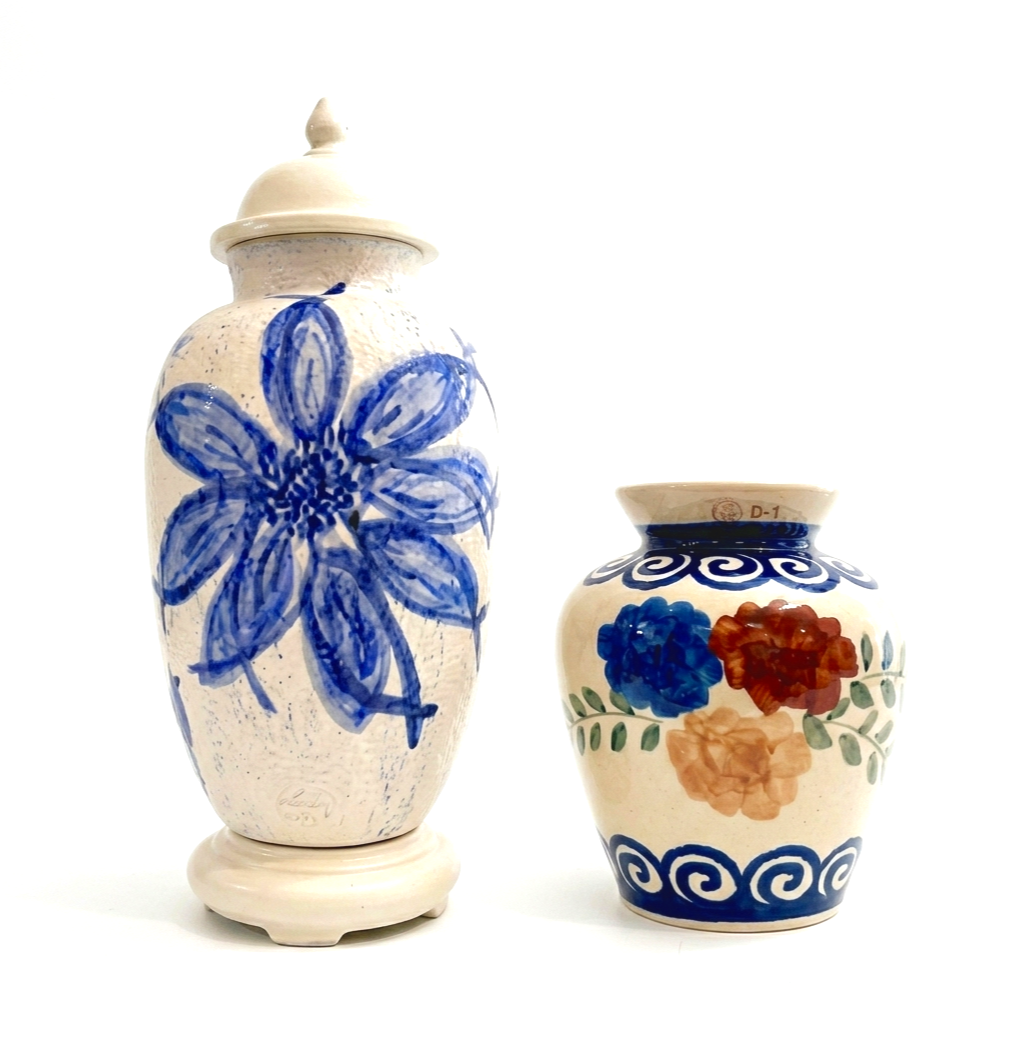
This curated assemblage offers a compelling study in tonal depth and tactile surface character. Both vessels are distinguished by their hand-rendered cobalt motifs, where visible brush-strokes and varying pigment density create a rhythmic, sculptural presence. The pairing contrasts a smooth, expansive ginger-jar form with a more compact, visually grounded stoneware vase, creating a sophisticated dialogue of texture and light interaction that anchors a refined interior with artisanal warmth.
Attribution & Period A rare, fully signed grouping of mid-to-late 20th-century ceramics. The larger vessel bears a 1960s impressed "Landry" maker’s mark beneath the glaze, while the smaller form is a documented late-20th-century example bearing the authentic Bolesławiec factory stamp and decorator code D-1. The presence of these marks materially strengthens the attribution and provides a clear lineage of artisanal production for both pieces.
Dimensions & Weight
Landry Ginger Jar: H: 10 in | Dia: 6 in
Bolesławiec Vase: H: 6.75 in | Mouth Dia: 3.5 in
Total Weight: Approx. 5.5 lbs
Condition Clinical and stable condition consistent with age. The Landry jar shows minor surface wear commensurate with its history as a lamp base. The Bolesławiec vase exhibits an interior base flake and a small glaze chip to the cobalt band, as documented. These minor character marks do not compromise the structural integrity or the assemblage's considerable decorative impact.
Authenticity & Construction Both objects serve as definitive examples of hand-painted underglaze techniques on high-fired ceramic and stoneware. The Landry jar’s mark is impressed directly into the clay body, while the Bolesławiec piece utilizes the historic stamped-and-painted tradition of Lower Silesia. The signatures verify that these are not mass-produced transfers but authentic workshop pieces where the "hand of the maker" is clearly visible in the texture of the glaze.
Placement Ideal for a mantle, sun-drenched console, or a curated bookshelf in a transitional or organic-modern interior. While presented here as a Signed Ceramic Assemblage, both the Landry jar and the Bolesławiec vase are currently available for individual acquisition via our separate listings for those seeking a singular focal point.
STANDARD ATTRIBUTION & VALUE DISCLOSURE This piece is described to the best of current scholarly and market knowledge. Any maker or regional attribution is based on visual analysis, materials, construction techniques, and documented stylistic comparisons. As with many MCM and antique design objects, definitive attribution may not be possible without original labels or factory records. Pricing reflects condition, quality, decorative appeal, and current collector demand rather than guaranteed maker identification.
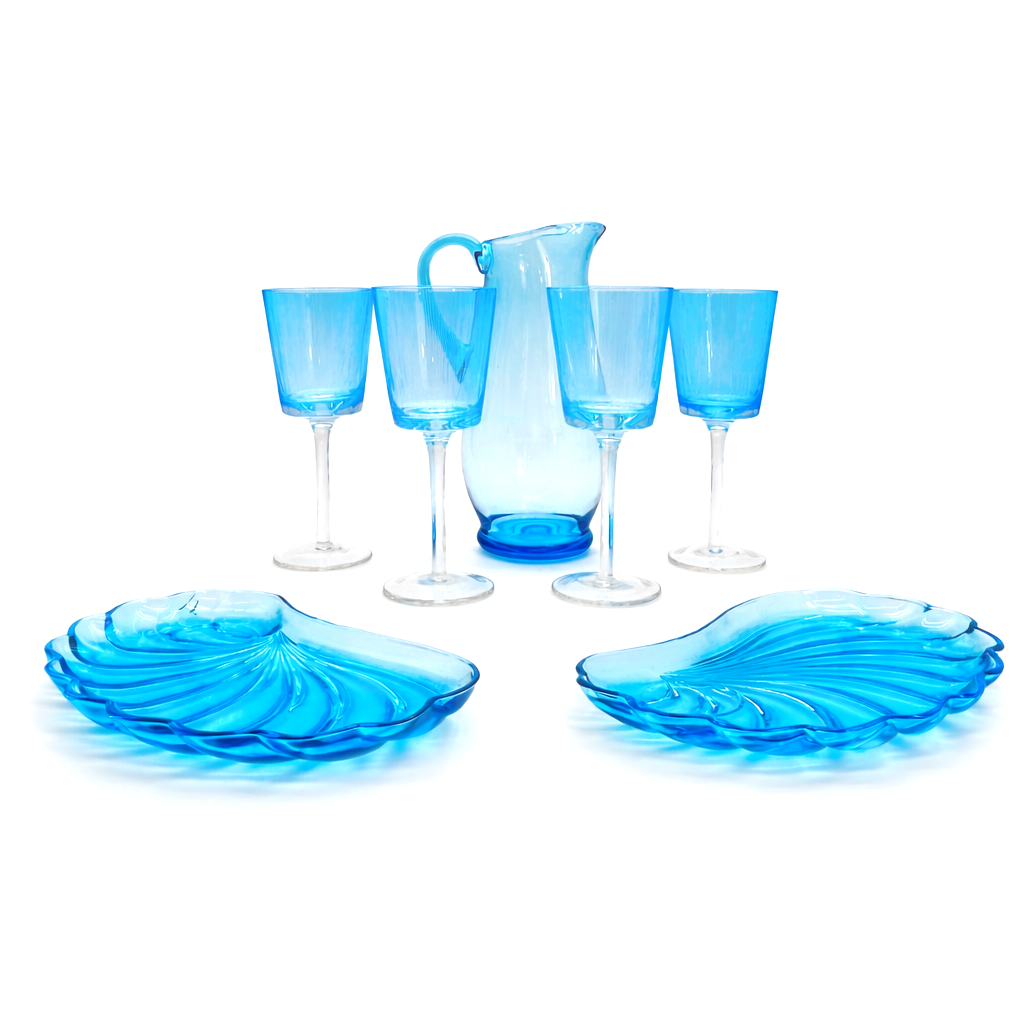
This curated seven-piece suite presents a masterclass in monochrome aquamarine glass, anchoring an interior with its luminous translucency and varied rhythmic textures. The collection—comprising a handblown opaline pitcher, a pair of shell-form dishes, and four optic ribbed wine glasses—is united by a shared tonal depth that shifts from ethereal sky blue to deep cerulean. Each element contributes to a cohesive, sculptural tablescape, offering a sophisticated interplay of smooth opaline surfaces, organic shell motifs, and architectural ribbing that interacts dynamically with both natural and UV light.
Attribution & Period Consistent with European decorative arts of the 1960s. The suite represents a curated assembly of mid-to-late 20th-century production, ranging from handblown Italian opaline glass (pitcher), stylistically aligned with Empoli-area workshops, to refined pressed glass examples (dishes and stemware). The attribution is based on a visual analysis of material composition—including manganese-bearing and uranium-reactive glass—and manufacturing techniques characteristic of the period.
Dimensions & Weight
Pitcher: 9" H x 5.5" W (including handle)
Shell Dishes (Pair): 10" L x 6.5" W x 1" H (each)
Wine Glasses (Set of 4): 7.75" H x 3.25" Diameter
Total Collection Weight: Approx. 6.5 lbs
Condition The suite is in overall excellent collector-grade condition. The pitcher and wine glasses show no chips, cracks, or repairs, with minor interior surface wear to the pitcher consistent with age. One shell-form dish exhibits a small, stable crack as documented; however, it does not compromise the structural or display integrity of the piece.
Authenticity & Construction This collection showcases a sophisticated range of glassmaking techniques. The pitcher features handblown construction with an elegantly applied handle and tooled spout, while the dishes and stemware utilize high-quality pressed-mold techniques to achieve their precise, symmetrical ribbing. The material integrity is confirmed through UV reactivity, with the stemware exhibiting a vivid green uranium fluorescence and the shells showing a soft manganese-driven glow under 365nm light.
Placement This assemblage is designed for high-concept entertaining or as a permanent sculptural installation on a minimalist sideboard, illuminated shelving, or a sun-drenched coastal console. While curated as a singular aesthetic statement, each component of this suite is also available for individual acquisition for those seeking a specific accent piece.
STANDARD ATTRIBUTION & VALUE DISCLOSURE This piece is described to the best of current scholarly and market knowledge. Any maker or regional attribution is based on visual analysis, materials, construction techniques, and documented stylistic comparisons. As with many MCM and antique design objects, definitive attribution may not be possible without original labels or factory records. Pricing reflects condition, quality, decorative appeal, and current collector demand rather than guaranteed maker identification.
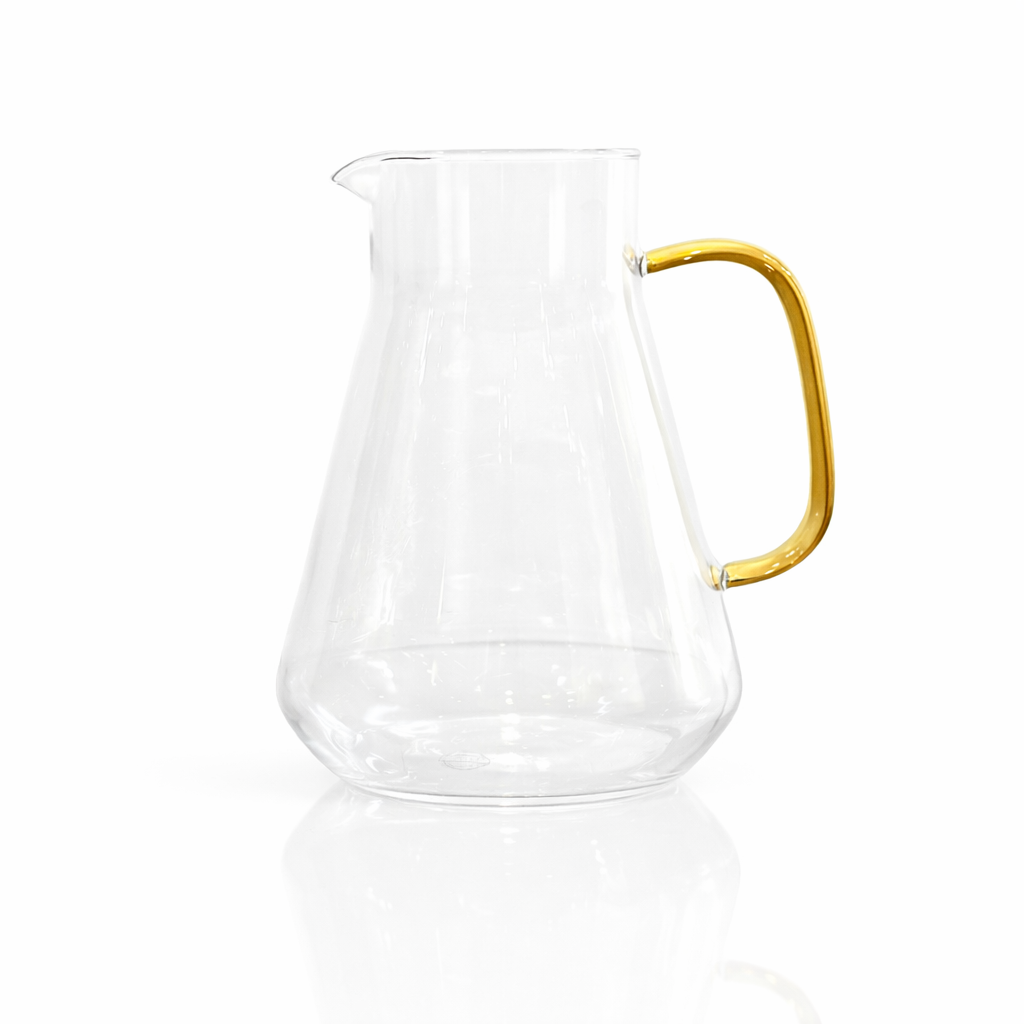
This exceptional hand-blown glass pitcher commands attention through its rigorous geometric profile and sophisticated use of color contrast. The tapered conical body transitions into a precision-cut spout, creating a silhouette that is both architecturally disciplined and visually light. Light interacts dynamically with the broad base and the suspended amber-toned handle, which provides a warm, jewel-like counterpoint to the high-clarity vessel. Its presence is sculptural, making it as much a centerpiece for a modernist interior as it is a functional object of utility.
Attribution & Period
Contemporary; by Brilliant Glassworks. This piece is identified by its original bilingual "Hand Made / Premium Quality" label. The construction utilizes high-performance borosilicate glass, characterized by its thermal resistance and superior clarity. The design language is consistent with the "Minimalist/Modernist" movement of the early 21st century, focusing on the fusion of industrial precision with artisanal hand-finishing techniques.
Dimensions & Weight
• Height: 8 inches
• Width / Diameter: 6 inches (at widest point including handle)
• Depth / Base Diameter: 5 inches
• Weight: 0.912 lbs
Condition
Excellent condition. The glass retains high original luster with no observed scratches, chips, or cracks. The internal structure is clear of significant inclusions. Subtle movement in the glass and the hand-applied handle attachment points are consistent with the handmade manufacturing process rather than defects.
Authenticity & Construction
This piece is a testament to modern flame-working techniques, featuring a hand-manipulated "C" handle in a contrasting canary glass. The base features a distinctive inward-curving ledge and a centered hand-finished swirl, indicating the piece was individualy blown and manipulated. The use of premium, thin-walled borosilicate glass allows for a lightweight yet durable form that emphasizes the purity of the liquid it contains.
Placement
This pitcher is ideally suited for a minimalist dining environment, a sun-drenched breakfast room, or as a sculptural element on an open kitchen shelf. Its clean lines complement Mid-Century Modern, Scandinavian, or Contemporary Architectural interiors.
STANDARD ATTRIBUTION & VALUE DISCLOSURE This piece is described to the best of current scholarly and market knowledge. Any maker or regional attribution is based on visual analysis, materials, construction techniques, and documented stylistic comparisons. As with many MCM and antique design objects, definitive attribution may not be possible without original labels or factory records. Pricing reflects condition, quality, decorative appeal, and current collector demand rather than guaranteed maker identification.
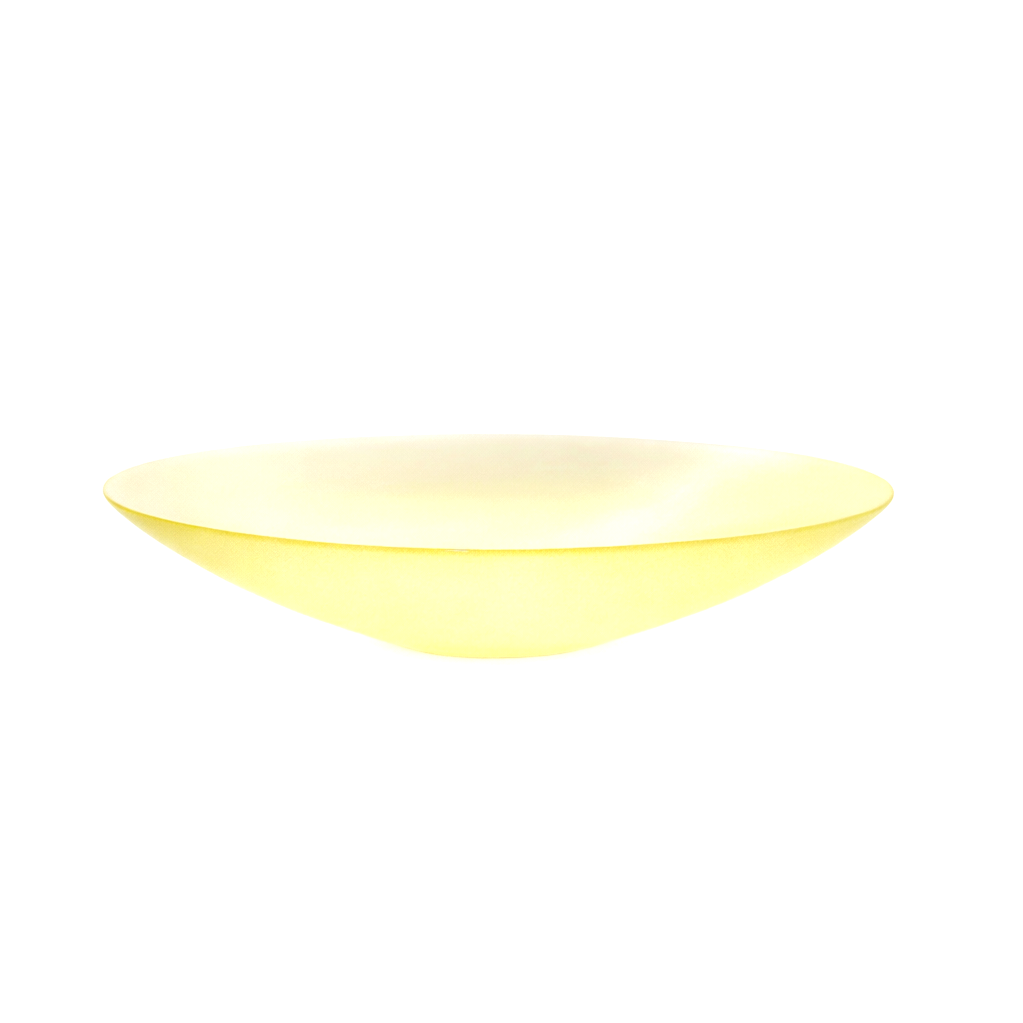
A wide, low-profile satin glass bowl with a luminous yellow tone and softly diffused surface, creating a refined interplay of light and translucency. The gently tapering form and broad diameter give it a strong sculptural presence, reading as both vessel and architectural object. Its subtle iridescence and matte finish soften reflections, enhancing its atmospheric quality. The restrained silhouette aligns with minimalist interiors while maintaining a distinctly organic character.
Attribution & Period
Scandinavian regional example, 1970s. The form, satin finish, and restrained color palette are consistent with Scandinavian art glass production of the period, particularly studio and factory work emphasizing organic profiles and diffused surfaces. No factory mark observed; attribution remains visual rather than documented.
Dimensions & Weight
Height: 2.75 in
Width / Diameter: 14 in
Depth / Base Diameter: 5.25 in
Weight: 2.85 lbs
Condition
Excellent condition. No cracks, chips, or scratches observed. Surface remains clean and consistent with original satin finish. Minor internal textural variation near the base—visible as a ripple effect from the hot glass forming process—documented in close-up imagery and inherent to manufacture.
Authenticity & Construction
Hand-formed glass, likely free-blown and shaped while hot, then finished with a satin acid-etched or sandblasted surface. The subtle ripple near the base reflects the natural movement of molten glass during shaping, supporting an authentic hand-worked process rather than pressed production. The even coloration and soft iridescence indicate controlled finishing typical of higher-quality art glass.
Placement
Ideal as a centerpiece on a dining or cocktail table, or as a sculptural accent on a console, credenza, or open shelving. Works particularly well in minimalist, Scandinavian, and contemporary interiors where material presence and form are prioritized over ornament.
STANDARD ATTRIBUTION & VALUE DISCLOSURE This piece is described to the best of current scholarly and market knowledge. Any maker or regional attribution is based on visual analysis, materials, construction techniques, and documented stylistic comparisons. As with many MCM and antique design objects, definitive attribution may not be possible without original labels or factory records. Pricing reflects condition, quality, decorative appeal, and current collector demand rather than guaranteed maker identification.
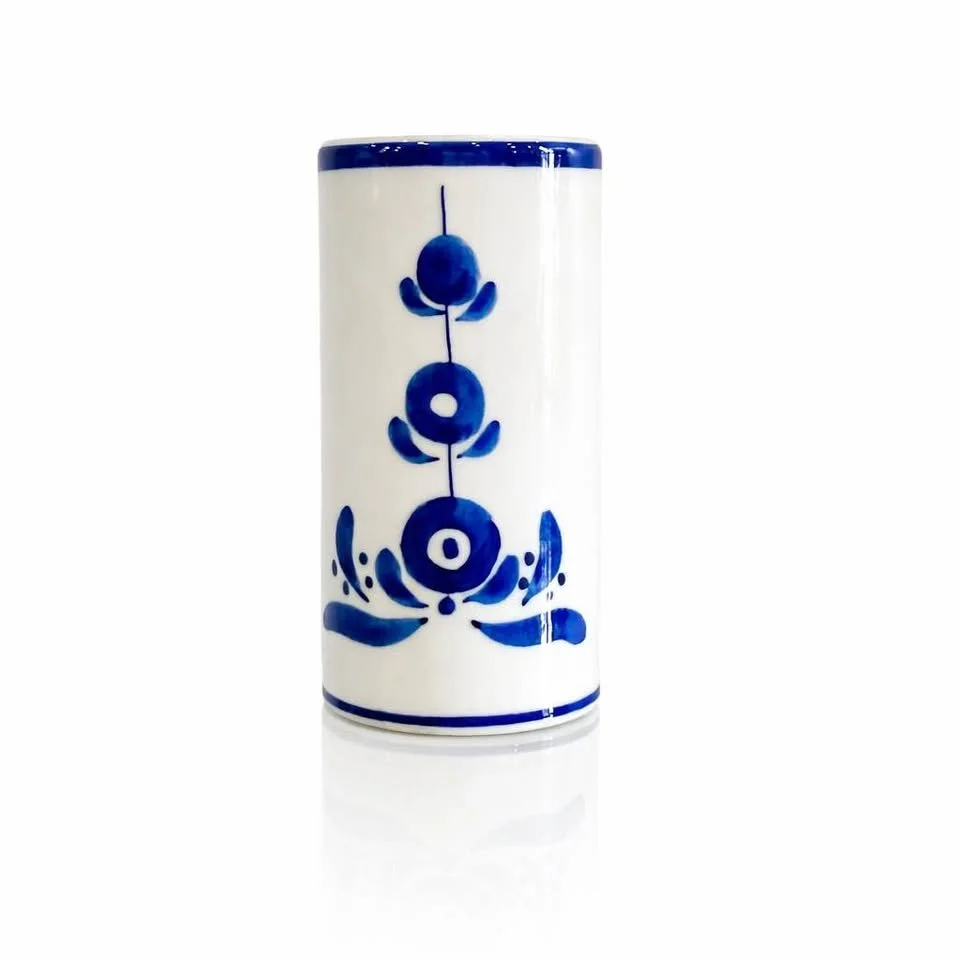
A refined hand-painted blue and white ceramic vase produced in Portugal, featuring a clean cylindrical form decorated with stylized floral motifs rendered in rich cobalt glaze. The design balances traditional Iberian blue-and-white pottery with a restrained, modern sensibility characteristic of mid-20th-century Portuguese decorative arts. The decoration is executed entirely by hand, with visible brush variation and soft tonal transitions within the cobalt, rather than flat or mechanical application. The crisp white ground provides strong contrast, allowing the saturated blue motifs to read clearly and rhythmically around the body. A solid cobalt band at the rim and base visually anchors the composition.
Attribution & Period
The underside bears a hand-painted makers mark reading
”Vinha do Castelo”
“Hand Painted”
‘Made in Portugal”,
along with pattern numbers and the notation ”For Kheila,” indicating export production for an external retailer or distributor. This type of marking is consistent with Portuguese studio and workshop production intended for the international market during the mid-20th century. Period Mid-20th Century (circa 1940s1960s)
Provenance
Portugal Medium: Hand-painted ceramic / faience Cobalt blue floral motif on white ground
Dimensions & Weight
Height: 6 1/4 inches
Diameter: 3 inches
Condition
Excellent condition. No chips, cracks, or repairs observed. Clean interior and well-preserved glaze with minor, expected age-appropriate surface variation only.
Placement
This vase fits comfortably within: Mid-century European decorative ceramics Blue-and-white interiors Transitional, collected, or gallery-style settings Its restrained scale and graphic clarity allow it to integrate easily into both classic and contemporary interiors. The form is elegant and versatile, suitable for display as a standalone object or as part of a curated blue-and-white ceramic grouping.
STANDARD ATTRIBUTION & VALUE DISCLOSURE; This piece is described to the best of current scholarly and market knowledge. Any maker or regional attribution is based on visual analysis, materials, construction techniques, and documented stylistic comparisons. As with many vintage and antique glass objects, definitive attribution may not be possible without original labels or factory records. Pricing reflects condition, quality, decorative appeal, and current collector demand rather than a guaranteed maker identification.
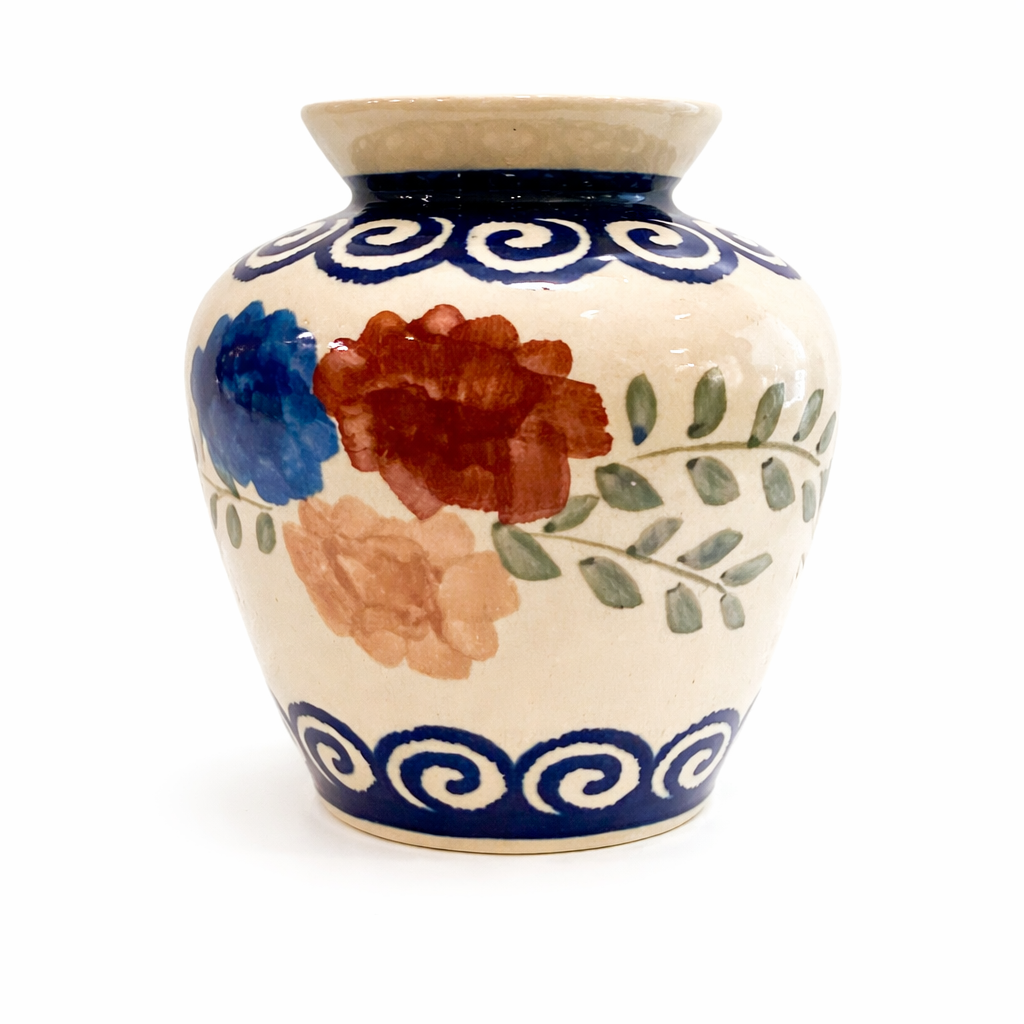
Authentic Bolesławiec hand-painted stoneware vase, executed in the historic Lower Silesian ceramic tradition and bearing the factory stamp “BOLESLAWIEC / HAND-MADE / IN POLAND” with decorator code D-1 to the underside.
This example embodies the export-era renaissance of Polish art pottery (late 20th century, c. 1980s–2000s), when Bolesławiec workshops re-established international prominence through high-fired, lead-free stoneware and distinctive cobalt brush decoration. The form is a classic bulb vase silhouette—compact yet visually grounded—with a softly flared neck and balanced proportions suitable for both floral display and curated shelf presentation.
Attribution & Period
Bolesławiec pottery traces its roots to the 18th century, with the post-war revival (after 1945) consolidating workshops into cooperatives that elevated technical consistency while maintaining hand-decoration. Marked examples with pattern codes such as “D-1” reflect organized production lines typical of late 20th-century export ware and are standard identifiers within the category.
Authenticity & Construction
The decoration combines traditional cobalt spiral banding at rim and foot with hand-painted floral motifs in saturated cobalt blue, iron red, and warm ochre, anchored by rhythmic green foliage. The brushwork remains expressive and clearly hand-rendered rather than transfer-applied, preserving the artisanal character collectors seek in authentic Bolesławiec production.
• Origin: Bolesławiec, Lower Silesia, Poland
• Period: Late 20th century (c. 1980s–2000s)
• Material: High-fired stoneware
• Decoration: Hand-painted underglaze florals with cobalt banding
• Mark: Factory stamp with decorator/pattern code “D-1”
Dimensions & Weight
• Height: approx. 6 3/4 in.
• Mouth diameter: approx. 3.5 in.
Condition
Visible interior base wear/flake and a small glaze chip to the blue band (see close-up photographs). No structural cracks noted. Presents well and remains stable for display. Condition reflected in pricing.
Placement
This piece is described to the best of current scholarly and market knowledge. Any maker or regional attribution is based on visual analysis, materials, construction techniques, and documented stylistic comparisons. As with many vintage and antique glass objects, definitive attribution may not be possible without original labels or factory records. Pricing reflects condition, quality, decorative appeal, and current collector demand rather than a guaranteed maker identification.
ATTRIBUTION & VALUE NOTE
Stamped Bolesławiec production; not attributed to a specific individual decorator beyond the factory code. This is authentic Polish stoneware from the recognized Bolesławiec tradition and priced appropriately within the secondary market for late 20th-century export-era examples.
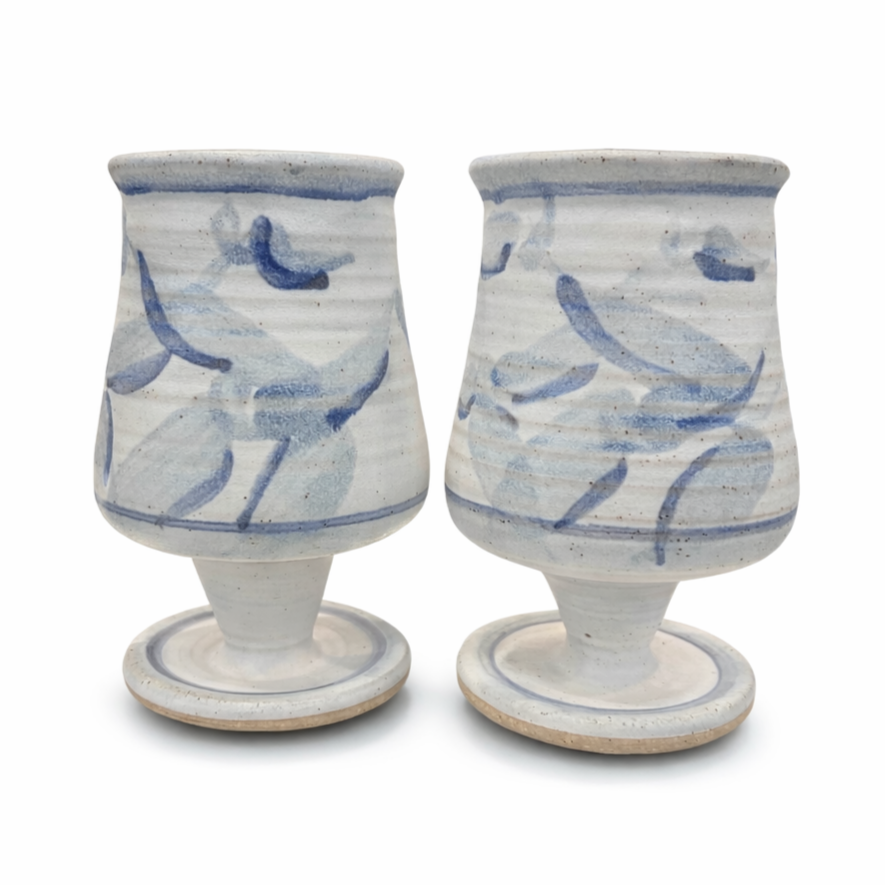
This matched pair of wheel-thrown stoneware goblets presents a compelling sculptural presence through balanced proportion and kinetic decoration. Each piece features a rounded, tactile bowl that tapers to a slender stem and a substantial pedestal foot. The ceramic surfaces are animated by hand-applied cobalt and pale blue glaze brushwork over a warm, lightly speckled stoneware ground, exhibiting a level of expressive yet disciplined execution characteristic of late 20th-century studio practice. The throwing rings are subtly integrated into the design, providing a rhythmic texture and ensuring a unique, hand-worked variation between the two forms.
Attribution & Period by Jane Snider1980s This pair is a confirmed example of the mature studio work of documented Canadian ceramic artist Jane Snider. Both goblets bear the clear, hand-incised signature "Snider" on the base, complete with central firing holes typical of studio kiln practice. The aesthetic—specifically the cobalt oxide brushwork and the functional-sculptural form—is stylistically aligned with known Snider productions from the 1980s, a period marked by increasing sophistication in Canadian studio ceramics.
Dimensions & Weight
Height: 5 inches Width / Diameter: 2 3/4 inches (Rim) Depth / Base Diameter: 2 3/4 inches (Base) Weight: 0.6 lbs (each)
Condition Excellent collector condition. Both goblets are structurally sound with no chips, cracks, or evidence of repair. Subtle, even surface wear is noted on the raised ridges of the cobalt decoration, consistent with age and gentle handling of functional studio ware. This minimal wear is honest and serves as a marker of authenticity.
Authenticity & Construction A matched pair, wheel-thrown in a high-fire stoneware body. The decorative program was achieved through direct overglaze brushwork using cobalt and a pale-blue wash, a technique requiring significant confidence as it does not allow for correction. The forms were fired in a reduction kiln, which accounts for the warm speckling in the clay body and the deep saturation of the cobalt.
Placement An ideal selection for a Scandinavian-influenced modern interior or as a centerpiece within a curated collection of North American studio pottery. Their functional nature and sculptural silhouette make them equally suited for use during an intimate gathering or for vertical display in a lit vitrine.
STANDARD ATTRIBUTION & VALUE DISCLOSURE This piece is described to the best of current scholarly and market knowledge. Any maker or regional attribution is based on visual analysis, materials, construction techniques, and documented stylistic comparisons. As with many MCM and antique design objects, definitive attribution may not be possible without original labels or factory records. Pricing reflects condition, quality, decorative appeal, and current collector demand rather than guaranteed maker identification.
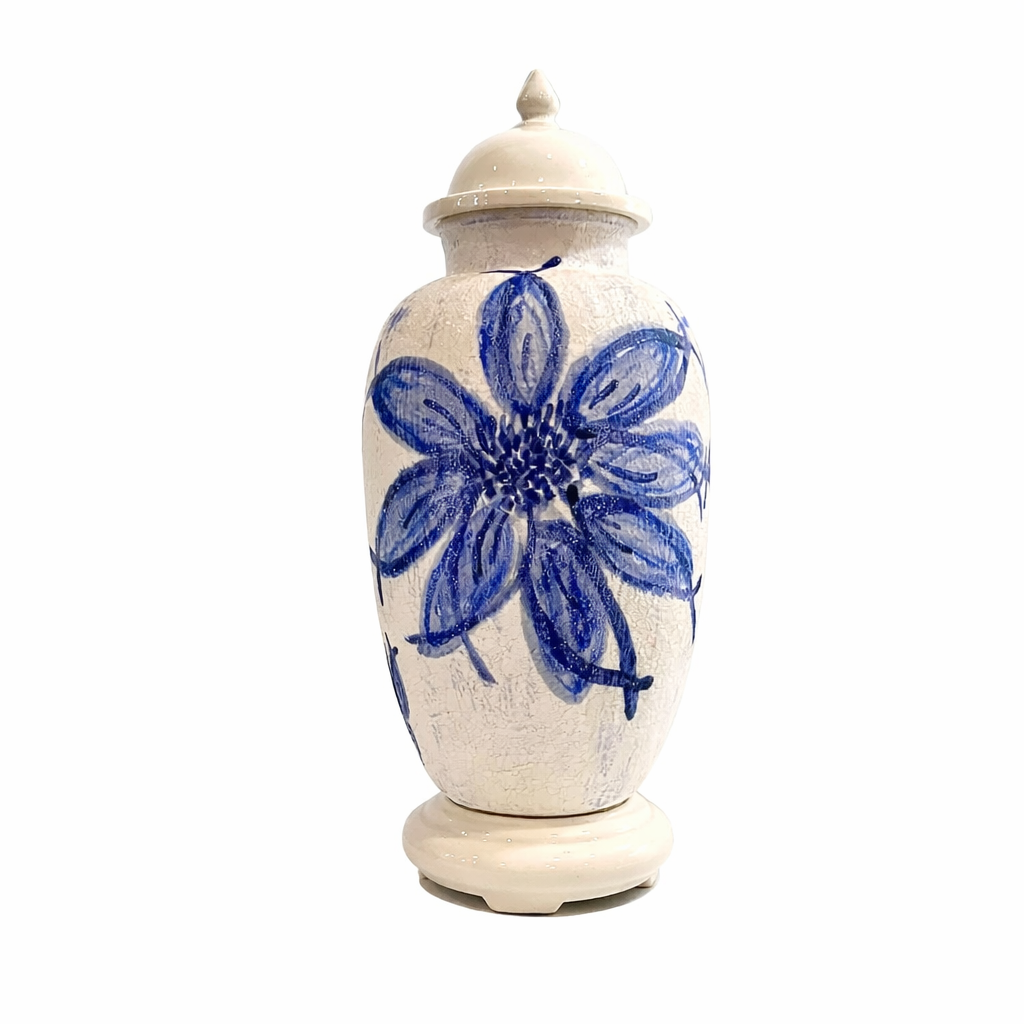
Landry maker-marked blue and white ceramic ginger jar–form lamp base, executed in bold hand-painted cobalt floral decoration on a creamy white ground. The LANDRY mark is impressed into the clay and sealed beneath the glaze—confirming it as a true production mark rather than a later inscription. For collectors, an under-glaze impressed mark materially strengthens attribution and long-term desirability.
Attribution & Period (collector-supported)
Maker: Landry (impressed under-glaze mark)
Origin: North America (likely Canada or United States)
Date: Mid-century, circa 1955–1975 (most consistent with 1960s production)
The form aligns with the strong mid-20th-century revival of ginger jar silhouettes in Western interiors, particularly during the height of chinoiserie influence in North American decorative arts. Many such ceramic vessels were purpose-built or later adapted as lamp bases during this period, making marked examples increasingly sought after.
Design & Appeal
• Classic ginger jar silhouette with balanced proportions
• Expressive cobalt blue floral brushwork with visible hand-painted character
• Creamy white ground with subtle textural variation
• Strong presence for chinoiserie, Hollywood Regency, traditional, coastal, or collected interiors
• Suitable for conversion or continued use as a lamp base (buyer to confirm wiring suitability if applicable)
Dimentions & Weight
Height (without lid): 10 inches
Widest diameter: 6 inches
Mouth diameter: 3 1/8 inches
Condition
Condition consistent with age. Surface wear and minor marks present, commensurate with decades of use. No major structural issues observed. Review photographs carefully for detailed condition; additional close-ups available upon request to ensure full transparency.
Included
Ceramic jar/lamp base and components shown in photographs only.
Placement
While North American in origin, the blue-and-white palette and relaxed hand-painted florals echo the timeless ceramics of Provence and the French Atlantic coast. The soft white ground and painterly cobalt decoration pair effortlessly with linen, bleached woods, rattan, and antique brass—making it a natural anchor piece within a French Coastal interior.
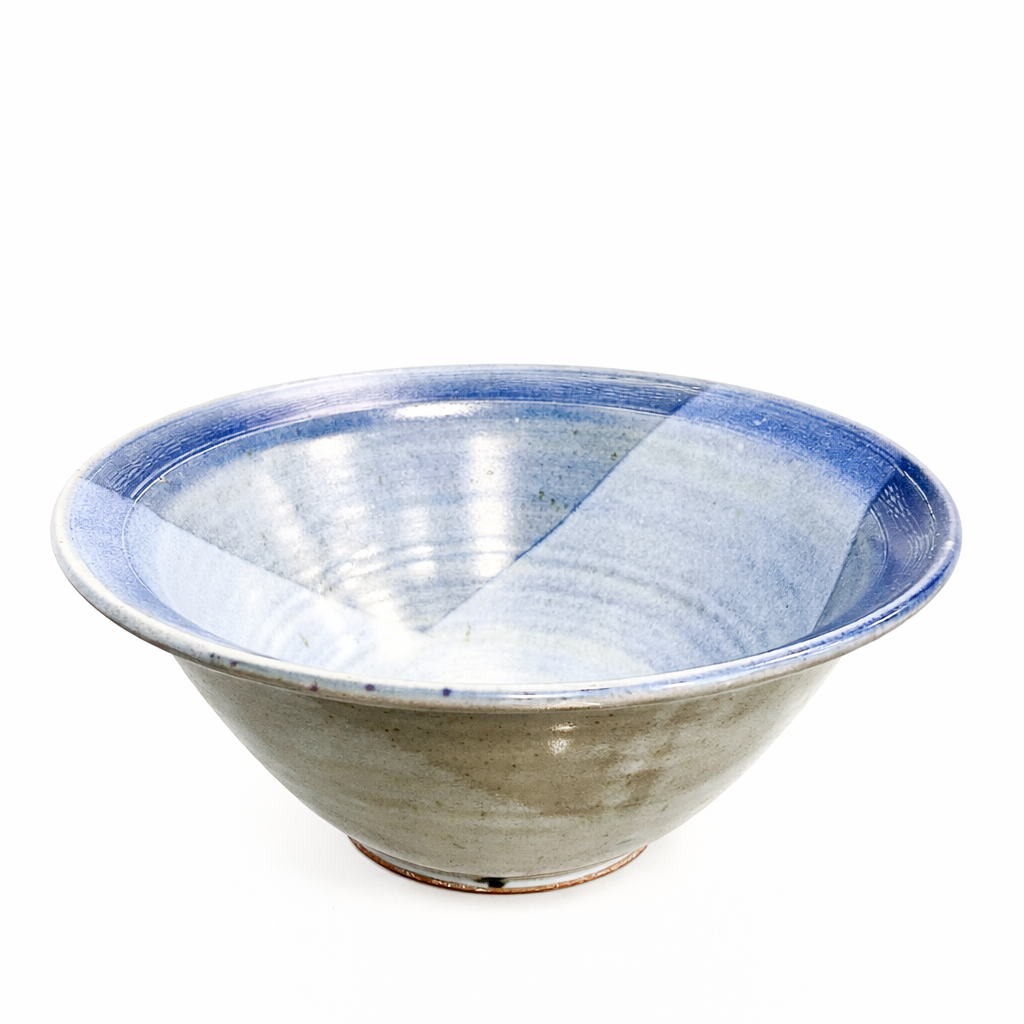
A substantial hand-thrown studio pottery bowl with a wide, gently flared form and classic wheel-thrown rings visible insidean immediate sign of studio production rather than factory ware.
The glaze is a cool, misty blue with deeper cobalt pooling at the rim, showing natural variation from the firing and the potters application. The exterior has a stoneware body with subtle speckling and a warm, exposed foot ring typical of wheel-thrown work.
Authenticity & Construction
Signature / mark (important for collectors) The underside shows an incised leaf (maple-like) motif as the makers mark. This is a true signature style mark (cut into the clay before firing), consistent with studio potters who used personal chops or carved symbols rather than printed stamps. Likely material & technique Hand-thrown stoneware (wheel-thrown; visible throwing lines) Glazed interior with a darker brushed/pooled rim band Unglazed foot ring with kiln-fired clay tone
Attribution & Period
Possible origin & dating (best-supported, without overclaiming) Based on the studio-pottery form, incised emblem mark, and blue glaze aesthetic, this bowl fits well with North American studio pottery trends that were especially popular from the mid-20th century into the late 20th century (c. 1960s1990s).
The carved leaf mark strongly suggests a potter working in a region where a leaf emblem would be meaningful (often seen with Canadian or North American makers), but without a readable name stamp, the exact maker and town can’t be stated with certainty.
Dimensions & Weight
Height: 5 1/4 in
Mouth diameter: 12 in
Base diameter: 4 1/2 in
Condition
Appears very good vintage condition from photos: no obvious cracks or repairs seen. Minor surface speckling/marks consistent with normal studio kiln firing and age. No chips, no hairlines, no repairs
Placement
Why collectors want it Large, display-worthy scale (12 mouth) Sculptural modern form suitable for MCM / minimalist interiors Artist mark (incised emblem) + handmade character from wheel-throwing and glaze variation
STANDARD ATTRIBUTION & VALUE DISCLOSURE
This piece is described to the best of current scholarly and market knowledge. Any maker or regional attribution is based on visual analysis, materials, construction techniques, and documented stylistic comparisons. As with many vintage and antique glass objects, definitive attribution may not be possible without original labels or factory records. Pricing reflects condition, quality, decorative appeal, and current collector demand rather than a guaranteed maker identification.
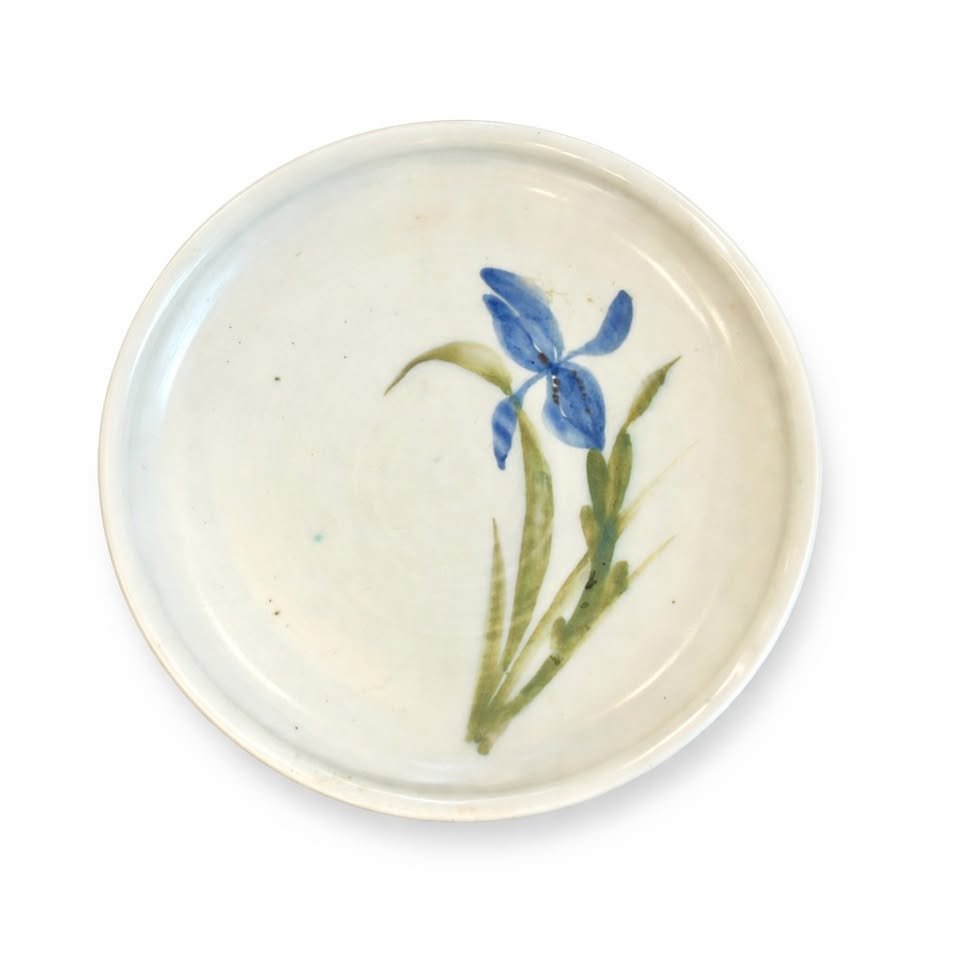
Studio Pottery Plate North America, c. 19451960 Wheel-thrown stoneware with hand-painted iris decoration
Artist Unknown An exceptional mid-century North American studio pottery plate, hand-thrown and hand-painted with a refined iris botanical motif.
This piece exemplifies the quiet sophistication and craftsmanship associated with postwar American studio ceramics, where individual makers emphasized form, brushwork, and glaze over commercial branding.
Authenticity & Construction
The plate is wheel-thrown, not slip-castconcentric throwing rings are clearly visible on the underside, a hallmark detail serious collectors recognize immediately. The glaze presents a soft, period-correct satin finish, and the painterly execution of the iris reflects a trained hand working confidently in oxide and slip.
Attribution & Period
Origin: North America
Make: Hand-thrown studio art pottery
Artist: Unidentified studio potter
Period: Circa 19451960
Unmarked studio pieces of this caliber were commonly produced by independent potters, university-affiliated ceramicists, or regional craft guild members during the American studio pottery movement, rather than factory lines. Many comparable works now reside in private and institutional collections without maker marks.
Provenance
This piece reflects the quality and restraint associated with mid-century North American studio ceramics, where works were produced individually rather than at scale. Comparable hand-thrown, hand-painted botanical plates from this periodparticularly those with intact glaze and strong painterly executionare increasingly scarce and are now traded primarily through galleries and specialist dealers rather than general vintage markets.
The iris motifsymbolic of renewal and refinementwas especially favored by studio potters working in the postwar period and remains highly collectible today.
Condition
Excellent condition No cracks, repairs, or structural issues Minor surface wear and kiln marks consistent with age and authenticity Decoration remains crisp and well-preserved (High-resolution photographs provided for full transparency.)
Dimensions & Weight
10 inches in diameter
Placement
Authentic mid-century North American studio pottery Hand-thrown and hand-painted (not mass produced) Classic botanical subject with strong collector demand Ideal as a cabinet plate, wall display, or curated shelf piece Comparable mid-century studio plates of similar quality routinely command premium prices in gallery and collector markets, particularly when botanical decoration and intact glaze are present. This is a serious collector piece, not decorative repro ware.
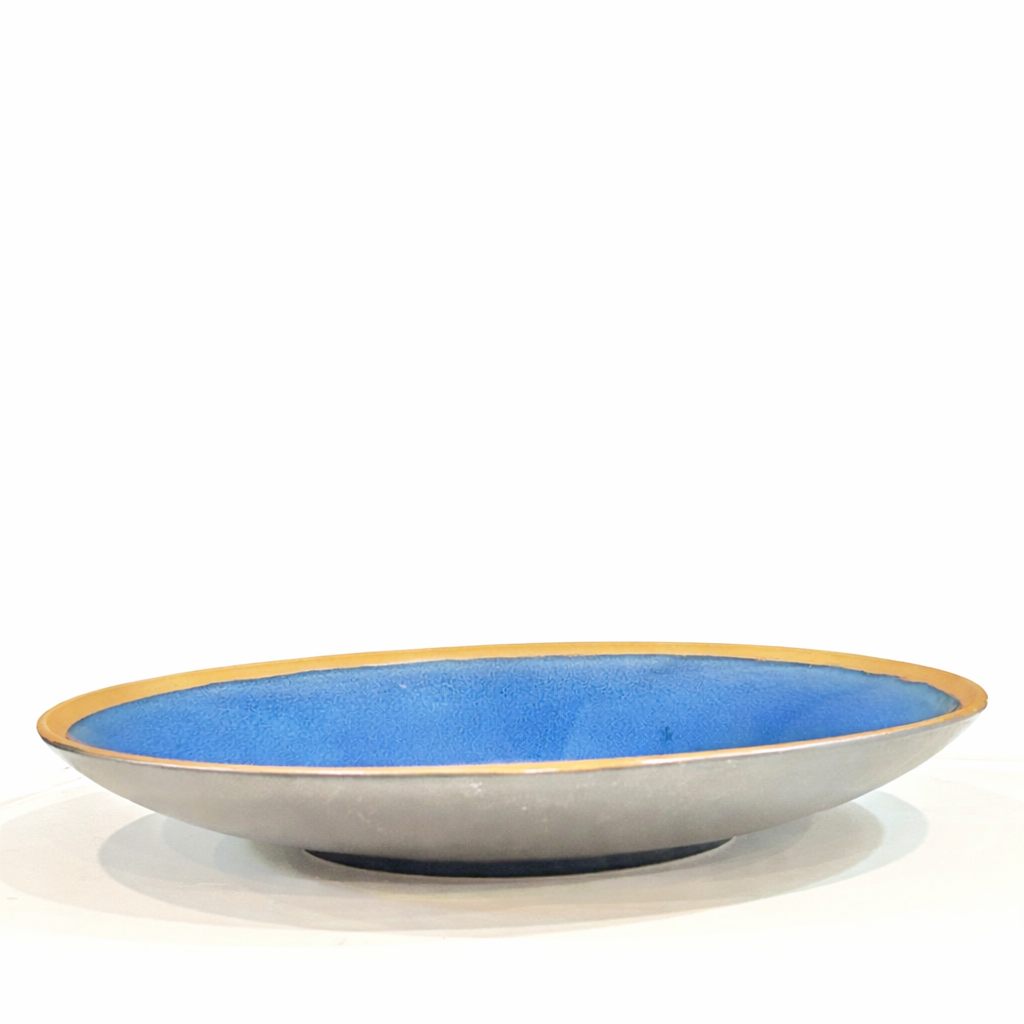
This is an authentic mid-century modern studio pottery bowl, dating to approximately 19551968, distinguished by its restrained modernist form and expressive kiln-fired glaze. The bowl features a deep cobalt-to-ink blue interior glaze with fine granular texture and natural pooling at the wellhallmarks of mid-century reduction or semi-reduction firing. The exterior is left in a matte charcoal/iron-rich stoneware, creating a deliberate contrast between surface and interior. A warm exposed terracotta rim and foot ring frame the piece, a design choice strongly associated with post-war studio ceramics emphasizing honesty of materials.
Attribution & Period
Stylistic & Historical Context The form, glaze restraint, and exposed clay are consistent with mid-century studio pottery traditions influenced by Bauhaus functionalism and Japanese mingei philosophy. Comparable work emerged from European (French, German, Scandinavian) and North American studio potters during the post-war period, particularly those working outside factory production.
The absence of a makers mark is not unusual for studio bowls of this era, especially those produced for design shops, galleries, or small ateliers rather than mass export.
Placement
This piece reads as decorative modernism rather than tablewareintended as a fruit bowl, centerpiece, or display object in a curated interior. MCM Collectable Valuable for This Piece Period-correct mid-century modern palette (blue, terracotta, charcoal)
Studio-made, not factory production Strong sculptural profile with excellent proportions Honest materials and visible firing character Highly versatile for interior styling or collection display
Condition:
Very good condition. No chips, cracks, or repairs Light surface wear consistent with age and careful use Glaze and foot ring remain structurally sound Please review photos for surface character; all marks shown are age-consistent.
Dimensions & Weight
Diameter:12 inches
Height: . 2 inches
Authenticity & Construction
Unsigned mid-century studio pottery bowls routinely sell in this bracket when the form and glaze are strong. The colorway and rim treatment are especially appealing to MCM interior designers, not just ceramic collectors. This is not common tourist potterythe restraint and glaze quality place it above casual vintage ceramics.
STANDARD ATTRIBUTION & VALUE DISCLOSURE; This piece is described to the best of current scholarly and market knowledge. Any maker or regional attribution is based on visual analysis, materials, construction techniques, and documented stylistic comparisons. As with many vintage and antique glass objects, definitive attribution may not be possible without original labels or factory records. Pricing reflects condition, quality, decorative appeal, and current collector demand rather than a guaranteed maker identification.
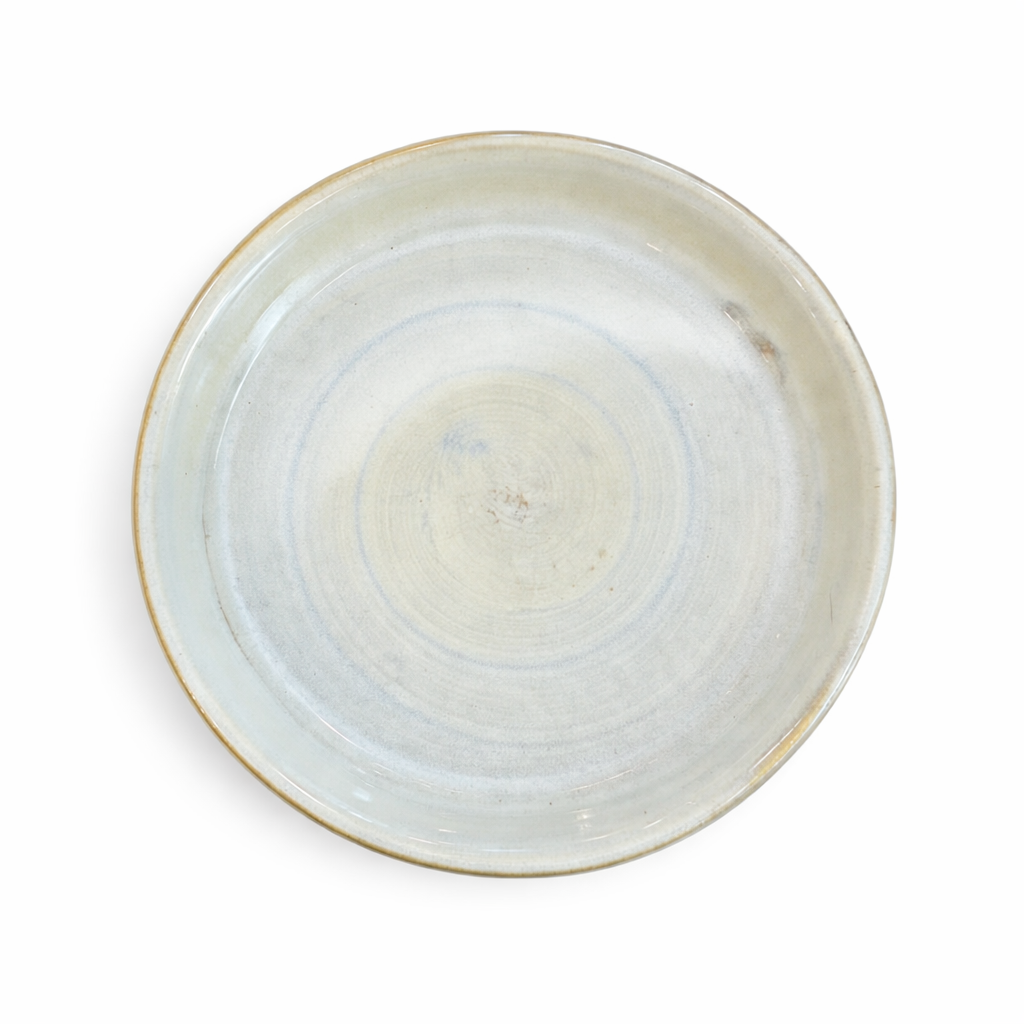
Studio pottery platter, wheel-thrown in stoneware and finished in a soft celadon-style blue-grey glaze with natural reduction variation. The surface shows subtle tonal pooling and quiet movement characteristic of late 20th-century North American studio ceramics.
Authenticity & Construction
The underside features an unglazed foot ring with a hand-drawn iron circle and a faint impressed makers stamp, now largely illegible due to age and useconfirming studio production rather than factory manufacture.
Attribution & Period
Based on clay body, glaze chemistry, and construction, this piece dates to the late 1970searly 1980s, a period when functional studio pottery emphasized restraint, everyday use, and material honesty.
A one-of-a-kind platter suitable for serving, display, or inclusion in a serious studio pottery collection.
Details
Hand-thrown stoneware platter
Unidentified studio potter
North American origin
Circa late 1970searly 1980s
Celadon-style blue-grey glaze
Unglazed foot ring with hand-drawn iron circle
Condition
Excellent condition consistent with age and use. No cracks, chips, or repairs. Surface variation and firing marks are inherent to studio pottery and part of the pieces character.
Dimensions & Weight
STANDARD ATTRIBUTION & VALUE DISCLOSURE; This piece is described to the best of current scholarly and market knowledge. Any maker or regional attribution is based on visual analysis, materials, construction techniques, and documented stylistic comparisons. As with many vintage and antique glass objects, definitive attribution may not be possible without original labels or factory records. Pricing reflects condition, quality, decorative appeal, and current collector demand rather than a guaranteed maker identification.
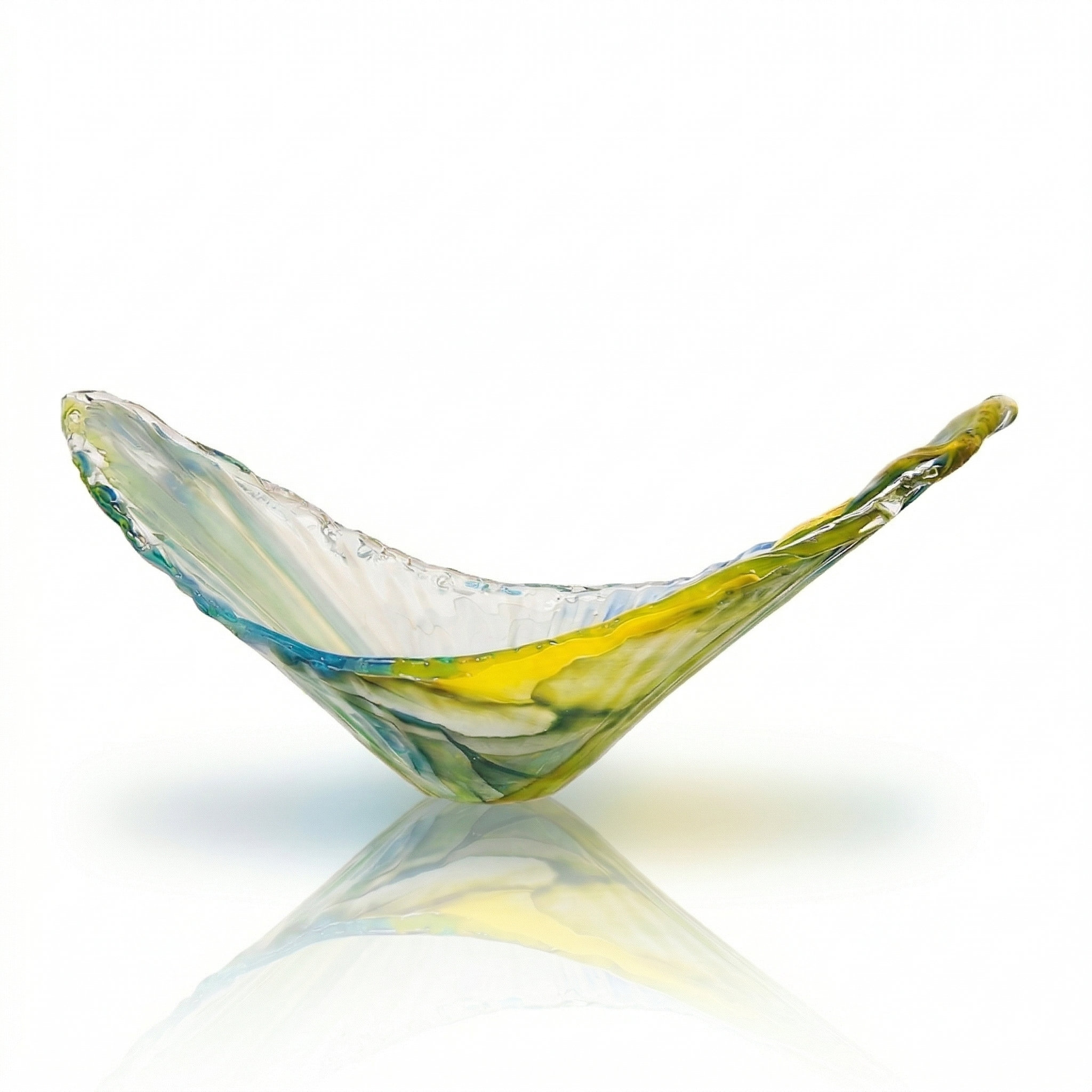
A monumental, sculptural studio art glass bowl defined by dramatic up-swept ”wing’ rims and a deep, floating basin-an object that reads as contemporary glass sculpture rather than utilitarian form. Thick clear casing amplifies the internal color fields, creating exceptional optical depth and a liquid, suspended-pigment effect as light moves through the glass. The silhouette is intentionally asymmetric, with lifted ends and a softly weighted center, presenting as a gallery-caliber statement piece for a console, cocktail table, or pedestal.
Attribution & Period
Unknown (Studio) unsigned
Attributed: Contemporary North American studio glass tradition (best-faith attribution based on form, finish, and technique)
Estimated Date & Place of Origin Circa: 1990-2010
Place of Origin: North America (attributed)
Authenticity & Construction
Hand-blown and hot-sculpted cased art glass; annealed; coldworked base.
This bowl was most likely made by gathering and blowing clear glass to establish the vessel, applying color (commonly frit/powder or thin color applications) to create the internal ribbons and veils, then adding a final clear casing layer over the color to encapsulate it and produce pronounced depth. While still hot, the rim was pulled and stretched into the winged form, then the work was annealed and finished with coldwork to the underside, resulting in a stable, refined base presentation. Color A luminous, oceanic palette with layered translucency and painterly movement:
Glacier / ice blue and pale aqua body tones with soft diffusion,
Teal and cerulean accents along the rim and edge swells
saturated chartreuse / citron / lemon-yellow ribbon suspended through the form
Subtle seafoam green transitions and milky opaline haze that bloom beneath the clear casing
high clarity crystal-clear exterior that magnifies internal striations and depth
Dimensions & Weight
Length: 23 in
Width: 10 in
Height: 8.75 in
Base diameter: 3.5 in
Condition
Excellent overall condition. No chips or hairline cracks observed. Minor surface wear to the underside consistent with careful display (typical for studio glass with a coldworked base).
Provenance
From a private collection. The work aligns with the late-20th/early-21st-century studio glass ethos; sculptural form, optical casing, and painterly color captured within clear crystal.
Placement
Striking under natural or directional light; ideal for a minimalist interior, coastal-modern palette, or as a centerpiece on dark stone, walnut, or lacquer surfaces where the casing depth reads most dramatically.
STANDARD ATTRIBUTION & VALUE DISCLOSURE
This piece is described to the best of current scholarly and market knowledge. Any maker or regional attribution is based on visual analysis, materials, construction techniques, and documented stylistic comparisons. As with many vintage and antique glass objects, definitive attribution may not be possible without original labels or factory records. Pricing reflects condition, quality, decorative appeal, and current collector demand rather than a guaranteed maker identification.
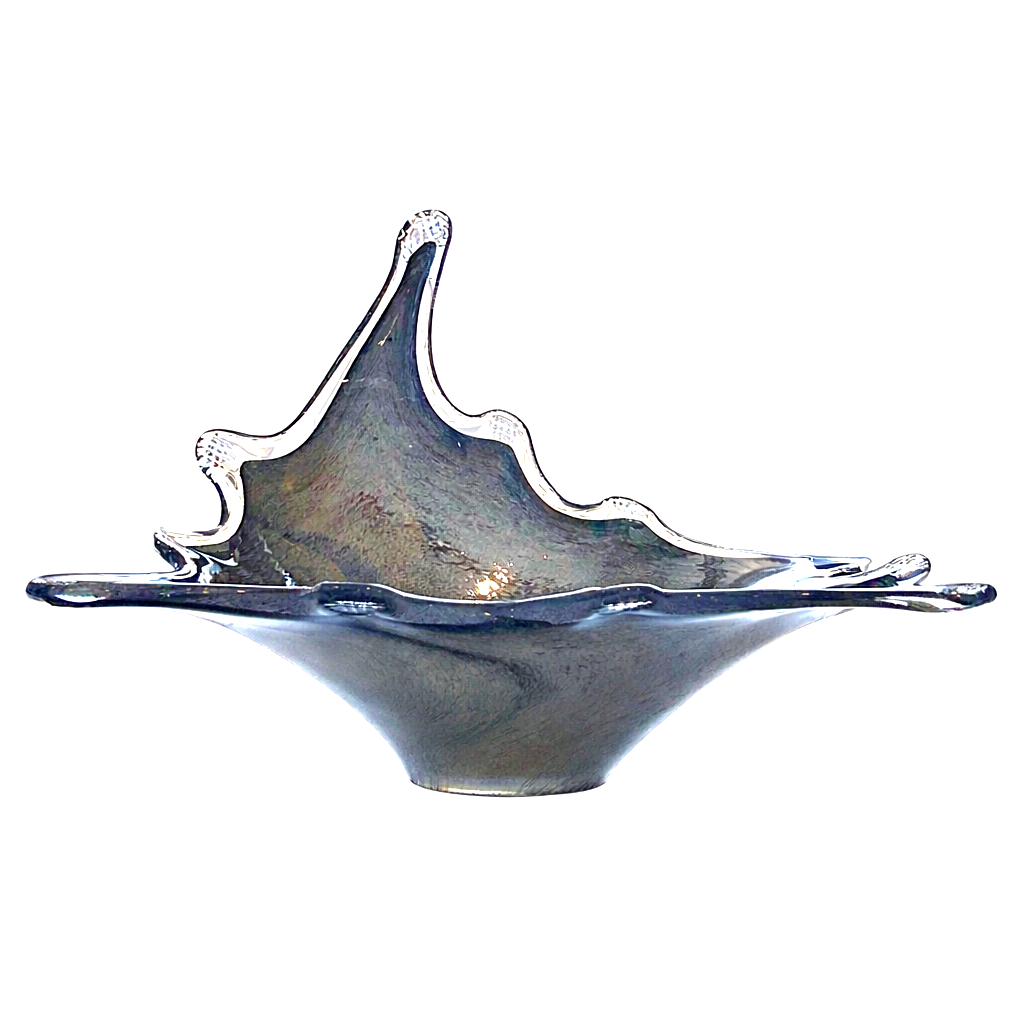
This masterfully hand-blown glass centerpiece commands attention with its dynamic, undulating "handkerchief" silhouette and ethereal sky blue hue. The interior is enriched with finely dispersed gold-leaf inclusions that create a shimmering, prismatic effect when struck by natural light. Its organic, multi-pointed rim evokes a sense of fluid movement, transforming a traditional vessel into a significant piece of glass sculpture that serves as a focal point in any sophisticated interior.
Attribution & Period
Region: Italy (Murano)
Period: 1970s
Attribution: By Murano (Labelled)
This piece retains its original foil "Hand Made in Italy - Murano" label on the base, confirming its origin from the Venetian archipelago. The construction features a "Cordonato d'Oro" style technique—integrating gold leaf into the glass—consistent with the high-production standards of mid-to-late 20th-century Murano furnaces. The specific font and layout of the sticker are characteristic of exported Venetian art glass from the 1970s.
Dimensions & Weight
Height: 9.5 inches
Width / Diameter: 16 inches
Depth / Base Diameter: 13 inches (Overall) / 2.625 inches (Base)
Weight: 4.918 lbs
Condition
The object is in excellent vintage condition. The glass body is free of chips, cracks, or professional repairs. There is minor, age-appropriate shelf wear and light scratching localized strictly to the underside of the polished base, consistent with its age and history of display. The sky blue coloration remains vibrant and uniform throughout the vessel.
Authenticity & Construction
This bowl was executed using traditional free-blown techniques. The artisan skillfully manipulated the molten glass to achieve the dramatic, asymmetric "fazzoletto" (handkerchief) folds. The inclusion of genuine gold leaf during the blowing process requires precise temperature control to ensure the leaf "shatters" into a delicate, even dust rather than clumping, a hallmark of skilled Italian glassmaking.
Placement
The expansive 16-inch scale of this piece makes it an ideal centerpiece for a large circular dining table or a minimalist credenza. Its translucent blue tones and gold-flecked interior are particularly effective when placed in a sun-drenched room or under direct gallery lighting, where the internal reflections can fully activate.
STANDARD ATTRIBUTION & VALUE DISCLOSURE; This piece is described to the best of current scholarly and market knowledge. Any maker or regional attribution is based on visual analysis, materials, construction techniques, and documented stylistic comparisons. As with many MCM and antique design objects, definitive attribution may not be possible without original labels or factory records. Pricing reflects condition, quality, decorative appeal, and current collector demand rather than guaranteed maker identification.
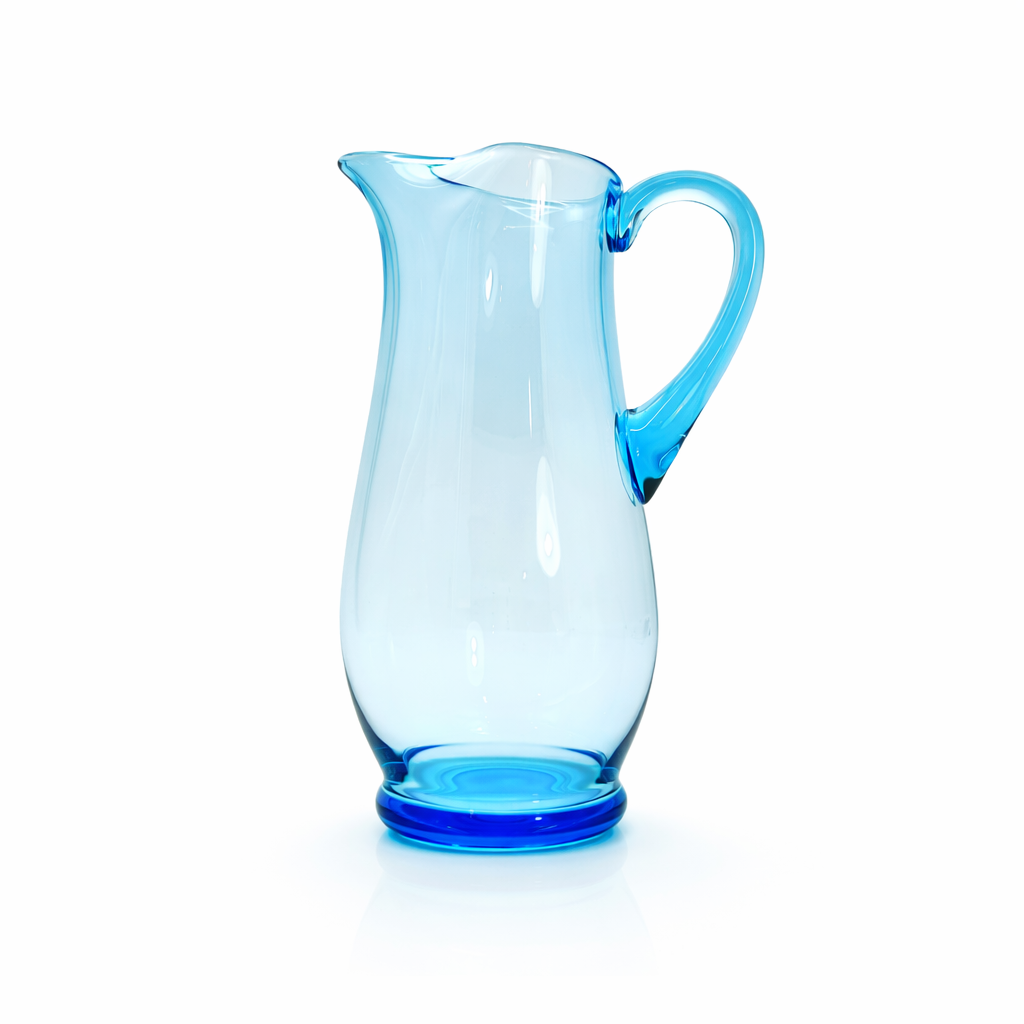
A finely proportioned aquamarine opaline glass pitcher with a tall tapering body, flared pouring lip, and elegantly drawn applied handle. The vessel carries strong sculptural presence, with the milky blue body deepening to more saturated cobalt-toned accents at the rim, handle joins, and foot. Its clean silhouette and luminous translucency give it a refined decorative effect even when not in use. Under 365nm UV light the glass shows a reflective glow, adding another layer of visual interest without, on its own, proving a specific glass formula.
Attribution & Period
Stylistically aligned with Italian opaline art glass, most closely comparable to Empoli-area decorative pitchers offered as 1960s handblown examples with similar pale blue opaline bodies, darker blue handle junctions, and applied handles. Comparable market examples identified as Empoli blue opaline pitchers from circa 1960 and the 1960s show closely related colour handling, silhouette, and construction, though this example bears no factory mark and no documented maker has been confirmed. Attribution therefore remains visual rather than documented, and the most defensible working date is the 1960s.
Dimensions & Weight
Height: 9 in
Width / Diameter: 5.5 in overall width including handle and spout; 3 in mouth diameter
Depth / Base Diameter: 2.625 in base diameter
Weight: 1.468 lbs
Condition
Excellent condition. No cracks, chips, or repairs observed. There appear to be light scratches to the interior belly, consistent with past cleaning by an abrasive cloth. Minor surface wear consistent with careful handling and age.
Authenticity & Construction
Handblown glass with an applied handle and tooled spout. The visible transitions at the handle attachments, the fluid shaping at the lip, and the concentrated colour at the joins and foot are consistent with studio or workshop hand-forming rather than pressed production. The opaline body and deeper blue accents create a materially rich effect that responds especially well to direct light and display lighting. Comparable Italian opaline pitchers from the 1960s are also described in the market as handblown with applied handles, supporting this construction reading.
Placement
Ideal for a refined bar cart, open shelving, dining console, or coastal-modern interior where coloured glass can function as a sculptural accent. It also presents well grouped with the separately offered matching aquamarine ribbed wine glasses and shell-form serving trays shown in the photographs, creating a cohesive monochrome tablescape while remaining individually sold. Under directional or UV lighting, the vessel takes on added atmospheric presence.
STANDARD ATTRIBUTION & VALUE DISCLOSURE
This piece is described to the best of current scholarly and market knowledge. Any maker or regional attribution is based on visual analysis, materials, construction techniques, and documented stylistic comparisons. As with many MCM and antique design objects, definitive attribution may not be possible without original labels or factory records. Pricing reflects condition, quality, decorative appeal, and current collector demand rather than guaranteed maker identification.
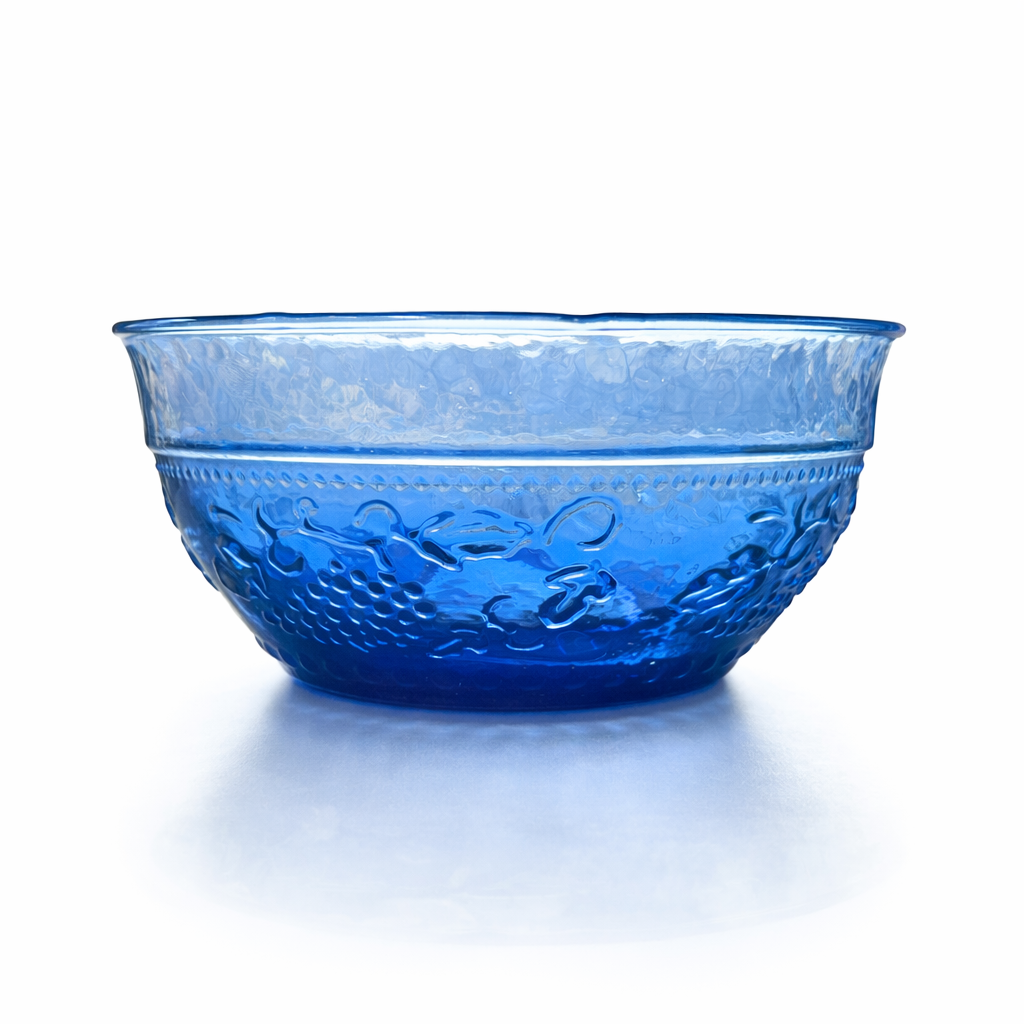
Cobalt-blue pressed-glass fruit / dessert bowl, attributed to Indiana Glass (Colony Brand), circa 1960s-1970s.
The bowl features an allover grape-and-leaf motif with a dotted/beaded band and a substantial, heavy feel typical of mid-century American pressed glass.
Authenticity & Construction
Under magnification you can see characteristic production features; subtle flow lines and ”hot glass” pooling consistent with molded, pressed manufacture. Unmarked, as many Colony/Indiana pressed pieces are.
Dimensions & Weight
2.75” Height
6” diameter (mouth)
3.5” diameter (base)
Weight: 0.91 lb
Condition:
Excellent condition. No chips, cracks, or scratches noted.
Attribution & Period
Based on the pattern language (grapes/leaves + beaded band), form, and the common unmarked production, this example is best attributed to Indiana Glass made for the Colony Brand (Lancaster Colony era) and placed most plausibly in the 1960s-1970s.
Placement
Mid-Century Modern, Traditional, Americana, Cottage.
STANDARD ATTRIBUTION & VALUE DISCLOSURE; This piece is offered in good faith based on visual examination, handling, and available comparative research. Any maker, pattern, material, or date attribution is an informed opinion and should be understood as such; unmarked glassware can be difficult to attribute with absolute certainty. Pricing reflects market comparable, condition, and rarity at the time of listing and does not constitute a formal appraisal.
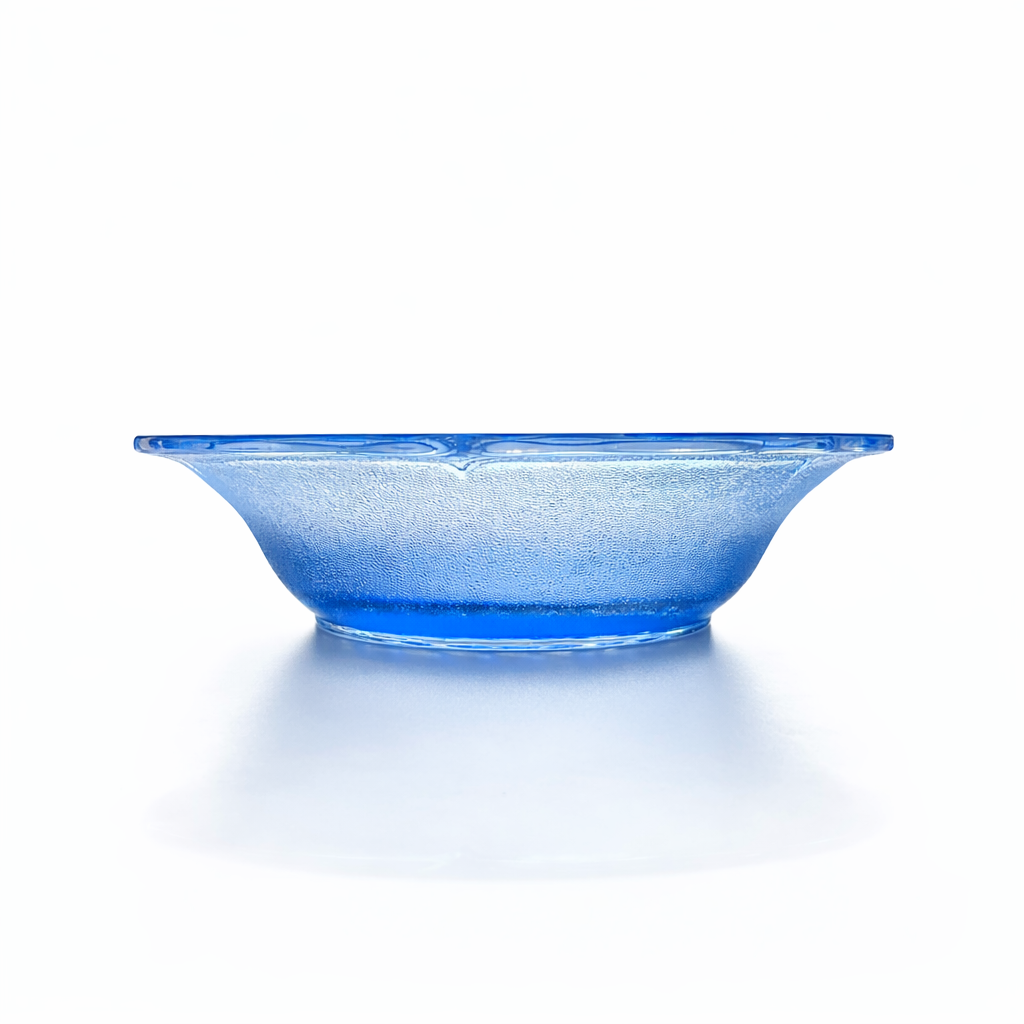
Heavy cobalt blue pressed-glass bowl, featuring a softly frosted satin interior, a scalloped rim, and a raised laurel wreath medallion molded into the base.
The glass is notably thick and weighty, with crisp mold definition and strong light refraction, giving the piece excellent visual presence despite its modest height.
Attribution & Period
Based on construction, finish, and weight, this bowl is best attributed to mid-century decorative pressed glass, circa 1950s-1970s. The frosted interior treatment, substantial glass mass, and isolated medallion motif are consistent with postwar production rather than Depression-era glass. No maker’s mark is present, which is typical for many decorative glass lines produced during this period.
Dimensions & weight
Height: 1 7/8 in
Mouth diameter: 7 1/4 in
Base diameter: 3 3/4 in
Weight: 1.05 lb
Condition
Very good vintage condition overall. There is one small hairline crack in the base, clearly shown in the final photo. The crack does not pass through the glass and does not present leakage based on inspection. Aside from this noted flaw, the bowl is immaculate, with no chips, scratches, or rim damage. Please review all close-up images carefully.
Placement
Ideal as a display or serving bowl, or as part of a curated blue-glass collection. The laurel motif adds a subtle classical element that pairs well with both mid-century and contemporary interiors, especially when styled under natural or directional light.
Standard attribution + value disclosure
This piece has been described using best-attribution practices based on visible characteristics, construction, and condition. As no maker’s mark or catalog match can be responsibly confirmed, it is listed as unattributed. The stated date range is an educated estimate. Condition has been disclosed in full with supporting photographs to ensure transparency and avoid returns.
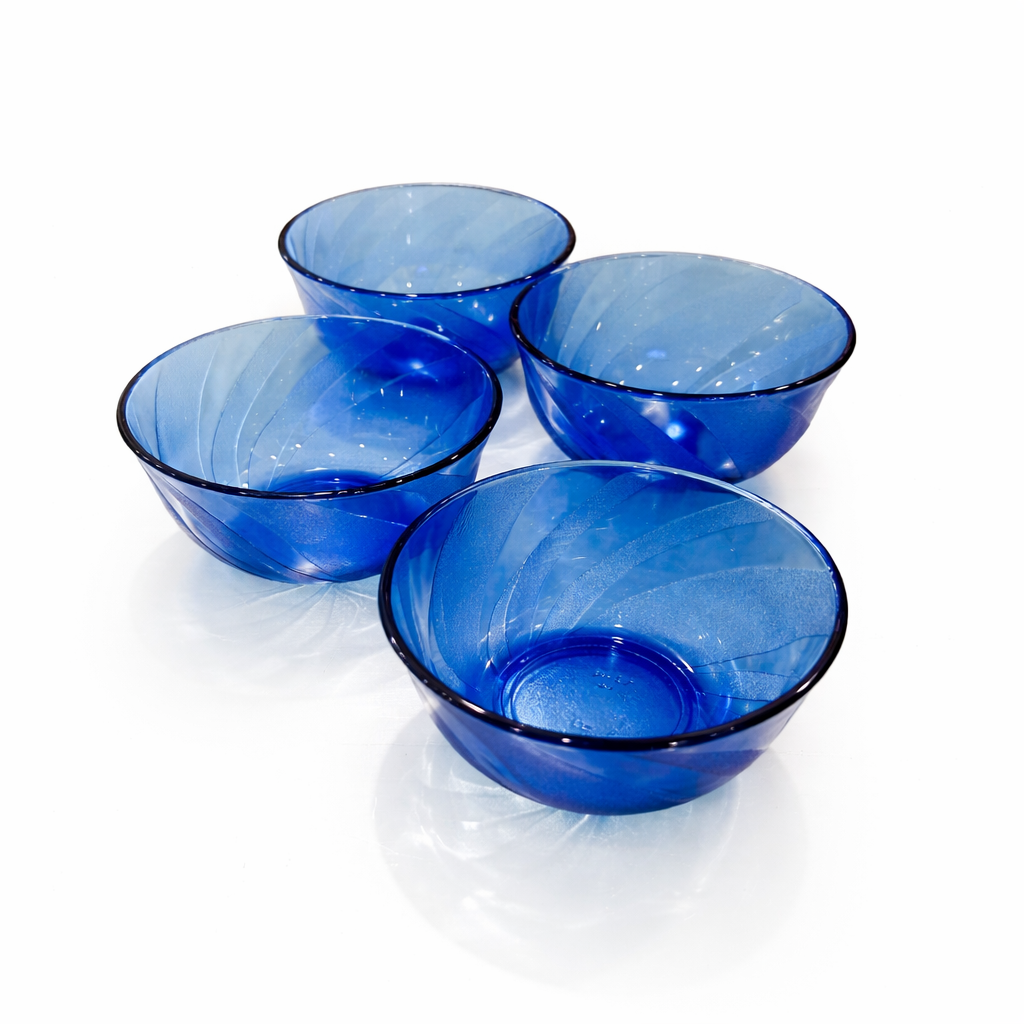
Set of four cobalt-blue glass bowls, a crisp modernist set with a spiral, frosted-satin swirl that reads like cut ribbon in the glass. Under bright light they throw beautiful water-like reflections, making them ideal as a collector’s accent set for a blue-glass shelf, bar vignette, or minimalist table styling.
Authenticity & Construction
Each bowl is marked “BRAZIL” on the underside with a small molded number (seen as 53 in close-up photos), consistent with late-20th-century export production.
The finish appears to be molded/pressed glass with selective frosting (typically achieved by etching or sandblasting) over a rich cobalt body; clean, graphic, and very display-forward.
Details
Quantity: 4 bowls
Origin mark: “BRAZIL” (molded)
Dimensions & Weight
2 in tall
4 1/2 in diameter
Base diameter (each): 2 in
Total weight (set): 1.1 lb
Condition
Great condition.
Please review photos closely for full surface detail.
No damages;
minor base wear or small manufacturing characteristics
(tiny bubbles/texture variations) can be typical with this type of glass.
Placement
Perfect as dessert bowls, nut/candy bowls, mise-en-place bowls, or simply as a blue-glass display set that plays beautifully with light.
STANDARD ATTRIBUTION & VALUE DISCLOSURE
This piece is described to the best of current scholarly and market knowledge. Any maker or regional attribution is based on visual analysis, materials, construction techniques, and documented stylistic comparisons. As with many vintage and antique glass objects, definitive attribution may not be possible without original labels or factory records. Pricing reflects condition, quality, decorative appeal, and current collector demand rather than a guaranteed maker identification.
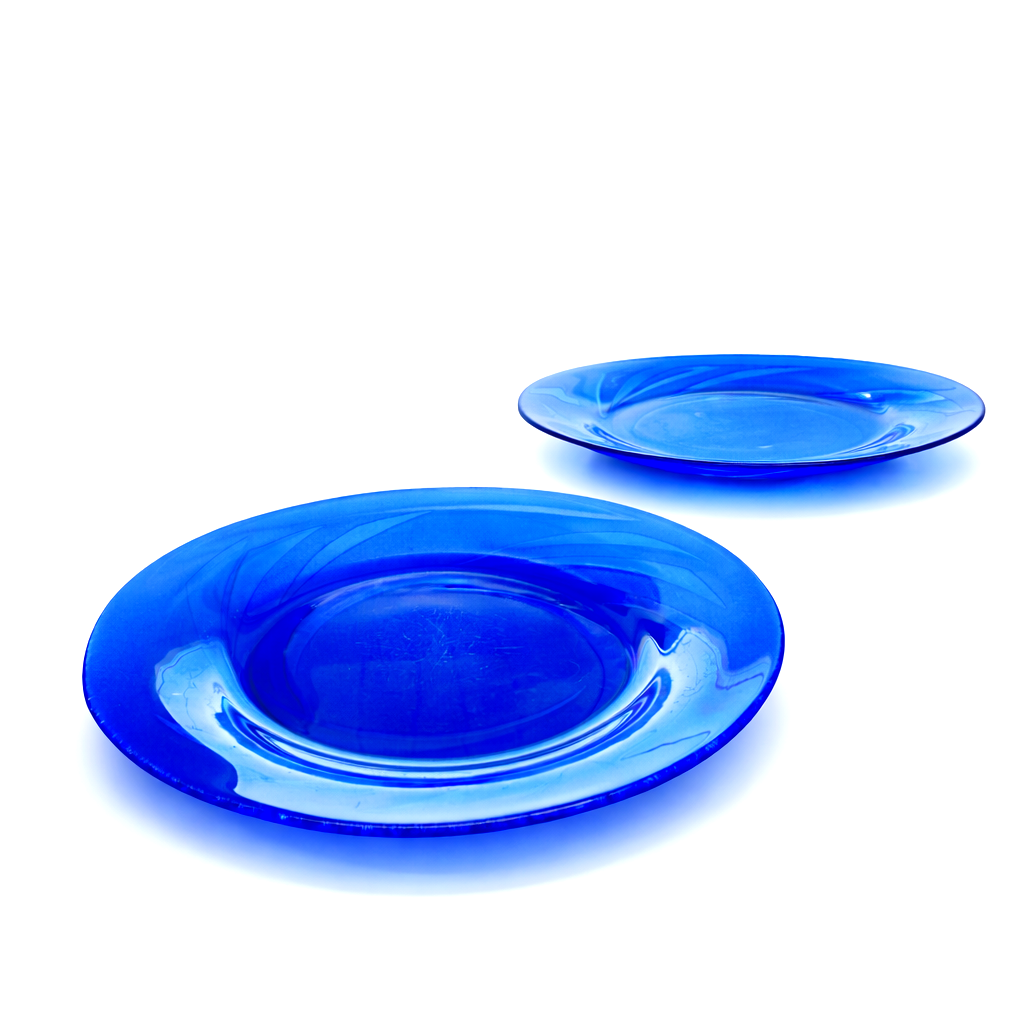
This pair of sculptural cobalt glass plates is a definitive expression of the late Art Deco and Streamline Moderne aesthetic, where decorative ornament was replaced by fluid geometry and the suggestion of motion. The design features a dramatic sweeping swirl relief that radiates from a finely textured central well, creating a powerful interplay between polished and satin-sanded surfaces. Executed in a deeply saturated cobalt glass, these plates possess an architectural mass that produces exceptional light transmission and a vivid, jewel-toned glow when illuminated.
Attribution & Research
Originating from Brazilian art glass production between 1940 and 1960, these plates are part of a high-durability line produced for the burgeoning South American modernist market. The markings "N° BRASIL" and "RESISTENTE" to the underside identify them as export-quality tableware designed to withstand both thermal stress and frequent handling without sacrificing refined aesthetics. During this mid-century period, Brazilian glassmakers adapted European avant-garde influences—specifically the "Streamline" movement—into robust, functional art glass, making this radial swirl motif a classic trope designed to emphasize the inherent refractive qualities of the pressed glass medium.
Dimensions & Weight
Diameter: 9 inches (22.9 cm) each
Combined Weight: 1.762 lbs (0.8 kg)
Presence: Substantial and balanced, possessing the visual weight of decorative sculptural objects.
Condition
Presented in excellent vintage condition, these plates retain their original surface brilliance and deep color saturation. The edges remain clean and well-preserved, exhibiting only minor utensil marks consistent with light, careful table use over several decades, with no chips, cracks, or structural damage observed.
Authenticity & Construction
Constructed from high-density pressed cobalt glass, these plates utilize a complex mold to achieve alternating polished and matte textures across the sculpted swirl relief. The "Resistente" branding was an early industry standard for tempered or thickened glass, ensuring the design remained durable while maintaining the saturated color depth prized by collectors of period glassware.
Placement
Ideally suited for Modernist architectural spaces or Art Deco interiors, these plates function equally well as sophisticated dinnerware or as wall-mounted sculptural installations. When positioned in natural window light or under gallery spotlights, the sweeping relief creates a dramatic prismatic effect, making them a striking choice for layered tabletop compositions, minimalist shelving, or glass display cabinets.
Provenance
Private decorative arts collection.
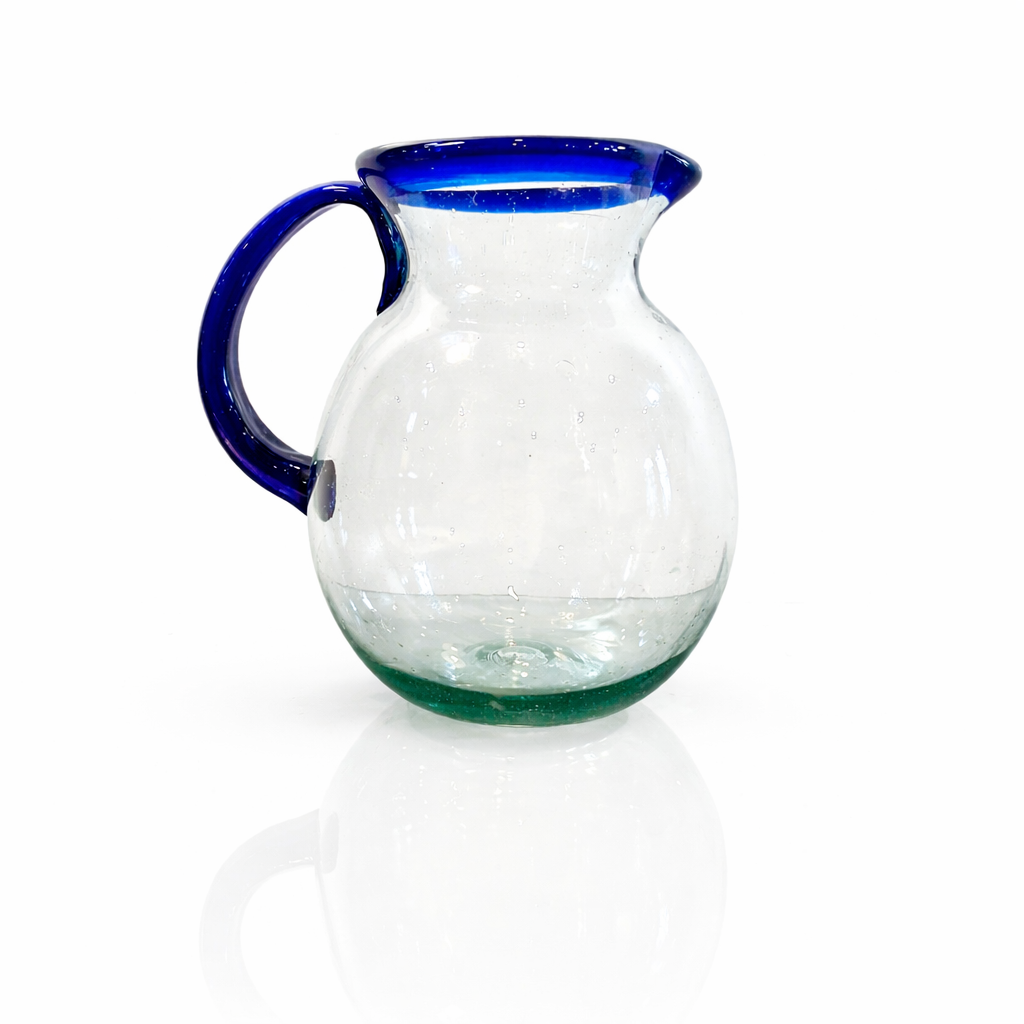
This exceptional hand-blown pitcher is a testament to the "Primitive-Modern" aesthetic, bridging the gap between historical glassmaking techniques and contemporary coastal design. Defined by its incredible density—weighing nearly 3 pounds—this piece possesses a physical presence that mass-produced glass simply cannot replicate.
Artisanal Signature Details:
• The Applied Cobalt Handle: Unlike molded pieces, the cobalt handle on this vessel was fused at the furnace after the primary body was blown. The visible "join" is not a flaw, but a deliberate mark of the maker’s hand, showcasing the moment the molten blue glass met the clear, seeded vessel.
• The Raw Pontil Base: The underside features a virile, unpolished pontil scar. This rugged texture is the "umbilical cord" of the glassblowing world—the point where the piece was broken from the iron rod. For the serious collector, this unpolished finish is the ultimate proof of an authentic, non-industrial origin.
• Seeded Clarity: Thousands of micro-bubbles (seeds) are suspended within the thick walls of the glass, catching the light and creating a shimmering, watery effect that changes throughout the day.
Collector’s Note:
This is a "hero" piece, designed to anchor a sun-drenched table or a curated shelving unit. Its scale and weight suggest it was produced in a high-end mid-century studio or a boutique European glassworks where craftsmanship took precedence over speed.
This is a stunning example of artisanal craftsmanship, perfect for the discerning collector of fine glass. This hand-blown pitcher features a striking cobalt blue rim and a matching applied handle, set against a clear, seeded glass body. Its significant weight and "primitive" finishing details speak to an authentic, old-world glassblowing process.
Key Features & Craftsmanship
• Artisanal Construction: The pitcher boasts a classic bulbous "belly" and a gracefully tapered neck. The cobalt handle shows a beautiful, slightly irregular attachment point, indicating it was hand-applied after the main body was formed.
• Textured Aesthetics: The glass body is filled with charming "seeds" (tiny air bubbles), a hallmark of hand-blown glass that adds depth and character.
• Authentic Pontil Scar: The base features a prominent, unpolished pontil scar. This rough mark is a badge of authenticity, proving the piece was held by a punty rod and hand-finished by a glassblower rather than mass-produced in a mold.
• Exceptional Weight: At nearly 3 pounds, this piece feels incredibly substantial and high-quality in the hand, far exceeding the weight of standard modern carafes.
This pitcher is a classic example of Hand-Blown Mexican Art Glass, likely produced between the 1960s and the 1980s.
While the "rough pontil" technique dates back centuries, this specific combination of seeded glass (tiny bubbles), cobalt blue applied trim, and heavy weight is the signature of high-end artisanal glassworks in regions like Tonalá or Tlaquepaque, Mexico.
Collector’s Note
Rare UV-Reactive Luminescence: A remarkable hidden feature of this piece is its intense neon-green fluorescence under ultraviolet light, confirming the presence of uranium minerals within the glass batch—a highly coveted attribute for collectors of 'Glow Glass' and radioactive antiques.
Why It Was Made This Way
• The Age (Mid-to-Late 20th Century): While it looks "antique" due to the rough base, this style became a massive interior design trend in the mid-century era. It was crafted to feel "primitive" and "honest" compared to the thin, machine-made glass of the time.
• The Weight (2.962 lbs): This indicates it was made from recycled lead-free glass, which is gathered more thickly on the blowpipe to ensure durability. In the collector world, this weight is a sign of "substantial quality."
• The "Post-Assembled" Handle: You noticed the handle looks added on later—that is exactly correct. In glassblowing, this is called an "applied handle." The body is blown first, and then a separate glob of molten cobalt glass is "trapped" onto the hot body and stretched to form the handle.
Origin & Provenance
Origin: Hand-Blown Artisanal Glass
Era: Circa 1970s
Region: North America / Mexico (Tlaquepaque Tradition)
Specifications
• Weight: 2.962 lbs
• Height: 9 inches
• Belly Diameter: 6.5 inches
• Total Width: 8 inches (including spout and handle)
• Mouth Diameter: 5 inches
Historical Significance:
This piece originates from a mid-to-late 20th-century studio practicing the "Old World" method of glasswork. Unlike modern reproductions that use "polished" bottoms to hide their manufacturing, this pitcher retains its unpolished pontil scar, a deliberate choice by the artist to honor the tradition of the blowpipe. The "seeded" nature of the glass—created by natural gases during the melting of recycled glass—gives it a unique, organic texture that is highly sought after by collectors of Rustic Modern and Mid-Century Glass.
Condition Report
This piece is in excellent vintage condition. There are no scratches, chips, or cracks. The integrity of the glass remains crystal clear, and the cobalt accents are vibrant. Note that the rough base is a natural result of the hand-making process and is not considered a defect.
"Despite its art-object status, the pitcher is fully functional. Its nearly 3-pound weight provides incredible stability on a table, making it as practical for serving chilled refreshments as it is beautiful as a standalone sculpture."
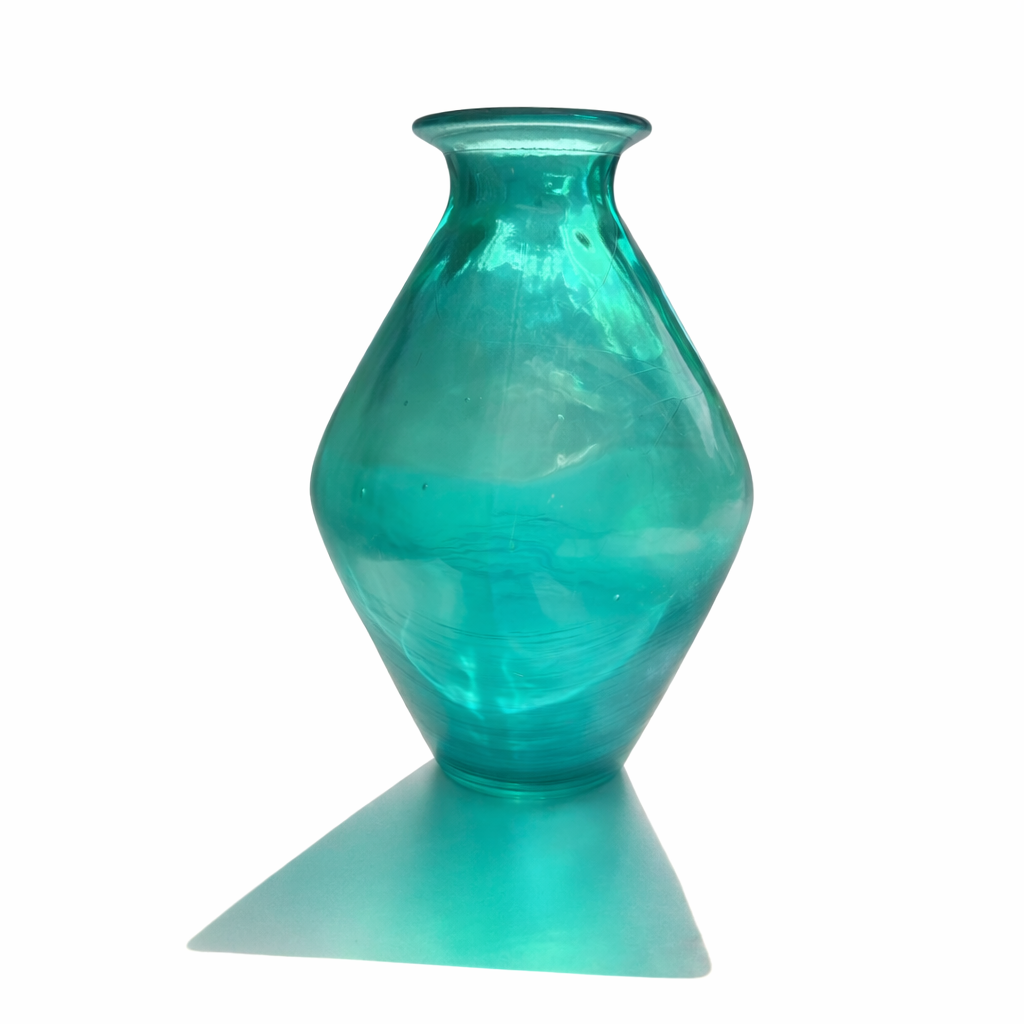
A substantial, architecturally scaled Spanish hand-blown art glass vase in saturated turquoise-green, executed within the Mediterranean modern movement of the 1970s–early 1980s. Bold in mass and fluid in surface articulation, this is a true studio-produced decorative object with confirmed Spanish origin and retained manufacturer’s label.
The form is generous and sculptural: a wide rounded shoulder rising from a stable circular base and tapering into a narrow, slightly flared mouth. The walls undulate subtly, with visible rotational striations created during the blowing process. Variations in thickness, color density, and internal movement—including entrapped bubbles—confirm free-blown production rather than mold-formed glass.
The color is deeply saturated, shifting between teal and turquoise depending on light angle, with rich tonal pooling through thicker areas of glass. While visually reminiscent of Scandinavian modern glass at first glance, the label, finishing characteristics, and glass chemistry clearly place the piece within Southern European—specifically Spanish—studio production intended for the international decorative export market.
The original label remains intact and reads:
“Made in Spain – Decorative Glass – Carefully Clean by Hand.”
This surviving label is significant, eliminating speculative attribution and anchoring the piece confidently within its regional and chronological context.
At over six pounds in weight, the vase carries substantial physical presence, reinforcing its function as a statement interior object rather than light utility glass.
Attribution & Period
Spain.
Circa 1970s–early 1980s.
Hand-blown decorative studio glass with original manufacturer’s export label.
Not Scandinavian; attribution is based on retained labeling, production finish, and material characteristics consistent with Spanish decorative glasshouses of the period.
Dimensions & Weight
Height: 13.5 in
Width (widest point): 13 in
Base diameter: 3.75 in
Mouth diameter: 0.5 in
Weight: 6.356 lbs
Monumental scale with strong visual authority.
Condition
Very good vintage condition overall.
No chips
No cracks
Minor surface paint wear to underside of base (documented)
Small faded surface area near one shoulder (approx. 1 in. square), documented
Cosmetic wear only; structurally excellent
All condition elements have been transparently disclosed to avoid ambiguity.
Authenticity & Construction
Free-blown art glass with visible rotational striations and organic wall variation. Entrapped air bubbles and density shifts consistent with studio handling. Original export label intact, confirming Spanish origin and late-20th-century decorative context.
Collectibility & Market Position
This is not positioned as Murano or Scandinavian master glass. Its value lies in:
Monumental scale
Strong turquoise saturation
Confirmed origin with intact label
Sculptural, organic-modern presence
In the 2026 market, large-format Southern European studio glass performs well within organic modern, Mediterranean, and contemporary layered interiors, where color mass and scale drive design value.
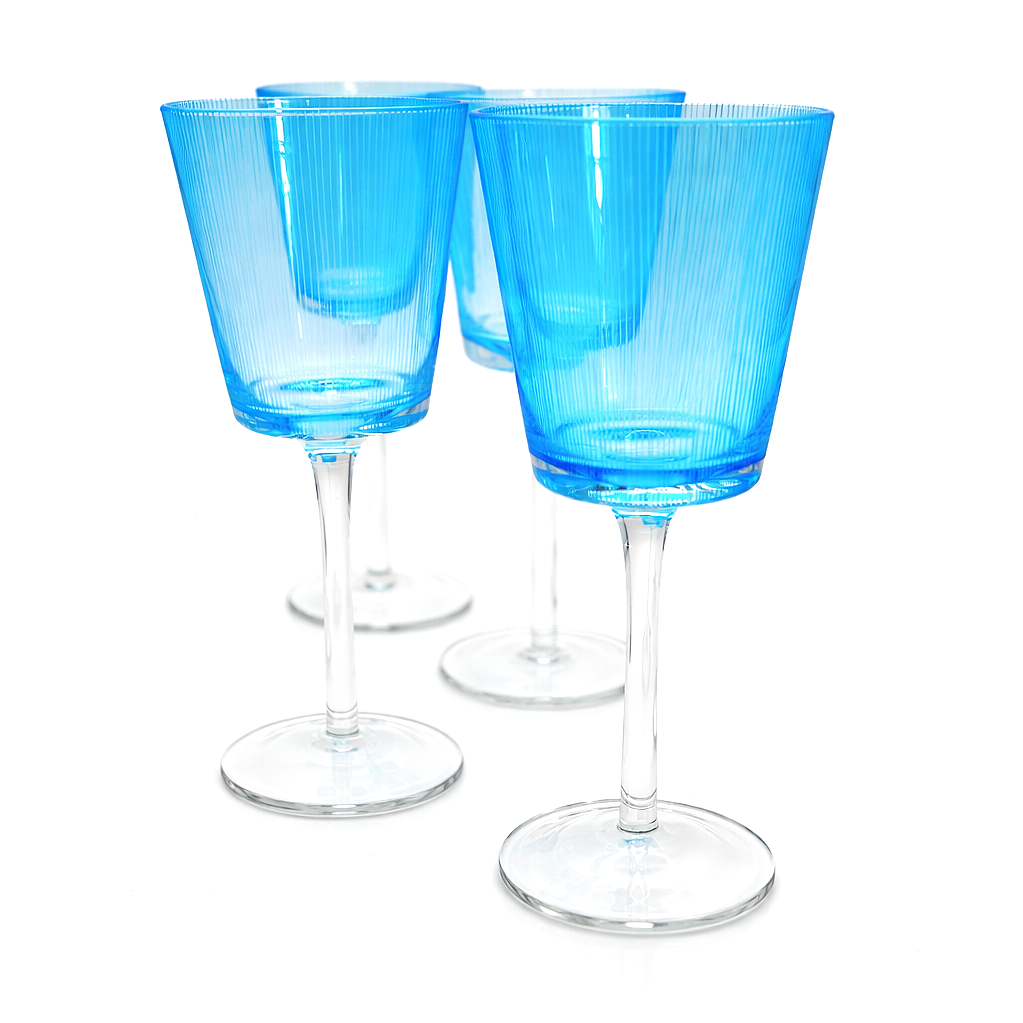
Service for 4, luminous aquamarine art glass wine glasses distinguished by finely ribbed vertical optic grooves that create striking light diffusion across the bowl. The sculptural cylindrical cups sit on slender stems and broad circular bases, producing a balanced architectural silhouette. The translucent blue glass intensifies under light and emits a vivid glow under 365nm ultraviolet illumination, revealing uranium content in the glass composition. The combination of color, ribbed texture, and elegant stem form gives the set strong visual presence whether used for entertaining or displayed as decorative glass.
Attribution & Period
Unmarked decorative arts example. The pressed optic ribbing, streamlined cylindrical bowl, and minimal stem profile are consistent with decorative glass tableware produced during the 1970s. No factory mark observed and no documented manufacturer identified; attribution remains visual rather than documented based on the glass composition, molded ribbed texture, and overall design language typical of late 20th-century decorative glassware.
Dimensions & Weight
Height: 7.75 in
Width / Diameter: 3.25 in (mouth)
Depth / Base Diameter: 2.75 in
Weight: 1.956 lbs. (combined weight of set)
Condition
Excellent condition. No observed chips, cracks, or repairs. Light base wear consistent with careful handling. The vertical lines across the exterior are molded grooves that protrude slightly and create intentional tactile texture rather than wear or scratching. Glass remains bright and clear and fluoresces strongly under 365nm UV light.
Authenticity & Construction
Pressed uranium glass with molded optic ribbing. The vertical grooves are formed directly in the mold during production and continue uniformly around the bowl, producing a tactile surface and optical diffusion effect. The bowls transition into drawn stems and circular bases typical of mass-produced decorative stemware of the period. Uranium content in the glass matrix causes the material to fluoresce vividly when exposed to ultraviolet light.
Placement
Ideal for a curated bar cart, illuminated display shelf, or sculptural table setting. The vivid blue tone and ribbed surface interact dramatically with directional lighting, and the UV reactivity makes them particularly striking in dim interiors or under accent lighting. They also pair visually with similarly colored art glass pitchers or serving pieces for a cohesive decorative grouping.
STANDARD ATTRIBUTION & VALUE DISCLOSURE; This piece is described to the best of current scholarly and market knowledge. Any maker or regional attribution is based on visual analysis, materials, construction techniques, and documented stylistic comparisons. As with many MCM and antique design objects, definitive attribution may not be possible without original labels or factory records. Pricing reflects condition, quality, decorative appeal, and current collector demand rather than guaranteed maker identification.
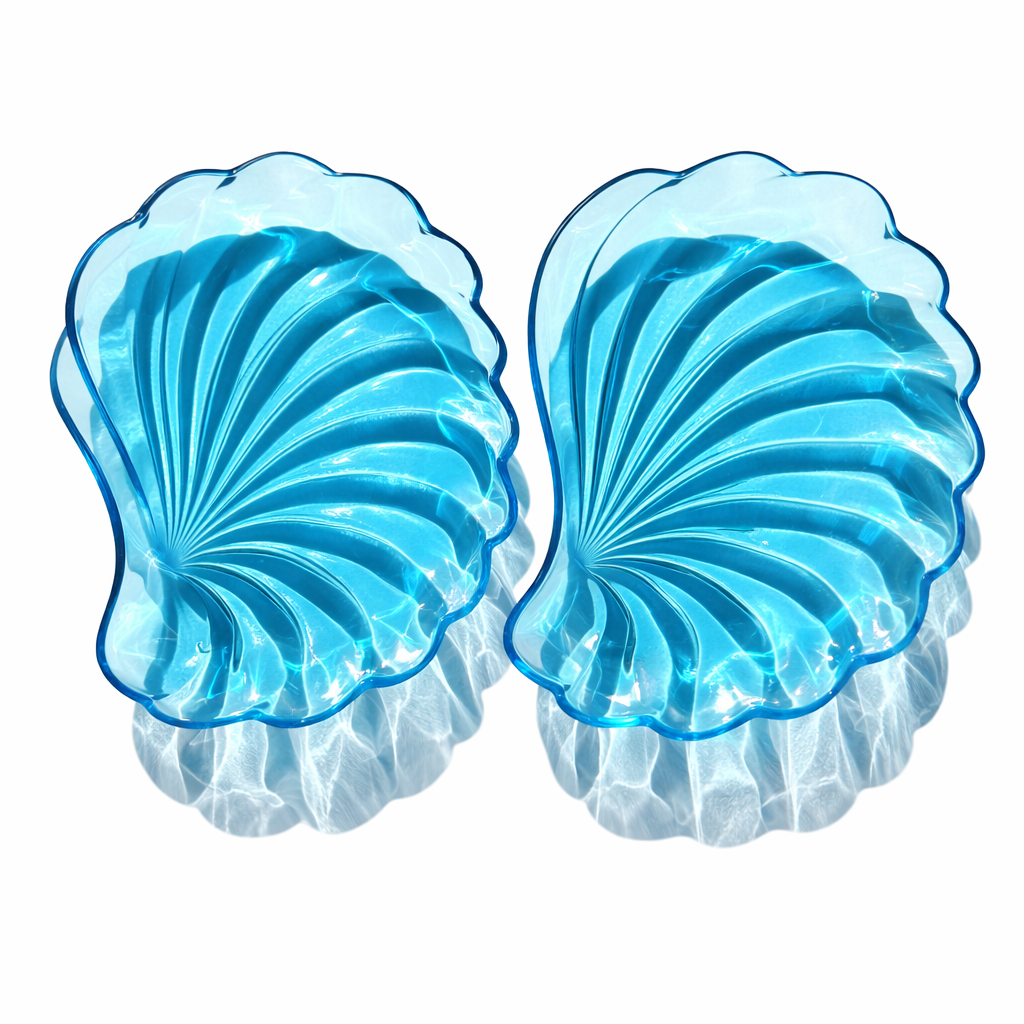
This offering comprises a matched pair of shell-form decorative glass dishes, produced in the 1960s and executed in thick aqua-toned pressed glass.
Authenticity & Construction
Each dish is modeled with deeply radiating spiral ribs that resolve into a tight central whorl, creating pronounced optical movement and a strong sculptural presence despite the shallow profile. The forms are crisply defined and highly symmetrical, characteristics consistent with postwar molded glass production rather than free-blown studio work. Close examination reveals controlled mold flow and uniform rib definition, visible in the documented macro images, confirming pressed manufacture while retaining a refined surface finish.
The aqua coloration is cool and luminous, shifting subtly between blue and green depending on ambient light. Under ultraviolet examination, the glass emits a soft green fluorescence when exposed to 365 nm UV light, with no reaction under 395 nm. This behavior is consistent with manganese-bearing glass, historically used as a refining and decolorizing agent in mid-20th-century production. The UV response definitively excludes uranium content.
Provenance
The shell motif reflects the period’s interest in abstracted natural forms, translated here into functional sculpture. These objects read equally as decorative dishes or as stand-alone display pieces and are particularly effective when backlit or shown against dark surfaces.
Dimensions & Weight (each)
Length: 10 inches
Width: 6 1/2 inches
Height: 1 inch
Combined weight: 3.06 lbs.
Condition
Good condition, consistent with age and use.
One dish exhibits a small, stable crack, clearly documented in the final image
No repairs observed
Light surface wear consistent with handling The crack does not compromise display integrity and has been fully disclosed.
Attribution & Period
Mid-20th century, circa 1960s. Dating is supported by manufacturing method, glass chemistry, UV response, and design language consistent with decorative pressed glass produced during this period. No maker’s mark is present; the pair is presented unattributed, in accordance with responsible cataloguing standards. Material & UV Disclosure Pressed (molded) glass with manganese content, confirmed by fluorescence under 365 nm UV light only. No uranium content indicated.
Placement
Decor / Collection Context Mid-Century Decorative Art Glass
Organic Modernism ;Sculptural Glass
STANDARD ATTRIBUTION & VALUE DISCLOSURE; This piece is described to the best of current scholarly and market knowledge. Any maker or regional attribution is based on visual analysis, materials, construction techniques, and documented stylistic comparisons. As with many vintage and antique glass objects, definitive attribution may not be possible without original labels or factory records. Pricing reflects condition, quality, decorative appeal, and current collector demand rather than a guaranteed maker identification.
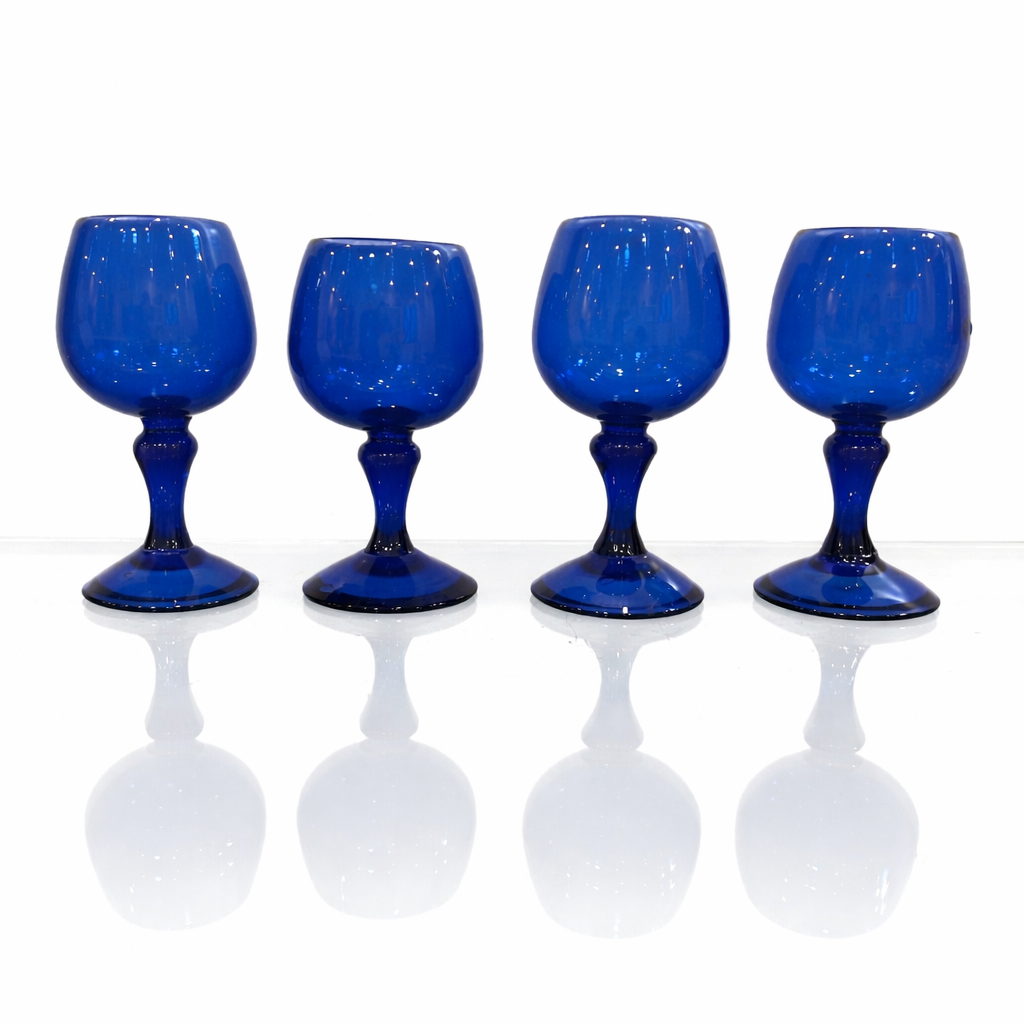
Set of four hand-blown cobalt blue glass goblets, each individually formed with subtle variations in scale and proportion, underscoring their artisanal manufacture. The goblets present a classic rounded bowl atop a slender, baluster-form stem and a gently flared foot, executed in richly saturated cobalt glass with excellent depth and clarity.
Each example shows a clearly defined pontil mark to the underside, visible in the close-up photographs, confirming hand-blown production rather than mold-formed manufacture. As expected with studio or small-batch glassmaking, no two goblets are identical: the bowls vary slightly in height and mouth diameter, lending the set a lively, organic character that collectors value.
The cobalt glass is evenly colored throughout, without flashing or surface application. Internal light play and soft striations visible under magnification are inherent to hot-worked glass and consistent with skilled freehand blowing. The weight and balance are excellent, making these both visually compelling and fully functional as tableware or display objects.
While unmarked, the form, material, and workmanship align with European hand-blown glass traditions, likely mid-20th century, and the set is offered unattributed to maintain accuracy.
⸻
Matched sets of hand-blown cobalt goblets are increasingly difficult to find, particularly with visible pontil marks and consistent color saturation. These occupy a desirable middle ground between decorative studio glass and usable stemware, appealing equally to interior designers, collectors of European glass, and those assembling refined bar or dining presentations.
⸻
This set of four hand-blown cordial glasses possesses a deep, mesmerizing cobalt hue that commands attention through its intense saturation and light-filtering properties. Each vessel exhibits a unique, organic silhouette, where the slight variations in scale and mouth opening emphasize the soulful, hand-wrought nature of the collection. The heavy-walled construction and spherical bowls create a compelling tactile experience, transforming functional stemware into a rhythmic sculptural installation for the modern sideboard.
⸻
Attribution & Condition Disclosure
All attributions regarding origin and date are offered in good faith based on observed construction and comparative examples and should be considered informed opinions rather than guarantees. Hand-blown glass naturally exhibits variation in form, thickness, and internal character. Buyers are encouraged to review all photographs carefully prior to purchase.
⸻
Dimensions & Weight
Quantity: Set of 4 goblets
Material: Hand-blown cobalt blue glass
Construction: Free-blown with visible pontil marks
Origin: Europe, likely studio or small-batch production
Date: Mid-20th century (circa 1950s–1970s)
Height: 4.5 in – 5 in (Variable)
Mouth Diameter: 1.625 in – 1.75 in (Variable)
Base Diameter: 2.5 in (Approximate)
Weight: 1.33 lbs (Collective)
Condition
The set is in excellent condition. No chips, cracks, or surface scratches are observed. The glass contains intentional, uncontrolled seed bubbles throughout the bowls and stems, characteristic of the hand-blowing process. The undersides feature authentic, rough-textured pontil marks where the glass was separated from the blowpipe, confirming handmade provenance.
⸻
Authenticity & Construction
These pieces are the result of traditional free-blown glassmaking. The variability in height and diameter serves as a testament to the maker's hand, ensuring no two pieces are identical. The inclusion of atmospheric bubbles within the molten glass adds a layered, "Brutalist" texture that captures and refracts light differently in every vessel.
Placement
Ideally suited for a contemporary bar cart or a minimalist open-shelf display. Their rich color provides a sophisticated "pop" against white marble or dark wood textures, making them an excellent choice for interior designers seeking to add depth and artisanal history to a dining space.
STANDARD ATTRIBUTION & VALUE DISCLOSURE; This piece is described to the best of current scholarly and market knowledge. Any maker or regional attribution is based on visual analysis, materials, construction techniques, and documented stylistic comparisons. As with many MCM and antique design objects, definitive attribution may not be possible without original labels or factory records. Pricing reflects condition, quality, decorative appeal, and current collector demand rather than guaranteed maker identification.

This commanding seven-piece set of cobalt barware, produced in the legendary glassworks of Arques, France, represents a masterclass in mid-century pressed glass design. The Royal Sapphire pattern is defined by its architectural weight and deep, saturated pigment, featuring a rhythmic interplay between stylized foliate panels and a dense "diamant" diamond-point base. The heavy-gauge glass is designed specifically to manipulate light, creating a prismatic azure glow that makes each vessel a sculptural object for the modern bar.
Attribution & Period
By J.G. Durand (Cristal d’Arques), 1970s.
This set is the documented Royal Sapphire pattern (often referred to in archival catalogs as Antique Blue), produced by the Verrerie Cristallerie d’Arques. The attribution is confirmed by the embossed "FRANCE" sans-serif mark on the base, which was the standard factory hallmark for Durand’s high-end export lines during the 1970s and 80s. The design reflects the factory’s "Grand Siècle" period, where they utilized traditional 19th-century motifs for a modern, high-durability audience.
Dimensions & Weight
Highball Tumblers (3):
• Height: 5 7/8 inches
• Mouth Diameter: 3 inches
• Base Diameter: 2 1/4 inches
Double Old Fashioned / Rocks (4):
• Height: 3 3/4 inches
• Mouth Diameter: 3 inches
• Base Diameter: 3 1/4 inches
• Set Weight: 5.542 lbs (Collective)
Condition
The set is in exceptional vintage condition, appearing barely used. The cobalt pigment is uniform and deep across all seven pieces. No chips, "flea bites" to the raised diamond facets, or caustic clouding from dishwasher use were observed. Minor, age-appropriate shelf wear is present on the undersides of the bases. The glass retains its original factory brilliance and clarity.
Authenticity & Construction
These vessels are crafted from heavy-press soda-lime glass, a hallmark of the Arques factory’s technical innovation in the mid-20th century. This method allowed for the crisp, high-relief definition seen in the "Royal Sapphire" foliate pattern. Each piece features the characteristic "FRANCE" embossed in the glass mold, ensuring its heritage and manufacturing origin.
Placement
The intense "Sapphire" hue and substantial heft make this set an ideal anchor for a refined Mid-Century Modern or Contemporary interior. They are best displayed on open shelving or a mirrored bar cart where backlighting can accentuate the jewel-toned depth of the glass. They pair exceptionally well with polished brass or dark walnut surfaces.
STANDARD ATTRIBUTION & VALUE DISCLOSURE; This piece is described to the best of current scholarly and market knowledge. Any maker or regional attribution is based on visual analysis, materials, construction techniques, and documented stylistic comparisons. As with many MCM and antique design objects, definitive attribution may not be possible without original labels or factory records. Pricing reflects condition, quality, decorative appeal, and current collector demand rather than guaranteed maker identification.
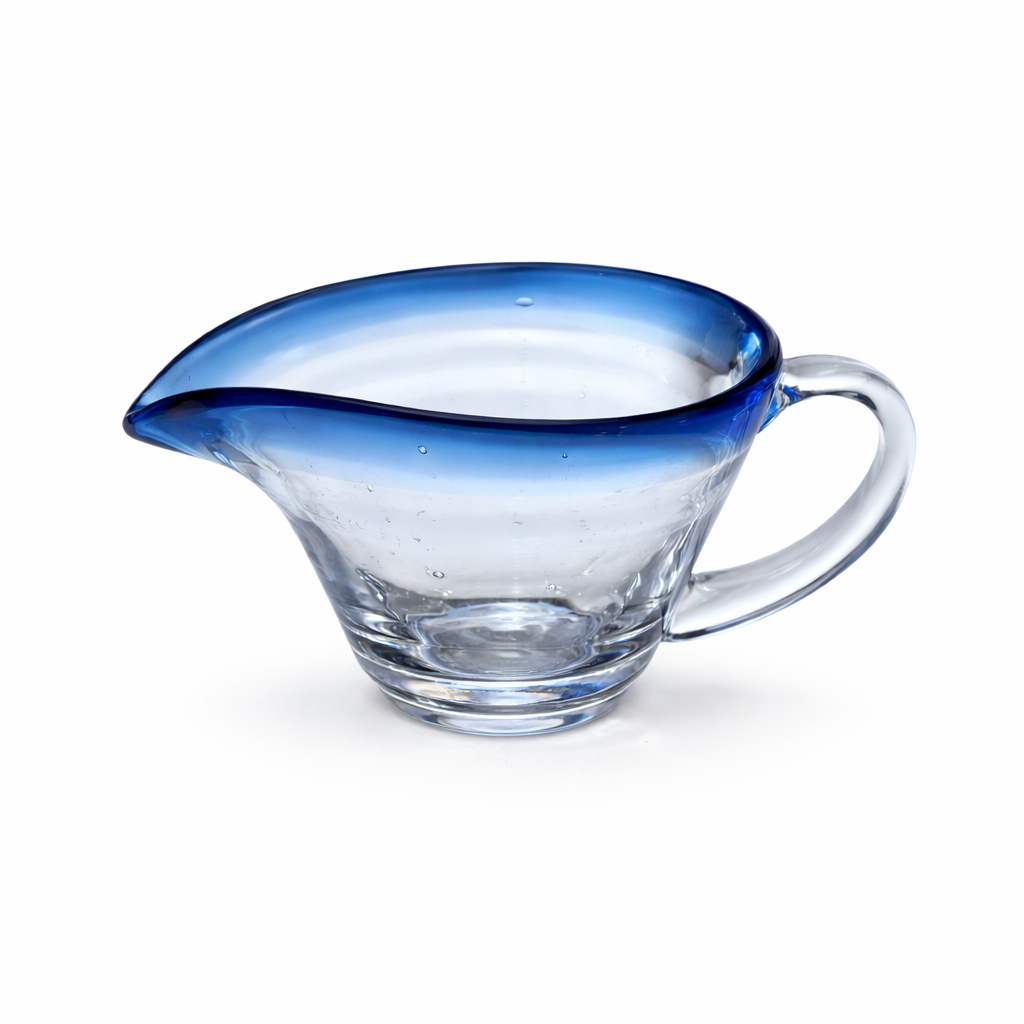
A collector-grade mid-century art glass creamer distinguished by its crystalline body and softly graduated cobalt-blue rim. Sculptural yet restrained, the form reflects modernist principles of proportion, clarity, and material honesty—where structure and glass chemistry carry the aesthetic rather than surface ornament.
The silhouette is fluid and intentional: a rounded belly rising into a gently pinched spout, counterbalanced by a hand-applied handle with subtle organic asymmetry. The cobalt rim is integral to the glass mass and softly feathered into the clear field, not flashed or surface-applied. Visible air inclusions throughout the body and rim confirm free-formed hot-glass working, characteristic of studio or small-batch production rather than high-precision factory crystal.
Under 365 nm black light, the glass exhibits a cool blue-white fluorescence. This reaction is consistent with soda-lime glass containing trace manganese used historically as a clarifying agent in mid-20th-century production. The UV response is intrinsic to the material and not the result of coating or alteration—an increasingly desirable attribute among collectors of reactive and chemically distinctive glass.
Unsigned, the creamer aligns stylistically with European and North American studio traditions of the 1950s–1970s and is offered unattributed to preserve cataloguing accuracy.
In the 2026 collector market, authentic UV-reactive mid-century studio glass continues to attract attention, particularly when form, chemistry, and color gradation coexist in a compact sculptural object.
Attribution & Period
Mid-20th century, circa 1950s–1970s.
Likely European or North American studio / small-batch production.
Unattributed; assessment based on construction technique, UV response, and stylistic comparison.
Material & Technique
Free-formed soda-lime art glass
Integral cobalt-blue graduated rim
Visible air inclusions consistent with hand-blown working
UV-reactive under 365 nm black light (manganese clarification response)
Dimensions & Weight
Height: 3 in
Length (including handle and spout): 6 in
Mouth diameter: 3.5 in
Base diameter: 2 in
Weight: 0.62416 lbs
Compact scale with notable material density.
Condition
Very good condition.
No chips
No cracks
No repairs observed
Air bubbles and internal movement inherent to hand-formed production
Glass is structurally sound and display-ready.
Authenticity & Construction
Hand-shaped spout and applied handle demonstrate manual tooling. Subtle asymmetry and internal variation reinforce studio origin. Absence of mold seams across primary surfaces supports non-pressed manufacture. UV fluorescence confirms authentic mid-century soda-lime formulation rather than contemporary reproduction glass.
Placement
Ideal for:
Mid-century modern tableware collections
Studio glass groupings
UV-reactive glass cabinets
Organic modern interiors
Sculptural bar or console styling
Its clarity, restrained cobalt accent, and chemical responsiveness allow it to function as both usable vessel and curated collector object.
STANDARD ATTRIBUTION & VALUE DISCLOSURE
This piece is described to the best of current scholarly and market knowledge. Any maker or regional attribution is based on visual analysis, materials, construction techniques, and documented stylistic comparisons. As with many vintage and antique glass objects, definitive attribution may not be possible without original labels or factory records. Pricing reflects condition, quality, decorative appeal, and current collector demand rather than a guaranteed maker identification.
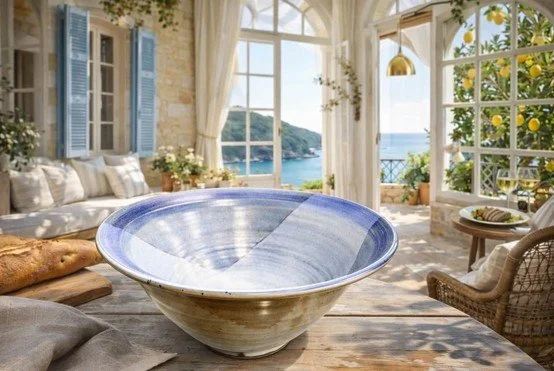
Pair of late 19th-century French faience candlesticks, executed in a commanding cobalt blue, ivory-white, and warm ochre palette with finely painted foliate banding and disciplined border work. The forms are architectural and confident, with flared circular bases, elongated shafts, and restrained upper collars that give them strong vertical presence.
Both examples carry a hand-painted underglaze blue mark reading “Choisy … Poterie” within an oval cartouche. The script and format strongly indicate production associated with Choisy-le-Roi, one of the most significant French faience centers of the 19th century. Given the hand-rendered nature of the mark, the pair is conservatively offered as Choisy-le-Roi attributed rather than factory-line certified without in-hand archival confirmation.
Attribution & Period
The decoration reflects traditional northern French tin-glazed earthenware practice: opaque white ground, hand-painted cobalt floral reserves, ochre accent banding, and rhythmic geometric borders. The glaze displays the soft depth and subtle surface variation characteristic of period faience firing.
Estimated late 19th to early 20th century, circa 1880–1910, based on glaze quality, decorative vocabulary, and hand-painted mark style.
Dimensions & Weight
Taller example : 12 in (30 cm)
Shorter example: 9–9.5 in (22–23 cm)
The intentional variation in height aligns with period decorative pairings rather than later machine-matched production. Glossy glaze with age-appropriate wear consistent with antique faience.
Condition
No major structural cracks observed in photographs. Expected minor edge wear consistent with handling over time. Please review images closely.
Authenticity & Construction
These candlesticks are antique French tin-glazed earthenware produced in the Choisy-le-Roi tradition. They are not later decorative reproductions. Visible surface variation, painterly brushstroke nuance, and glaze pooling are inherent to hand-painted faience manufacture and support period production. Minor kiln and production irregularities visible at the base mark areas, including glaze pooling.
Placement
A commanding mantel or cabinet pair with strong French provincial authority. Particularly effective layered into traditional European interiors, curated blue-and-white collections, or maximalist antique displays.
Shop the
New
Collection
A refined hand-painted blue and white ceramic vase produced in Portugal, featuring a clean cylindrical form decorated with stylized floral motifs rendered in rich cobalt glaze. The design balances traditional Iberian blue-and-white pottery with a restrained, modern sensibility characteristic of mid-20th-century Portuguese decorative arts. The decoration is executed entirely by hand, with visible brush variation and soft tonal transitions within the cobalt, rather than flat or mechanical application. The crisp white ground provides strong contrast, allowing the saturated blue motifs to read clearly and rhythmically around the body. A solid cobalt band at the rim and base visually anchors the composition.
Attribution & Period
The underside bears a hand-painted makers mark reading
”Vinha do Castelo”
“Hand Painted”
‘Made in Portugal”,
along with pattern numbers and the notation ”For Kheila,” indicating export production for an external retailer or distributor. This type of marking is consistent with Portuguese studio and workshop production intended for the international market during the mid-20th century. Period Mid-20th Century (circa 1940s1960s)
Provenance
Portugal Medium: Hand-painted ceramic / faience Cobalt blue floral motif on white ground
Dimensions & Weight
Height: 6 1/4 inches
Diameter: 3 inches
Condition
Excellent condition. No chips, cracks, or repairs observed. Clean interior and well-preserved glaze with minor, expected age-appropriate surface variation only.
Placement
This vase fits comfortably within: Mid-century European decorative ceramics Blue-and-white interiors Transitional, collected, or gallery-style settings Its restrained scale and graphic clarity allow it to integrate easily into both classic and contemporary interiors. The form is elegant and versatile, suitable for display as a standalone object or as part of a curated blue-and-white ceramic grouping.
STANDARD ATTRIBUTION & VALUE DISCLOSURE; This piece is described to the best of current scholarly and market knowledge. Any maker or regional attribution is based on visual analysis, materials, construction techniques, and documented stylistic comparisons. As with many vintage and antique glass objects, definitive attribution may not be possible without original labels or factory records. Pricing reflects condition, quality, decorative appeal, and current collector demand rather than a guaranteed maker identification.
Discover the latest additions to our collection—handpicked pieces that bring new energy to your space.
A substantial hand-thrown studio pottery bowl with a wide, gently flared form and classic wheel-thrown rings visible insidean immediate sign of studio production rather than factory ware.
The glaze is a cool, misty blue with deeper cobalt pooling at the rim, showing natural variation from the firing and the potters application. The exterior has a stoneware body with subtle speckling and a warm, exposed foot ring typical of wheel-thrown work.
Authenticity & Construction
Signature / mark (important for collectors) The underside shows an incised leaf (maple-like) motif as the makers mark. This is a true signature style mark (cut into the clay before firing), consistent with studio potters who used personal chops or carved symbols rather than printed stamps. Likely material & technique Hand-thrown stoneware (wheel-thrown; visible throwing lines) Glazed interior with a darker brushed/pooled rim band Unglazed foot ring with kiln-fired clay tone
Attribution & Period
Possible origin & dating (best-supported, without overclaiming) Based on the studio-pottery form, incised emblem mark, and blue glaze aesthetic, this bowl fits well with North American studio pottery trends that were especially popular from the mid-20th century into the late 20th century (c. 1960s1990s).
The carved leaf mark strongly suggests a potter working in a region where a leaf emblem would be meaningful (often seen with Canadian or North American makers), but without a readable name stamp, the exact maker and town can’t be stated with certainty.
Dimensions & Weight
Height: 5 1/4 in
Mouth diameter: 12 in
Base diameter: 4 1/2 in
Condition
Appears very good vintage condition from photos: no obvious cracks or repairs seen. Minor surface speckling/marks consistent with normal studio kiln firing and age. No chips, no hairlines, no repairs
Placement
Why collectors want it Large, display-worthy scale (12 mouth) Sculptural modern form suitable for MCM / minimalist interiors Artist mark (incised emblem) + handmade character from wheel-throwing and glaze variation
STANDARD ATTRIBUTION & VALUE DISCLOSURE
This piece is described to the best of current scholarly and market knowledge. Any maker or regional attribution is based on visual analysis, materials, construction techniques, and documented stylistic comparisons. As with many vintage and antique glass objects, definitive attribution may not be possible without original labels or factory records. Pricing reflects condition, quality, decorative appeal, and current collector demand rather than a guaranteed maker identification.
English Ceramic Salad Plates, J&G Meakin "Sol" Pale Yellow and Gilt Bordered Tableware - Set of 8
This exceptional set of eight porcelain side or salad plates exhibits a sophisticated creamware aesthetic, bridging classic British potting traditions with clean, early modern lines. The design centers on a luminous white field framed by a wide, pale yellow rim, defined by a vibrant inner platinum-toned or silver gilt accent line and a delicate gold gilt rim. The glazing reveals subtle, organic stone flecks throughout the stoneware composition, giving each piece a compelling, tactile material depth. When arranged together, the collection creates a structured, architectural presence on the table, capturing and scattering light across its finely glazed, stepped surfaces.
These plates are by J&G Meakin of Hanley, Staffordshire, England, bearing the company's celebrated "Sol" registry mark (Reg No. 391413) alongside a radiant sun emblem under the glaze. This specific registry number and stamp sequence indicates a production origin within the Early Modern period, specifically the 1910s. The authenticity of the set is further supported by individual, hand-engraved potter's tally numbers (including 10, 18, 25, and 26) impressed into the reverse of the plates, documenting the artisan-level bench production of early 20th-century Staffordshire tableware.
Height: 0.75 in (1.9 cm)
Width / Diameter: 8.5 in (21.6 cm)
Depth / Base Diameter: 5.0 in (12.7 cm)
Weight: 0.75 lbs (0.34 kg) per plate
The set is in very good, collector-grade condition, showing no chips, cracks, or professional repairs. Consistent with age and gentle historic use, the plates display minor, superficial utensil marks across the central wells under close inspection. The perimeter gold gilt borders show slight, graceful wear, while the inner silver gilt accent lines remain remarkably bright and intact. Natural kiln-born stone inclusions and minor pooling in the glaze are present, characteristic of the period's material firing process.
Each plate was manufactured using semi-porcelain or fine ironstone clay bodies, precision-molded and fired at high temperatures to achieve a durable, resonant ring. The multi-colored banding showcases an advanced multi-stage decorative process where the pale yellow slip ground was applied prior to the meticulous hand-gilding of the inner and outer metallic accents. This complex production method ensures that while the set presents a uniform design language, each plate retains subtle variations that highlight its bench-made origin.
This complete set of eight serves as a sophisticated addition to refined modern or classical dining rooms. Perfect for upscale curation as salad, starter, or dessert service, they pair beautifully with minimalist contemporary chargers or antique sterling flatware. Their pale cream tones and reflective metallic borders make them equally striking when displayed en masse within a lit breakfront or architectural niche.
This piece is described to the best of current scholarly and market knowledge. Any maker or regional attribution is based on visual analysis, materials, construction techniques, and documented stylistic comparisons. As with many MCM and antique design objects, definitive attribution may not be possible without original labels or factory records. Pricing reflects condition, quality, decorative appeal, and current collector demand rather than guaranteed maker identification.