
The Vault:
Reserve Collection
A controlled release of museum-caliber glass and decorative arts.
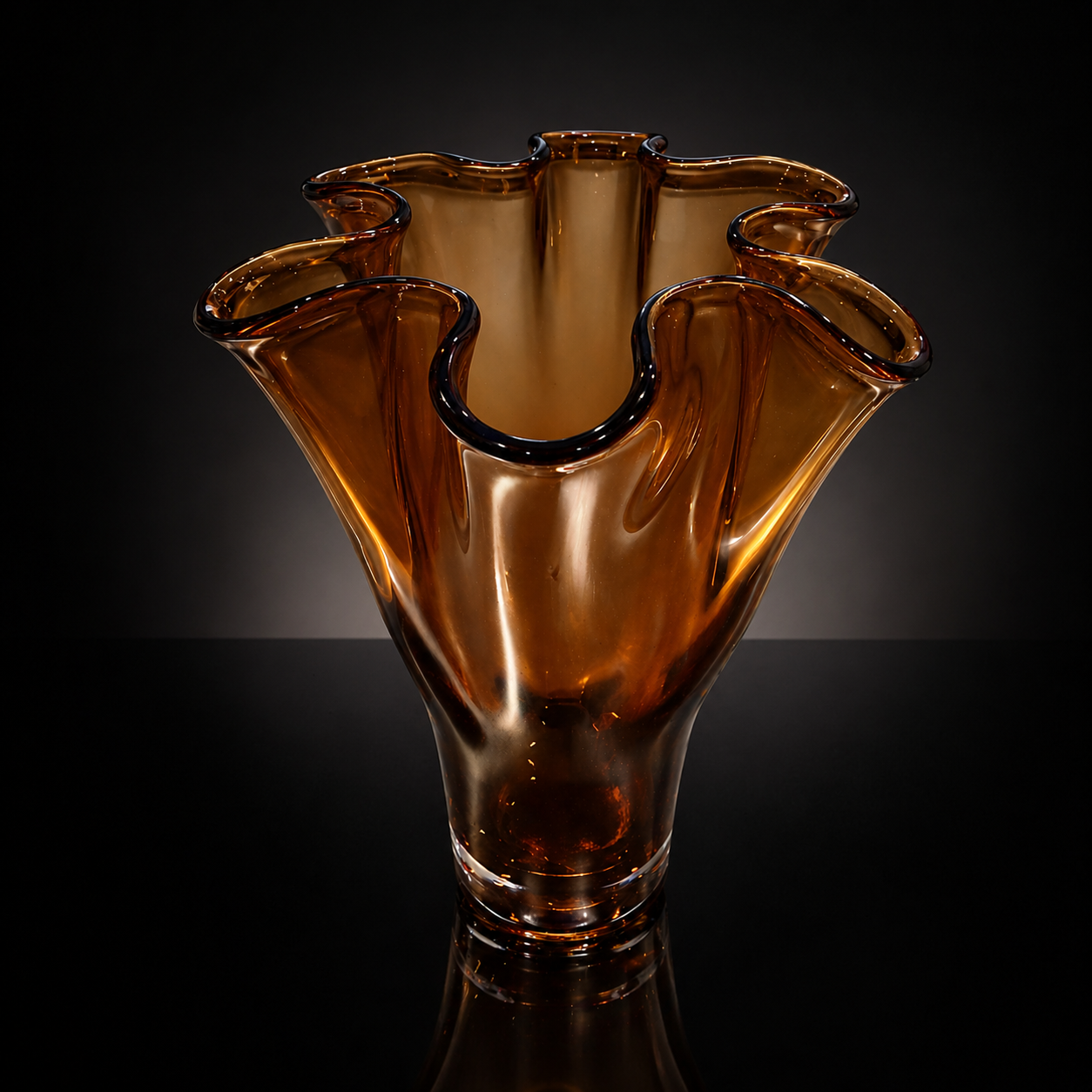
A dramatic mid-century, inspired hand-blown art glass vase in rich amber, shaped in the celebrated fazzoletto (handkerchief) tradition, with a six-lobed, ruffled rim finished in a deep cobalt-to-amethyst edge. The silhouette is all movement; folded, wave-like shoulders that rise from a substantial, thick-walled base, giving the piece real architectural presence and the satisfying weight collectors look for in quality art glass.
Authenticity & Construction
The vase shows uncontrolled air bubbles throughout the body;an honest studio-glass hallmark that confirms hot-worked production rather than factory-pressed glass. The base appears exceptionally thick and polished, with a subtle symmetrical vertical groove/optic suggestion rising upward, adding depth and light-play when displayed near a window or under gallery lighting.
Attribution & Period
Design context and dating The ”fazzoletto” form is historically associated with Italian Murano design; the handkerchief concept was jointly conceived by Fulvio Bianconi and Paolo Venini in 1948, and the style was produced in many variations afterward. (The Metropolitan Museum of Art) Based on the profile, heavy base, and color treatment, this example is best placed as late 20th century, circa 1960s-1970s, in the Murano taste. Maker is unattributed due to the absence of a signature or label.
Dimensions & Weight
Height: 12 inches
Width: 9.5 inches
Base diameter: 3.5 inches
Weight: 5.692 pounds
Condition
Very good overall condition. Light scratching to the underside/base only; no other surface scratching noted. No signature observed. Air bubbles are present throughout and are inherent to the making.
Placement
Style Mid-Century Modern “Italian Modern” Murano taste; Organic Modern; Sculptural
STANDARD ATTRIBUTION & VALUE DISCLOSURE
Disclosure All maker attributions, dates, and origins are offered in good faith based on visible construction details and comparative market research, and should be considered informed opinions rather than guarantees. Studio glass is hand-formed and may exhibit natural variations including asymmetry, surface texture, air bubbles, or minor inclusions inherent to the process. Buyers are encouraged to review all images and request additional details prior to purchase.
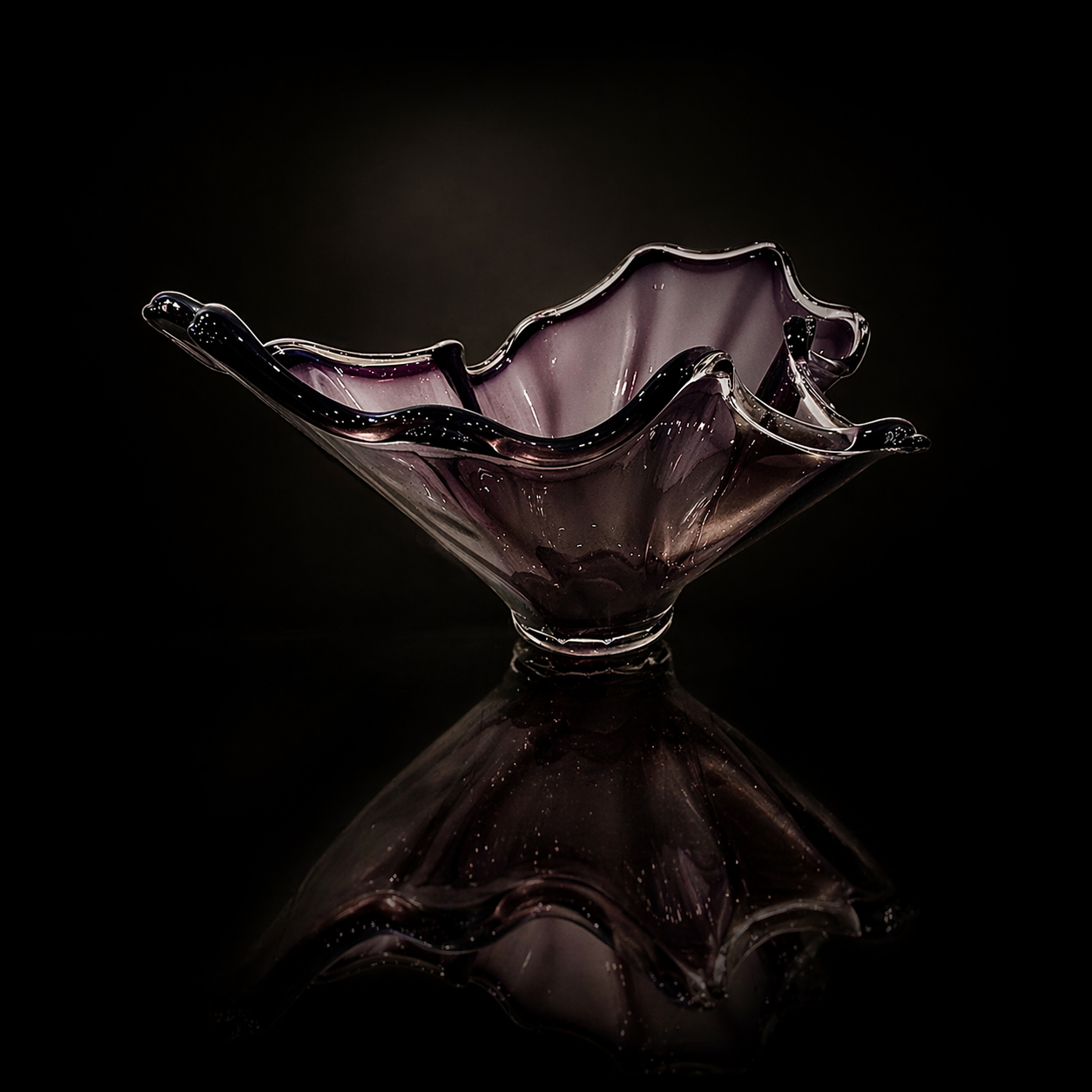
A commanding sculptural centerpiece defined by its sweeping, asymmetric form and deeply saturated amethyst tonality, this large-scale art glass bowl captures light with exceptional depth and movement. The flared, undulating rim transitions from rich purple to clear glass, creating a luminous halo effect that enhances its architectural silhouette. Subtle internal inclusions and controlled bubbles add dimensional complexity, while the thick, weighted base anchors the composition visually and physically. The piece reads as both functional vessel and standalone sculptural object, equally suited to refined interiors.
Attribution & Period
Unmarked Murano glass example, Italy, 1960s. The fluid freeform profile, sommerso-style color transition, and presence of controlled internal bubbles are consistent with mid-century Murano production. The substantial weight, polished pontil, and sculptural emphasis align with Italian studio glass practices of the period. No factory mark observed; attribution remains visual rather than documented.
Dimensions & Weight
Height: 10 inches
Width / Diameter: 18.25 inches (widest), 15 inches (narrowest)
Depth / Base Diameter: 4.25 inches
Weight: 7.256 lbs
Condition
Overall strong visual condition. One small internal crack visible within the base. Typical internal inclusions and controlled bubbles from the glassmaking process. Base shows a polished pontil with light wear consistent with age and handling. No major rim chips observed. Color transition and clarity remain vibrant.
Authenticity & Construction
Hand-blown art glass with a sculpted freeform rim and controlled cooling techniques. The polished pontil scar confirms removal from the blowpipe and finishing by grinding and polishing. The internal bubble inclusions and layered coloration indicate deliberate studio techniques rather than mass production, enhancing both visual depth and collectible appeal.
Placement
Ideal as a centerpiece on a dining or console table, or as a focal sculptural object on a plinth or glass shelf. Its scale and color make it particularly effective in minimalist, modernist, or gallery-style interiors where light interaction can be fully appreciated.
STANDARD ATTRIBUTION & VALUE DISCLOSURE; This piece is described to the best of current scholarly and market knowledge. Any maker or regional attribution is based on visual analysis, materials, construction techniques, and documented stylistic comparisons. As with many MCM and antique design objects, definitive attribution may not be possible without original labels or factory records. Pricing reflects condition, quality, decorative appeal, and current collector demand rather than guaranteed maker identification.
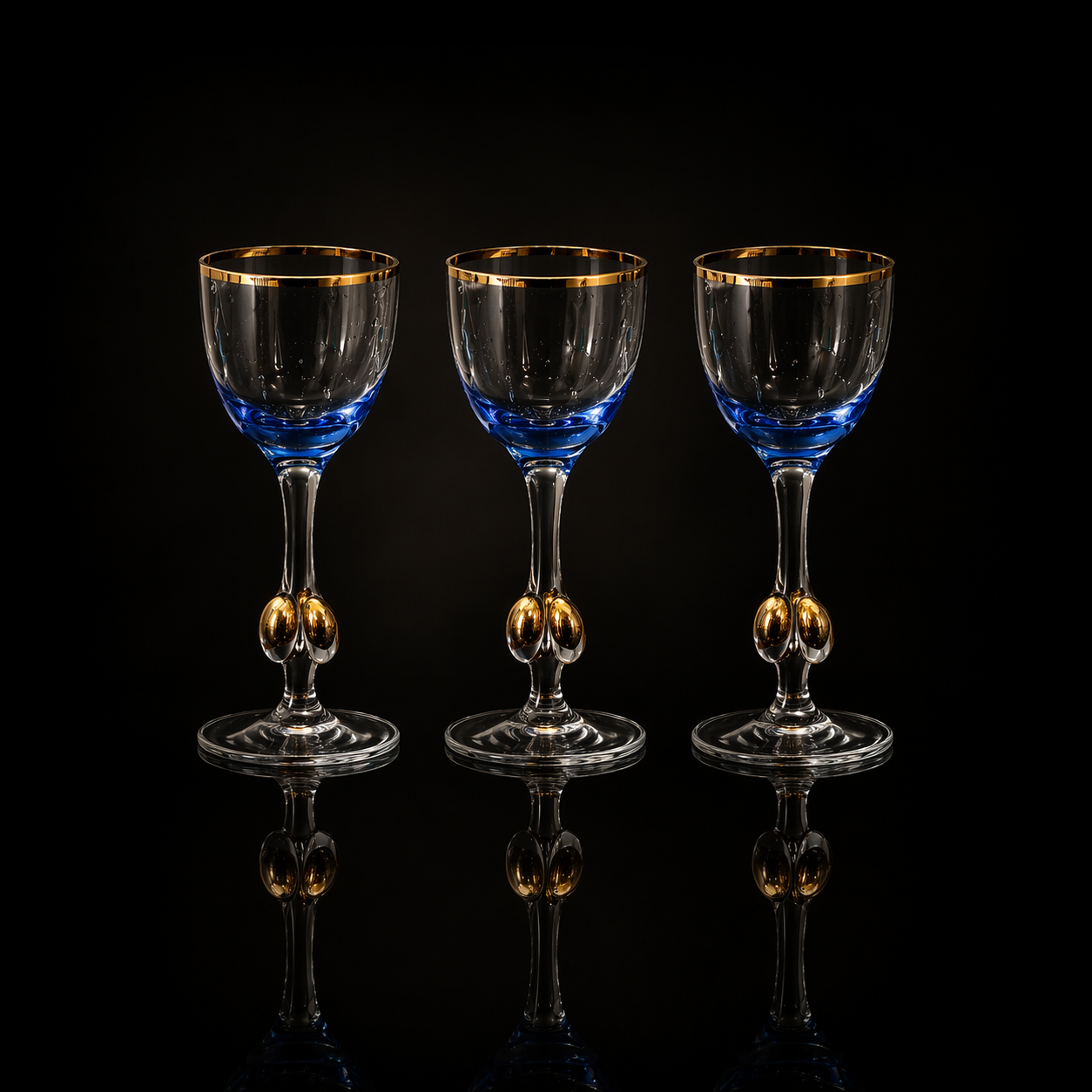
This exceptional set of three cordial glasses represents a masterclass in Venetian-style technical glasswork, defined by the striking juxtaposition of saturated cobalt and encapsulated gold. Each vessel features a deep, pooled-color bowl finished with a meticulously applied gilt rim, elevated by a sculptural clear stem. The centerpiece of the design is a series of fully encapsulated gold-leaf orbs—a demanding "hot-work" technique that creates a sense of suspended luxury and architectural weight. These are not merely barware; they are small-scale sculptures designed for the most refined tablescapes.
Attribution & Period
Regional Example: Italy (Murano Region), circa 1970s–1990s The construction methods—specifically the internal layering of gold leaf within the stem and the controlled "wash" of the cobalt—are stylistically aligned with high-end Venetian furnace productions such as those by Seguso or Salviati. While unmarked, the consistency of the glass batch and the precision of the gold-orb encapsulation are definitive indicators of luxury studio production rather than mass-market export. The "Architectural" and "Technical" mastery of those encapsulated gold orbs; in the world of Murano glass, this technique is often associated with the Scavo or Bullicante traditions, but the clean, gold-leaf execution suggests a more refined Venetian Modernist approach. These stems were originally part of a prestigious suite.
The bowls show controlled bubble inclusion and layered color transitions typical of premium European decorative glass. The gold orbs are fully encapsulated within the clear stem, not surface-applied, giving depth, weight, and long-term stability. These are visually and technically aligned with the matching decanter (sold separately) that has been positioned as a museum-quality example , and they present as an intentional, designed suite rather than mixed replacements.
Dimensions & Weight (Per Glass)
Height: 4 ¾ in
Mouth Diameter: 1 ⅝ in
Base Diameter: 1 ¾ in
Total Weight (Set of 3): 0.342 lb
Condition
Immaculate / Museum Quality. The set presents in pristine condition with no evidence of chips, clouding, or restorative work. The gilt rims remain entirely intact with no thinning or oxidation, and the internal gold orbs are flawlessly preserved within the crystal.
Authenticity & Construction
The manufacturing of these stems requires a sophisticated multi-stage process: the gold orbs are applied to the stem while the glass is molten and then "cased" in a secondary layer of clear crystal to ensure permanent encapsulation. This ensures the gold remains untarnished and protected by the weight of the glass. The bowls show the characteristic subtle undulations and micro-bubble inclusions associated with authentic hand-blown Italian crystal.
Placement
These stems are ideally suited for a backlit modernist bar or an entryway vitrine. When paired with the matching decanter, they create a commanding visual narrative of 20th-century European luxury. They are best displayed on reflective surfaces to amplify the interplay between the sapphire blue and the radiant gold internals.
Standard Attribution & Value Disclosure; This set is described to the best of current scholarly and market knowledge. Attribution is based on material analysis and documented Venetian design language. Pricing reflects the rarity of the set, the technical difficulty of the gold encapsulation, and the current market demand for high-end Italian modernist glass.Set of three matching aperitif / cordial glasses executed in clear glass with a saturated cobalt-blue wash pooled at the bowl, finished with a finely applied gilt rim. Each glass is elevated on a sculptural clear stem featuring applied gold-filled spherical orbs, a technically demanding decorative detail that places these firmly in the realm of high-end studio or luxury production rather than standard barware.
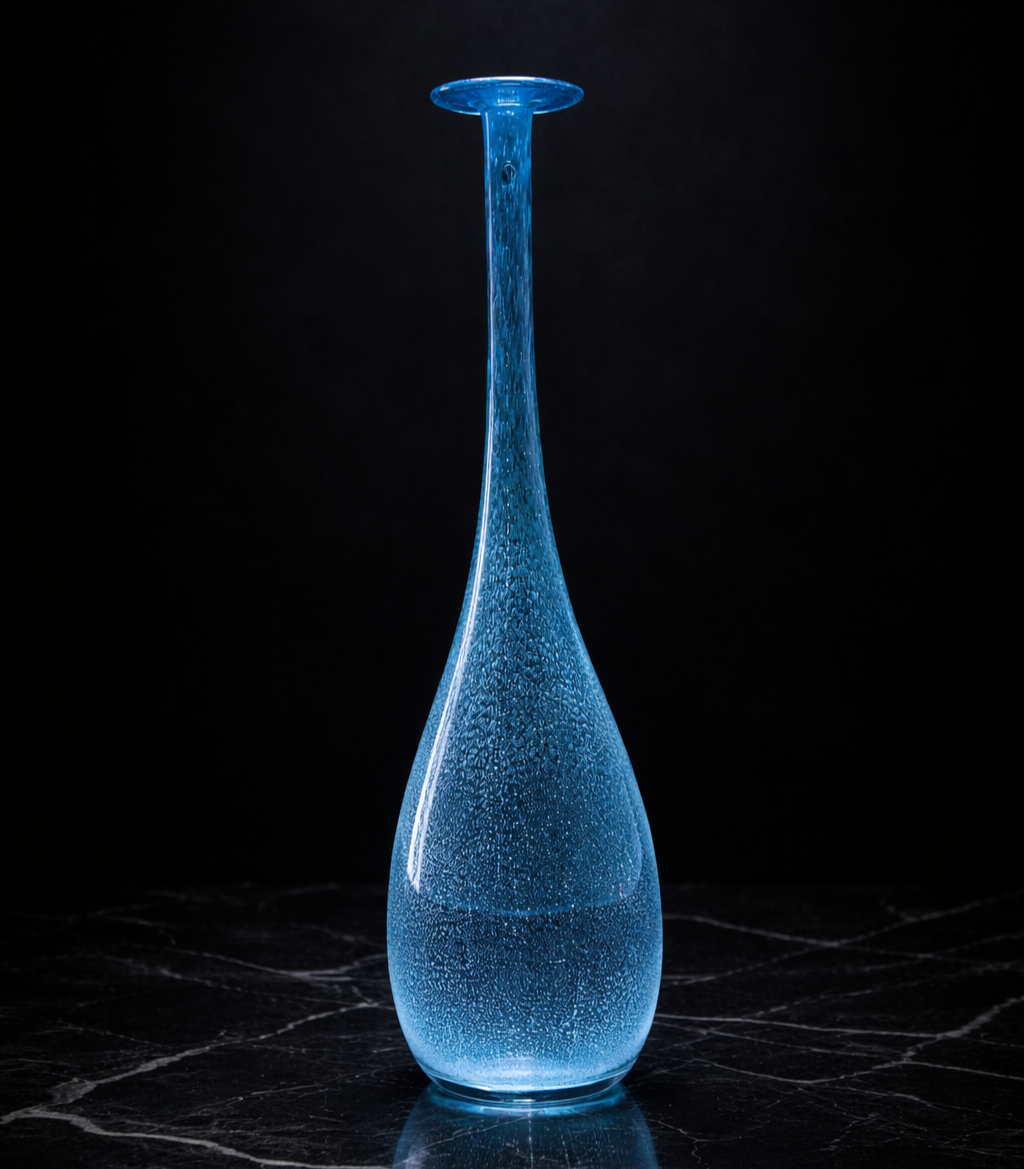
A commanding and highly sculptural Murano art glass vase defined by its elongated neck, flared disc rim, and teardrop body. The surface is richly animated with dense internal bubbles, creating a luminous, atmospheric effect that intensifies toward the base. The glass transitions through layered amethyst tones with a subtle optical depth, producing strong light interaction from every angle. Its verticality and refined proportions give it a striking architectural presence suited for elevated interiors.
Attribution & Period
Attributed to Murano, Italy, 1960s. The form, controlled bullicante bubble technique, and internal color saturation are consistent with mid-century Murano studio production. The pronounced pontil finish, heavy base, and sculptural silhouette align with documented Venetian glassmaking practices of the period. No factory mark observed; attribution remains visual rather than documented.
Dimensions & Weight
Height: 20.5 in
Width / Diameter: 2.75 in (body)
Depth / Base Diameter: 2.875 in (base)
Opening Diameter: 0.75 in
Top Disc Diameter: 2 in
Weight: 2.942 lbs
Condition
Excellent condition. No chips, cracks, repairs, scratches, or structural damage observed. Surface remains clean and glossy with expected minor base wear from handling. Dense internal bubbles are inherent to the manufacturing process. Strong UV reactivity noted under 365nm light.
Authenticity & Construction
Hand-blown glass constructed using the bullicante technique, where controlled air bubbles are introduced in layers to create a uniform, textured field within the glass mass. The elongated neck and flared rim were shaped hot at the end of the blowing process. The base shows a finished pontil mark, confirming hand-worked studio production rather than molded manufacture.
Placement
Ideal as a standalone sculptural object on a console, pedestal, or architectural shelf. Particularly effective in minimal or modern interiors where vertical form and light interaction can be emphasized. Works well in curated glass groupings or as a focal accent in refined residential or gallery environments.
STANDARD ATTRIBUTION & VALUE DISCLOSURE; This piece is described to the best of current scholarly and market knowledge. Any maker or regional attribution is based on visual analysis, materials, construction techniques, and documented stylistic comparisons. As with many MCM and antique design objects, definitive attribution may not be possible without original labels or factory records. Pricing reflects condition, quality, decorative appeal, and current collector demand rather than guaranteed maker identification.
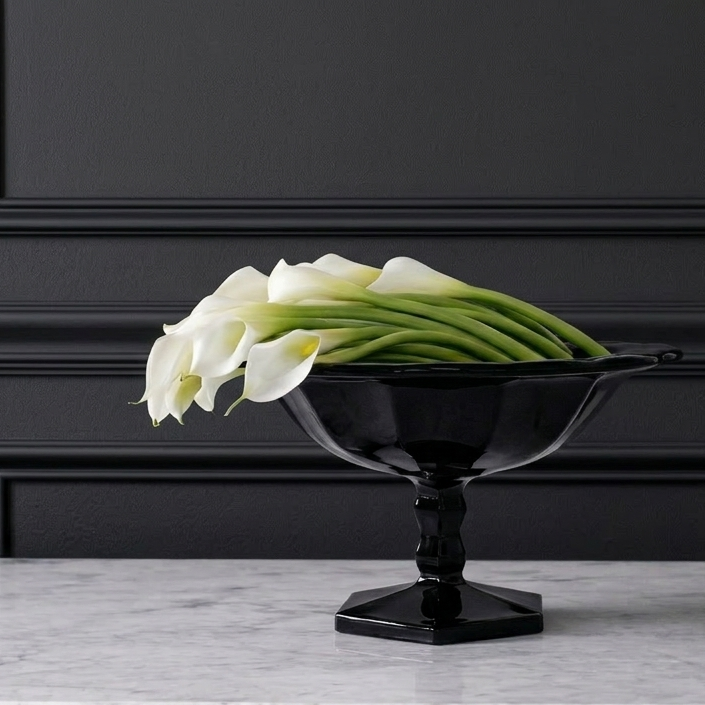
This striking centerpiece bowl exhibits a commanding sculptural presence, characterized by its deep, light-absorbing obsidian hue and substantial glass weight. The form features a bold, undulating scalloped rim that creates a rhythmic play of shadow and reflection across its polished surface. Supported by a faceted hexagonal pedestal, the object balances architectural geometry with organic fluid lines, making it a compelling focal point for a refined interior.
Attribution & Period
Stylistically aligned with American Mid-Century glass production, this piece is consistent with the high-quality press-molded techniques utilized by firms such as Tiffin or Fostoria during the 1940s. The dense "black" glass—technically a very deep purple known as black amethyst—and the precise faceting of the stem are characteristic of mid-century decorative arts from the Ohio River Valley region. No factory mark is observed, which is typical for glass of this era originally identified by paper labels.
Based on the hexagonal pedestal stem and the specific "scalloped" rim profile combined with the weight of the glass, this piece is most defensibly attributed to the 1940s.
While black glass had a surge in the 1930s (Depression era), the transition toward bolder, more geometric architectural stems like this hexagonal design became a hallmark of "Elegant Glass" manufacturers (like Tiffin and Fostoria) as they moved into the early 1940s. By the late 1950s, styles shifted toward more "free-form" or "organic" ruffles (like Viking Glass), making the structured, rhythmic scallops on your piece a classic representation of early-to-mid 1940s American glass design.
Dimensions & Weight
Height: 6 inches
Width / Diameter: 9 inches
Depth / Base Diameter: 4 1/4 inches
Weight: 2.336 lbs
Condition
The condition is excellent, presenting in collector-grade quality. Clinical observation reveals no chips, cracks, or professional repairs. The polished surface is remarkably well-preserved with no observed scratches or utensil marks. Base wear is minimal, consistent with age and careful display.
Authenticity & Construction
The object is crafted from solid, pigment-rich glass through a sophisticated molding and finishing process. The substantial weight and clarity of the mold lines signify a high standard of production, ensuring the durability and depth of color that distinguishes artisan glass from mass-market imitations. The transition from the hexagonal base to the fluted bowl demonstrates a mastery of geometric transitions.
Placement
This piece serves as an ideal architectural accent on a minimalist sideboard, a dark-stained executive desk, or as a central vessel on a contemporary dining table. Its monochromatic palette allows it to integrate seamlessly into both Brutalist and Hollywood Regency aesthetics.
STANDARD ATTRIBUTION & VALUE DISCLOSURE;This piece is described to the best of current scholarly and market knowledge. Any maker or regional attribution is based on visual analysis, materials, construction techniques, and documented stylistic comparisons. As with many MCM and antique design objects, definitive attribution may not be possible without original labels or factory records. Pricing reflects condition, quality, decorative appeal, and current collector demand rather than guaranteed maker identification.
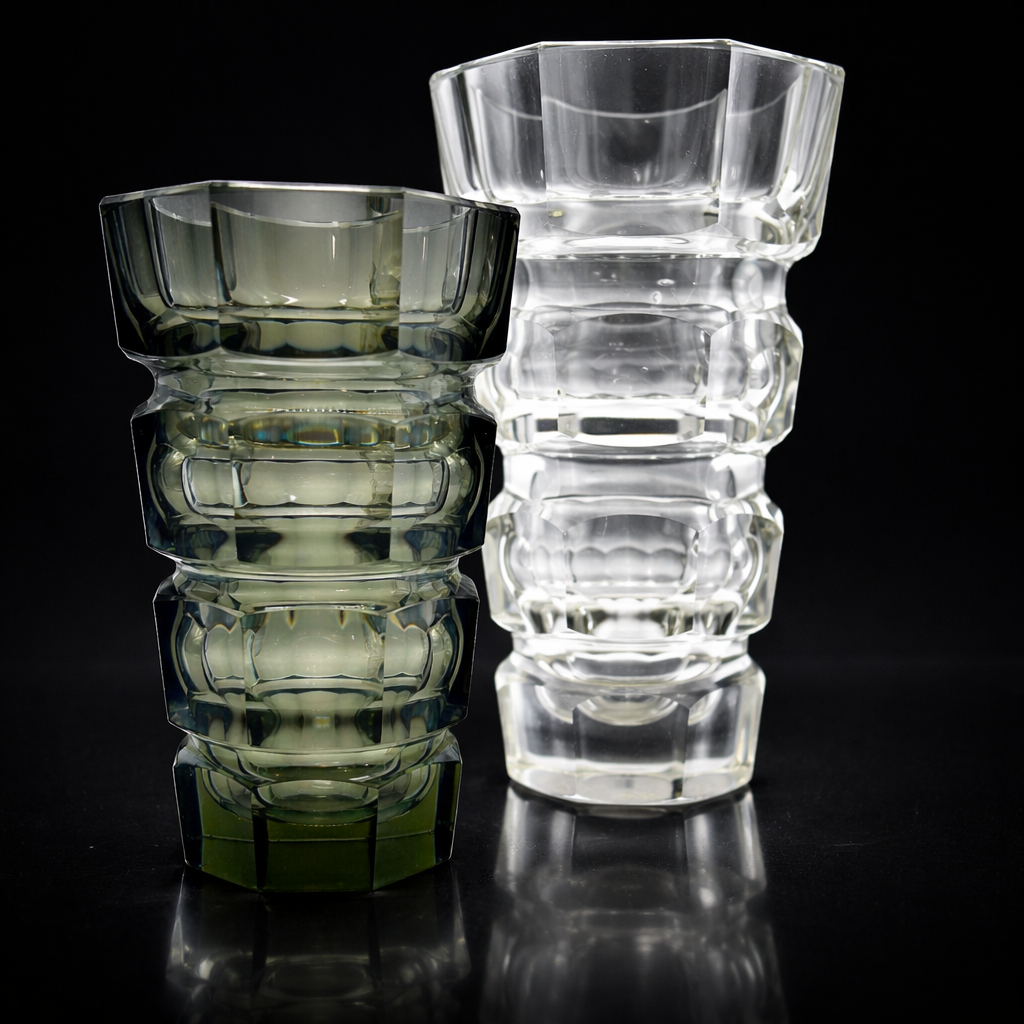
A sculptural mid-century smoky cut lead crystal vase produced in the Bohemian glassmaking tradition of the Karlovy Vary region, circa 1955–1970. The vessel presents a striking architectural composition defined by stacked cylindrical registers deeply cut with repeating oval optic lenses framed by vertical facets.
The body rises from a sharply faceted octagonal base and terminates in a wide octagonal mouth. The smoky crystal coloration enhances the geometry of the cutting, creating rich tonal contrast and dramatic light refraction across the layered structure.
This modernist cutting style became characteristic of mid-century Bohemian export crystal, where heavy crystal blanks were transformed into sculptural decorative objects through precise hand cutting and polishing.
Under ultraviolet light the crystal displays subtle fluorescence consistent with manganese-clarified European lead crystal used in mid-twentieth-century Bohemian production.
Attribution & Period
Czech / Bohemian cut lead crystal
Karlovy Vary glassmaking tradition
circa 1955–1970
Unsigned
Dimensions & Weight
Height: 6 in
Mouth diameter: approx. 3.25 in
Base diameter: approx. 3.5 in
Weight: approx. 1.73 lbs
Condition
Very good vintage condition overall. One tiny flea-bite chip to the base edge noted for accuracy; not visible in normal display.
Authenticity & Construction
Hand-cut lead crystal produced from a thick crystal blank and finished through traditional wheel-cutting techniques. The deep optic lenses and faceted geometry reflect the cutting style associated with mid-century Bohemian crystal workshops operating within the Karlovy Vary export tradition.
Placement
Ideal for console display, bookshelf styling, bar presentation, or layered decorative groupings with other sculptural crystal objects.
STANDARD ATTRIBUTION & VALUE DISCLOSURE
This piece is described to the best of current scholarly and market knowledge. Any maker or regional attribution is based on visual analysis, materials, construction techniques, and documented stylistic comparisons. As with many vintage and antique glass objects, definitive attribution may not be possible without original labels or factory records. Pricing reflects condition, quality, decorative appeal, and current collector demand rather than a guaranteed maker identification.
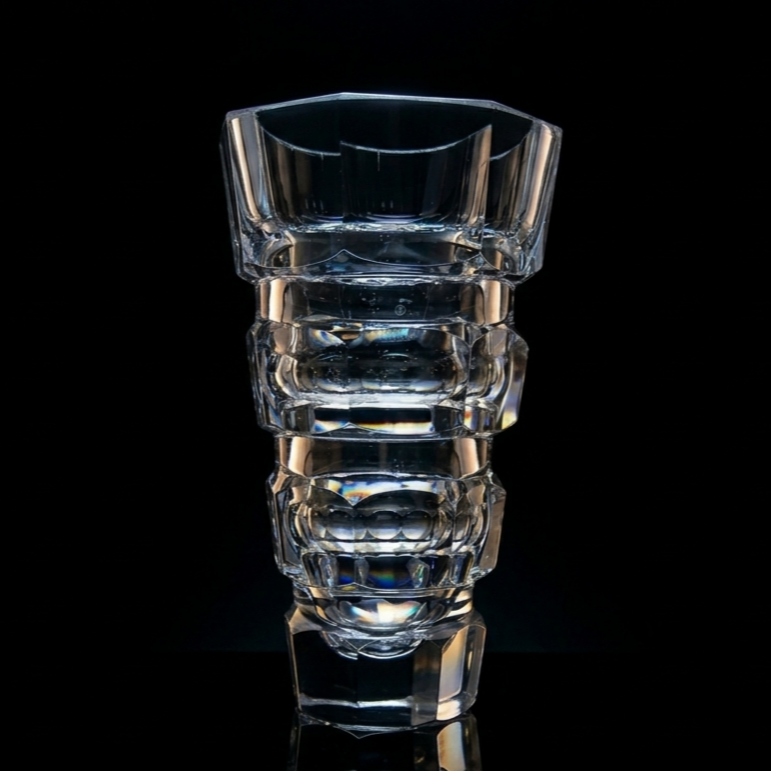
A monumental architectural cut crystal vase executed in the Bohemian glassmaking tradition of the Karlovy Vary region, circa 1955–1970. The sculptural vessel is built from heavy lead crystal and defined by a bold geometric composition: a faceted octagonal base rising through stacked cylindrical bands deeply carved with repeating oval optic lenses.
The precision cutting creates strong optical refraction throughout the body of the crystal, producing dramatic internal reflections as light passes through the layered architecture. Vertical facets frame each band, reinforcing the stepped columnar silhouette and giving the vase the visual presence of a sculptural object rather than a purely utilitarian vessel.
This architectural style emerged in mid-century Czech crystal workshops, where master cutters transformed thick crystal blanks into modernist decorative objects that balanced geometry, clarity, and light. The vase functions equally well as a vessel or as a standalone decorative sculpture placed where natural light can activate the deep cutting.
Under ultraviolet light the crystal shows a soft fluorescence typical of manganese-clarified European lead crystal used during the mid-twentieth century, confirming traditional Bohemian glass chemistry.
⸻
Attribution & Period
Czech / Bohemian luxury cut lead crystal
Karlovy Vary glassmaking tradition
circa 1955–1970
Unsigned
⸻
Dimensions & Weight
Height: approx. 8 in
Mouth diameter: approx. 4.5–4.75 in
Base diameter: approx. 2 7/8 in
Weight: approx. 3.46 lbs
⸻
Condition
Very good condition. Minor surface wear to the base consistent with age and display. No chips or cracks observed. Cutting remains crisp and bright.
⸻
Authenticity & Construction
Hand-cut lead crystal. The vase was formed from a thick blown crystal blank and subsequently cut on grinding wheels to produce the deep oval optic lenses and faceted vertical panels. The cutting depth and polishing quality are consistent with high-quality Bohemian crystal production exported from the Karlovy Vary region during the mid-twentieth century.
⸻
Placement
Ideal for architectural interiors, pedestal display, luxury console styling, illuminated cabinet presentation, or modernist decorative arrangements where the optical depth of the crystal can interact with natural light.
⸻
STANDARD ATTRIBUTION & VALUE DISCLOSURE
This piece is described to the best of current scholarly and market knowledge. Any maker or regional attribution is based on visual analysis, materials, construction techniques, and documented stylistic comparisons. As with many vintage and antique glass objects, definitive attribution may not be possible without original labels or factory records. Pricing reflects condition, quality, decorative appeal, and current collector demand rather than a guaranteed maker identification.
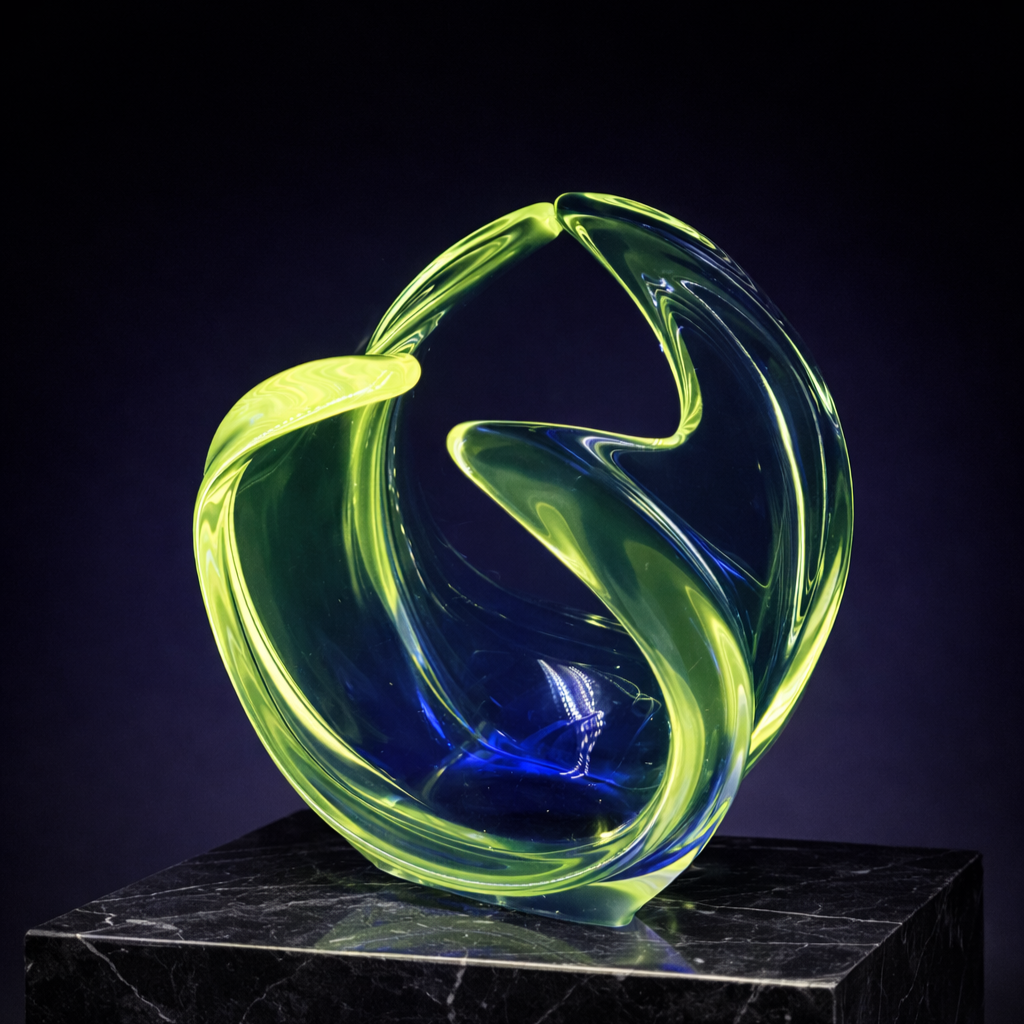
This substantial hand-formed glass sculpture commandingly interacts with light through its deeply saturated cobalt core and high-clarity crystal casing. The form is defined by sweeping, asymmetric rim articulations that create a sense of arrested motion, moving beyond functional vessel logic into pure sculptural expression. Under 365nm UV light, the outer casing reveals a vibrant neon-green fluorescence, indicating the presence of uranium oxide—a technical characteristic that adds a hidden, secondary dimension to its visual profile.
Attribution & Period
1960s. The technical execution—specifically the heavy "sommerso" style casing and the inclusion of UV-reactive agents—is stylistically aligned with mid-century Bohemian and Scandinavian studio traditions. The deliberate weighting of the base and the precision of the internal color suspension suggest a high-level production house, likely from the Zelezny Brod (ZBS) or Sklo Union regions, where experimental glass chemistry and organic "free-form" shaping were hallmarks of the era.
Dimensions & Weight
Height: 8 1/4 inches
Width: 6 inches
Depth: 3 1/2 inches
Weight: 3.362 lbs
Condition
Excellent vintage condition. The glass remains remarkably clear with no chips, cracks, or flea bites to the delicate rim. Minor surface shelf wear is restricted to the underside of the base, consistent with age and authentic handling.
Authenticity & Construction
This piece is a testament to advanced hot-working control, featuring a cased glass technique where the cobalt interior is submerged into a thick gather of uranium-infused crystal. The presence of subtle concentric working marks and internal lensing at the base confirms a hand-formed process. Unlike mass-produced pressed glass, the varying thickness of the walls creates complex prismatic effects and a sophisticated optical depth.
Placement
With its dual-tone profile and dramatic silhouette, this sculpture is ideally suited for a lit pedestal, a modernist console, or as a centerpiece in a curated glass collection. Its reactive properties make it a compelling "discovery" piece for interiors utilizing varied lighting schemes.
STANDARD ATTRIBUTION & VALUE DISCLOSURE
This piece is described to the best of current scholarly and market knowledge. Any maker or regional attribution is based on visual analysis, materials, construction techniques, and documented stylistic comparisons. As with many MCM and antique design objects, definitive attribution may not be possible without original labels or factory records. Pricing reflects condition, quality, decorative appeal, and current collector demand rather than guaranteed maker identification.
CERTIFICATE OF AUTHENTICITY & PROVENANCE REPORT
Reference Number: G-1960-CB-0824
Object Classification: Sculptural Art Glass
Period: Mid-Century Modern (Circa 1960–1969)
Material Composition: Cased Lead Crystal with Cobalt Oxide Core and Uranium Oxide Outer Gather
OBJECT DESCRIPTION & ANALYSIS
This masterwork of mid-century glassmaking is a sophisticated example of the Sommerso technique, characterized by a deep, light-absorbing cobalt interior suspended within a heavy, high-clarity crystal casing. The form is defined by an aggressive, free-form rim treatment that prioritizes sculptural silhouette over utilitarian function.
Of particular note to the collector is the rare inclusion of uranium oxide within the clear casing. While appearing colorless under natural daylight, the material exhibits a vibrant neon-green fluorescence under 365nm UV light. This dual-state characteristic identifies the piece as a product of advanced chemical experimentation common in high-end European studios during the 1960s.
TECHNICAL SPECIFICATIONS
• Method: Hand-formed, hand-tooled glass (unmarked)
• Dimensions: 8 1/4" H × 6" W
• Weight: 3.362 lbs
• Reactive Profile: 365nm UV Positive (High Luminance)
ATTRIBUTION & CURATORIAL CONTEXT
The sculptural language—specifically the interplay between the optically heavy base and the fluid, asymmetric "wings"—is stylistically aligned with the works of the Zelezny Brod (ZBS) glassworks in the former Czechoslovakia. The tension between the weighted mass and the delicate, hand-pulled rim suggests a master-level blower. The absence of a factory mark is consistent with period studio exports intended for high-end boutique markets in the United Kingdom and North America.
CONDITION SUMMARY
The specimen is in Exhibition Grade condition. No chips, fractures, or internal clouding are present. The integrity of the glass remains pristine, with only negligible surface micro-scratches on the underside of the base, verifying its authentic age and shelf-life.
VALUATION RATIONALE
The valuation of $1,250 USD reflects the specimen’s exceptional physical mass, the technical complexity of the uranium-cased layering, and the current market demand for "discovery" pieces that offer interactive light elements within a minimalist modernist framework.
Statement of Authenticity
This document serves as a formal record of the object’s characteristics and market position at the time of listing. All descriptions are based on professional visual analysis, material testing (UV), and comparative stylistic research within the field of 20th-century decorative arts.
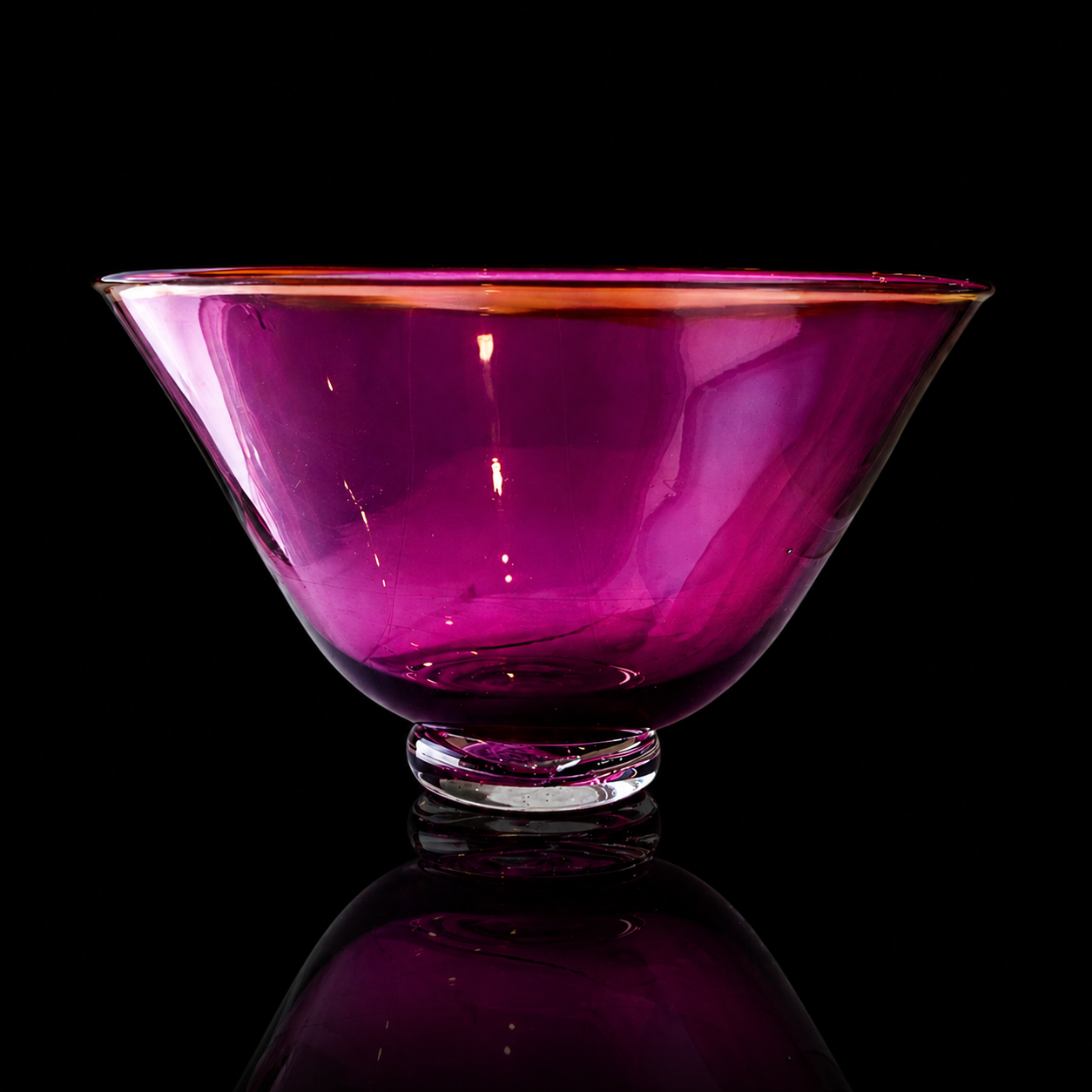
This commanding hand-blown vessel is a definitive expression of Finnish modernist glass artistry, featuring a deeply saturated cranberry core that radiates into a luminous amber rim. The architectural, wide-flaring silhouette is elevated by an intentional field of controlled internal air inclusions (bullicante), creating a rhythmic optical play that captures and refracts light. Its substantial mass and sophisticated tonal transitions from magenta-toned cranberry to golden amber reflect the peak of the Scandinavian studio glass movement.
Attribution & Period
The base features a professionally engraved presentation signature and date: "S. Kiitos 69." The "S" prefix denotes Suomi (Finland), while "Kiitos" identifies the piece as a bespoke commemorative or diplomatic gift commissioned from a premier Finnish glassworks—likely Riihimäki or Kumela—during the 1969 revival of experimental studio techniques. The elongated, stylized script is the hallmark of a master factory engraver.
Material & Fluorescence
The glass composition utilizes traditional 1960s mineral oxides, confirmed by a dual-spectrum UV reaction. Under 365nm light, the amber transitions exhibit a characteristic manganese-yellow glow, while the cranberry core reveals a vibrant cadmium-orange fluorescence, authenticating the piece’s mid-century chemical "recipe" and high-quality mineral content.
Condition & Construction
Condition: Excellent. The glass remains brilliantly clear with a high-polished luster. The base shows age-appropriate shelf contact consistent with its five-decade history as a curated object.
Base: Expertly ground and perfectly smooth polished pontil, a finish reserved for the highest grade of Finnish art glass production.
Technique: Multi-layered Sommerso gather with precisely introduced air-suspension.
Dimensions & Weight
Height: 5 1/8 inches
Mouth Diameter: 8 1/2 inches
Weight: 1.674 lbs
Presence: A substantial, balanced sculptural object with significant visual weight.
Placement
This vessel functions as a high-impact architectural centerpiece. It is ideally suited for a minimalist gallery pedestal or a mid-century teak sideboard, where backlighting can fully activate the internal bubble structure and the glowing cranberry-to-amber gradient.
STANDARD ATTRIBUTION & VALUE DISCLOSURE; This piece is described to the best of current scholarly and market knowledge. Any maker or regional attribution is based on visual analysis, materials, construction techniques, and documented stylistic comparisons. As with many vintage and antique glass objects, definitive attribution may not be possible without original labels or factory records. Pricing reflects condition, quality, decorative appeal, and current collector demand rather than a guaranteed maker identification.
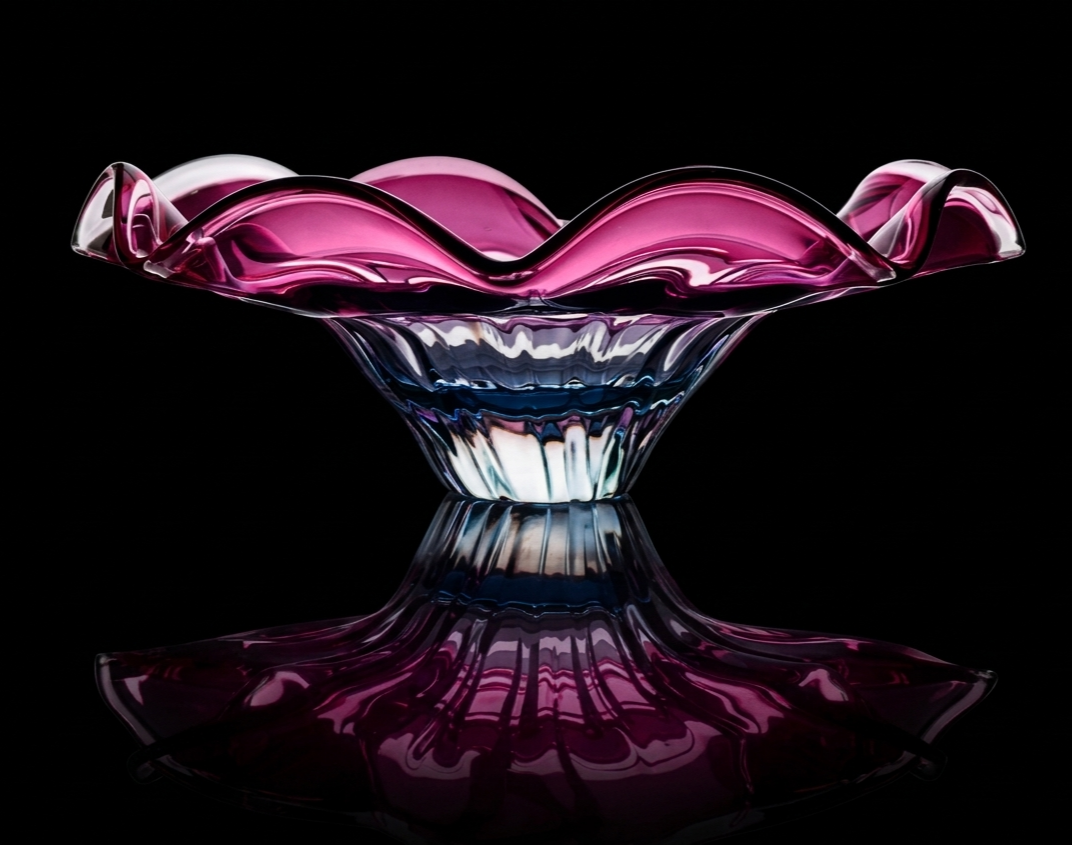
A commanding Murano glass centerpiece of architectural presence and saturated chromatic depth, executed in the Sommerso technique and signed Guarnieri. The form rises from a compact pedestal into a dramatic, undulating rim—each lobe extending five inches outward—creating a silhouette that reads as sculptural rather than functional.
The color transition is deliberate and masterful: a dense sapphire-blue core submerged beneath radiant fuchsia and crystalline casing, producing optical movement and refracted light at every angle. At 15.5 inches in diameter, this is a statement-scale Venetian work designed for visual impact in serious interiors.
Attribution & Period
Late 20th Century, 1980s The piece is signed by Guarnieri, an attribution confirmed by the diamond-point etched signature on the polished base. The Guarnieri workshop, active during the prolific post-war Venetian glass revival, is noted for a confident application of the Sommerso method. This specific work is stylistically aligned with the 1980s preference for "statement-scale" glass, moving away from mid-century minimalism toward more rhythmic, hand-manipulated organic forms that prioritize visual impact over traditional utility.
Dimensions & Weight
Diameter: 15.5 inches
Height: 6 inches
Each lobe projection: 5 inches
Base Diameter: 3 inches
Weight: Substantial, heavy-bodied sculptural glass
Condition
The object is in very good condition. Clinical inspection reveals light surface scratches to the underside of the base, consistent with appropriate shelf wear and the piece's significant weight. No cracks, chips, or structural repairs are observed. The internal color layers and the scalloped rim edges remain clean, crisp, and free of inclusions.
Authenticity & Construction
This work was executed on the island of Murano using the traditional Sommerso (submerged) technique, where a dense sapphire-blue core was dipped into molten fuchsia glass before being encased in a heavy layer of clear crystal. The piece was free-blown and then hand-manipulated at the furnace to achieve the rhythmic, five-lobed expansion. The polished pontil and the hand-etched studio signature distinguish this as a high-end artisanal production rather than a commercial mold-pressed object.
Placement
This work was executed on the island of Murano using the traditional Sommerso (submerged) technique, where a dense sapphire-blue core was dipped into molten fuchsia glass before being encased in a heavy layer of clear crystal. The piece was free-blown and then hand-manipulated at the furnace to achieve the rhythmic, five-lobed expansion. The polished pontil and the hand-etched studio signature distinguish this as a high-end artisanal production rather than a commercial mold-pressed object.
STANDARD ATTRIBUTION & VALUE DISCLOSURE
This piece is described to the best of current scholarly and market knowledge. Any maker or regional attribution is based on visual analysis, materials, construction techniques, and documented stylistic comparisons. As with many vintage and antique glass objects, definitive attribution may not be possible without original labels or factory records. Pricing reflects condition, quality, decorative appeal, and current collector demand rather than a guaranteed maker identification.
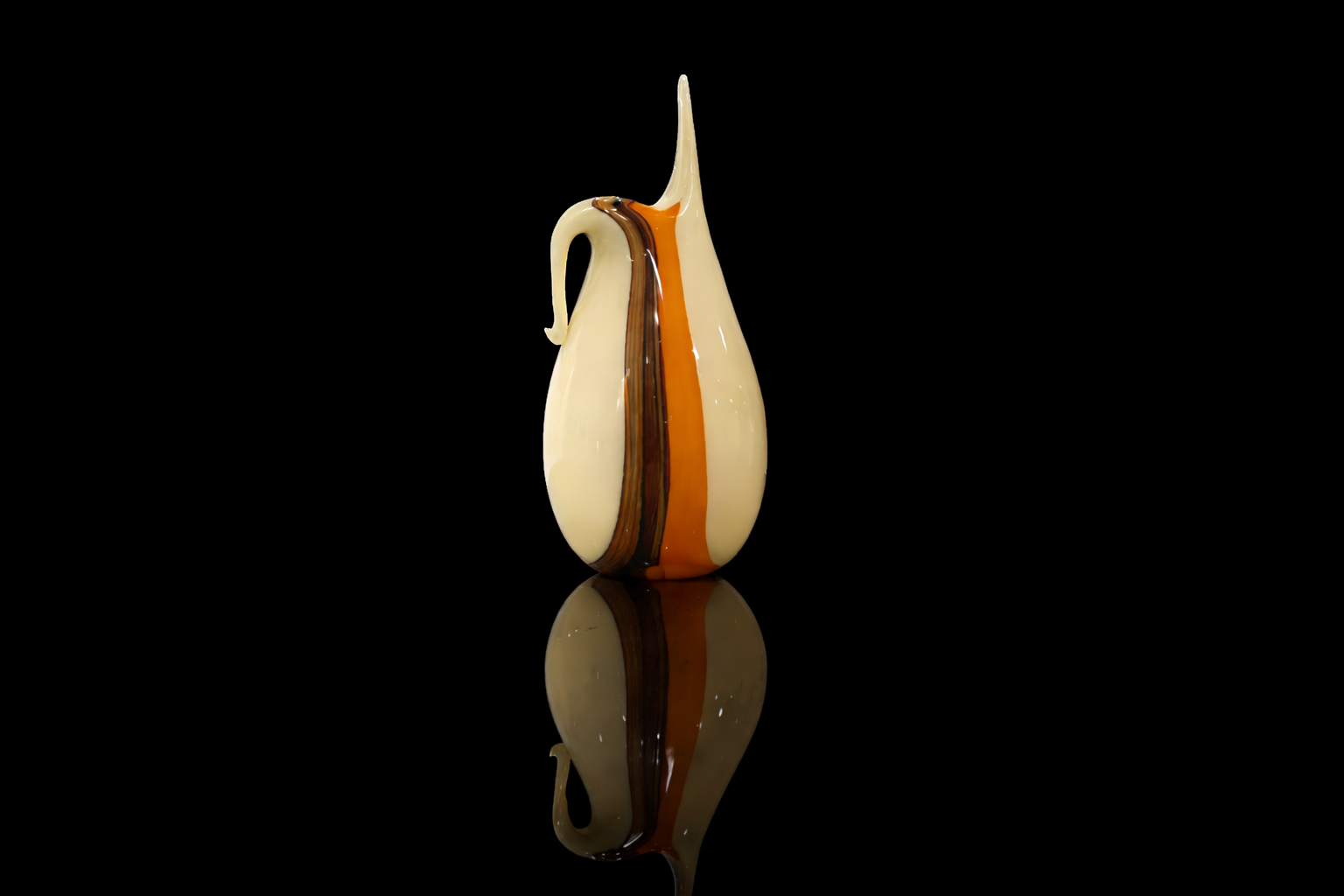
An architecturally sculpted mid-century Murano art glass pitcher, hand-blown in Venice during the apex of Italian post-war modernism. Executed circa 1955–1965, this example embodies the technical authority and expressive restraint that defined the golden era of Murano export glass.
The silhouette is elongated and elegant, tapering into a drawn spout pulled directly from the molten body. A hot-applied, hand-formed handle arcs with tension and controlled asymmetry — a hallmark of authentic Venetian studio production. The form is fluid yet balanced, sculptural yet disciplined.
Encased vertical canna striping in saturated amber and smoky brown descends through a luminous opaline ground. The coloration is fully integrated within the glass mass using sommerso-influenced layering techniques, creating depth, internal movement, and dimensional light play unattainable in surface-decorated glass. The body glows warmly in ambient light and reveals nuanced tonal gradations when backlit.
The base is smoothly fire-polished with confident weight and stability. While conceived as a functional pitcher, its scale and presence elevate it firmly into collectible sculptural territory.
Ultraviolet Confirmation
Under black light, the opaline body exhibits a vivid blue-green fluorescence consistent with uranium-bearing glass formulations used in mid-century Murano production. This strong reaction supports period authenticity and distinguishes the piece from later reproductions or modern decorative glass.
The UV response is documented in accompanying photographs.
Details
Origin: Murano, Italy
Period: Circa 1955–1965
Material: Hand-blown Venetian art glass
Technique: Canna striping with sommerso-style encasement
Colors: Amber, smoky brown, uranium-reactive opaline cream
Height: 15 inches
Width (widest point): 7 inches
Base diameter: 4 inches
Markings: Unsigned, consistent with many export examples of the period
Condition
Excellent vintage condition. No cracks, chips, or repairs observed. Surface clarity remains strong with no clouding or structural issues.
Collector Positioning
Mid-century Murano forms combining sculptural silhouette, integrated canna work, and uranium-reactive opaline are increasingly scarce in the secondary market. Pieces of this scale and purity of form are actively sought by serious collectors of Venetian glass and Italian modern design.
A refined, display-dominant example of authentic Murano craftsmanship from its most celebrated era.
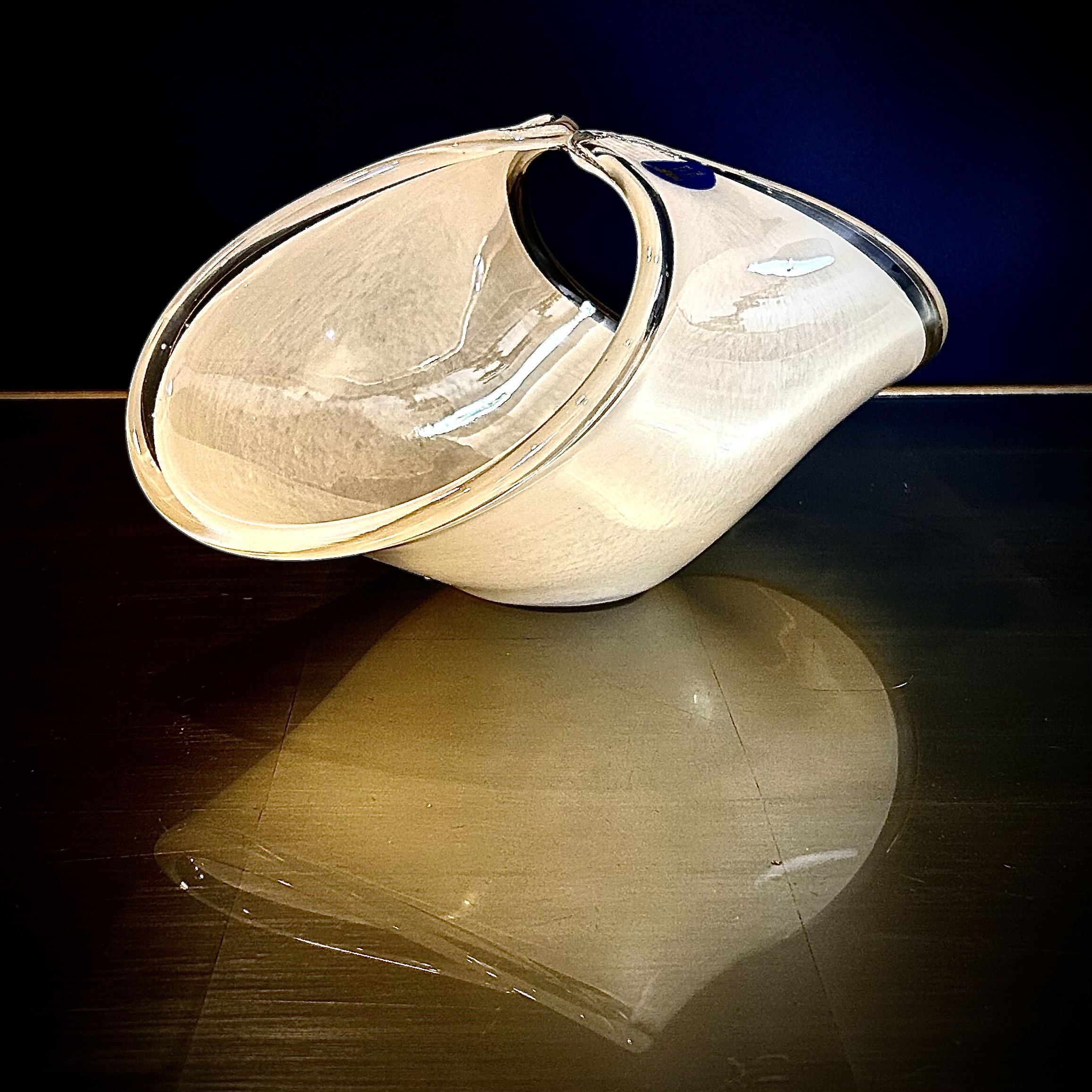
This substantial Murano glass centerpiece commands attention through its fluid, biomorphic silhouette and sophisticated play of light. The piece features a masterful "Sommerso" technique, where a dense, ethereal white lattimo core is suspended within thick, brilliantly clear glass walls. Its sweeping, wing-like proportions create a sense of kinetic energy, transforming from every angle to reveal soft gradients and crisp, hand-finished edges.
Attribution & Period
Consistent with Murano production, Italy, 1970s. The piece bears a "Murano / Hand Made in Italy" foil label and a secondary "White Cristal" distributor label. The construction utilizes the Sommerso (submerged) method typical of mid-to-late 20th-century Venetian workshops, while the sweeping, aerodynamic form is stylistically aligned with the organic modernism popularized by masters like Seguso or Barbini during this era.
Dimensions & Weight
Height: 6.75 in
Width / Diameter: 13.25 in
Depth / Base Diameter: 2.75 in (7 cm)
Weight: 4.83 lbs
Condition
Excellent condition. No chips, cracks, or structural repairs observed. Light shelf wear consistent with age is present on the polished base. Minimal internal carbon deposits and microscopic air bubbles (seeds) are present, characteristic of the hand-blown manufacturing process.
Authenticity & Construction
This centerpiece is a hand-worked "Euvre Réalisée selon la Technique des Maîtres" (Work created according to the technique of the masters). It was formed by layering molten glass of different densities and manually stretching the rim to create the dramatic, asymmetrical peaks. The base is expertly ground and polished to ensure stability and optical clarity.
Placement
This architecturally significant bowl serves as a luminous focal point on a minimalist dining table, a low-profile coffee table, or an entryway console. Its neutral palette and sculptural profile make it a versatile acquisition for interiors ranging from High-Modernist to Contemporary Chic.
STANDARD ATTRIBUTION & VALUE DISCLOSURE;This piece is described to the best of current scholarly and market knowledge. Any maker or regional attribution is based on visual analysis, materials, construction techniques, and documented stylistic comparisons. As with many MCM and antique design objects, definitive attribution may not be possible without original labels or factory records. Pricing reflects condition, quality, decorative appeal, and current collector demand rather than guaranteed maker identification.
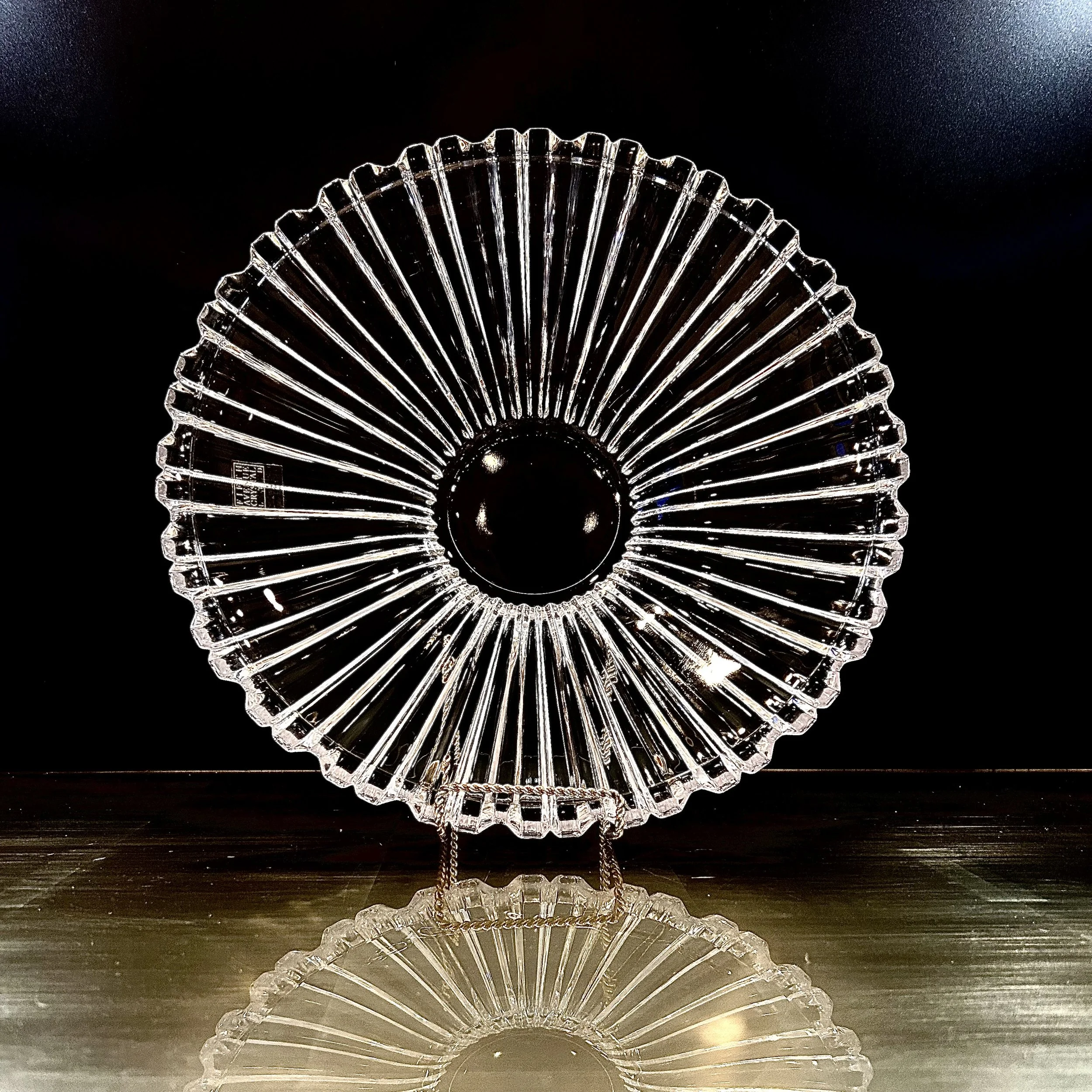
This substantial lead crystal bowl commands attention through its dramatic radial fluting and expansive, shallow proportions. The piece creates a striking play of light, utilizing deep vertical ribs that catch and refract illumination from the center to the scalloped perimeter. Its impressive 14.5-inch diameter and low-profile silhouette emphasize a sculptural presence that bridges the gap between functional centerpiece and fine art glass.
Attribution & Period; by Fifth Avenue Crystal, 1990s
This piece is identified by its original factory label for Fifth Avenue Crystal. Stylistically, the deep-cut radial pattern and high-clarity lead crystal are characteristic of the Late 20th Century revival of classic brilliant-cut motifs, updated here with a cleaner, more minimalist architectural geometry.
Dimensions & Weight
Height: 2.75 inches
Width / Diameter: 14.5 inches
Depth / Base Diameter: 4 inches
Weight: 5.236 lbs
Condition
Excellent vintage condition. The crystal maintains high clarity and luster. Light surface scratches are present on the interior and base, consistent with age and gentle residential use. No chips, cracks, or repairs observed.
Authenticity & Construction
Constructed from high-quality lead crystal, the piece is heavy and resonant. The design features precise, uniform fluting that radiates from a polished central well to a rhythmic, scalloped rim. The presence of the original foil label confirms its provenance and manufacturing standards.
Placement
The low, wide profile makes this an ideal centerpiece for a large dining table or a focal point on a low cocktail table. It is particularly effective when placed under direct lighting to capitalize on its refractive properties within a Contemporary or Hollywood Regency interior.
STANDARD ATTRIBUTION & VALUE DISCLOSURE;This piece is described to the best of current scholarly and market knowledge. Any maker or regional attribution is based on visual analysis, materials, construction techniques, and documented stylistic comparisons. As with many MCM and antique design objects, definitive attribution may not be possible without original labels or factory records. Pricing reflects condition, quality, decorative appeal, and current collector demand rather than guaranteed maker identification.
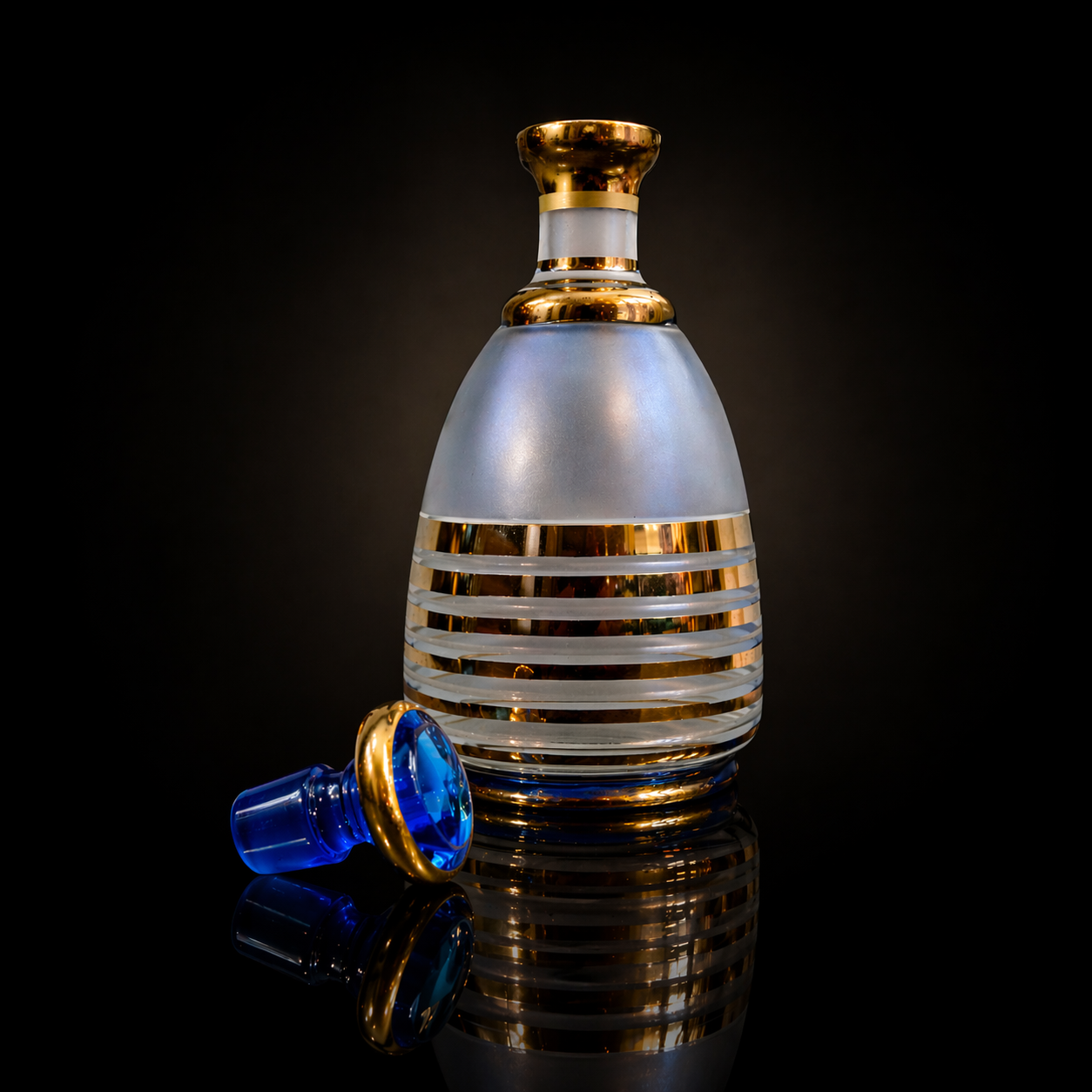
An exceptional mid-century art glass decanter of commanding presence, executed in frosted opaline glass with richly saturated cobalt and fire-gilded gold banding. Monumental in proportion and disciplined in execution, this is a collector-level statement object—architectural, deliberate, and materially authoritative.
It earns the designation “museum-quality” through its master-level handblown construction, precision fire-gilded banding, sculptural balance, and the exceptional preservation of both surface finish and original stopper—qualities associated with curated gallery and institutional-level mid-century art glass rather than decorative production.
The body is formed in hand-blown opaline glass with a soft, evenly frosted surface that diffuses light with a restrained, velvety glow. Precision-applied horizontal fire-gilded bands encircle the lower body in balanced intervals, their application dense and luminous rather than thinly flashed. The gilding integrates seamlessly with the form, creating rhythmic contrast against the matte ground.
The shoulder rises into a tapered neck capped by a substantial, weighty stopper featuring a deep cobalt blue core. The stopper is properly ground and fitted—secure, balanced, and original to the piece. The cobalt element provides chromatic tension against the restrained opaline and gold palette, anchoring the composition visually while reinforcing its mid-century Italian design language.
The form language—rounded yet architectural, ornamented yet controlled—aligns strongly with Murano and Murano-influenced studio production of the 1950s–1960s, when sculptural decanters were conceived as centerpiece objects rather than utilitarian barware. While unsigned, the construction quality, material density, and precision finishing position this work firmly within high-end mid-century art glass practice.
This is not decorative filler. It is a surface anchor—scaled to command a console, bar, or pedestal without visual noise.
Attribution & Period
Mid-20th century, circa 1950s–1960s.
Murano or Murano-influenced studio production.
Unsigned; attributed based on material, gilding technique, and formal vocabulary consistent with Italian modern glass.
Materials & Technique
Hand-blown opaline glass body
Consistent frosted finish (intentional, not wear)
Fire-applied gold banding
Ground and fitted stopper with integral cobalt blue core
Substantial weight and density throughout.
Condition
Excellent vintage condition.
No cracks
No chips
No repairs observed
Minor surface variations consistent with authentic hand-blown production
Stopper original and properly fitted; no wobble or replacement.
Placement
Ideal for:
Advanced art glass collections
Italian modern interiors
High-end bar installations
Gallery-level display
This piece was conceived as an object of presence and restraint—best suited to collectors and designers who understand material authority and proportion.
Styling Note
The decanter is shown styled with coordinating cobalt and gilt stemware for visual reference only. The glasses are not included in this offering and are sold separately. When paired, the ensemble creates a cohesive mid-century bar presentation—layering frosted opaline, saturated cobalt, and fire-gilded gold into a unified, collector-level installation.
The decanter itself is offered individually.
STANDARD ATTRIBUTION & VALUE DISCLOSURE
This piece is described to the best of current scholarly and market knowledge. Any maker or regional attribution is based on visual analysis, materials, construction techniques, and documented stylistic comparisons. As with many vintage and antique glass objects, definitive attribution may not be possible without original labels or factory records. Pricing reflects condition, quality, decorative appeal, and current collector demand rather than a guaranteed maker identification.
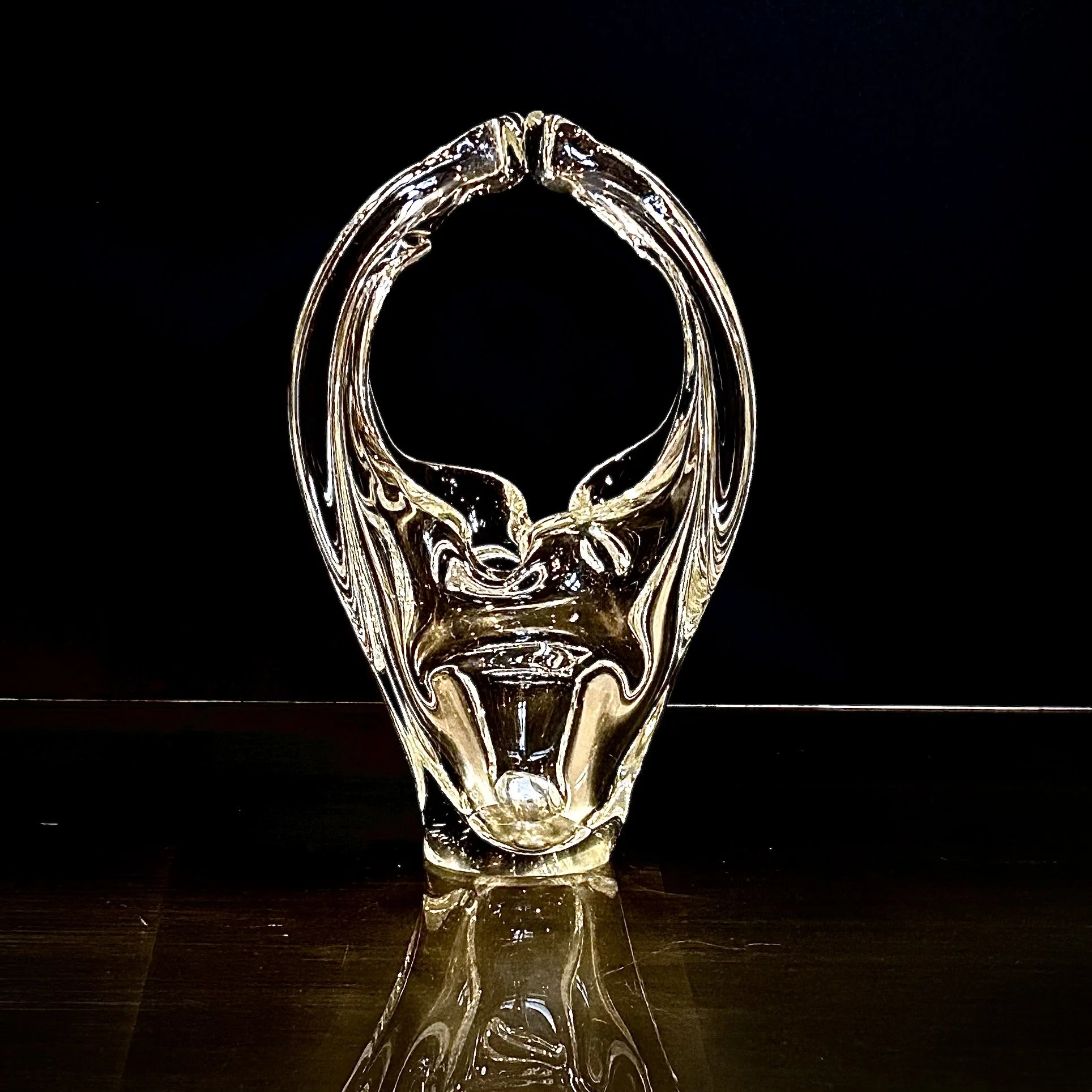
A highly sculptural clear art glass vessel defined by its fluid, looping silhouette and controlled internal movement. The form rises in a continuous arc, creating a striking open center that interacts dynamically with light and surrounding space. Subtle internal striations and suspended bubbles enhance depth, while the polished surfaces produce strong reflective and refractive effects. Under UV light, the glass exhibits a distinct orange fluorescence, adding an additional layer of visual interest.
Attribution & Period
Stylistically aligned with Murano glass production, Italy, 1960s. The freeform organic shaping, controlled internal flow patterns, and polished pontil base are consistent with mid-century Venetian studio techniques. No factory mark observed; attribution remains visual rather than documented.
Dimensions & Weight
Height: 7.5 in
Width / Diameter: 3.5 in
Depth / Base Diameter: 4 in / 2 in
Weight: 1.73 lbs
Condition
Excellent condition. No chips or cracks observed. Minor surface scratches to the base consistent with light shelf wear. Internal inclusions and air bubbles are inherent to the making process.
Authenticity & Construction
Hand-blown art glass formed using freeform hot-working techniques, allowing the molten material to be shaped into an asymmetrical, continuous loop. The clarity, internal movement, and controlled thickness variation reflect skilled studio craftsmanship typical of mid-century Italian glassmaking.
Placement
Ideal as a standalone sculptural accent on a console, credenza, or pedestal. Performs particularly well in environments with directional lighting, where its transparency and internal structure can be fully appreciated. Suitable for modern, minimalist, and architectural interiors.
STANDARD ATTRIBUTION & VALUE DISCLOSURE
This piece is described to the best of current scholarly and market knowledge. Any maker or regional attribution is based on visual analysis, materials, construction techniques, and documented stylistic comparisons. As with many MCM and antique design objects, definitive attribution may not be possible without original labels or factory records. Pricing reflects condition, quality, decorative appeal, and current collector demand rather than guaranteed maker identification.
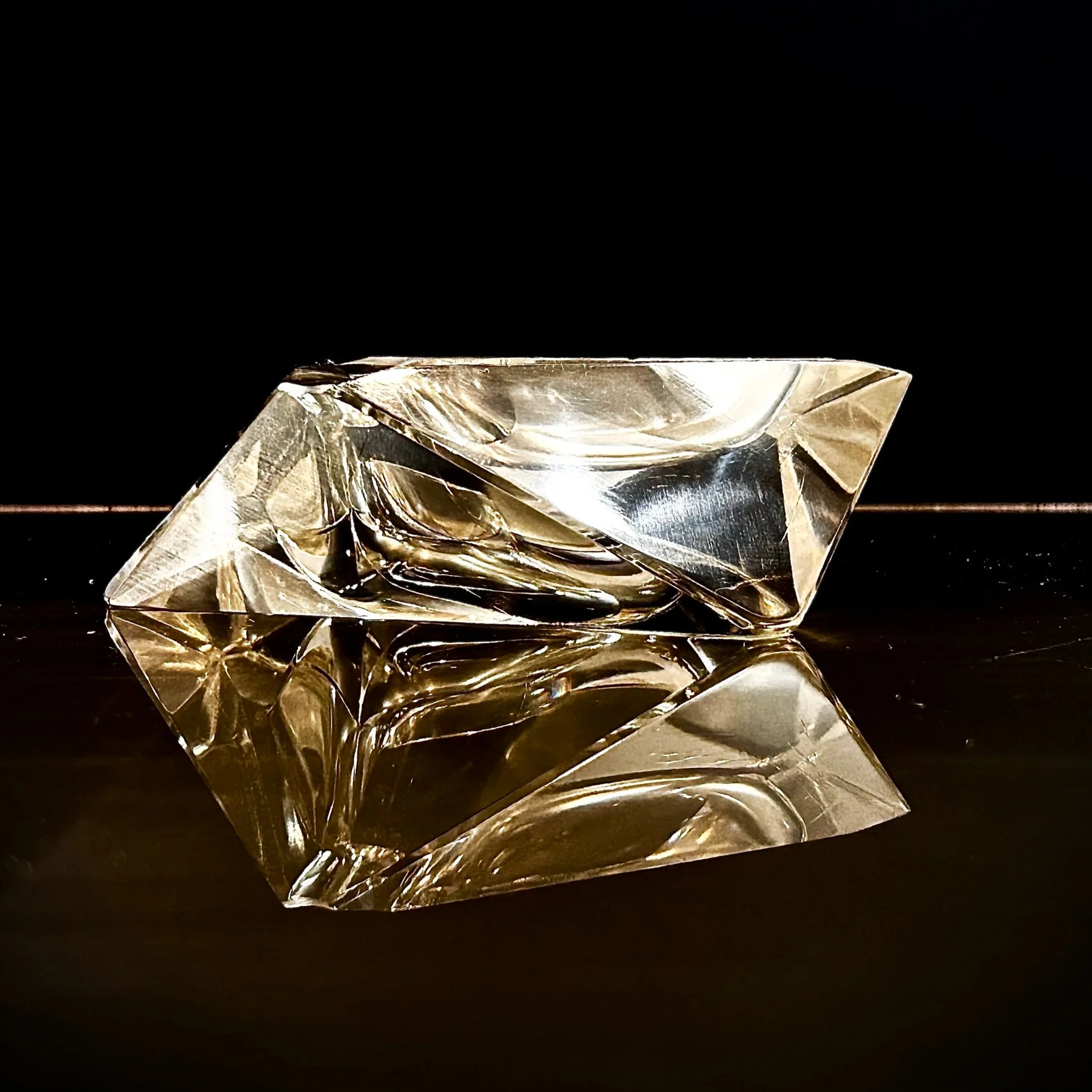
This exquisite sculptural object exemplifies the rigorous geometric precision of mid-century Italian design. Executed in heavy, high-clarity crystal, the piece utilizes a multifaceted, triangular form that engages in a complex play of refraction, transforming light into an internal landscape. Its substantial weight and refined, architectural silhouette anchor a room with a sophisticated presence that transcends utility.
The Design Aesthetic
Consistent with the iconic aesthetic emerging from the Murano studios during the 1960s, this work reflects a dedication to minimalist, geometric purity. The clarity of the material and the sharp, planar execution are hallmarks of the period's most sought-after refractive sculptures. Designed as both a functional centerpiece and a contemplative art object, its low profile and triangular footprint make it a compelling addition to a curated office or a modernist coffee table.
Specifications
Dimensions: 5” W x 5” D x 1.375” H
Weight: 1.5 lbs
Material: High-Lead Crystal / Optical Glass
Origin: Italian School (Attributed to the manner of Flavio Poli)
Period: Mid-Century Modern
Condition & Provenance
Clinical and direct. The glass is in excellent condition with high transparency. One corner features a singular, minute chip as shown in documentation. Minimal surface wear consistent with age and placement; no clouding or significant scratching observed.
This exceptional work of heavy art glass commands attention through its rigorous geometric precision and remarkable interaction with light. The piece utilizes a multifaceted, triangular exterior that creates a complex internal landscape of refraction, transforming the object into a high-stakes sculptural centerpiece. Its substantial weight and high-clarity material ensure it anchors a room with a sophisticated, architectural presence that transcends utility.
Dimensions & Weight
Height: 1.375 inches
Width / Diameter: 5 inches
Depth / Base Diameter: 5 inches (Equilateral)
Weight: 1.5 lbs
Authenticity & Construction
This piece is executed in high-lead crystal or exceptionally clear optical glass, hand-cut and polished to achieve its razor-sharp edges and flat planes. The construction relies on the "cold-work" process, where a solid block of glass is ground and polished to create its final form—a labor-intensive method that results in far superior light refraction compared to molded glass.
Placement
The low profile and triangular footprint make this an ideal addition to a brutalist coffee table, a minimalist executive desk, or a tiered shelving unit where it can serve as a sophisticated catchall for personal effects or exist purely as a refractive sculpture
Note on Material Integrity: Under ultraviolet illumination, the crystal exhibits a distinctive and vibrant fluorescence. This optical phenomenon is a direct result of the specific mineral composition—typically manganese—employed in glass formulations during the mid-20th century. This reaction serves as a compelling marker of authenticity, confirming the piece's period-accurate composition and distinct material character.
Standard Attribution Note: This object is presented in the stylistic manner of 1960s Italian glass production, specifically echoing the geometric designs associated with the studios of Murano. While the piece is unsigned and the specific artisan remains undocumented, its material quality, weight, and sculptural execution are characteristic of the highest caliber of mid-century Venetian craftsmanship.
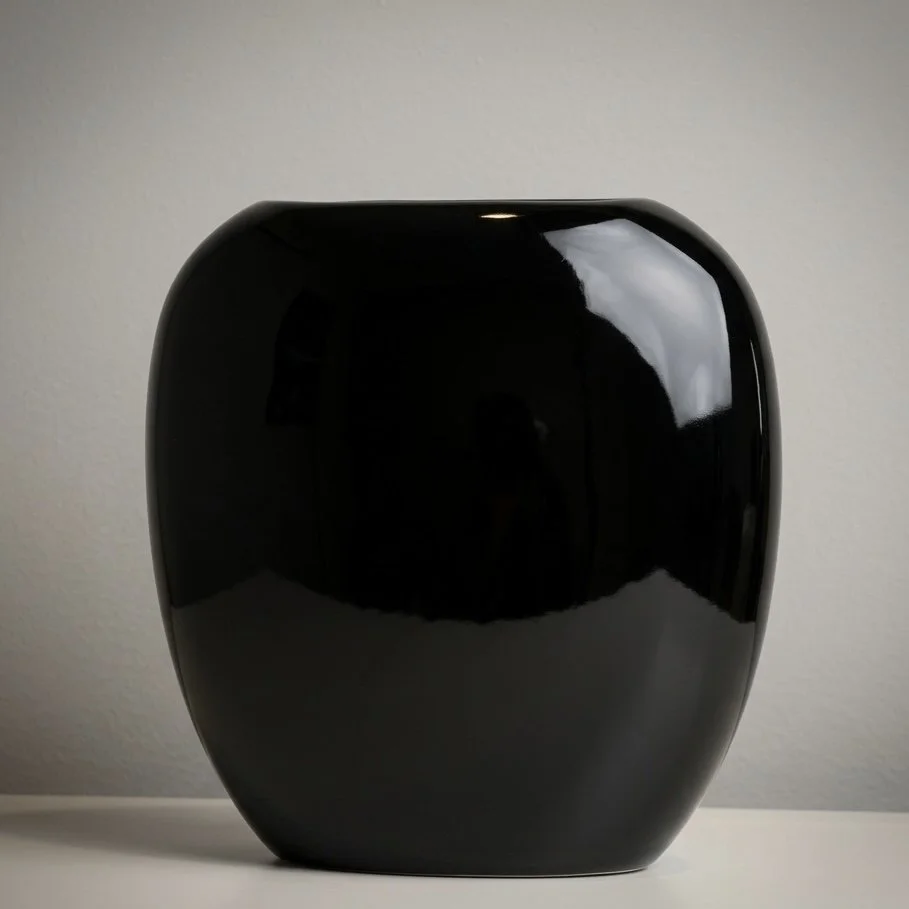
This monolithic vessel exerts a powerful sculptural presence through its compressed, ovoid geometry and "mirror-black" glaze. The form is a masterclass in mid-century minimalism, utilizing a low center of gravity and a precise, elongated aperture designed specifically for the structural requirements of architectural floral arrangement. Its surface depth and high-reflectivity finish create a sophisticated interplay of shadow and light, making it a definitive statement piece for a curated interior.
Attribution & Period
Mid-Century Modern (1960s)
This vessel is a definitive example of Japanese studio pottery, attributed to the Mashiko tradition. The hand-incised signature on the base is consistent with the stylized, western-facing marks used by Mashiko-based artists during the 1960s international design boom. The characteristic "pin-hole" bubbling in the glaze and the iron-rich clay body are direct signatures of the high-temperature reduction firing processes unique to the Tochigi Prefecture. This piece represents the critical era where traditional Japanese folk-craft (Mingei) transitioned into high-modernist sculptural art.
Dimensions & Weight
Height: 5.75 in
Width / Diameter: 6 in (widest area)
Depth / Base Diameter: 3.375 in x 1.625 in (base)
Weight: 0.224 lbs
Condition
The vessel is in immaculate, museum-grade condition. The high-gloss midnight glaze remains vibrant and deep with no chips, cracks, or restorations. Clinical examination reveals minor "glaze pops" or pin-hole bubbles near the shoulder, which are an authentic, sought-after result of the artisan kiln firing process. Light, appropriate shelf wear is present on the unglazed foot, confirming its vintage origin and careful residential history.
Authenticity & Construction
Hand-thrown and expertly altered, the vessel exhibits a seamless transition from its stable base to the elegantly tapered rim. The midnight glaze is applied with exceptional thickness, achieving a liquid-like depth that is a hallmark of Mashiko studio work. The hand-incised signature is deeply integrated into the clay body, providing a permanent and verifiable mark of provenance.
Placement
The dramatic silhouette and noir finish demand a prominent placement. It is exceptionally well-suited for a brutalist sideboard, a minimalist stone mantel, or a glass-top executive desk. It functions with equal strength as a standalone sculptural object or as a vessel for a singular, architectural branch to highlight its Ikebana heritage.
STANDARD ATTRIBUTION & VALUE DISCLOSURE; This piece is described to the best of current scholarly and market knowledge. Any maker or regional attribution is based on visual analysis, materials, construction techniques, and documented stylistic comparisons. As with many MCM and antique design objects, definitive attribution may not be possible without original labels or factory records. Pricing reflects condition, quality, decorative appeal, and current collector demand rather than guaranteed maker identification.
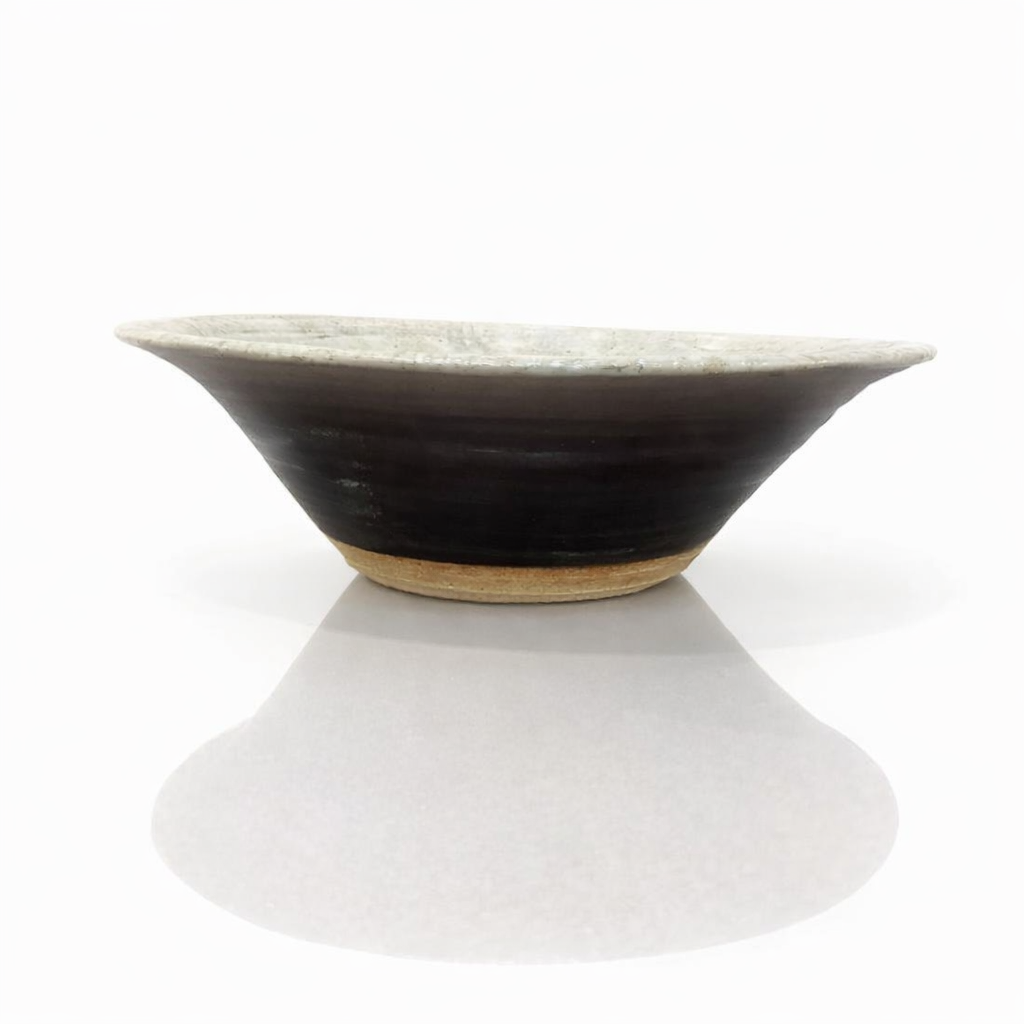
Monumental hand-thrown studio stoneware bowl of commanding scale and refined restraint, executed in a Japanese-influenced ash-glaze tradition. The form is broad and architectural, with a wide flared rim and shallow grounded profile that gives the piece quiet authority and sculptural balance.
The interior is finished in a pale, milky ash-style glaze layered with visible throwing rings, natural speckling, and soft pooling toward the well. The surface carries depth and tonal movement characteristic of high-temperature firing. The exterior transitions into warm iron-brown reduction tones, revealing kiln atmosphere variation and controlled firing mastery
The unglazed foot exposes the clay body and firing marks. A small impressed spiral near the base reads as a studio trimming or maker’s mark rather than a commercial stamp, reinforcing handmade origin. Pencil notations to the underside are consistent with studio inventory markings and are not later additions.
Attribution & Period
While unattributed, the scale, glaze chemistry, and disciplined form strongly align with late 20th-century Western studio pottery influenced by Japanese mingei and ash-glaze traditions. The restraint, surface behavior, and confident proportions indicate an experienced studio hand rather than hobby production.
Late 20th century, likely 1970s–1990s, within the Western studio pottery movement informed by Japanese aesthetics.
Dimensions & Weight
Mouth diameter: 13 in
Depth: 4 in
Base diameter: 5 in
Condition
Very good studio condition. No cracks, repairs, or structural issues observed. Minor glaze variation, kiln marks, and surface irregularities are inherent to high-fire studio production and integral to the aesthetic.
Authenticity & Construction
This is high-fired studio stoneware rooted in Japanese-influenced ash-glaze practice. It is not factory production or decorative mass-market pottery. Surface movement and firing variation confirm authentic studio origin.
Placement
A large-scale ceramic statement suited to gallery display, architectural interiors, wabi-sabi environments, or curated postwar studio collections. Equally compelling as a sculptural centerpiece or standalone vessel.
STANDARD ATTRIBUTION & VALUE DISCLOSURE; This piece is described to the best of current scholarly and market knowledge. Any maker or regional attribution is based on visual analysis, materials, construction techniques, and documented stylistic comparisons. As with many vintage and antique glass objects, definitive attribution may not be possible without original labels or factory records. Pricing reflects condition, quality, decorative appeal, and current collector demand rather than a guaranteed maker identification.
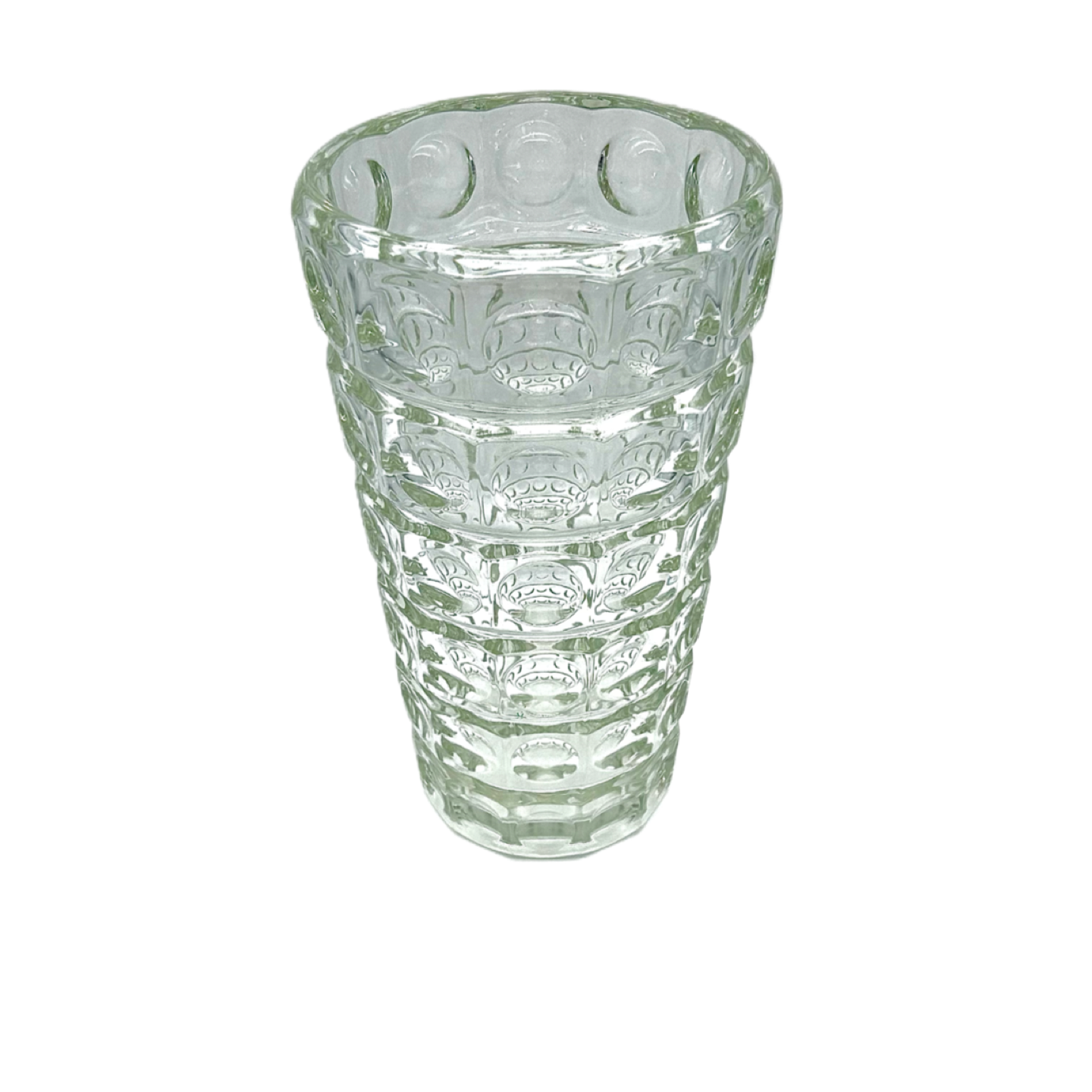
A commanding sculptural pressed glass vase defined by its architectural silhouette and deeply molded relief pattern. The vessel’s stacked geometry and repeating crescent motifs create a rhythmic surface that refracts light with dramatic clarity, transforming the piece into a luminous decorative object rather than simple tableware. Substantial in both scale and weight, the form reads as a modernist glass sculpture—equally effective as a standalone statement piece or within a curated interior arrangement.
Produced using thick-walled molded glass, the vase demonstrates the refined industrial artistry that defined Central European glassmaking in the mid-20th century. The faceted structure and strong relief pattern interact with ambient light to produce a dynamic visual presence, giving the object the character of architectural decor. Its bold vertical proportions and substantial mass allow it to anchor a space visually, making it particularly suited for design-forward interiors.
Attribution & Period
Czech / Bohemian pressed glass, mid-20th century, circa 1940–1969.
The strong geometric structure, heavy molded construction, and repeating relief ornament are consistent with pressed glass design traditions associated with Czech glassworks of the period. Factories such as Rudolfova Huť, Rosice, and other later Sklo Union group manufacturers produced similar sculptural glass objects that balanced industrial technique with modernist decorative form.
No factory mark or signature is present. Attribution is therefore based on stylistic and construction analysis rather than a confirmed catalog identification.
Dimensions & Weight
Height: 12 in
Mouth Diameter: 6.75 in
Base Diameter: 4.5 in
Weight: 7.356 lbs
The significant weight reflects thick-walled pressed glass construction typical of higher quality Central European molded glass.
Condition
This piece is in excellent overall condition, remaining structurally sound and free of chips or cracks, with only light surface scratching at the base consistent with gentle shelf contact.
Authenticity & Construction
The vase was produced using a heavy pressed-glass molding process in which molten glass is pressed into a precision steel mold to create a detailed relief surface. This technique allows for deep sculptural patterning and consistent structural clarity while producing thick, durable walls.
The sharply defined crescent motifs and crisp geometric contours indicate a high-quality mold and careful finishing after release from the mold. The substantial glass mass and balanced proportions reflect the design philosophy of Central European pressed glass—objects intended to function both as decorative sculpture and functional vessel.
Under UV light the glass displays a blue-toned response. This reaction appears inherent to the material composition of the glass rather than a surface treatment and is commonly associated with mineral content present in certain mid-20th-century glass formulations.
Placement
This piece performs best as a sculptural decorative object within a refined interior setting. Its scale and visual weight make it ideal for placement on a console, credenza, pedestal, or architectural shelf where the molded relief can interact with ambient light. It also integrates well within curated glass collections or modernist interiors where strong form and material presence are central to the composition.
STANDARD ATTRIBUTION & VALUE DISCLOSURE; This piece is described to the best of current scholarly and market knowledge. Any maker or regional attribution is based on visual analysis, materials, construction techniques, and documented stylistic comparisons. As with many MCM and antique glass objects, definitive attribution may not be possible without original labels or factory records. Pricing reflects condition, quality, decorative appeal, and current collector demand rather than a guaranteed maker identification.
Early access to newly sourced glass, private releases, and collector-only acquisitions.
-
"Glass Addict. I can't resist!"
Current Member
-
"It's like Candy."
Existing Member
-
"This has been such a worthwhile investment in myself."
Alumni
This exceptional art glass vase commands a powerful sculptural presence through its high-contrast geometry and flawless, monochrome finish. Executed using a sophisticated casing technique, a core of deep, opaque white lattimo (milk) glass is enveloped by a substantial outer layer of crystal-clear glass, creating a mesmerizing internal depth. The hand-polished flat facets act as architectural prisms, capturing ambient light to define the form’s sharp angles and brilliant glossy finish. Combining minimalist design principles with an intense material presence, this piece serves as a visually compelling focal point for refined interiors.
Attribution & Period; Mid-Century Modern (1945–1975)
This piece is consistent with Italian Murano art glass craftsmanship from the late 1960s to early 1970s. The precise, blocky faceting pattern and masterfully executed white cased construction are stylistically aligned with the celebrated mid-century designs of glass masters such as Flavio Poli for Seguso Vetri d'Arte and the geometric animalier forms popularized by Archimede Seguso. In keeping with many premium Venetian art glass objects of this era, no factory signatures or acid-etched marks are observed on the base, as production pieces traditionally relied on foil showroom labels. The high lead-flint optical quality of the glass, the rigorous geometry, and the expertly ground flat base dictate an attribution as an unmarked decorative arts example of excellent mid-century caliber, crafted in the manner of Flavio Poli.
Dimensions & Weight
Height: 6.0 in (15.24 cm)
Width / Diameter: 4.5 in (11.43 cm) at widest point
Depth / Base Diameter: 2.0 in (5.08 cm)
Weight: 1.136 lbs (0.52 kg)
Condition
Excellent mid-century condition, clinical and beautifully preserved. The hand-sculpted glass body retains its absolute structural integrity, with no chips, cracks, or fleabites along the sharp, vulnerable facet junctions or the upper rim. The fire-polished and cold-cut exterior surfaces are free of distracting scratches or grazing. The ground, flat base shows only negligible, age-appropriate shelf wear consistent with careful handling over a period of decades.
Authenticity & Construction
The vase is executed using traditional Murano hand-blown and tool-formed techniques, followed by extensive cold-working. The artisan first gathered the opaque white core and cased it within a heavy outer sleeve of clear glass before manipulating the molten mass into its general form. Once cooled, the block was painstakingly ground down and cold-polished on a lathe to cut the crisp, geometric facets that define its architectural silhouette. The base features a meticulously flat-polished finish, confirming its high-end artisanal pedigree.
Placement
This vase acts as a perfect geometric anchor on a minimalist travertine mantelpiece, a chic vanity table, or integrated within a curated gallery display on a low-profile rosewood credenza. Its stark white composition allows it to function beautifully within Hollywood Regency, Postmodern, or high-end contemporary layouts alongside both organic textures and sharp metallic accents.
STANDARD ATTRIBUTION & VALUE DISCLOSURE; This piece is described to the best of current scholarly and market knowledge. Any maker or regional attribution is based on visual analysis, materials, construction techniques, and documented stylistic comparisons. As with many MCM and antique design objects, definitive attribution may not be possible without original labels or factory records. Pricing reflects condition, quality, decorative appeal, and current collector demand rather than guaranteed maker identification.