
DISTINCT PORCELAIN
Explore our range of services designed to help you move forward with confidence, wherever you're headed next.
DISTINCT PORCELIAN
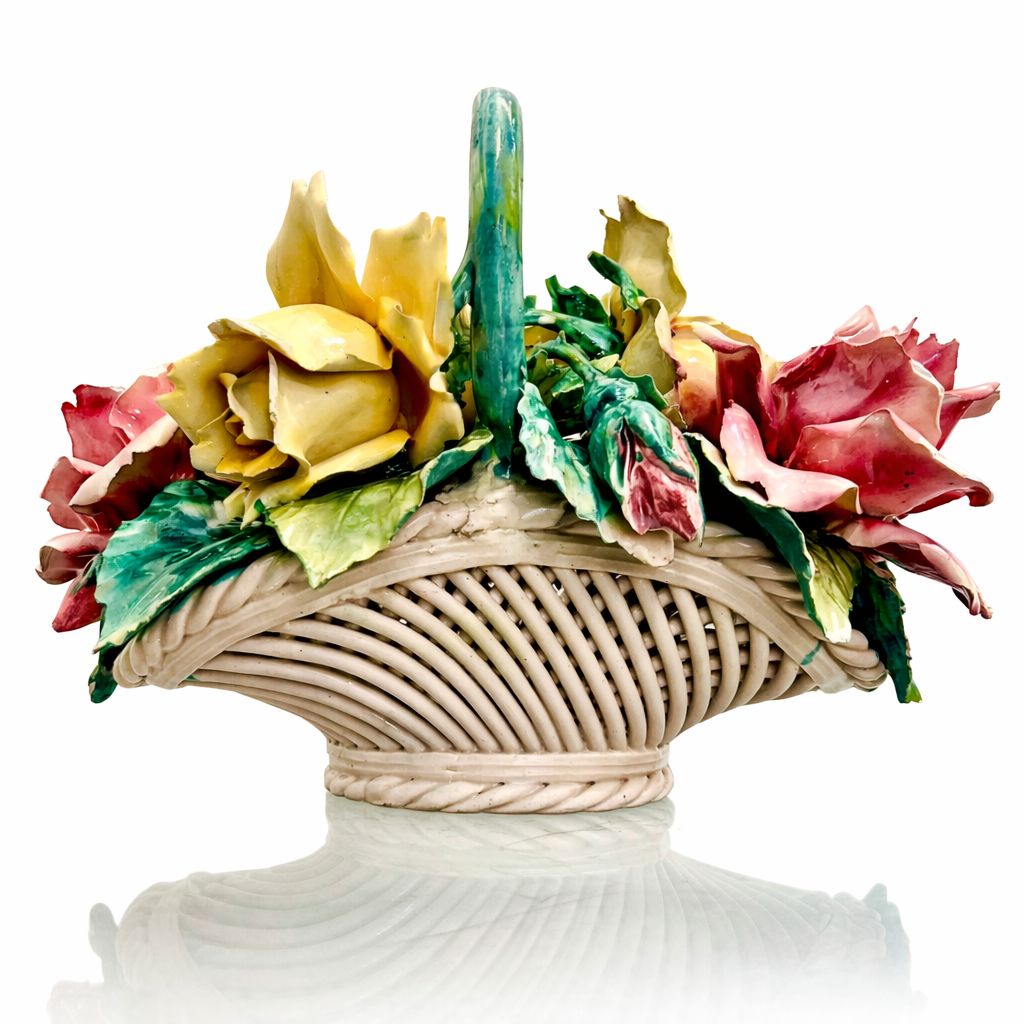
This sculptural and richly dimensional Italian porcelain centerpiece is executed in the enduring Capodimonte tradition, featuring a dense arrangement of hand-modeled roses in full bloom. The composition rises from an intricately molded, high-relief woven basket, anchored by a gracefully arched hunter-green handle. The floral modeling is exceptionally expressive, with petals curled and tiered in shades of blush pink and butter-yellow, set against variegated foliage to create a sense of naturalistic movement and profound depth.
At 13 inches in length, the piece possesses a commanding visual weight, bridging the gap between traditional Italian craftsmanship and the bold, "statement-scale" decorative preferences of the mid-to-late 20th century.
Attribution & Period
Origin: Italy.
Style: Capodimonte-tradition decorative porcelain.
Circa: 1960s–1980s. The underside bears the export-era "ITALY" mark and factory-specific alphanumeric coding (3HA), identifying it as a premium production from the postwar Italian decorative arts boom intended for international luxury markets.
Condition Report This centerpiece remains in display-strong condition with a vibrant, high-gloss glaze. Clinical inspection reveals honest, age-appropriate imperfections to the delicate porcelain extremities, including visible chipping to several petals on the pink rose and minor tip-wear on the yellow blossoms. These localized chips are consistent with the fragile nature of hand-modeled porcelain and do not compromise the structural integrity or the overwhelming decorative impact of the work.
Dimensions & Weight
Height: 9 in
Length: 13 in
Depth: 7 in
Presence: Substantial sculptural profile with balanced proportions.
Curation & Placement An ideal focal point for Grandmillennial, Neo-Classical, or European romantic interiors, this basket excels when placed on a low-profile console or a mahogany center table. Its saturated palette and high-relief textures allow it to function as a standalone masterwork or as the anchor for a layered maximalist display within a lit vitrine.
STANDARD ATTRIBUTION & VALUE DISCLOSURE; This piece is described to the best of current scholarly and market knowledge. Any maker or regional attribution is based on visual analysis, materials, construction techniques, and documented stylistic comparisons. As with many vintage and decorative ceramic objects, definitive attribution may not be possible without original factory documentation. Pricing reflects condition, quality, decorative appeal, and current collector demand rather than a guaranteed maker identification.
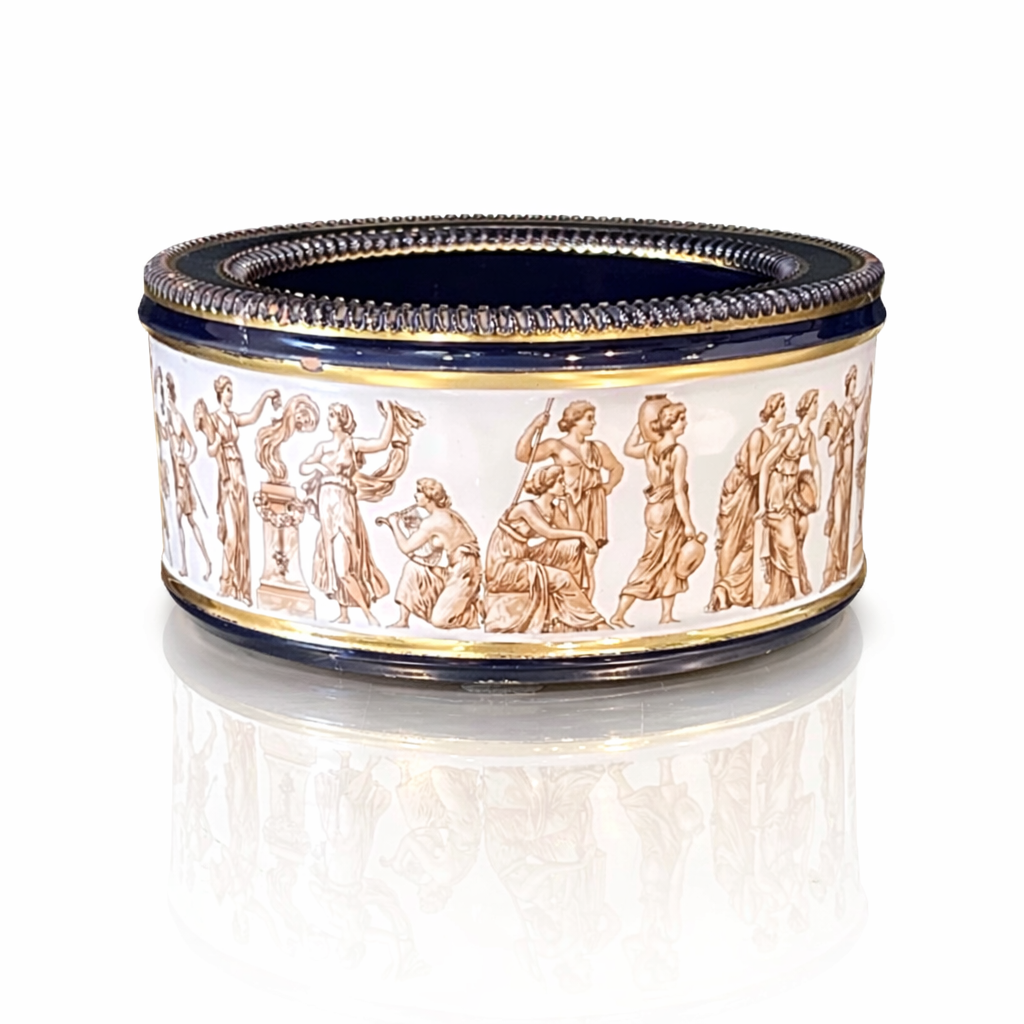
An exceptional hand-made Florentine majolica cachepot produced in Italy during the mid-20th century, exemplifying the post-war revival of Neoclassical design rooted in Renaissance Florence.
The cylindrical body is wrapped in a continuous grisaille classical frieze depicting draped female figures in procession — musicians, dancers, and votive bearers — rendered in relief against a saturated cobalt ground. The composition draws directly from ancient Roman bas-reliefs and Renaissance reinterpretations of antiquity, echoing decorative traditions long associated with Grand Tour collecting and Wedgwood jasperware classicism.
The deep cobalt glaze provides dramatic contrast to the sculptural white figures, while hand-applied gilding and a beaded egg-and-dart rim reinforce its architectural presence. The interior is fully glazed, confirming its intended function as a luxury cachepot rather than purely decorative earthenware.
This is a statement object — classical, disciplined, and visually commanding.
Mark & Attribution
Gilt mark to underside:
“HAND MADE IN ITALY – FIORENTINE”
Studio reference: “Sr 865”
The marking is consistent with post-war Florentine workshop production created for the international export market, particularly the United States.
Origin & Date
Florence, Italy
Circa 1950s–1960s
Produced during the resurgence of Florentine decorative ceramic workshops following World War II, when artisan studios revived Renaissance and classical motifs for luxury export.
Materials & Technique
• Hand-thrown majolica (tin-glazed earthenware/faience)
• Relief-molded classical frieze
• Hand-painted cobalt glaze
• Hand-applied gilding
• Kiln-fired finish
Labor-intensive construction and finishing distinguish this from later mass-market reproductions.
Dimensions
Diameter: approximately 7 inches
Substantial cabinet scale with strong architectural presence.
Condition
Very good vintage condition.
• Minor, expected gilt wear
• Typical kiln irregularities consistent with hand craftsmanship
• No cracks
• No structural damage observed
Displays exceptionally well; glaze saturation remains strong and even.
Historical Context
Post-war Florentine workshops intentionally revived Renaissance humanist aesthetics, producing decorative objects that referenced classical antiquity and the Grand Tour tradition. These pieces were marketed to collectors furnishing libraries, formal interiors, and traditional estates.
Mid-century Florentine majolica is increasingly collected due to:
• Limited studio production
• High labor content
• Strong alignment with European classical decorative arts
• Export history tied to luxury interior design markets
Placement
Ideal for:
• Neoclassical interiors
• Grand Tour–inspired collections
• Library, console, or pedestal display
• Traditional or architectural settings requiring sculptural ceramic presence
Provenance
Acquired from private estates and longstanding collections in North America.
STANDARD ATTRIBUTION & VALUE DISCLOSURE
This piece is described to the best of current scholarly and market knowledge. Any maker or regional attribution is based on visual analysis, materials, construction techniques, and documented stylistic comparisons. As with many vintage and antique ceramic objects, definitive attribution may not be possible without original factory records. Pricing reflects condition, quality, decorative appeal, and current collector demand rather than a guaranteed maker identification.
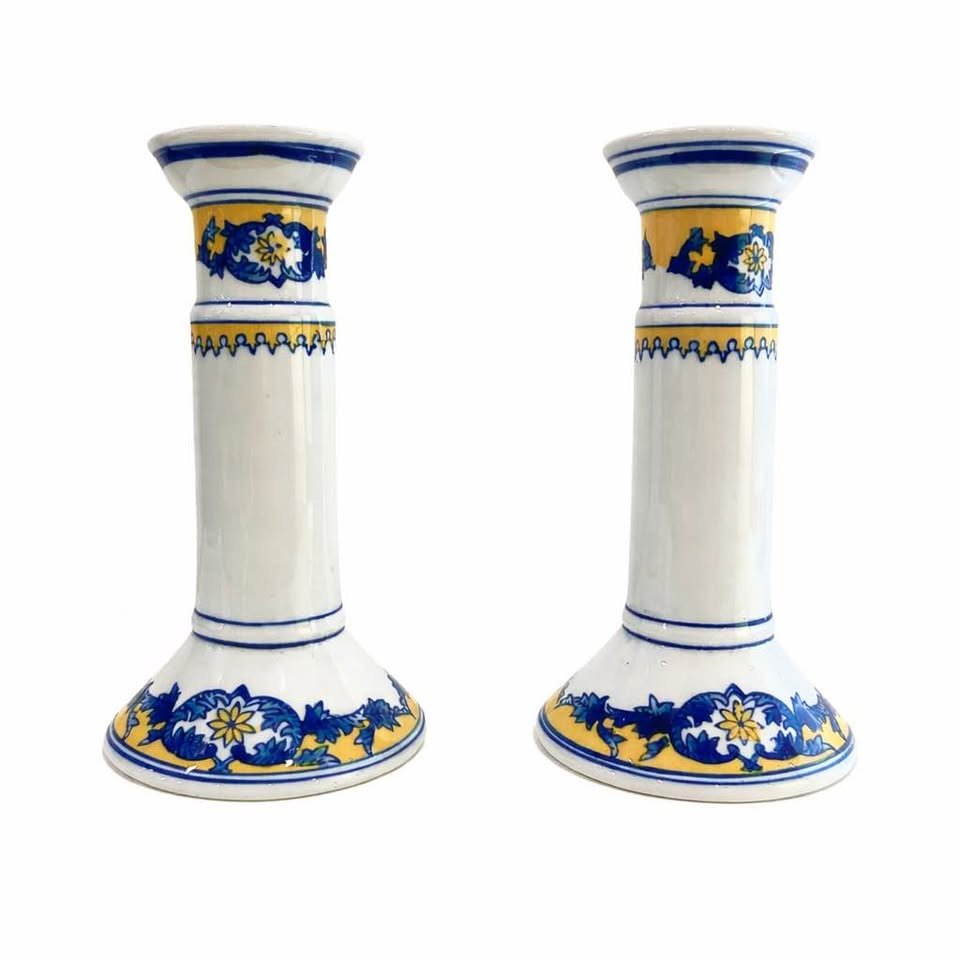
Pair of late 19th-century French faience candlesticks, executed in a commanding cobalt blue, ivory-white, and warm ochre palette with finely painted foliate banding and disciplined border work. The forms are architectural and confident, with flared circular bases, elongated shafts, and restrained upper collars that give them strong vertical presence.
Both examples carry a hand-painted underglaze blue mark reading “Choisy … Poterie” within an oval cartouche. The script and format strongly indicate production associated with Choisy-le-Roi, one of the most significant French faience centers of the 19th century. Given the hand-rendered nature of the mark, the pair is conservatively offered as Choisy-le-Roi attributed rather than factory-line certified without in-hand archival confirmation.
Attribution & Period
The decoration reflects traditional northern French tin-glazed earthenware practice: opaque white ground, hand-painted cobalt floral reserves, ochre accent banding, and rhythmic geometric borders. The glaze displays the soft depth and subtle surface variation characteristic of period faience firing.
Estimated late 19th to early 20th century, circa 1880–1910, based on glaze quality, decorative vocabulary, and hand-painted mark style.
Dimensions & Weight
Taller example : 12 in (30 cm)
Shorter example: 9–9.5 in (22–23 cm)
The intentional variation in height aligns with period decorative pairings rather than later machine-matched production. Glossy glaze with age-appropriate wear consistent with antique faience.
Condition
No major structural cracks observed in photographs. Expected minor edge wear consistent with handling over time. Please review images closely.
Authenticity & Construction
These candlesticks are antique French tin-glazed earthenware produced in the Choisy-le-Roi tradition. They are not later decorative reproductions. Visible surface variation, painterly brushstroke nuance, and glaze pooling are inherent to hand-painted faience manufacture and support period production. Minor kiln and production irregularities visible at the base mark areas, including glaze pooling.
Placement
A commanding mantel or cabinet pair with strong French provincial authority. Particularly effective layered into traditional European interiors, curated blue-and-white collections, or maximalist antique displays.
Discover the latest hand selected items to our collection; pieces to bring new energy to your space.
THE SOCIAL TABLE
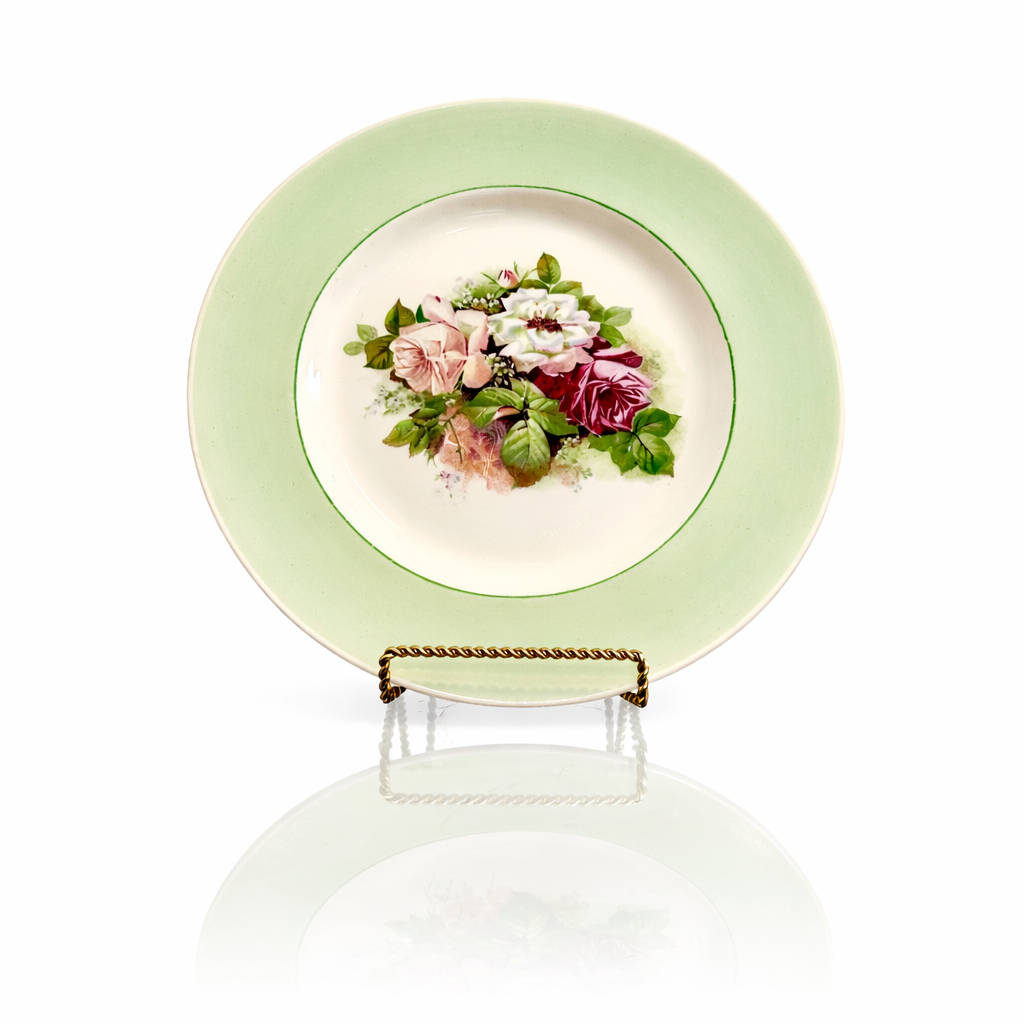
This elegant English cabinet plate bears the prestigious Clarice Cliff script mark, centering a refined botanical rose study within a softly graduated celadon-to-seafoam border. The composition masterfully balances romantic naturalism with the controlled symmetry of the Art Deco movement, reflecting the shift toward structured negative space and "designer-led" domestic aesthetics. While Cliff is internationally celebrated for her avant-garde "Bizarre" wares, this piece showcases the sophisticated, painterly lines produced under her direction at Newport Pottery, offering a more restrained and versatile expression of 20th-century British art pottery.
Attribution & Period
Origin: Staffordshire, England.
Manufacturer: Newport Pottery / A.J. Wilkinson.
Designer: Associated with the studio of Clarice Cliff (1899–1972).
Circa: 1930s–1940s. The reverse features the authentic green script “Clarice Cliff” backstamp, distinguishing this as a period production rather than a contemporary reproduction.
Dimensions
Diameter: 10.75 in
Scale: Substantial cabinet-sized display plate.
Condition Report The plate is in good condition, presenting a clean and professional aesthetic. Clinical inspection reveals light, age-appropriate surface wear and minor kiln speckling consistent with interwar production techniques. The backstamp shows expected softening from age; however, the glaze remains vibrant, and no chips, cracks, or structural repairs are observed.
Authenticity & Construction Executed on a glazed earthenware body, the piece features a multi-tonal rose bouquet framed by a hand-shaded celadon halo. This layering technique provides a luminous quality to the rim, elevating it from standard floral china to a curated work of designer-associated art pottery.
Curation & Placement Ideally suited for Clarice Cliff designer groupings or disciplined English Art Deco collections, this plate possesses a commanding "cabinet presence." It excels as a focal point in a curated plate wall installation or when styled atop a modernist console, where the celadon border provides a sophisticated chromatic anchor.
Imperial German Period, Circa 1900–1918
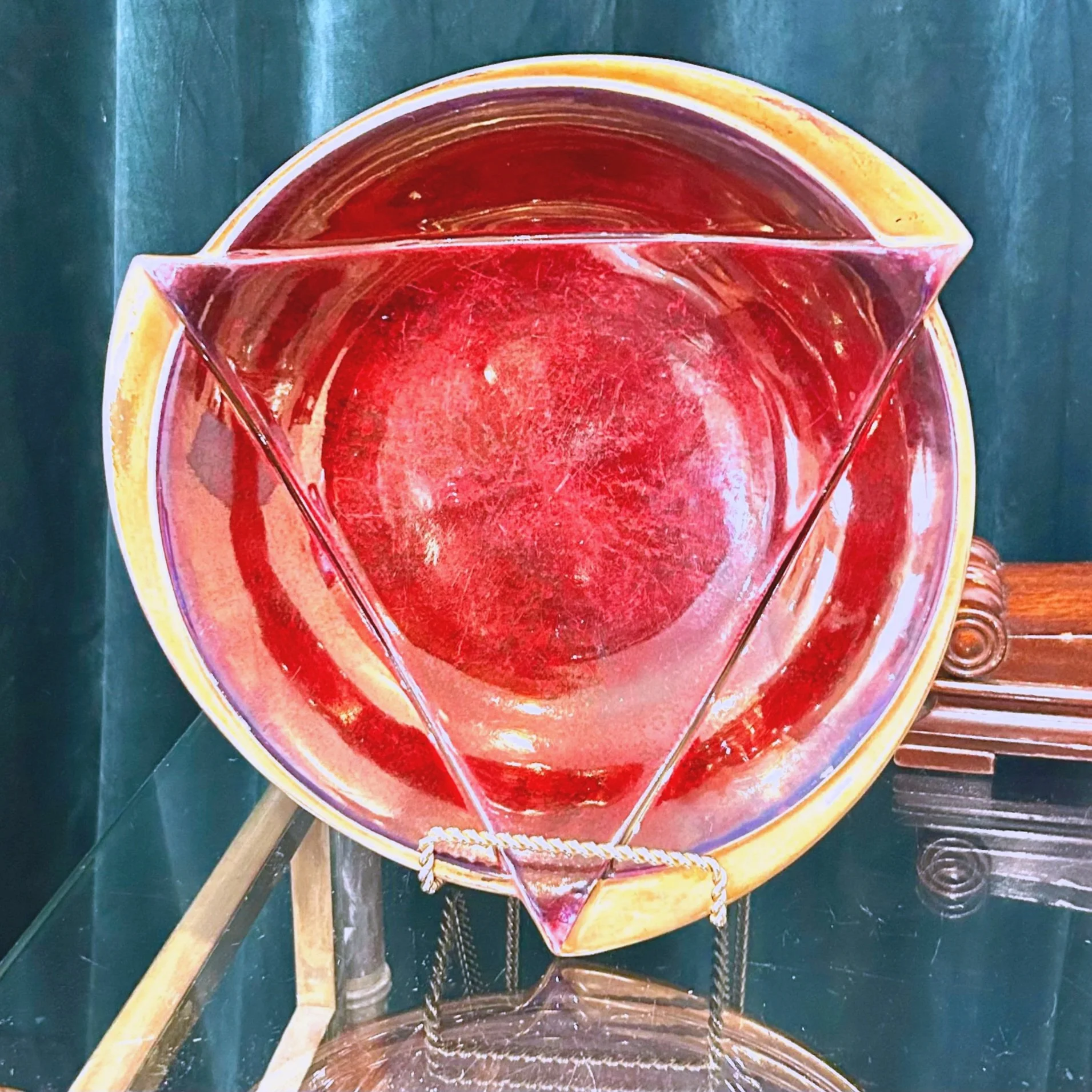
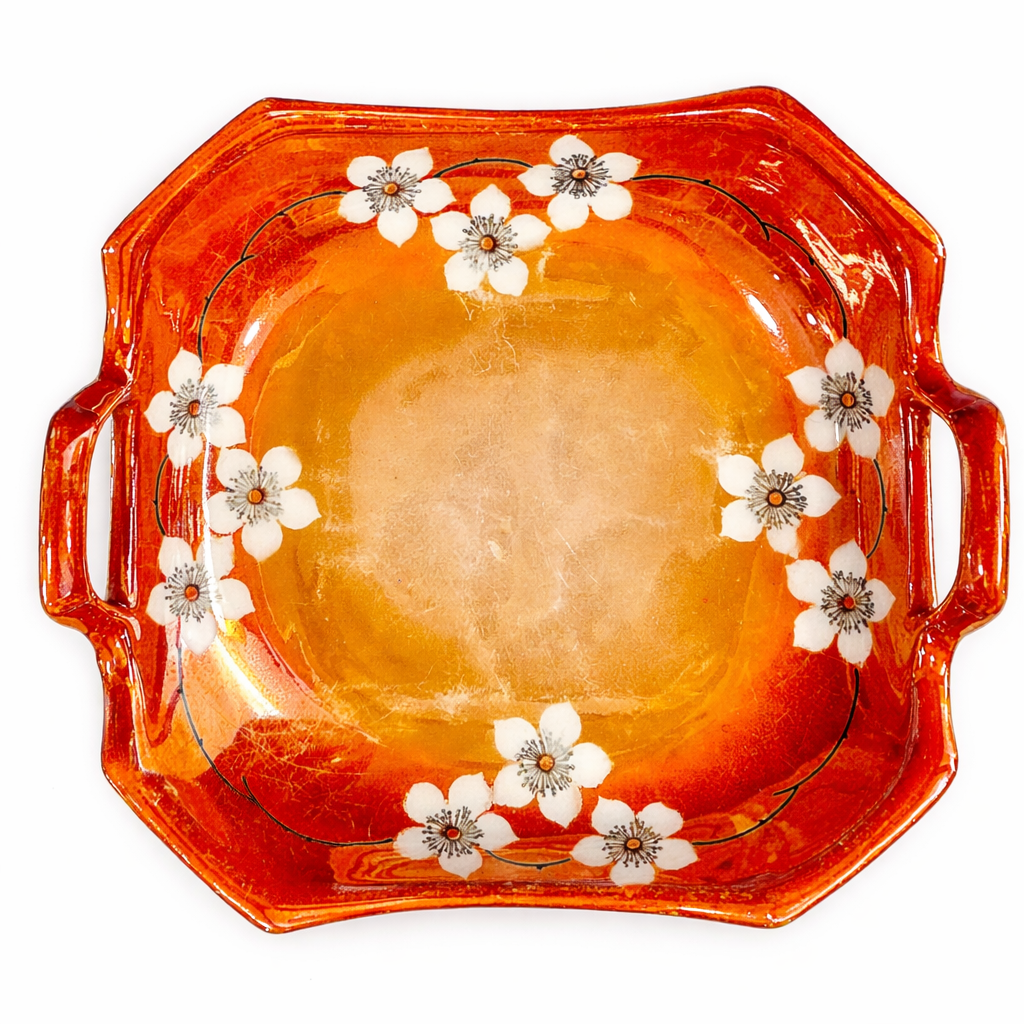
A visually commanding Royal R.S. Prussia porcelain serving bowl executed on a Tillowitz blank during the final decades of Imperial Prussian production. The sculptural scalloped form with integrated handles is elevated by a saturated oxblood-to-amber gradient ground—an unusually bold and luminous field for the factory—encircled by finely hand-painted white blossoms with dark stamens and delicate outlining.
The ombré firing transitions from deep red at the rim into glowing amber and warm gold toward the center, creating dimensional depth rarely seen in more common pastel R.S. examples. The high-gloss glaze amplifies the chromatic intensity, giving the piece strong cabinet presence and immediate decorative authority.
Attribution & Period
Royal R.S. Prussia (Reinhold Schlegelmilch)
Tillowitz, Silesia (now Tułowice, Poland)
Green wreath mark with star and “R.S.”
Circa 1900–1918
Produced during the golden era of Prussian export porcelain, prior to the dissolution of Prussia following World War I. Tillowitz blanks were widely regarded for their refined molding and high-gloss finish, often serving as the foundation for elevated decorative programs.
Dimensions & Weight
10 inches across (handle to handle)
Substantial weight consistent with high-grade early 20th-century serving porcelain
Balanced, display-ready proportions
Condition
Very good antique condition.
• No cracks
• No structural repairs observed
• Minor age-appropriate interior utensil wear consistent with original use
• Glaze retains strong luster
• Color saturation remains vivid and stable
Presents exceptionally well for display.
Authenticity & Construction
Fine porcelain blank with molded scalloped form and integrated handles;True hand-painted floral decoration (not transfer printed),Gradient oxblood ground achieved through controlled firing technique, High-gloss glaze with depth characteristic of period Prussian production -Green wreath R.S. mark consistent with documented pre-1918 Tillowitz output.
Placement
An ideal acquisition for:
• Serious Royal R.S. Prussia collectors
• Imperial German porcelain specialists
• Early 20th-century European decorative arts collections
• High-impact cabinet or console presentation
• Layered maximalist, Art Nouveau, or transitional interiors
The saturated oxblood ground distinguishes this example from the more commonly encountered pastel florals in the R.S. market, giving it elevated decorative appeal in a luxury setting.
STANDARD ATTRIBUTION & VALUE DISCLOSURE;This piece is described to the best of current scholarly and market knowledge. Any maker or regional attribution is based on visual analysis, materials, construction techniques, and documented stylistic comparisons. As with many vintage and antique glass objects, definitive attribution may not be possible without original labels or factory records. Pricing reflects condition, quality, decorative appeal, and current collector demand rather than a guaranteed maker identification.
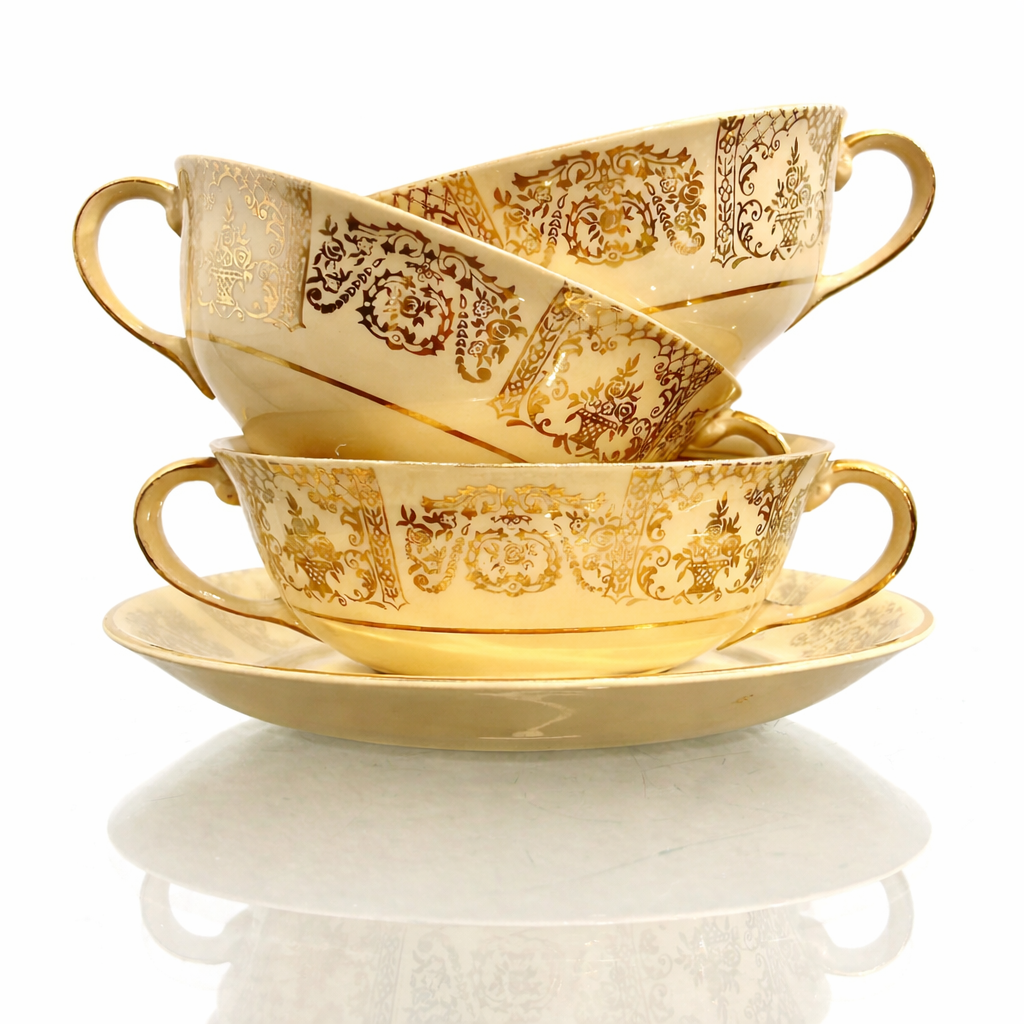
Set of three antique English handled bouillon cups accompanied by one matching saucer, produced by Johnson Bros., England, bearing the desirable “Victory” crown backstamp. Executed in luminous ivory bone China, this group is richly ornamented with elaborate gilt decoration: a broad burnished gilt band, scrolling classical panel reserves, intricate cartouche work, and central rosette medallion detailing within the saucer well. The gilding presents with strong warmth and depth, offering the high-fired glow associated with quality late Victorian and early Edwardian Staffordshire production. The double-handled bouillon form is inherently more architectural than a standard teacup — designed for formal broth and cream soup service, yet equally prized today for cabinet display due to its sculptural silhouette and heavy gold presence. The “Victory” mark remains particularly sought after among Johnson Bros collectors for its ornate, classical styling and confident gilded treatment.
Attribution & Period
Maker: Johnson Bros., England
Mark: Arched “Victory” with crown device and “Johnson Bros England”
Period: Circa 1890s–1910s (Late Victorian to Early Edwardian)
The England export mark, crown device, and decorative language align with documented Johnson Bros production of the late 19th to early 20th century.
Dimensions & Weight
Saucer: 6 1/4 inches diameter
Cup: 4 1/2 inches diameter
Cup Base: 3 1/2 inches diameter
(Traditional bouillon proportions — visually balanced and display-ready.)
Condition
Presents exceptionally well for antique gilt-enriched bone china.
• Light rim gilt softening consistent with age
• Minor surface wear and small scattered marks to underside/foot visible in close inspection
• No visible structural cracks
• No visible repairs
• No chips or hairlines observed
The gilding retains strong visual impact.
Authenticity & Construction
Fine English bone China (vitrified porcelain body with bone ash), characterized by its smooth ivory tone and resonant ring. The gilding is factory-applied and richly layered, consistent with higher-tier Johnson Bros decorative production. The handled bouillon format reflects formal dining service traditions of the period and is less commonly encountered than standard tea forms, increasing decorative desirability.
Placement
Ideal for curated Victorian or Edwardian dining presentations, gilded cabinet display, formal layered tablescapes, or integration into a heritage English bone China collection.
STANDARD ATTRIBUTION & VALUE DISCLOSURE; This piece is described to the best of current scholarly and market knowledge. Any maker or regional attribution is based on visual analysis, materials, construction techniques, and documented stylistic comparisons. As with many vintage and antique glass objects, definitive attribution may not be possible without original labels or factory records. Pricing reflects condition, quality, decorative appeal, and current collector demand rather than a guaranteed maker identification.